Robotics Software Engineer Career Roadmap
Robotics Software Engineers write the software that lets a machine sense, plan and act in the physical world. They build the perception, planning and control code that runs on robots, test it in simulation before it touches hardware, and debug failures that only appear on a real machine. The work sits between software engineering, control theory and hardware, and it is growing as manufacturers, logistics firms and AI labs build robots that learn from data.
Is this the right path for you?
Robotics software hiring favors people with a mechanical, electrical or computer science background who can work across the stack. Many engineers come from embedded software, automotive autonomy, drone software or research labs. A robot you have built and made fail on purpose is a stronger entry point than a certificate.
If you want to know why a machine did the wrong thing at the wrong moment, and you enjoy turning that question into a test, you already think like a robotics engineer. The work is patient debugging against real physics: logs, replays and small controlled experiments.
The honest caveat is that the field is narrower than general software. Many roles require a degree and some hardware exposure, and most jobs are concentrated in a few regions and sectors such as manufacturing, logistics, warehousing and autonomous vehicles. Expect long hiring processes that include a technical test on a real or simulated robot.
Career Progression
Where does this role lead?
Click any role to explore timeline, key skills and, where the Department of Labor publishes it, pay.
Entry
Junior Robotics Software Engineer
~0–2 yrs
$74,464 (Level I)
You write and test nodes inside a larger robot stack, run simulations, and reproduce bugs from logs. Entry seats are about careful testing and clear debugging.
Key skills
Pay shown is the U.S. Department of Labor prevailing wage for Level I (entry), Level III (mid) and Level IV (senior) in the nearest BLS occupation, base wage for the typical metro, wage year 2025, shown for the main track only. It is a benchmark, not an offer; branches and lead, staff and executive stages have no official figure.
Visual roadmap
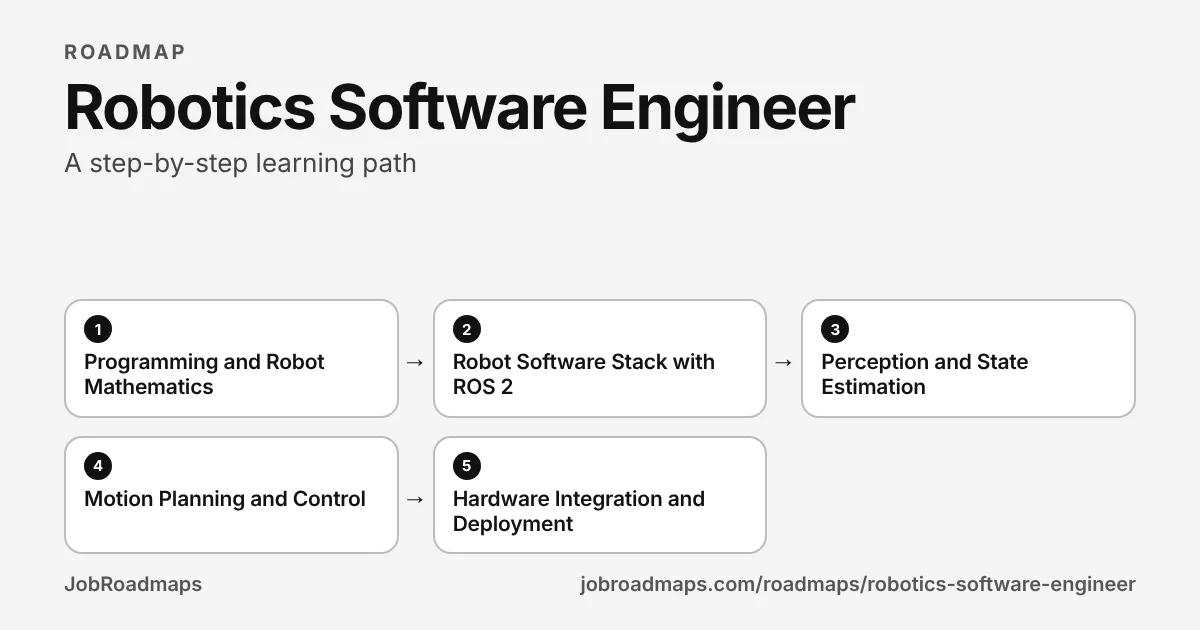
Robotics Software Engineer learning path
Work down the line, one step at a time. Tick each skill as you can do it.
- 1
Programming and Robot Mathematics
2–3 monthsBuild the foundations: C++ for real-time code, Python for tooling, and the linear algebra of rigid-body motion. Learn rotations, homogeneous transforms and coordinate frames well enough to debug a frame mix-up by reading the numbers.
Skills to learn
- C++
- Python
- Linear Algebra
- Rigid-Body Transforms
- Coordinate Frames
- Unit Testing
- 2
Robot Software Stack with ROS 2
3–4 monthsLearn the middleware most robots run on: nodes, topics, services, actions, launch files and the transform tree. Build a small system in simulation, then write tests that run in continuous integration.
Skills to learn
- ROS 2
- Gazebo Simulation
- Launch Files
- Transform Tree (TF)
- Message Design
- Simulation Testing
- 3
Perception and State Estimation
3–4 monthsTurn sensor data into an estimate of where the robot is and what surrounds it. Work with cameras and lidar, filter noisy measurements with Kalman filters, and build a simple localization or mapping pipeline you can evaluate against ground truth.
Skills to learn
- Sensor Fusion
- Kalman Filters
- Localization
- SLAM
- Point Clouds
- OpenCV
- 4
Motion Planning and Control
3–6 monthsMake the robot move safely toward a goal. Study kinematics, plan collision-free paths, generate smooth trajectories, and tune feedback controllers. Measure tracking error and collision margins, not only whether the arm reached the target once.
Skills to learn
- Kinematics
- Motion Planning
- Trajectory Generation
- PID Control
- Collision Checking
- Model Predictive Control
- 5
Hardware Integration and Deployment
6–12 monthsMove code from simulation to a physical robot. Handle real-time deadlines, sensor latency and safety stops, read logs from a failed run, and set up over-the-air updates or fleet monitoring. The job at this stage is making software that keeps working when the hardware is not ideal.
Skills to learn
- Real-Time Constraints
- Safety Systems
- Logging and Replay
- Hardware Debugging
- Fleet Monitoring
- Deployment Pipelines
jobroadmaps.com/roadmaps/robotics-software-engineer · Pay, demand and employer data for this role are further down the page.
Books worth reading as a Robotics Software Engineer
Where to start, in order. The full list of 8, grouped by career stage, is on its own page.
Getting started
Modern Robotics
by Kevin M. Lynch, Frank C. Park · 2017
~540 pages~14 hrs to read
The mathematics of robot motion: configuration space, rigid-body transforms, kinematics and dynamics, with a clear path from the basics to control. It is the reference most robotics software depends on.
View book →Programming Robots with ROS
by Morgan Quigley, Brian Gerkey, William D. Smart · 2015
~430 pages~11 hrs to read
A practical introduction to building a robot software system with the Robot Operating System, from nodes and messages to simulation. It shows how the pieces of a robot connect.
View book →
Doing the job
Probabilistic Robotics
by Sebastian Thrun, Wolfram Burgard, Dieter Fox · 2005
~670 pages~17 hrs to read
How robots estimate their state from noisy sensors: Bayes filters, Kalman filters, localization and mapping. It is the standard treatment of state estimation for mobile robots.
View book →Introduction to Autonomous Robots
by Roland Siegwart, Illah Nourbakhsh, Davide Scaramuzza · 2011
~470 pages~12 hrs to read
A survey of mobile robot locomotion, sensing, localization and navigation. It connects the perception and planning topics into one picture of an autonomous system.
View book →
Senior and leading
Principles of Robot Motion
by Howie Choset, Kevin M. Lynch, Seth Hutchinson, George Kantor, Wolfram Burgard, Lydia E. Kavraki, Sebastian Thrun · 2005
~640 pages~16 hrs to read
Theory and algorithms for planning and controlling robots across many configurations. It helps a lead judge which planning approach fits a platform and what its guarantees are.
View book →
All 8 books for a Robotics Software Engineer →Browse all books →
Some book links are affiliate links: we earn a small commission if you buy, at no cost to you. It does not affect what we list.
Courses and certifications for a Robotics Software Engineer
3 courses, tutorials and certifications, each read on the provider's own page. One from each stage to start; the full list, with a guide to choosing, is on its own page.
Getting started · Course
Modern Robotics
Northwestern University
Doing the job · Hands-on tutorial
ROS 2 Tutorials (Humble)
Open Robotics
Prerequisites & Education
What credentials do employers look for?
These are the most common paths into this role — no single one is required.
Education Level
View list — coming soon- Bachelor's in Computer Science, Electrical Engineering or Mechanical Engineering
- Master's in robotics or control for research and autonomy roles
- Bachelor's in any discipline with embedded or real-time software experience
Robotics hiring values a working robot over the degree. A technical degree is usually expected, and hardware exposure helps.
Certifications
View list — coming soon- No vendor certificate is standard for robotics software. Courses and reading are the reference points.
Pick a certificate only when the employer runs a specific platform you can show experience with.
Bootcamps & Training
View list — coming soon- Modern Robotics (Northwestern) — free lectures covering rigid-body motion and kinematics
- ROS 2 Tutorials (Humble) — free official tutorials for building a robot system
- Getting Started with Gazebo — free documentation for simulation
All three are free and documented. Build a simulated robot with them so the course becomes a project.
Portfolio & Other
View list — coming soon- A simulated robot with ROS 2 nodes, tests and a short write-up of a bug you found
- A log or replay from a real or simulated run that shows a fault you diagnosed
- A public repository with launch files, configuration and build instructions
Hiring managers read these for debugging judgment. Show the failure and how you isolated it.
Your Roadmap
5 stepsProgramming and Robot Mathematics
2–3 monthsBuild the foundations: C++ for real-time code, Python for tooling, and the linear algebra of rigid-body motion. Learn rotations, homogeneous transforms and coordinate frames well enough to debug a frame mix-up by reading the numbers.
Skills to learn
Robot Software Stack with ROS 2
3–4 monthsLearn the middleware most robots run on: nodes, topics, services, actions, launch files and the transform tree. Build a small system in simulation, then write tests that run in continuous integration.
Skills to learn
Perception and State Estimation
3–4 monthsTurn sensor data into an estimate of where the robot is and what surrounds it. Work with cameras and lidar, filter noisy measurements with Kalman filters, and build a simple localization or mapping pipeline you can evaluate against ground truth.
Skills to learn
Motion Planning and Control
3–6 monthsMake the robot move safely toward a goal. Study kinematics, plan collision-free paths, generate smooth trajectories, and tune feedback controllers. Measure tracking error and collision margins, not only whether the arm reached the target once.
Skills to learn
Hardware Integration and Deployment
6–12 monthsMove code from simulation to a physical robot. Handle real-time deadlines, sensor latency and safety stops, read logs from a failed run, and set up over-the-air updates or fleet monitoring. The job at this stage is making software that keeps working when the hardware is not ideal.
Skills to learn
Start here this week
This week: install ROS 2 and a simulator, bring up a simulated mobile robot, and make it drive to a goal you publish from the command line. Record a short video and write down every frame or timing mistake you made. That log is your first evidence of robotics work.
Structured entry path: learn the transforms and ROS 2 first, then add perception and planning to the same simulated robot. Once it runs reliably in simulation, test it on a small inexpensive physical platform, and document where the real world differed from the simulator.
Pay
U.S. Department of Labor data for the nearest BLS occupation, Software developers. BLS has no occupation for this exact title, so treat these as a benchmark.
Median: U.S. Bureau of Labor Statistics, Occupational Employment and Wage Statistics (median wage, May 2024) and Employment Projections (2024–34). Levels: U.S. Department of Labor Office of Foreign Labor Certification prevailing wage levels (wage year 2025, typical metro), a base-wage benchmark for the metro in the middle of 511 areas, not an offer. See every metro.
Job Titles at Each Level
Entry
Robotics Software Engineer / Robotics Software Developer
Mid
Senior Robotics Software Engineer / Autonomy Engineer / Perception Engineer
Senior
Staff Robotics Engineer / Robotics Software Lead / Robotics Platform Lead
Steps Overview
- 1
Programming and Robot Mathematics
2–3 months
- 2
Robot Software Stack with ROS 2
3–4 months
- 3
Perception and State Estimation
3–4 months
- 4
Motion Planning and Control
3–6 months
- 5
Hardware Integration and Deployment
6–12 months
Explore more roadmaps
Not sure this is the right path? Browse all tech career roadmaps.
View Similar RoadmapsBuilt a project while following this roadmap?
Turn it into a hiring-ready case study in 10 seconds — free.
Ready to explore more?
Browse all career roadmaps across tech, business, and creative fields.