Frontend Developer Career Roadmap
The browser is the most crowded stage in human history — every interface humans touch runs here, and frontend developers decide what happens on it. We're talking about performance budgets, accessibility trees, real-time state, animations that feel like physics. It's a discipline that rewards obsessives: equal parts engineering rigor and aesthetic judgment, and the prevailing orthodoxy that separates 'developer' from 'designer' was written by people who never watched a user struggle with their checkout form.
Is this the right path for you?
Frontend developers come from three main paths: self-taught (bootcamp graduates or online course completers), CS degree holders, and designers who crossed the code line. The self-taught route is the most common and the most varied in quality. Bootcamps compress the timeline but don't compress the learning — what takes 4 years in a CS program takes 6 months in a bootcamp plus 18 months of deliberate practice after.
If you find yourself caring about the 12ms render delay on a button hover, or noticing that a website's scroll behavior feels wrong before you can articulate why — you're already wired for this work. Frontend rewards people who find the gap between 'it works' and 'it feels right' genuinely interesting.
One honest note: the junior frontend market is flooded. Bootcamps graduate thousands of people every year, most with the same three tutorial projects. If your portfolio looks like everyone else's, you will not hear back. Portfolio differentiation isn't optional — it's the difference between getting interviews and not getting interviews.
Frontend Developer in 42 seconds
Pay and outlook: U.S. Bureau of Labor Statistics Employment Projections 2024–34, "Web developers". Step timeframes are editorial estimates.
Read the transcript
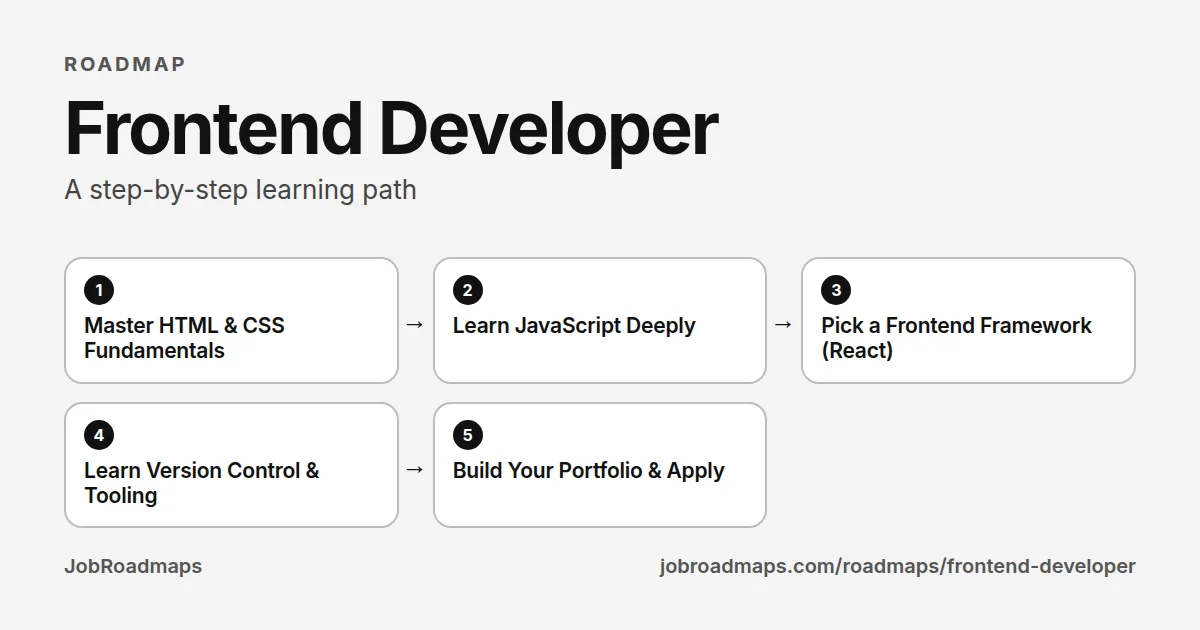
The Frontend Developer roadmap: 5 steps, with an estimated 6–12 months to entry level.
Pay and outlook, from the U.S. Bureau of Labor Statistics, for web developers: median pay of $90,930 a year.
Employment is projected to grow 7.5% from 2024 to 2034, with about 5,400 openings a year.
The career ladder runs from Junior Frontend Developer, to Frontend Developer, to Senior Frontend / UI Engineer.
The path, in 5 steps.
Master HTML and CSS Fundamentals: 4–6 weeks.
Learn JavaScript Deeply: 6–8 weeks.
Pick a Frontend Framework (React): 6–10 weeks.
Learn Version Control and Tooling: 2–3 weeks.
Build Your Portfolio and Apply: 4–6 weeks.
The full step-by-step roadmap is at jobroadmaps.com/roadmaps/frontend-developer.
Career Progression
Where does this role lead?
Click any role to explore timeline, key skills and, where the Department of Labor publishes it, pay.
Entry
Junior Frontend
~1 yr
$55,910 (Level I)
You'll spend more time reading code than writing it — that's normal. Shipping working features under guidance is the goal.
Key skills
Pay shown is the U.S. Department of Labor prevailing wage for Level I (entry), Level III (mid) and Level IV (senior) in the nearest BLS occupation, base wage for the typical metro, wage year 2025, shown for the main track only. It is a benchmark, not an offer; branches and lead, staff and executive stages have no official figure.
Visual roadmap
Frontend Developer learning path
Work down the line, one step at a time. Tick each skill as you can do it.
- 1
Master HTML & CSS Fundamentals
4–6 weeksLearn the building blocks of the web. Understand semantic HTML5 elements, the CSS box model, flexbox, CSS Grid, and responsive design principles. Build at least 5 static web pages from scratch.
Skills to learn
- Semantic HTML5 Elements
- CSS Box Model & Specificity
- Flexbox
- CSS Grid
- CSS Custom Properties (Variables)
- CSS Animations & Transitions
- Responsive Design / Mobile-First
- Media Queries
- WCAG Accessibility Basics
- Browser DevTools
Start with
- 2
Learn JavaScript Deeply
6–8 weeksJavaScript is the engine of interactive web experiences. Study core concepts: variables, functions, DOM manipulation, async/await, the event loop, and ES6+ features. Complete small projects like a to-do list, weather app, and quiz game.
Skills to learn
- JavaScript ES6+ (const, let, arrow fns)
- DOM Manipulation
- Event Listeners & Delegation
- Promises & Async/Await
- Fetch API & REST calls
- Error Handling (try/catch)
- Closures & Scope
- Module System (ESM)
- LocalStorage & SessionStorage
- Array Methods (map, filter, reduce)
Start with
- 3
Pick a Frontend Framework (React)
6–10 weeksReact is the dominant choice for frontend development. Learn components, props, state, hooks (useState, useEffect), and React Router. Build a multi-page app with an external API.
Skills to learn
- React Components & JSX
- useState & useEffect
- useContext & useReducer
- React Router v6
- TanStack Query (data fetching)
- Zustand or Redux Toolkit
- TypeScript with React
- React Testing Library
- Next.js App Router
- Tailwind CSS
Start with
- 4
Learn Version Control & Tooling
2–3 weeksGit and GitHub are non-negotiable. Learn branching, pull requests, and merge conflicts. Also set up a modern dev environment: Node.js, npm/yarn, and a bundler like Vite.
Skills to learn
- Git (branches, merge, rebase)
- GitHub / GitLab (PRs, reviews)
- npm / pnpm / yarn
- Vite (bundler)
- ESLint & Prettier
- VS Code + Extensions
- Terminal / zsh basics
- Vitest or Jest
Start with
- 5
Build Your Portfolio & Apply
4–6 weeksCreate 3–5 polished projects that showcase different skills: a personal site, a React app consuming a public API, and a UI clone of a popular product. Write clean READMEs and deploy everything publicly.
Skills to learn
- Vercel / Netlify Deployment
- Custom Domain Setup
- Lighthouse & Core Web Vitals
- SEO Fundamentals
- Open Graph Meta Tags
- GitHub Pages
- Technical Writing (README)
- Resume Tailoring for ATS
Start with
jobroadmaps.com/roadmaps/frontend-developer · Pay, demand and employer data for this role are further down the page.
Job Market Insights for Frontend Developer
Data-backed
What do employers actually ask for?
Read from live job postings — how often each credential is named, from rare to almost always.
"Computer Science background" is the most common credential named, yet it appears only occasionally in what we could read. Postings that state it are the minority, but these counts are a floor, so do not read this as "no one asks".
Some postings say outright that equivalent experience or a self-taught route is accepted. That wording is worth reading closely when you see it.
Our read: a portfolio that proves the skill, and a referral from someone inside the company, usually carry more weight than a credential match on paper. That is judgement, not something these counts measure.
Requirement
How often named
Computer Science background
Equivalent experience accepted
Bachelor's degree
Our read: how often a credential is named is not how strictly it is enforced. Equivalent experience, a standout portfolio, or a referral often counts for more than the credential listed.
Data-backed
Which skills appear most in job postings?
Read from live job postings, ranked from most to least often named.
architecture leads the list and is named frequent. If you are only going to learn one thing before applying, the postings say start here.
Past the fundamentals, 5 specialisation skills (architecture included) start separating candidates who can do the job from candidates who have done it. The 15 niche skills are named rarely enough that knowing them is upside, not prerequisite.
Skill
How often named
architecture
observability
security
code review
state management
A/B testing
accessibility
data visualization
design systems
build systems
web performance
responsive design
SEO
Sorted by how often named · JobRoadmaps
Data-backed
Which tools and artifacts appear most in job postings?
Read from live job postings, ranked from most to least often named.
Redux is the most-named tool, but no tool is a universal requirement here.
Industry overlay
Targeting a specific industry?
The core roadmap gets you through the door anywhere. The difference between "qualified" and "they hired someone else" often lives in industry-specific context — the norms, the compliance floors, the tools assumed fluent in that sector.
PCI-DSS compliance basics
Card data handling is regulated — frontend code touching payments must know what cannot be stored or logged.
Real-time data patterns
Trading dashboards and live balance updates require WebSockets, SSE, and optimistic UI as standard.
Form validation depth
Financial forms enforce strict rules (routing numbers, card numbers, tax IDs) — Luhn algorithm checks are table stakes.
Accessibility (WCAG 2.1 AA)
Many financial products serve regulated populations. AA compliance is often a legal requirement, not optional.
Audit trail awareness
Actions must be logged for compliance. Frontend devs learn not to silently swallow errors or retry without user awareness.
Companies hiring:
StripeBrexRobinhoodPlaidCoinbaseComplex data visualisation
SaaS dashboards surface analytics, usage metrics, and reports — charting libraries and custom SVG rendering are daily work.
Design system ownership
B2B SaaS companies invest heavily in internal component libraries. Frontend engineers often own and maintain them.
Real-time UI patterns
Collaborative tools like Figma and Notion require WebSockets, operational transforms, and conflict-free UX.
Feature flag–driven development
SaaS release cadences rely on flags for gradual rollouts, beta features, and per-customer overrides.
Multi-tenancy awareness
Enterprise SaaS serves multiple orgs from one codebase — theming, permissions, and scoped data are architectural constraints.
Companies hiring:
FigmaNotionLinearLoomRetoolIndustry premiums based on aggregated job posting data · Updated quarterly
Interactive
How ready are you right now?
Check the skills you already have to see your current job-market fit.
The most-named skill for this role is architecture, so a gap there costs you the most. Skills at the top of the scale appear across most postings, so a single gap there narrows your options more than a gap in a rarer skill. Check what you already have to see your biggest current gap.
Readiness Check
Check the skills you already have
0/5
base skills
Your biggest gap: architecture, the most often named of the skills you have not ticked.
Start there, then work down the list.
Books worth reading as a Frontend Developer
Where to start, in order. The full list of 11, grouped by career stage, is on its own page.
Getting started

Eloquent JavaScript
by Marijn Haverbeke · 2011
~470 pages~12 hrs to read
A thorough tour of the language itself, then the browser, the DOM and Node, with exercises throughout. Read it in your first months so closures, async code and the event model stop feeling magical.
View book →Learning Web Design
by Jennifer Robbins, Aaron Gustafson · 2001
~750 pages~19 hrs to read
A patient introduction to HTML, CSS, layout, images and publishing a site. Read it first if you are coming to the browser from scratch, and keep it as the gentle companion to your own first pages.
View book →
Doing the job

Learning React
by Alex Banks, Eve Porcello · 2017
~310 pages~8 hrs to read
Components, props, state and hooks, built up through small examples. Read it when you move from plain JavaScript to your first framework and need a clear mental model of how React renders.
View book →
Effective TypeScript
by Dan Vanderkam · 2019
~250 pages~6 hrs to read
Short, opinionated items on getting the type system to catch real bugs instead of getting in your way. Read it once you have written some TypeScript and want to design types deliberately.
View book →
Senior and leading

Building Micro-Frontends
by Luca Mezzalira · 2021
~350 pages~9 hrs to read
Weighs when to split a large frontend into independently deployed pieces, and how to do it with composition, routing and shared state. Read it when your codebase and team have outgrown a single app.
View book →
Frontend Architecture for Design Systems
by Micah Godbolt · 2016
~200 pages~5 hrs to read
A guide to structuring CSS, components, tooling and workflow so a shared design system can scale across teams. Read it when you are asked to own the frontend foundation, not just features.
View book →
All 11 books for a Frontend Developer →Browse all books →
Some book links are affiliate links: we earn a small commission if you buy, at no cost to you. It does not affect what we list.
Prerequisites & Education
What credentials do employers look for?
These are the most common paths into this role — no single one is required.
Education Level
View list — coming soon- Bachelor's in Computer Science, Software Engineering, or related field
- Bachelor's in any discipline — common for career changers
- Associate's degree with strong portfolio
- No degree — portfolio and experience carry equal weight at most companies
Most frontend roles list a degree as preferred, not required. A strong portfolio regularly outweighs formal education at the screening stage.
Certifications
View list — coming soon- AWS Certified Cloud Practitioner — useful if working on cloud-deployed apps
- Google UX Design Certificate — relevant for frontend/design crossover roles
- Meta Front-End Developer Certificate (Coursera)
- Accessibility certification (IAAP CPACC) — valued at enterprise companies
Certifications carry less weight than a deployed project for most frontend roles, but can help pass automated resume filters.
Bootcamps & Training
View list — coming soon- Any accredited full-stack or frontend bootcamp (General Assembly, Flatiron, App Academy)
- The Odin Project — free, self-paced, widely respected
- freeCodeCamp — recognised by many hiring managers as a credible path
- Scrimba Frontend Developer Path
Bootcamp graduates are routinely hired at top companies. The portfolio you build during and after matters far more than the bootcamp name.
Portfolio & Other
View list — coming soon- GitHub profile with consistent commit history across real projects
- Live deployed projects (Vercel, Netlify) — a URL beats a description every time
- Open source contributions — even small bug fixes show collaboration skills
- Technical blog or writeups — demonstrates communication and depth
- Freelance or contract work — real client requirements add credibility
For frontend roles, a strong portfolio is the single highest-signal credential. It is often the deciding factor when candidates are otherwise equal.
Your Roadmap
5 stepsMaster HTML & CSS Fundamentals
4–6 weeksLearn the building blocks of the web. Understand semantic HTML5 elements, the CSS box model, flexbox, CSS Grid, and responsive design principles. Build at least 5 static web pages from scratch.
Skills to learn
Learn JavaScript Deeply
6–8 weeksJavaScript is the engine of interactive web experiences. Study core concepts: variables, functions, DOM manipulation, async/await, the event loop, and ES6+ features. Complete small projects like a to-do list, weather app, and quiz game.
Skills to learn
Pick a Frontend Framework (React)
6–10 weeksReact is the dominant choice for frontend development. Learn components, props, state, hooks (useState, useEffect), and React Router. Build a multi-page app with an external API.
Skills to learn
Learn Version Control & Tooling
2–3 weeksGit and GitHub are non-negotiable. Learn branching, pull requests, and merge conflicts. Also set up a modern dev environment: Node.js, npm/yarn, and a bundler like Vite.
Skills to learn
Build Your Portfolio & Apply
4–6 weeksCreate 3–5 polished projects that showcase different skills: a personal site, a React app consuming a public API, and a UI clone of a popular product. Write clean READMEs and deploy everything publicly.
Skills to learn
Start here this week
This week: build one real project — not a tutorial clone, not a todo app. Pick something you'd actually use, deploy it on a custom domain, and make it work. Vercel and Netlify have free tiers. The domain costs $10. That deployed URL is worth more than a dozen local projects.
For structured entry, the Meta Front-End Developer Certificate on Coursera covers the fundamentals systematically. freeCodeCamp's curriculum is free and comprehensive. Either works — what matters is that you finish one, not that you started three. Most people drop out of self-taught programs before they get to the hard parts.
Pay
U.S. Department of Labor data for the nearest BLS occupation, Web developers. BLS has no occupation for this exact title, so treat these as a benchmark.
Median: U.S. Bureau of Labor Statistics, Occupational Employment and Wage Statistics (median wage, May 2024) and Employment Projections (2024–34). Levels: U.S. Department of Labor Office of Foreign Labor Certification prevailing wage levels (wage year 2025, typical metro), a base-wage benchmark for the metro in the middle of 217 areas, not an offer. See every metro.
Job Titles at Each Level
Entry
Junior Frontend Developer
Mid
Frontend Developer
Senior
Senior Frontend / UI Engineer
Steps Overview
- 1
Master HTML & CSS Fundamentals
4–6 weeks
- 2
Learn JavaScript Deeply
6–8 weeks
- 3
Pick a Frontend Framework (React)
6–10 weeks
- 4
Learn Version Control & Tooling
2–3 weeks
- 5
Build Your Portfolio & Apply
4–6 weeks
Explore more roadmaps
Not sure this is the right path? Browse all tech career roadmaps.
View Similar RoadmapsBuilt a project while following this roadmap?
Turn it into a hiring-ready case study in 10 seconds — free.
Ready to explore more?
Browse all career roadmaps across tech, business, and creative fields.