Data Scientist Career Roadmap
Data science is part statistics, part software engineering, part organizational psychology — because generating an insight is only half the job; the other half is convincing anyone to act on it. You'll build models that predict churn, detect fraud, recommend products, and optimize pricing. Some of it will feel like clairvoyance. Most of it will be data cleaning. Both are necessary. Neither is glamorous. The career is.
Is this the right path for you?
Data scientists come from three main backgrounds: statistics and math (PhDs and master's students who realized academia wasn't the only option), engineers who discovered ML and went deeper, and analysts who kept pushing until they hit modeling. Each background brings a different strength and a different gap — the math people often can't engineer, the engineers often can't validate, and the analysts often can't scale.
If you find yourself more interested in the assumption behind the model than the model's output — more interested in why the data is shaped the way it is than in the prediction it generates — you're already thinking like a data scientist. The job is fundamentally about skepticism applied to information.
The math bar is real and non-negotiable. Linear algebra, probability theory, and statistics aren't prerequisites you can defer — they're the substrate the job runs on. Courses that teach data science by calling sklearn functions without teaching the theory produce people who can fit a model but can't tell you when the model is wrong. That distinction is what separates junior data scientists from senior ones.
Career Progression
Where does this role lead?
Click any role to explore timeline, key skills and, where the Department of Labor publishes it, pay.
Entry
Data Analyst
~1–2 yrs
$62,546 (Level I)
Your primary job is answering questions with data. Learning to ask the right question is as important as knowing how to query it.
Key skills
Pay shown is the U.S. Department of Labor prevailing wage for Level I (entry), Level III (mid) and Level IV (senior) in the nearest BLS occupation, base wage for the typical metro, wage year 2025, shown for the main track only. It is a benchmark, not an offer; branches and lead, staff and executive stages have no official figure.
Visual roadmap
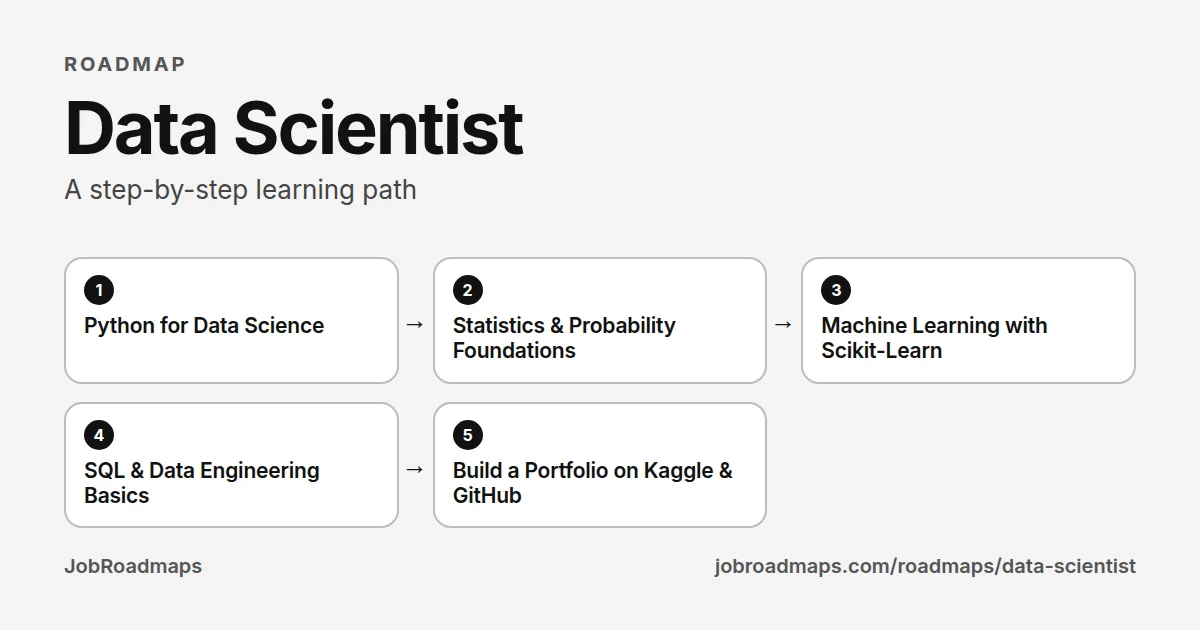
Data Scientist learning path
Work down the line, one step at a time. Tick each skill as you can do it.
- 1
Python for Data Science
6–8 weeksPython is the lingua franca of data science. Learn pandas for data manipulation, NumPy for numerical computing, and Matplotlib/Seaborn for visualization. Complete at least 3 data analysis projects on real datasets.
Skills to learn
- Python 3 (type hints, comprehensions)
- pandas (merge, groupby, pivot)
- NumPy (array ops, broadcasting)
- Matplotlib & Seaborn
- Plotly (interactive charts)
- Jupyter Notebooks
- Google Colab
- Data Cleaning (nulls, outliers)
- Data Type Casting & Validation
Start with
- 2
Statistics & Probability Foundations
6–8 weeksUnderstand descriptive statistics, probability distributions, hypothesis testing, A/B testing, confidence intervals, and regression fundamentals. This is the mathematical backbone of data science.
Skills to learn
- Descriptive Statistics (mean, std, IQR)
- Probability Distributions (Normal, Poisson)
- Hypothesis Testing (t-test, chi-square)
- p-values & Statistical Significance
- A/B Test Design & Power Analysis
- Confidence Intervals
- Linear & Logistic Regression
- Bayesian Inference Basics
- Correlation vs. Causation
Start with
- 3
Machine Learning with Scikit-Learn
8–10 weeksLearn supervised learning (linear regression, decision trees, random forests, SVMs) and unsupervised learning (k-means clustering, PCA). Use scikit-learn for model training, evaluation, and tuning.
Skills to learn
- scikit-learn Pipelines
- Linear & Logistic Regression
- Decision Trees & Random Forests
- Gradient Boosting (XGBoost, LightGBM)
- K-Means & DBSCAN Clustering
- PCA (dimensionality reduction)
- Cross-Validation & Grid Search
- SHAP (model explainability)
- Feature Engineering & Selection
- Imbalanced Data (SMOTE, class weights)
Start with
- 4
SQL & Data Engineering Basics
4–5 weeksData scientists spend most of their time querying databases. Master SQL: complex joins, window functions, CTEs, and query optimization. Understand data pipelines and basic ETL concepts.
Skills to learn
- SQL (Joins, CTEs, Window Functions)
- BigQuery
- Snowflake
- dbt (data build tool)
- Apache Airflow (basic DAGs)
- ETL vs. ELT patterns
- Parquet & Columnar Storage
- Delta Lake / Apache Iceberg basics
- PySpark (distributed processing)
Start with
- 5
Build a Portfolio on Kaggle & GitHub
6–8 weeksComplete 3–5 Kaggle competitions or projects. Create a capstone project solving a real business problem with full EDA, modeling, and presentation. Document everything clearly for future employers.
Skills to learn
- Kaggle Competitions (Bronze/Silver target)
- Streamlit App Deployment
- MLflow Experiment Tracking
- Weights & Biases (W&B)
- Data Storytelling (narrative + visuals)
- End-to-End Project Documentation
- GitHub Portfolio Setup
- Technical Blog Writing
Start with
jobroadmaps.com/roadmaps/data-scientist · Pay, demand and employer data for this role are further down the page.
Job Market Insights for Data Scientist
Data-backed
What do employers actually ask for?
Read from live job postings — how often each credential is named, from rare to almost always.
"PhD / doctorate" is the most common credential named, yet it appears only rarely in what we could read. Postings that state it are the minority, but these counts are a floor, so do not read this as "no one asks".
Some postings say outright that equivalent experience or a self-taught route is accepted. That wording is worth reading closely when you see it.
Our read: a portfolio that proves the skill, and a referral from someone inside the company, usually carry more weight than a credential match on paper. That is judgement, not something these counts measure.
Requirement
How often named
PhD / doctorate
Computer Science background
Bachelor's degree
Master's degree
Equivalent experience accepted
Our read: how often a credential is named is not how strictly it is enforced. Equivalent experience, a standout portfolio, or a referral often counts for more than the credential listed.
Data-backed
Which skills appear most in job postings?
Read from live job postings, ranked from most to least often named.
Machine Learning is the most-named skill. Common, but not universal: many postings do not list it.
Past the fundamentals, 5 specialisation skills (Machine Learning included) start separating candidates who can do the job from candidates who have done it. The 15 niche skills are named rarely enough that knowing them is upside, not prerequisite.
Skill
How often named
Experimentation
Causal Inference
Optimization
Product Analytics
Data Visualization
Deep Learning
Segmentation
Feature Engineering
Model Deployment
ETL
Fraud Detection
Distributed Systems
Statistical Inference
Anomaly Detection
Recommendation Systems
Large Language Models
Bayesian Methods
Sorted by how often named · JobRoadmaps
Data-backed
Which tools and artifacts appear most in job postings?
Read from live job postings, ranked from most to least often named.
No tool dominates. The most-named, Snowflake, is still rare; postings for this role rarely list tools by name.
Tool / Artifact
How often named
Looker
Sorted by how often named · JobRoadmaps
Industry overlay
Targeting a specific industry?
The core roadmap gets you through the door anywhere. The difference between "qualified" and "they hired someone else" often lives in industry-specific context — the norms, the compliance floors, the tools assumed fluent in that sector.
Credit risk modelling
Lending companies use ML to predict default probability — regulatory constraints (ECOA, FCRA) require model explainability.
Fraud detection systems
Real-time fraud scoring at transaction time requires low-latency features and threshold tuning with asymmetric costs.
Model explainability (SHAP, LIME)
Adverse action notices for denied credit require legally defensible explanations of model decisions.
Time-series financial modelling
Price prediction, volatility modelling, and risk factor analysis require deep understanding of financial time series.
Regulatory model validation
Financial models must pass third-party validation and stress testing — documentation and reproducibility are non-negotiable.
Companies hiring:
StripeAffirmKlarnaPlaidTwo SigmaCustomer lifetime value (LTV) modelling
SaaS unit economics hinge on LTV/CAC — probabilistic models (BG/NBD, Pareto) forecast customer value accurately.
Churn prediction & early warning systems
Subscription businesses need 30–90 day advance warning of churn to enable customer success interventions.
Product-led growth analytics
PLG SaaS tracks activation funnels, time-to-value, and feature adoption — data scientists define and own these metrics.
NLP for support & feedback
SaaS support tickets and NPS verbatims contain rich signal — topic modelling and sentiment analysis extract actionable insights.
Revenue attribution modelling
Multi-touch attribution across channels requires probabilistic models to accurately credit marketing spend.
Companies hiring:
SalesforceHubSpotMixpanelAmplitudeTableauIndustry premiums based on aggregated job posting data · Updated quarterly
Interactive
How ready are you right now?
Check the skills you already have to see your current job-market fit.
The most-named skill for this role is Machine Learning, so a gap there costs you the most. No single skill dominates, but each gap narrows which postings fit you. Check what you already have to see your biggest current gap.
Readiness Check
Check the skills you already have
0/5
base skills
Your biggest gap: Machine Learning, the most often named of the skills you have not ticked.
Start there, then work down the list.
Books worth reading as a Data Scientist
Where to start, in order. The full list of 12, grouped by career stage, is on its own page.
Getting started

Python for Data Analysis, 3rd Edition
by Wes McKinney · 2011
~550 pages~14 hrs to read
Written by the creator of pandas, it covers loading, cleaning, reshaping and summarising tabular data in Python. Read it early, alongside real datasets, because nearly every later data task starts with these skills.
View book →
Practical Statistics for Data Scientists, 2nd Edition
by Peter Bruce, Andrew Bruce, Peter Gedeck · 2017
~370 pages~9 hrs to read
Explains the statistics a working data scientist needs: sampling, distributions, A/B testing, regression and classification, with code in R and Python. Read it when you can already wrangle data and want to know which method fits the question.
View book →
Doing the job

Hands-On Machine Learning with Scikit-Learn, Keras & TensorFlow, 3rd Edition
by Aurélien Géron · 2017
~860 pages~22 hrs to read
Project-driven walk-through of the machine learning workflow, from classical models in Scikit-Learn to neural networks in Keras. Work through it once you are comfortable with Python and basic statistics.
View book →
Feature Engineering for Machine Learning
by Alice Zheng, Amanda Casari · 2016
~220 pages~6 hrs to read
A compact guide to turning raw numeric, text and categorical data into features that models can use. Useful once your first models plateau and the gains have to come from the data rather than the algorithm.
View book →
Senior and leading

Data Science for Business: What You Need to Know about Data Mining and Data-Analytic Thinking
by Foster Provost, Tom Fawcett · 2013
~410 pages~10 hrs to read
Frames data science as a way to make business decisions, covering problem framing, evaluation and the trade-offs behind predictive models. A good fit for senior data scientists who must scope projects and explain their value to non-technical leaders.
View book →
Designing Machine Learning Systems: An Iterative Process for Production-Ready Applications
by Chip Huyen · 2022
~390 pages~10 hrs to read
Covers data pipelines, deployment, monitoring and the lifecycle of production models. Read it when your work shifts from notebooks to models that other teams depend on.
View book →
All 12 books for a Data Scientist →Browse all books →
Some book links are affiliate links: we earn a small commission if you buy, at no cost to you. It does not affect what we list.
Prerequisites & Education
What credentials do employers look for?
These are the most common paths into this role — no single one is required.
Education Level
View list — coming soon- Bachelor's in Statistics, Mathematics, Computer Science, or Engineering
- Master's in Data Science, Applied Statistics, or Machine Learning — common at senior roles
- Bachelor's in Economics, Physics, or Biology with strong quantitative coursework
- PhD — expected at research-heavy companies (AI labs, pharma, finance)
A quantitative bachelor's combined with hands-on ML projects often outcompetes a less-applied master's degree at product-focused companies.
Certifications
View list — coming soon- Google Professional Machine Learning Engineer — strong industry signal for applied ML
- AWS Certified AI Practitioner — $100 entry-level AI/ML cert; low barrier, good for demonstrating cloud AI literacy
- Microsoft Azure Data Scientist Associate (DP-100) — covers training, experimenting, and deploying ML models on Azure Machine Learning; valued at Azure-first companies ($165)
- Microsoft Azure AI Fundamentals (AI-900) — $165 entry-level; good baseline for data scientists working in Azure ecosystems before pursuing DP-100
- CertNexus Certified AI Practitioner (CAIP) — $368, vendor-neutral, covers ML algorithms, model training, and deploying AI solutions in business contexts
- IBM Data Science Professional Certificate (Coursera) — widely recognised entry credential
- TensorFlow Developer Certificate (Google) — signals hands-on model-building competency
- AWS Certified Machine Learning – Specialty — valuable for data scientists deploying models on AWS
- Databricks Certified Machine Learning Professional — valued at data-platform heavy companies
- SAS Certified Professional: AI & Machine Learning — $5,845 three-exam enterprise credential; relevant at large organisations running SAS analytics infrastructure
ML certs carry more weight than general data certs — they demonstrate hands-on model-building, not just SQL and dashboards. CertNexus CAIP is the best value vendor-neutral option.
Bootcamps & Training
View list — coming soon- Kaggle Learn — free, project-driven, widely respected in the field
- fast.ai — practical deep learning, used internally at many AI companies
- DataCamp career tracks — structured but supplement with real projects
- Springboard Data Science Bootcamp — mentored, job-placement focused
Kaggle competition placements (even top 25%) are a stronger portfolio signal than most bootcamp completions for DS roles.
Portfolio & Other
View list — coming soon- Kaggle profile with competition history and published notebooks
- GitHub with reproducible ML experiments and documented findings
- End-to-end project: data collection → EDA → model → deployment
- Streamlit or Gradio app serving a live model — shows productionisation thinking
- Published writeup or blog post explaining a model or analysis
A deployed model or interactive analysis communicating real business insight outweighs any credential at most product companies.
Your Roadmap
5 stepsPython for Data Science
6–8 weeksPython is the lingua franca of data science. Learn pandas for data manipulation, NumPy for numerical computing, and Matplotlib/Seaborn for visualization. Complete at least 3 data analysis projects on real datasets.
Skills to learn
Statistics & Probability Foundations
6–8 weeksUnderstand descriptive statistics, probability distributions, hypothesis testing, A/B testing, confidence intervals, and regression fundamentals. This is the mathematical backbone of data science.
Skills to learn
Machine Learning with Scikit-Learn
8–10 weeksLearn supervised learning (linear regression, decision trees, random forests, SVMs) and unsupervised learning (k-means clustering, PCA). Use scikit-learn for model training, evaluation, and tuning.
Skills to learn
SQL & Data Engineering Basics
4–5 weeksData scientists spend most of their time querying databases. Master SQL: complex joins, window functions, CTEs, and query optimization. Understand data pipelines and basic ETL concepts.
Skills to learn
Build a Portfolio on Kaggle & GitHub
6–8 weeksComplete 3–5 Kaggle competitions or projects. Create a capstone project solving a real business problem with full EDA, modeling, and presentation. Document everything clearly for future employers.
Skills to learn
Start here this week
This week: do one Kaggle competition end-to-end. Not to win or place. To feel the whole workflow — data loading, EDA, feature engineering, model selection, evaluation, submission. The first time through is disorienting. That's the point. Getting disoriented now is better than getting disoriented in an interview.
For structured entry, fast.ai's Practical Deep Learning for Coders is the best first ML course — it starts with working code and builds toward theory, which is the right order for most people. Pair it with 3Blue1Brown's Essence of Linear Algebra and StatQuest on YouTube for the math intuition. The combination is better than most graduate curricula.
Pay
U.S. Department of Labor data for the nearest BLS occupation, Data scientists. BLS has no occupation for this exact title, so treat these as a benchmark.
Median: U.S. Bureau of Labor Statistics, Occupational Employment and Wage Statistics (median wage, May 2024) and Employment Projections (2024–34). Levels: U.S. Department of Labor Office of Foreign Labor Certification prevailing wage levels (wage year 2025, typical metro), a base-wage benchmark for the metro in the middle of 339 areas, not an offer. See every metro.
Job Titles at Each Level
Entry
Junior Data Analyst / Data Scientist
Mid
Data Scientist
Senior
Senior Data Scientist / ML Engineer
Steps Overview
- 1
Python for Data Science
6–8 weeks
- 2
Statistics & Probability Foundations
6–8 weeks
- 3
Machine Learning with Scikit-Learn
8–10 weeks
- 4
SQL & Data Engineering Basics
4–5 weeks
- 5
Build a Portfolio on Kaggle & GitHub
6–8 weeks
Explore more roadmaps
Not sure this is the right path? Browse all tech career roadmaps.
View Similar RoadmapsBuilt a project while following this roadmap?
Turn it into a hiring-ready case study in 10 seconds — free.
Ready to explore more?
Browse all career roadmaps across tech, business, and creative fields.