DevOps Engineer Career Roadmap
DevOps is the discipline that makes shipping software feel like breathing instead of drowning. CI/CD pipelines, infrastructure-as-code, container orchestration, observability — none of it is glamorous, and all of it is foundational. The developers write the code; DevOps engineers build the scaffolding that carries it from a laptop to a server to a human who needed it yesterday. The leverage is enormous. The on-call rotations are real. The gap between teams that have this and teams that don't is measured in shipping velocity and 3 AM pages.
Is this the right path for you?
DevOps engineers tend to come from sysadmin and IT operations backgrounds, from backend developers who got frustrated handing infrastructure problems off to someone else, and from Linux enthusiasts who've been tinkering with servers since before it was a career. Each path arrives with different strengths — sysadmins know operations but often lack software engineering instincts; developers know code but often underestimate infrastructure complexity.
If a broken deployment pipeline bothers you more than a broken UI — if you find yourself wanting to automate the repetitive parts before you even finish doing them manually the first time — you're already wired for this work. DevOps rewards operational paranoia and a low tolerance for manual toil.
On-call is part of the job. Not at every company, but at most companies that take infrastructure seriously. If getting paged at 2am for a production outage sounds like a dealbreaker, that's important information to factor in early. The compensation at senior levels partly reflects that reality.
Career Progression
Where does this role lead?
Click any role to explore timeline, key skills and, where the Department of Labor publishes it, pay.
Entry
Junior DevOps
~1 yr
$74,464 (Level I)
You're learning to automate things that humans currently do manually. Every repeated action is a problem worth solving.
Key skills
Pay shown is the U.S. Department of Labor prevailing wage for Level I (entry), Level III (mid) and Level IV (senior) in the nearest BLS occupation, base wage for the typical metro, wage year 2025, shown for the main track only. It is a benchmark, not an offer; branches and lead, staff and executive stages have no official figure.
Visual roadmap
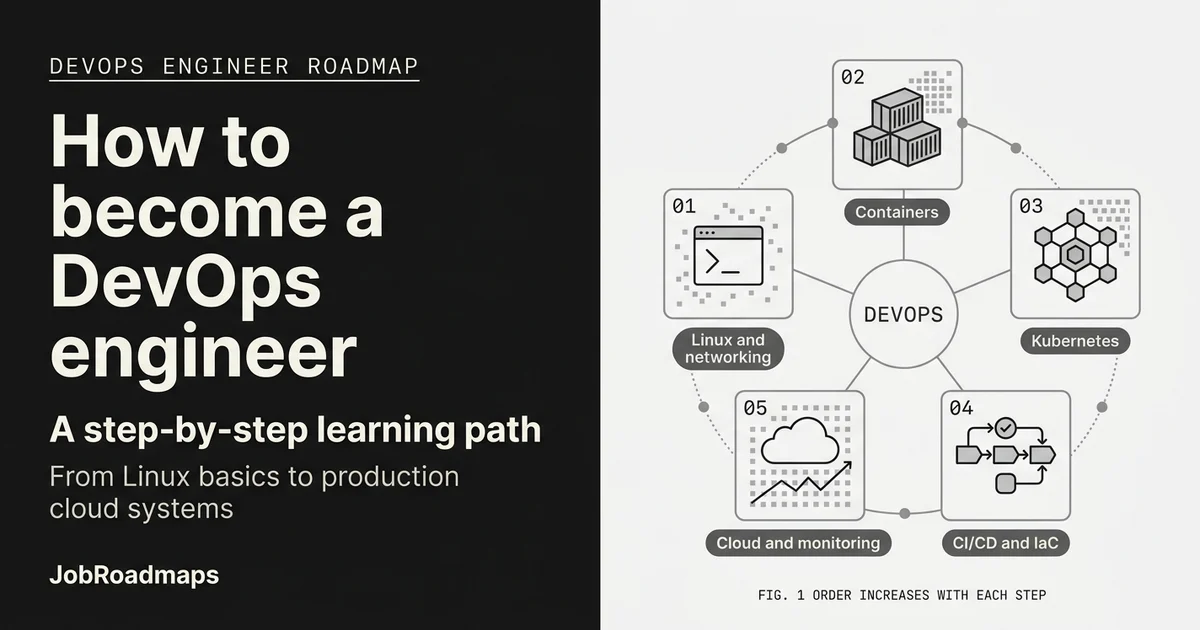
DevOps Engineer learning path
Work down the line, one step at a time. Tick each skill as you can do it.
- 1
Linux & Networking Fundamentals
5–7 weeksGet comfortable in the terminal. Learn file system navigation, permissions, process management, shell scripting (Bash), and networking basics: TCP/IP, DNS, HTTP, and firewalls.
Skills to learn
- Linux CLI (navigate, perms, processes)
- Bash Scripting (functions, loops, cron)
- SSH & SCP
- TCP/IP & DNS
- HTTP/HTTPS & TLS/SSL
- grep, awk, sed, curl
- Systemd & Service Management
- Firewall (iptables / ufw)
- Subnet & CIDR basics
Start with
- 2
Containers with Docker
4–6 weeksUnderstand containerization and why it matters. Learn to build Docker images, run containers, manage volumes and networks, and use Docker Compose for multi-service apps.
Skills to learn
- Docker Engine & CLI
- Dockerfile (multi-stage builds)
- Docker Compose
- Container Registries (ECR, GHCR)
- Container Networking
- Docker Volumes
- Health Checks
- Image Scanning (Trivy, Snyk)
- Docker BuildKit optimisation
Start with
- 3
Kubernetes & Container Orchestration
6–8 weeksLearn Kubernetes concepts: pods, deployments, services, config maps, and ingress. Practice on Minikube locally then deploy to a managed cluster. Understand Helm for package management.
Skills to learn
- Pods, Deployments & StatefulSets
- Services & Ingress (Nginx, Traefik)
- ConfigMaps & Secrets
- Helm Charts
- RBAC (role-based access control)
- Persistent Volumes (PV, PVC)
- Horizontal Pod Autoscaler (HPA)
- Namespaces & Resource Quotas
- kubectl CLI mastery
- Kustomize
Start with
- 4
CI/CD & Infrastructure as Code
6–8 weeksBuild CI/CD pipelines with GitHub Actions or GitLab CI. Learn Terraform for infrastructure as code — provision cloud resources declaratively. Understand GitOps principles.
Skills to learn
- GitHub Actions
- GitLab CI
- Terraform HCL (resources, modules)
- Terraform remote state (S3 + DynamoDB)
- Ansible (configuration management)
- ArgoCD (GitOps)
- HashiCorp Vault (secrets)
- Pre-commit hooks
- Infrastructure testing (Terratest)
Start with
- 5
Cloud Platforms & Monitoring
8–10 weeksGet AWS, GCP, or Azure certified (AWS Solutions Architect Associate is most popular). Learn monitoring with Prometheus and Grafana, log aggregation with the ELK stack, and incident management.
Skills to learn
- AWS (EC2, S3, EKS, Lambda, IAM)
- GCP / Azure (multi-cloud awareness)
- Prometheus & Grafana
- ELK Stack (Elasticsearch, Kibana)
- OpenTelemetry (distributed tracing)
- Datadog / New Relic
- SLIs, SLOs & Error Budgets
- On-call & Incident Management
- FinOps & Cost Optimization
- PagerDuty / OpsGenie
Start with
jobroadmaps.com/roadmaps/devops-engineer · Pay, demand and employer data for this role are further down the page.
Job Market Insights for DevOps Engineer
Data-backed
What do employers actually ask for?
Read from live job postings — how often each credential is named, from rare to almost always.
"Bachelor's degree" is the most common credential named, yet it appears only rarely in what we could read. Postings that state it are the minority, but these counts are a floor, so do not read this as "no one asks".
Some postings say outright that equivalent experience or a self-taught route is accepted. That wording is worth reading closely when you see it.
Our read: a portfolio that proves the skill, and a referral from someone inside the company, usually carry more weight than a credential match on paper. That is judgement, not something these counts measure.
Requirement
How often named
Bachelor's degree
Computer Science background
Equivalent experience accepted
Master's degree
Our read: how often a credential is named is not how strictly it is enforced. Equivalent experience, a standout portfolio, or a referral often counts for more than the credential listed.
Data-backed
Which skills appear most in job postings?
Read from live job postings, ranked from most to least often named.
automation leads the list and is named frequent. If you are only going to learn one thing before applying, the postings say start here.
Past the fundamentals, 9 specialisation skills (automation included) start separating candidates who can do the job from candidates who have done it. The 11 niche skills are named rarely enough that knowing them is upside, not prerequisite.
Skill
How often named
automation
security
on-call rotation
CI/CD
networking
monitoring
alerting
metrics
Infrastructure as Code
reliability engineering
multi-cloud
Sorted by how often named · JobRoadmaps
Data-backed
Which tools and artifacts appear most in job postings?
Read from live job postings, ranked from most to least often named.
No tool dominates. The most-named, GitLab, is still rare; postings for this role rarely list tools by name.
Tool / Artifact
How often named
GitLab
Salesforce
GitHub
CloudFormation
Jenkins
PagerDuty
Sorted by how often named · JobRoadmaps
Industry overlay
Targeting a specific industry?
The core roadmap gets you through the door anywhere. The difference between "qualified" and "they hired someone else" often lives in industry-specific context — the norms, the compliance floors, the tools assumed fluent in that sector.
CI/CD pipeline design
SaaS ships continuously — engineers own the build, test, and deploy pipelines that gate every feature release.
Platform engineering (Internal Developer Platforms)
Mature SaaS companies build self-service infra — golden paths, backstage portals, and automated environment provisioning.
Observability stack ownership
Metrics, logs, and traces across microservices require opinionated toolchain choices and retention policies.
GitOps workflows
ArgoCD and Flux-based GitOps are standard at SaaS companies for declarative, auditable deployment state.
SLO / error budget management
Reliability engineering at SaaS companies involves defining SLOs, burn rate alerts, and error budget policies.
Companies hiring:
GitHubGitLabDatadogPagerDutyLaunchDarklyMulti-region availability design
Infrastructure platforms must survive regional failures — active-active multi-region with automatic failover is the baseline.
Infrastructure as Code (Terraform / Pulumi)
Every resource is code-managed. Drift detection, state locking, and module design are daily engineering concerns.
eBPF & kernel-level observability
Advanced infra companies instrument the kernel itself — eBPF-based tools like Cilium and Falco are increasingly expected.
Container orchestration internals
Understanding Kubernetes scheduler, etcd, and control plane components separates operators from engineers at cloud firms.
Cost attribution & FinOps
Cloud companies are also cloud customers — tagging strategies, reserved instance management, and showback dashboards are valued.
Companies hiring:
AWSGoogle CloudCloudflareHashiCorpPulumiIndustry premiums based on aggregated job posting data · Updated quarterly
Interactive
How ready are you right now?
Check the skills you already have to see your current job-market fit.
The most-named skill for this role is automation, so a gap there costs you the most. Skills at the top of the scale appear across most postings, so a single gap there narrows your options more than a gap in a rarer skill. Check what you already have to see your biggest current gap.
Readiness Check
Check the skills you already have
0/8
base skills
Your biggest gap: automation, the most often named of the skills you have not ticked.
Start there, then work down the list.
Books worth reading as a DevOps Engineer
Where to start, in order. The full list of 12, grouped by career stage, is on its own page.
Getting started

The Phoenix Project
by Gene Kim, Kevin Behr, George Spafford · 2013
~430 pages~11 hrs to read
A novel about an IT team rescuing a failing project, built around the flow of work from development to operations. Read it first to see why pipelines, queues and handoffs matter before you touch any tooling.
View book →
The Linux Command Line
by William Shotts · 2012
~500 pages~13 hrs to read
A walk through the shell from navigation to scripting. Most DevOps work happens over SSH on Linux boxes, so work through it in your first months.
View book →
Doing the job

The DevOps Handbook
by Gene Kim, Jez Humble, Patrick Debois, John Willis · 2016
~480 pages~12 hrs to read
Lays out the practices behind fast, safe delivery: flow, feedback and continual learning, with case studies. A reference for designing CI/CD pipelines and improving how your team ships.
View book →
Kubernetes: Up and Running
by Brendan Burns, Joe Beda, Kelsey Hightower, Lachlan Evenson · 2017
~330 pages~8 hrs to read
Covers pods, services, deployments, config and storage, written by people close to the project. Read it once you are comfortable with containers and need to run them in production.
View book →
Senior and leading

Accelerate: The Science of Lean Software and DevOps
by Nicole Forsgren, Jez Humble, Gene Kim · 2018
~290 pages~7 hrs to read
Presents the research behind the delivery-performance measures and the capabilities that drive them. Useful when you need evidence to argue for investment in pipelines and practices.
View book →
Team Topologies
by Matthew Skelton, Manuel Pais · 2019
~240 pages~6 hrs to read
Describes team types and interaction modes for organizing around fast flow, including platform and enabling teams. Read it when you shape how DevOps or platform work is split across teams.
View book →
All 12 books for a DevOps Engineer →Browse all books →
Some book links are affiliate links: we earn a small commission if you buy, at no cost to you. It does not affect what we list.
Courses and certifications for a DevOps Engineer
15 courses, tutorials and certifications, each read on the provider's own page. One from each stage to start; the full list, with a guide to choosing, is on its own page.
Getting started · Course
Introduction to Linux (LFS101)
The Linux Foundation
Doing the job · Hands-on tutorial
Understanding GitHub Actions
GitHub Docs
Senior and leading · Certification
AWS Certified DevOps Engineer – Professional
Amazon Web Services
Prerequisites & Education
What credentials do employers look for?
These are the most common paths into this role — no single one is required.
Education Level
View list — coming soon- Bachelor's in Computer Science, Information Systems, or related field
- Bachelor's in Networking, Systems Administration, or IT
- Self-taught sysadmin background — common entry path
- No degree with hands-on lab/homelab experience and certs
DevOps is one of the most credential-receptive engineering disciplines. Certifications (especially cloud and Kubernetes) carry real weight alongside experience.
Certifications
View list — coming soon- AWS Solutions Architect – Associate — near-mandatory for AWS-heavy shops; $150 exam, validates EC2/S3/VPC/IAM design
- KCNA (Kubernetes and Cloud Native Associate) — $250, entry-level CNCF cert; best first K8s credential before CKA; no prerequisites
- CKA (Certified Kubernetes Administrator) — $395, 2-hour hands-on exam; top signal for platform/SRE roles; requires real cluster troubleshooting skill, not just theory
- CKAD (Certified Kubernetes Application Developer) — $395, targets developers deploying workloads on K8s; covers Pods, ConfigMaps, multi-container patterns, and resource limits; good alternative to CKA for app-focused DevOps roles
- CKS (Certified Kubernetes Security Specialist) — $395, requires active CKA first; covers cluster hardening, network policies, supply chain security, and runtime threat detection; the credentialing ceiling for K8s security
- KCSA (Kubernetes and Cloud Native Security Associate) — $250, entry-level security complement to KCNA; no prerequisites; good stepping stone before CKS
- HashiCorp Terraform Associate — $70.50, validates IaC fundamentals; near-required for platform engineering roles
- Microsoft Azure DevOps Engineer Expert (AZ-400) — near-required at Azure-first enterprises; covers pipelines, repos, testing, and deployment strategies
- Google Cloud Professional DevOps Engineer — $200, validates GCP-native CI/CD, SRE practices, and reliability engineering
- GitHub Actions — Microsoft/GitHub cert for CI/CD automation; directly relevant to most DevOps pipelines
- CompTIA Linux+ — good foundational cert for systems work; validates Linux CLI, scripting, and server management
CKA + AWS SA-Associate is the most common cert pairing in DevOps/SRE job postings. The CNCF K8s ladder runs: KCNA → CKA → CKS (admin path) or KCNA → CKAD (developer path). All CNCF exams are performance-based — no multiple choice, just a live cluster.
Bootcamps & Training
View list — coming soon- KodeKloud — hands-on labs for Kubernetes, Docker, Terraform, and CI/CD
- A Cloud Guru / Pluralsight — structured cloud certification preparation
- Linux Foundation training courses — authoritative for Kubernetes
- Udemy DevOps Bootcamp (Nana Janashia) — highly rated practical course
Lab-based learning (KodeKloud, Linux Foundation) is more valuable than video-only courses — DevOps is a hands-on discipline.
Portfolio & Other
View list — coming soon- Public GitHub with Terraform modules, Helm charts, or CI/CD pipeline configs
- Homelab or personal infrastructure documented in a blog or README
- Contributions to cloud-native open source projects (CNCF ecosystem)
- Any public dashboard, runbook, or post-mortem writeup
- Certifications dashboard (Credly) — visible proof of completed exams
Infrastructure-as-code samples on GitHub are a strong differentiator — most DevOps candidates lack a code-based portfolio.
Your Roadmap
5 stepsLinux & Networking Fundamentals
5–7 weeksGet comfortable in the terminal. Learn file system navigation, permissions, process management, shell scripting (Bash), and networking basics: TCP/IP, DNS, HTTP, and firewalls.
Skills to learn
Containers with Docker
4–6 weeksUnderstand containerization and why it matters. Learn to build Docker images, run containers, manage volumes and networks, and use Docker Compose for multi-service apps.
Skills to learn
Kubernetes & Container Orchestration
6–8 weeksLearn Kubernetes concepts: pods, deployments, services, config maps, and ingress. Practice on Minikube locally then deploy to a managed cluster. Understand Helm for package management.
Skills to learn
CI/CD & Infrastructure as Code
6–8 weeksBuild CI/CD pipelines with GitHub Actions or GitLab CI. Learn Terraform for infrastructure as code — provision cloud resources declaratively. Understand GitOps principles.
Skills to learn
Cloud Platforms & Monitoring
8–10 weeksGet AWS, GCP, or Azure certified (AWS Solutions Architect Associate is most popular). Learn monitoring with Prometheus and Grafana, log aggregation with the ELK stack, and incident management.
Skills to learn
Start here this week
This week: spin up a Linux VM on any free cloud tier (AWS, GCP, or Oracle Free Tier all work), deploy a simple web app on it manually, and then write the bash script that reproduces the whole setup from a clean image. That script is the beginning of infrastructure-as-code thinking.
For structured entry, the AWS Certified Cloud Practitioner is the floor credential that gets resumes through initial screening at most companies. It's not deep, but it signals fluency. Pair it with Linux Essentials (LPI) for the underlying skills. The hands-on labs on KodeKloud are better than any tutorial video for building operational muscle memory.
Pay
U.S. Department of Labor data for the nearest BLS occupation, Software developers. BLS has no occupation for this exact title, so treat these as a benchmark.
Median: U.S. Bureau of Labor Statistics, Occupational Employment and Wage Statistics (median wage, May 2024) and Employment Projections (2024–34). Levels: U.S. Department of Labor Office of Foreign Labor Certification prevailing wage levels (wage year 2025, typical metro), a base-wage benchmark for the metro in the middle of 511 areas, not an offer. See every metro.
Job Titles at Each Level
Entry
Junior DevOps / Site Reliability Engineer
Mid
DevOps Engineer / SRE
Senior
Senior DevOps / Platform Engineer
Steps Overview
- 1
Linux & Networking Fundamentals
5–7 weeks
- 2
Containers with Docker
4–6 weeks
- 3
Kubernetes & Container Orchestration
6–8 weeks
- 4
CI/CD & Infrastructure as Code
6–8 weeks
- 5
Cloud Platforms & Monitoring
8–10 weeks
Explore more roadmaps
Not sure this is the right path? Browse all tech career roadmaps.
View Similar RoadmapsBuilt a project while following this roadmap?
Turn it into a hiring-ready case study in 10 seconds — free.
Ready to explore more?
Browse all career roadmaps across tech, business, and creative fields.