AI Engineer Career Roadmap
AI engineering is software engineering that happens to involve large language models — which means all the hard parts of engineering are still there (reliability, latency, cost, observability) plus a new set of hard parts that didn't exist three years ago (prompt injection, hallucination, non-determinism, context window management). The romanticized version looks like magic. The production version looks like every other distributed system: logs, retries, timeouts, and the occasional catastrophic edge case.
Is this the right path for you?
AI engineers come from software engineering backgrounds that expanded into LLM integrations, from ML engineering roles that moved up the stack toward application-layer work, and from Python developers who started building AI-powered tools and kept going. The role is genuinely new — it solidified as a job title around 2023 — which means there's no single established pipeline and the expectations vary significantly between companies.
If you think about AI systems in terms of latency budgets, context window management, and failure modes rather than just model capabilities — if you find the engineering challenge of making an LLM reliably useful more interesting than the model itself — you're already thinking like an AI engineer. The role rewards people who can turn a demo into a production system.
This is a genuine opportunity for people who move early. Companies are still figuring out what AI engineer means, which means there's more room for people who can demonstrate working production systems than in more established roles. The bar is rising as the field matures — the window for early-mover advantage is narrowing. Build and ship things now.
Career Progression
Where does this role lead?
Click any role to explore timeline, key skills and, where the Department of Labor publishes it, pay.
Entry
Junior AI Engineer
~1–2 yrs
$74,464 (Level I)
You're building LLM-powered features using existing APIs and frameworks. Learning when retrieval-augmented generation beats fine-tuning — and why — is the key early lesson.
Key skills
Pay shown is the U.S. Department of Labor prevailing wage for Level I (entry), Level III (mid) and Level IV (senior) in the nearest BLS occupation, base wage for the typical metro, wage year 2025, shown for the main track only. It is a benchmark, not an offer; branches and lead, staff and executive stages have no official figure.
Visual roadmap
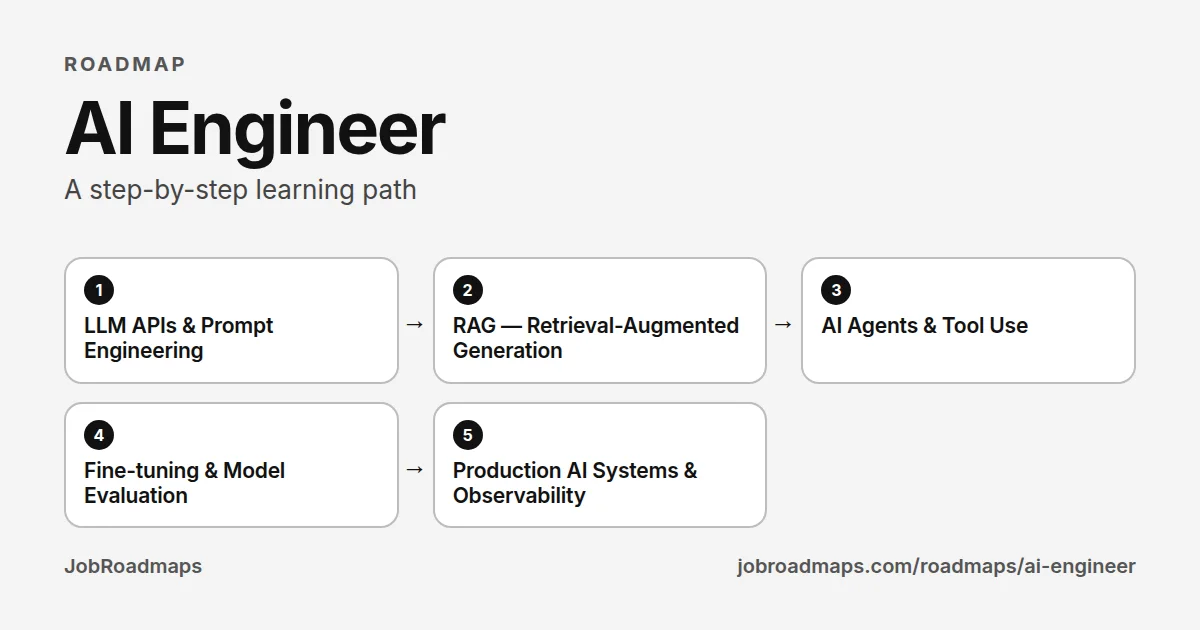
AI Engineer learning path
Work down the line, one step at a time. Tick each skill as you can do it.
- 1
LLM APIs & Prompt Engineering
3–4 weeksLearn to call LLM APIs (Anthropic Claude, OpenAI GPT-4o, Google Gemini). Master prompt engineering: system prompts, few-shot examples, chain-of-thought, structured outputs (JSON mode), and temperature/top-p controls. Understand token economics and prompt caching.
Skills to learn
- Claude API (Anthropic)
- OpenAI GPT-4o API
- Google Gemini API
- System Prompts
- Few-Shot Examples
- Chain-of-Thought (CoT)
- JSON Mode / Structured Output
- Temperature & Top-p Sampling
- Token Counting & Cost Estimation
- Prompt Caching
- Context Window Management
- Model Selection Trade-offs
Start with
- 2
RAG — Retrieval-Augmented Generation
5–7 weeksBuild RAG systems that ground LLMs in your data. Learn text chunking strategies, embedding models, vector databases (Pinecone, Weaviate, pgvector, Qdrant), and retrieval pipelines. Implement hybrid search and reranking. Evaluate retrieval quality with recall@k and faithfulness metrics.
Skills to learn
- text-embedding-3-small / ada-002
- sentence-transformers
- Pinecone
- Weaviate
- pgvector (PostgreSQL)
- Qdrant
- Chroma
- Recursive Character Splitter
- Semantic Chunking
- Hybrid Search (BM25 + vectors)
- Cohere Rerank
- Recall@k Evaluation
- LlamaIndex
- LangChain
Start with
- 3
AI Agents & Tool Use
6–8 weeksBuild autonomous AI agents that use tools, browse the web, write and execute code, and call external APIs. Learn agentic frameworks (LangGraph, AutoGen, CrewAI, Claude tool use). Design reliable multi-step workflows with proper memory and state management.
Skills to learn
- Function Calling / Tool Use
- LangGraph
- LangChain
- AutoGen (Microsoft)
- CrewAI
- ReAct Prompting
- Short-term Agent Memory
- Long-term Memory (vector store)
- Web Search Tool Integration
- Code Execution (sandboxed)
- Multi-Agent Orchestration
- Anthropic Computer Use
Start with
- 4
Fine-tuning & Model Evaluation
6–8 weeksLearn when to fine-tune vs. RAG vs. prompt engineering. Practice fine-tuning open-source models (Llama 3, Mistral) with LoRA/QLoRA using Axolotl or Unsloth. Build evaluation pipelines with LLM-as-judge, RAGAS, BERTScore, and custom faithfulness metrics.
Skills to learn
- Llama 3.1 / 3.2
- Mistral 7B / Mixtral
- LoRA (Low-Rank Adaptation)
- QLoRA (Quantized LoRA)
- Axolotl
- Unsloth
- HuggingFace Transformers
- RAGAS (RAG Evaluation)
- LLM-as-Judge
- BERTScore
- Faithfulness & Relevance Metrics
- Model Quantization (GGUF, GPTQ)
Start with
- 5
Production AI Systems & Observability
4–6 weeksDeploy AI features at scale: streaming responses, latency optimisation, cost management, and fallback strategies. Implement LLM observability (LangSmith, Langfuse, Helicone). Build guardrails for prompt injection, hallucination, and output safety. Add semantic caching to cut costs.
Skills to learn
- LangSmith
- Langfuse
- Helicone
- Server-Sent Events (SSE) Streaming
- Token Budget Management
- Fallback Chains
- Prompt Injection Defense
- Guardrails AI / NeMo Guardrails
- Semantic Caching (Redis)
- Rate Limiting & Throttling
- FastAPI + Docker Deployment
- CI/CD with LLM Evals (GitHub Actions)
Start with
jobroadmaps.com/roadmaps/ai-engineer · Pay, demand and employer data for this role are further down the page.
Job Market Insights for AI Engineer
Data-backed
What do employers actually ask for?
Read from live job postings — how often each credential is named, from rare to almost always.
"Computer Science background" is the most common credential named, yet it appears only rarely in what we could read. Postings that state it are the minority, but these counts are a floor, so do not read this as "no one asks".
Some postings say outright that equivalent experience or a self-taught route is accepted. That wording is worth reading closely when you see it.
Our read: a portfolio that proves the skill, and a referral from someone inside the company, usually carry more weight than a credential match on paper. That is judgement, not something these counts measure.
Requirement
How often named
Computer Science background
Equivalent experience accepted
Bachelor's degree
Master's degree
Certification mentioned
Our read: how often a credential is named is not how strictly it is enforced. Equivalent experience, a standout portfolio, or a referral often counts for more than the credential listed.
Data-backed
Which skills appear most in job postings?
Read from live job postings, ranked from most to least often named.
Postings for this role rarely list skills by name. The most-named, Python, is still only occasional, so none of these is a universal requirement.
Skill
How often named
Fine-tuning
Generative AI
Security and Governance
Technical Leadership
Context Engineering
Production Deployment
Data Pipeline
Code Review
Model Serving
Sorted by how often named · JobRoadmaps
Data-backed
Which tools and artifacts appear most in job postings?
Read from live job postings, ranked from most to least often named.
Claude is the most-named tool, but no tool is a universal requirement here.
Tool / Artifact
How often named
Claude
LangGraph
Salesforce
GitHub
Cursor
Notion
Sorted by how often named · JobRoadmaps
Industry overlay
Targeting a specific industry?
The core roadmap gets you through the door anywhere. The difference between "qualified" and "they hired someone else" often lives in industry-specific context — the norms, the compliance floors, the tools assumed fluent in that sector.
Model explainability for regulated decisions
Credit and fraud decisions touched by AI must be explainable to regulators and customers under fair lending laws — a black-box model can be a legal liability, not just a technical one.
Guardrails against hallucinated financial advice
An AI feature that fabricates a balance, rate, or transaction detail creates real financial and legal exposure, so output validation against source-of-truth systems is mandatory.
Adversarial robustness for fraud models
Fraud rings actively probe AI-based detection systems for blind spots, so engineers must design against active adversaries, not just natural distribution shift.
PII redaction in LLM pipelines
Prompts and logs touching financial AI features routinely contain account numbers and SSNs, requiring redaction before data reaches any third-party model API.
Model risk management (SR 11-7 alignment)
Banks apply a formal model governance framework originally written for statistical models to AI systems, requiring documented validation and ongoing monitoring.
Companies hiring:
StripeBrexCapital OneRampAffirmRAG pipeline design over customer data
SaaS AI features answer questions grounded in each customer's own workspace data, so retrieval quality and per-tenant data isolation matter more than raw model choice.
Prompt cost/latency optimisation at scale
Every AI feature call is a per-seat cost line item — engineers tune prompt length, caching, and model tiering to keep unit economics from eroding margin.
Multi-tenant AI feature isolation
One customer's fine-tuned behaviour or uploaded context must never leak into another's session, which shapes how prompts, embeddings, and memory are scoped.
Structured output reliability (JSON mode / function calling)
AI features feed directly into product UI and downstream workflows, so malformed output breaks the product, not just a chat response.
Feature flag-gated model rollouts
New models and prompt versions ship to SaaS customers gradually with the ability to roll back per account, mirroring how the rest of the product ships.
Companies hiring:
NotionSalesforceIntercomHubSpotZendeskIndustry premiums based on aggregated job posting data · Updated quarterly
Interactive
How ready are you right now?
Check the skills you already have to see your current job-market fit.
The most-named skill for this role is Python, so a gap there costs you the most. No single skill dominates, but each gap narrows which postings fit you. Check what you already have to see your biggest current gap.
Readiness Check
Check the skills you already have
0/5
base skills
Your biggest gap: Python, the most often named of the skills you have not ticked.
Start there, then work down the list.
Books worth reading as a AI Engineer
Where to start, in order. The full list of 12, grouped by career stage, is on its own page.
Getting started

Hands-On Large Language Models
by Jay Alammar, Maarten Grootendorst · 2024
~400 pages~10 hrs to read
A visual, code-first tour of tokens, embeddings, text generation, semantic search, RAG and fine-tuning. Read it first if you can program but have not yet built on language models.
View book →
Prompt Engineering for LLMs
by John Berryman, Albert Ziegler · 2024
~250 pages~6 hrs to read
Covers how models read a prompt and how to assemble context, structure instructions and build prompts into applications. Good early on, when most of your output is prompts and the glue around them.
View book →
Doing the job

AI Engineering
by Chip Huyen · 2025
~350 pages~9 hrs to read
Covers building applications on foundation models: evaluation, prompting, RAG, finetuning, inference optimisation and the architecture around them. The closest thing to a textbook for the role; read it once you have shipped a first feature.
View book →LLM Engineer's Handbook
by Paul Iusztin, Maxime Labonne · 2024
Walks an LLM application through data collection, fine-tuning, deployment, RAG and monitoring as one end-to-end system. Useful when you are moving from a demo to something that has to run and be maintained.
View book →
Senior and leading

Designing Machine Learning Systems
by Chip Huyen · 2022
~390 pages~10 hrs to read
Covers data pipelines, feature engineering, deployment, monitoring and iteration for production ML. Read it when you own a system, not just a model, and need to reason about what breaks over time.
View book →
Designing Data-Intensive Applications
by Martin Kleppmann · 2017
~620 pages~16 hrs to read
The standard reference on storage, replication, partitioning, transactions and stream processing. Read it once your AI features depend on databases and queues you have to reason about.
View book →
All 12 books for a AI Engineer →Browse all books →
Some book links are affiliate links: we earn a small commission if you buy, at no cost to you. It does not affect what we list.
Prerequisites & Education
What credentials do employers look for?
These are the most common paths into this role — no single one is required.
Education Level
View list — coming soon- Bachelor's in Computer Science, Software Engineering, or Mathematics
- Master's in Artificial Intelligence, ML, or Data Science — increasingly expected at senior roles
- Bachelor's in any technical field with demonstrable LLM integration or model deployment experience
- No formal degree — AI Engineer is a newer role where shipped projects carry exceptional weight
AI Engineer is a rapidly evolving discipline. At most product companies, demonstrated ability to ship LLM-powered features and integrate APIs outweighs formal credentials in 2024–2025 hiring.
Certifications
View list — coming soon- AWS Certified AI Practitioner — entry-level, $100, covers foundational AI/ML on AWS; good first credential for those coming from cloud backgrounds
- AWS Certified Generative AI Developer Professional — $300, for developers deploying production gen AI on AWS; covers agents, prompt engineering, and responsible AI
- Microsoft Azure AI Engineer Associate — covers Azure OpenAI, Cognitive Services, and ML pipelines; valuable if your company is Azure-first
- ARTiBA Artificial Intelligence Engineer (AIE) — $750, vendor-neutral, validates AI system design and ML fundamentals across industries
- CertNexus Certified AI Practitioner (CAIP) — $368, vendor-neutral credential covering ML algorithms, model deployment, and AI in business contexts
- DeepLearning.AI LLMOps Specialisation (Coursera) — directly relevant to production LLM systems
- Google Cloud Professional Machine Learning Engineer — covers ML deployment and pipeline management
- Google Cloud Generative AI Leader — foundational credential for professionals leading AI initiatives on Google Cloud; covers Gemini APIs, Vertex AI, and responsible AI ($99)
AWS AI Practitioner ($100) is the lowest barrier entry cert worth having. For senior roles, Azure AI Engineer or ARTiBA AIE carry more weight than general cloud certs.
Bootcamps & Training
View list — coming soon- DeepLearning.AI short courses (Andrew Ng) — RAG, agents, LangChain, function calling
- fast.ai Practical Deep Learning — strong foundation for understanding models you integrate
- Full Stack Deep Learning (FSDL) — end-to-end AI product development, deployment, and monitoring
- Weights & Biases MLOps course — free, practical, covers experiment tracking and model management
DeepLearning.AI's short courses on RAG, agents, and fine-tuning are the most directly job-relevant training available for AI Engineer roles in 2024–2025.
Portfolio & Other
View list — coming soon- Deployed LLM-powered app using OpenAI, Anthropic, or open-source models — live URL required
- RAG pipeline implementation with a vector database (Pinecone, Weaviate, or pgvector) on GitHub
- Fine-tuned model published on Hugging Face Hub with evaluation results and a model card
- AI agent or multi-step tool-use system with documented architecture and failure modes
- Technical writeup or talk explaining a real AI product decision, trade-off, or eval methodology
A deployed AI product with real users is the single most powerful credential for this role. Companies hiring AI Engineers want to see that you can ship, not just experiment in notebooks.
Your Roadmap
5 stepsLLM APIs & Prompt Engineering
3–4 weeksLearn to call LLM APIs (Anthropic Claude, OpenAI GPT-4o, Google Gemini). Master prompt engineering: system prompts, few-shot examples, chain-of-thought, structured outputs (JSON mode), and temperature/top-p controls. Understand token economics and prompt caching.
Skills to learn
RAG — Retrieval-Augmented Generation
5–7 weeksBuild RAG systems that ground LLMs in your data. Learn text chunking strategies, embedding models, vector databases (Pinecone, Weaviate, pgvector, Qdrant), and retrieval pipelines. Implement hybrid search and reranking. Evaluate retrieval quality with recall@k and faithfulness metrics.
Skills to learn
AI Agents & Tool Use
6–8 weeksBuild autonomous AI agents that use tools, browse the web, write and execute code, and call external APIs. Learn agentic frameworks (LangGraph, AutoGen, CrewAI, Claude tool use). Design reliable multi-step workflows with proper memory and state management.
Skills to learn
Fine-tuning & Model Evaluation
6–8 weeksLearn when to fine-tune vs. RAG vs. prompt engineering. Practice fine-tuning open-source models (Llama 3, Mistral) with LoRA/QLoRA using Axolotl or Unsloth. Build evaluation pipelines with LLM-as-judge, RAGAS, BERTScore, and custom faithfulness metrics.
Skills to learn
Production AI Systems & Observability
4–6 weeksDeploy AI features at scale: streaming responses, latency optimisation, cost management, and fallback strategies. Implement LLM observability (LangSmith, Langfuse, Helicone). Build guardrails for prompt injection, hallucination, and output safety. Add semantic caching to cut costs.
Skills to learn
Start here this week
This week: build a RAG (Retrieval-Augmented Generation) application on a document set you actually care about. Not a tutorial RAG on sample data — your own documents, your own use case. Evaluate the retrieval quality honestly. Note where it fails. Ship it somewhere people can use it. That project is worth ten certifications.
For structured entry, DeepLearning.AI's short courses on LLM application development cover the core toolkit (prompt engineering, RAG, agents, function calling) systematically. Pair them with reading the Anthropic and OpenAI documentation directly — the API docs tell you what the models can actually do, not what the course assumes they do. The gap is instructive.
Pay
U.S. Department of Labor data for the nearest BLS occupation, Software developers. BLS has no occupation for this exact title, so treat these as a benchmark.
Median: U.S. Bureau of Labor Statistics, Occupational Employment and Wage Statistics (median wage, May 2024) and Employment Projections (2024–34). Levels: U.S. Department of Labor Office of Foreign Labor Certification prevailing wage levels (wage year 2025, typical metro), a base-wage benchmark for the metro in the middle of 511 areas, not an offer. See every metro.
Job Titles at Each Level
Entry
AI Engineer / Prompt Engineer
Mid
AI Engineer / LLM Engineer
Senior
Senior AI Engineer / AI Architect
Steps Overview
- 1
LLM APIs & Prompt Engineering
3–4 weeks
- 2
RAG — Retrieval-Augmented Generation
5–7 weeks
- 3
AI Agents & Tool Use
6–8 weeks
- 4
Fine-tuning & Model Evaluation
6–8 weeks
- 5
Production AI Systems & Observability
4–6 weeks
Explore more roadmaps
Not sure this is the right path? Browse all tech career roadmaps.
View Similar RoadmapsBuilt a project while following this roadmap?
Turn it into a hiring-ready case study in 10 seconds — free.
Ready to explore more?
Browse all career roadmaps across tech, business, and creative fields.