AI Trainer Career Roadmap
An AI trainer helps a language model get better by working with it directly. You write example answers, compare and rank the model's responses, correct mistakes, check them against written guidelines and test the model on tasks in a subject, a language or a skill such as coding. The postings call the job AI tutor, AI trainer, data annotation specialist, annotation quality specialist or human data specialist, and each employer defines it a little differently. It is not a machine-learning engineer's job (building the model) and not a prompt engineer's (building products on top of it), though the work is close to both.
Is this the right path for you?
The routes in are varied. Graduates and professionals with real expertise in a subject, a language or coding. Writers, editors, teachers, translators, researchers and software developers who want to apply their skill to AI. People from content moderation, support and quality assurance who like careful judgement. Many seats are about what you already know, with the AI part learned on the job.
You will fit if you are patient, precise and honest about uncertainty. The job is reading the same kind of answer many times, applying a rule consistently and explaining a judgement in a sentence. If you enjoy checking work and noticing small errors, it suits you. If you want to build models or write production software all day, other roads are better.
Be honest about the market. Much of this work is contract or project-based, and some employers post many near-identical seats at once, one per language or subject, so a count of openings overstates how many different employers are hiring. Our own posting data for this role is thin and dominated by a few employers, so this page shows few market numbers, and we leave the one-per-language tutor seats out of the counts. Treat the roles as a way in to AI work, not a guaranteed long career, and build skills (evaluation, quality, operations) that carry to other roles.
Job titles this roadmap covers
- AI Tutor
- Writes, ranks and corrects model answers in a subject or language so the model learns from them. xAI posts separate tutor seats by subject and by language.
- Data Annotation Specialist
- Labels or reviews text, code or other data against a written guideline. Cohere posts annotation seats by field, such as engineering, data science and generalist.
- Annotation Quality Specialist
- Checks other people's labels, spots where annotators disagree and updates the guideline. Mistral AI posts general and code-focused versions of the role.
- AI Evaluation Specialist
- Designs tests of model output, scores answers against a rubric and reports where the model fails. The work appears next to research and engineering evaluation seats.
- Human Data Operations or Program Manager
- Runs the contributors, vendors, schedules and quality bars behind a data project. Anthropic, OpenAI and xAI post human data operations and program roles.
- AI Red Teamer
- A neighbouring path: tries to make a model fail or misbehave and writes up how it happened. OpenAI and Scale AI post red-team seats, usually with a security background.
Career Progression
Where does this role lead?
Click any role to explore timeline, key skills and, where the Department of Labor publishes it, pay.
Entry
AI Trainer / Data Annotation Specialist
~0–1 yrs
You work on a project task by task: write, rank, label or correct. Entry seats are available but often temporary, so a portfolio and a clear area of expertise help.
Key skills
Visual roadmap
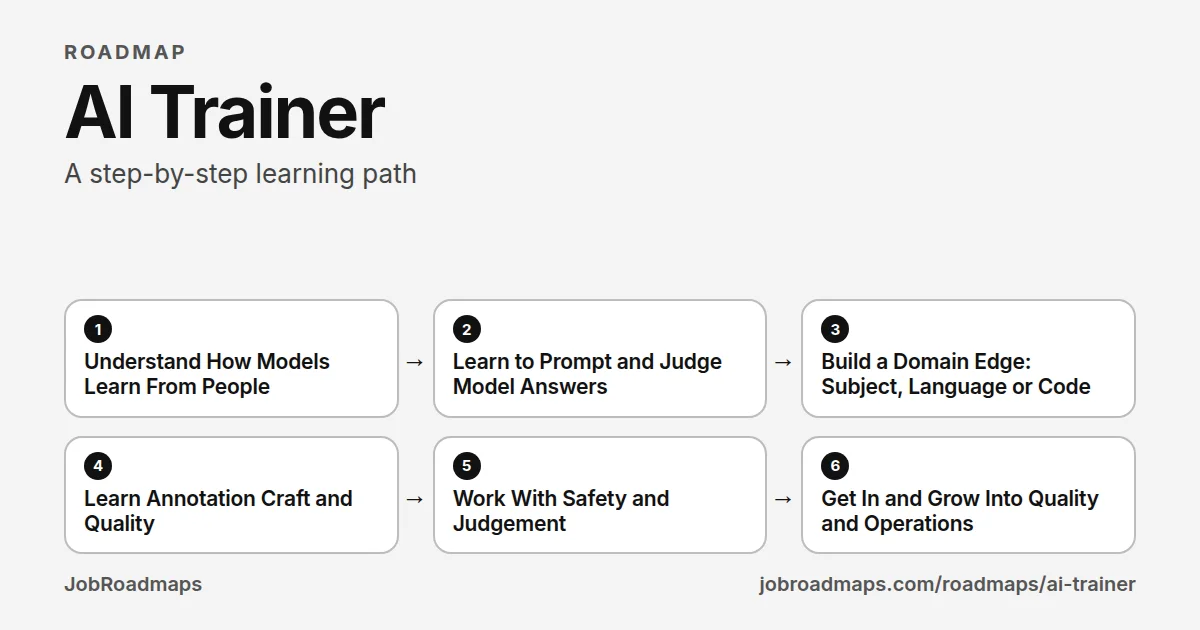
AI Trainer learning path
Work down the line, one step at a time. Tick each skill as you can do it.
- 1
Understand How Models Learn From People
1–2 weeksStart with the idea behind the job. A language model first learns from a huge amount of text, then people teach it to be useful: they write good example answers, compare two responses and say which is better, and correct mistakes. Learn this in plain terms, including why a clear instruction and a consistent judgement matter more than speed. Read three postings and note which kind of work each describes: writing, ranking, labelling or checking.
Skills to learn
- Pretraining versus teaching with human feedback
- Example answers, comparisons and corrections
- Why guidelines and consistency matter
- The jobs: tutor, annotator, quality reviewer, evaluator
- What your output is used for
Start with
- 2
Learn to Prompt and Judge Model Answers
3–4 weeksPractise the daily task: give a model a clear instruction, read what comes back and decide how good it is. Learn to write prompts that state the goal, the format and the limits, and to check answers for correctness, completeness, tone and safety. Keep a notebook of prompts, the answers and your scores, and write a short rubric for what counts as good.
Skills to learn
- Writing clear prompts and instructions
- Checking answers for accuracy and completeness
- Writing a short scoring rubric
- Comparing two answers and explaining why
- Spotting made-up facts
Start with
- 3
Build a Domain Edge: Subject, Language or Code
6–10 weeksThe postings ask for expertise as much as for AI knowledge. xAI posts tutor seats by subject and by language, Cohere posts annotation seats for engineering, data science and generalist work, and Mistral AI posts a code-focused quality role. Pick one strong area and be able to show it: a language you write well, a field you have worked in, or programming. Coding is the easiest to prove with a small portfolio.
Skills to learn
- One subject, language or skill you can defend
- Writing explanations a learner can follow
- Reading and testing code (if you choose coding)
- Citing sources and checking facts
- A small portfolio of worked examples
Start with
- 4
Learn Annotation Craft and Quality
4–6 weeksGood annotation is consistent annotation. Learn how a guideline is written and applied, how edge cases are decided, how two reviewers are compared and how a project catches drift. Try a free labelling tool on a small data set, write down every rule you had to invent and see where a second person would label the same item differently. That habit is what quality roles hire for.
Skills to learn
- Reading and applying a written guideline
- Edge cases and how to record a decision
- Agreement between reviewers
- Spot checks and feedback to contributors
- A labelling tool on a small project
Start with
- 5
Work With Safety and Judgement
3–4 weeksMany seats involve sensitive content, bias or harmful requests, and some are explicitly about safety. Learn the basics: what makes an answer unsafe or unfair, how to follow a policy when the case is unclear, how to protect your own wellbeing with difficult material and how to report a problem. The neighbouring red-team path goes further, trying to break a model on purpose; it usually needs a security background.
Skills to learn
- Safety policies and how to apply them
- Bias and fairness in answers
- Handling sensitive content responsibly
- Reporting problems and edge cases
- Red teaming as a neighbouring path
Start with
- 6
Get In and Grow Into Quality and Operations
3–6 monthsMost people start as a contributor on a project, often on contract, then move to reviewing others and owning quality. From there the path leads to evaluation work, to human data operations and program seats such as those at Anthropic, OpenAI and xAI, or toward red teaming. Contract work comes through the labs' own programmes and through specialist data vendors, and many seats are temporary, so build a portfolio you can carry: your rubric, your reviewed examples and a short write-up of a quality problem you found.
Skills to learn
- Entry routes: contributor programmes and data vendors
- A portfolio of rubrics, reviewed examples and write-ups
- From contributor to reviewer to quality lead
- Evaluation and red-team branches
- Operations and program management
Start with
jobroadmaps.com/roadmaps/ai-trainer · Pay, demand and employer data for this role are further down the page.
Job Market Insights for AI Trainer
Data-backed
What do employers actually ask for?
Read from live job postings — how often each credential is named, from rare to almost always.
"Bachelor's degree" is the most common credential named, yet it appears only occasionally in what we could read. Postings that state it are the minority, but these counts are a floor, so do not read this as "no one asks".
Our read: a portfolio that proves the skill, and a referral from someone inside the company, usually carry more weight than a credential match on paper. That is judgement, not something these counts measure.
Requirement
How often named
Bachelor's degree
Our read: how often a credential is named is not how strictly it is enforced. Equivalent experience, a standout portfolio, or a referral often counts for more than the credential listed.
Data-backed
Which skills appear most in job postings?
Read from live job postings, ranked from most to least often named.
data annotation leads the list and is named frequent. If you are only going to learn one thing before applying, the postings say start here.
Past the fundamentals, 4 specialisation skills (data annotation included) start separating candidates who can do the job from candidates who have done it. The 7 niche skills are named rarely enough that knowing them is upside, not prerequisite.
Skill
How often named
data annotation
program management
dashboards
RLHF
tool use
data analysis
quality assurance
data pipeline
Sorted by how often named · JobRoadmaps
Industry overlay
Targeting a specific industry?
The core roadmap gets you through the door anywhere. The difference between "qualified" and "they hired someone else" often lives in industry-specific context — the norms, the compliance floors, the tools assumed fluent in that sector.
rubric design
Labs grade model outputs against rubrics that decide what the model learns.
inter annotator agreement
Agreement metrics show whether guidelines are clear enough to scale.
campaign management
Data is bought and delivered as campaigns with timelines and budgets.
trajectory analysis
Agent behaviour must be checked step by step across long tasks.
Companies hiring:
AnthropicOpenAIxAIMistral AICoherecode review
Enterprise customers expect code and analysis outputs to be correct.
domain expertise
Engineering and finance tasks need trainers who understand the field.
BYOD contractor management
Remote contractors use their own devices, which affects tooling and onboarding.
Companies hiring:
CohereMistral AIIndustry premiums based on aggregated job posting data · Updated quarterly
Interactive
How ready are you right now?
Check the skills you already have to see your current job-market fit.
The most-named skill for this role is data annotation, so a gap there costs you the most. Skills at the top of the scale appear across most postings, so a single gap there narrows your options more than a gap in a rarer skill. Check what you already have to see your biggest current gap.
Readiness Check
Check the skills you already have
0/5
base skills
Your biggest gap: data annotation, the most often named of the skills you have not ticked.
Start there, then work down the list.
Books worth reading as a AI Trainer
Where to start, in order. The full list of 12, grouped by career stage, is on its own page.
Getting started

Artificial Intelligence: A Guide for Thinking Humans
by Melanie Mitchell · 2019
~340 pages~9 hrs to read
A clear, non-technical account of what AI can and cannot do. It gives you the right picture of what a model is before you start judging its answers.
View book →
Co-Intelligence: Living and Working with AI
by Ethan Mollick · 2024
A practical, readable guide to working with language models day to day. It builds the habit of testing a model on your own work and noticing where it fails.
View book →
Doing the job
Thinking, Fast and Slow
by Daniel Kahneman · 2011
~500 pages~13 hrs to read
How people make fast, flawed judgements and where careful thinking helps. It trains you to notice your own shortcuts when scoring answers.
View book →Noise: A Flaw in Human Judgment
by Daniel Kahneman, Olivier Sibony, Cass R. Sunstein · 2021
~480 pages~12 hrs to read
Why different people give different judgements on the same case, and how guidelines reduce it. The most direct book on the consistency that quality roles are paid for.
View book →
Senior and leading

The Alignment Problem: Machine Learning and Human Values
by Brian Christian · 2020
~360 pages~9 hrs to read
The history and problems of making AI systems do what people intend. It explains why human feedback exists and what is still unsolved.
View book →
Designing Machine Learning Systems: An Iterative Process for Production-Ready Applications
by Chip Huyen · 2022
~390 pages~10 hrs to read
How machine-learning systems are built and run in practice. Read it when you move toward evaluation or operations and need to speak to engineers.
View book →
All 12 books for a AI Trainer →Browse all books →
Some book links are affiliate links: we earn a small commission if you buy, at no cost to you. It does not affect what we list.
Courses and certifications for a AI Trainer
7 courses, tutorials and certifications, each read on the provider's own page. One from each stage to start; the full list, with a guide to choosing, is on its own page.
Getting started · Course
ChatGPT Prompt Engineering for Developers
DeepLearning.AI
Doing the job · Hands-on tutorial
Prompt engineering guide
OpenAI
Prerequisites & Education
What credentials do employers look for?
These are the most common paths into this role — no single one is required.
Education Level
View list — coming soon- Bachelor's or higher in the subject you will work in (languages, sciences, law, humanities, engineering): the most common signal for tutor seats
- Bachelor's in computer science or data science for coding and quality roles
- Professional experience in your field (teaching, writing, translation, research, software): a regular route
- Self-taught with a strong portfolio of worked examples: possible for some contributor seats
Check each posting. Many name expertise in a subject or a language more than a specific degree, and some ask for advanced study in the field.
Certifications
View list — coming soon- No certification is standard for AI training
- Short courses in prompting and evaluation show you have practised the task
- Field credentials (a teaching, translation, coding or professional qualification): carry weight for domain seats
- Privacy or security training: helpful for sensitive-data projects and red-team paths
The strongest signal is a rubric you wrote and a set of reviewed examples you can discuss.
Bootcamps & Training
View list — coming soon- DeepLearning.AI short course on prompt engineering: a short introduction of about 1 hour 40 minutes of lessons
- Anthropic and OpenAI prompt guides: free reference documentation
- Label Studio documentation: a free, open-source labelling tool to practise on
- The Python Tutorial: free, if you take a coding domain
A paid bootcamp is rarely needed. Practise on your own examples and keep the work.
Portfolio & Other
View list — coming soon- A rubric for scoring answers in your subject, with three worked examples
- A set of twenty reviewed model answers with your scores and reasons
- A guideline revision after you found two reviewers disagreeing
- A short write-up of an error pattern you found in a model's answers
Use public or invented material only. Never publish confidential project data.
Your Roadmap
6 stepsUnderstand How Models Learn From People
1–2 weeksStart with the idea behind the job. A language model first learns from a huge amount of text, then people teach it to be useful: they write good example answers, compare two responses and say which is better, and correct mistakes. Learn this in plain terms, including why a clear instruction and a consistent judgement matter more than speed. Read three postings and note which kind of work each describes: writing, ranking, labelling or checking.
Skills to learn
Learn to Prompt and Judge Model Answers
3–4 weeksPractise the daily task: give a model a clear instruction, read what comes back and decide how good it is. Learn to write prompts that state the goal, the format and the limits, and to check answers for correctness, completeness, tone and safety. Keep a notebook of prompts, the answers and your scores, and write a short rubric for what counts as good.
Skills to learn
Build a Domain Edge: Subject, Language or Code
6–10 weeksThe postings ask for expertise as much as for AI knowledge. xAI posts tutor seats by subject and by language, Cohere posts annotation seats for engineering, data science and generalist work, and Mistral AI posts a code-focused quality role. Pick one strong area and be able to show it: a language you write well, a field you have worked in, or programming. Coding is the easiest to prove with a small portfolio.
Skills to learn
Learn Annotation Craft and Quality
4–6 weeksGood annotation is consistent annotation. Learn how a guideline is written and applied, how edge cases are decided, how two reviewers are compared and how a project catches drift. Try a free labelling tool on a small data set, write down every rule you had to invent and see where a second person would label the same item differently. That habit is what quality roles hire for.
Skills to learn
Work With Safety and Judgement
3–4 weeksMany seats involve sensitive content, bias or harmful requests, and some are explicitly about safety. Learn the basics: what makes an answer unsafe or unfair, how to follow a policy when the case is unclear, how to protect your own wellbeing with difficult material and how to report a problem. The neighbouring red-team path goes further, trying to break a model on purpose; it usually needs a security background.
Skills to learn
Get In and Grow Into Quality and Operations
3–6 monthsMost people start as a contributor on a project, often on contract, then move to reviewing others and owning quality. From there the path leads to evaluation work, to human data operations and program seats such as those at Anthropic, OpenAI and xAI, or toward red teaming. Contract work comes through the labs' own programmes and through specialist data vendors, and many seats are temporary, so build a portfolio you can carry: your rubric, your reviewed examples and a short write-up of a quality problem you found.
Skills to learn
Start here this week
This week: pick a topic you know well and ask a model ten questions in it. Score each answer for accuracy, completeness and clarity on a three-point scale, write one sentence on why, and note where you changed your mind between the first and second read. Then write a half-page guideline someone else could use to score the same answers the same way. That exercise is close to what a first project task looks like.
For structure: spend the first month on how models learn and on prompting, the next two on a domain area and an annotation tool, then write a rubric and review twenty examples using it, and keep it as your portfolio. Apply to contributor programmes and data vendors, and for quality or operations seats at the labs once you have run a review.
Job Titles at Each Level
Entry
AI Trainer / Data Annotation Specialist
Mid
Annotation Quality Specialist / AI Evaluation Specialist
Senior
Human Data Operations Manager / Human Data Program Manager
Steps Overview
- 1
Understand How Models Learn From People
1–2 weeks
- 2
Learn to Prompt and Judge Model Answers
3–4 weeks
- 3
Build a Domain Edge: Subject, Language or Code
6–10 weeks
- 4
Learn Annotation Craft and Quality
4–6 weeks
- 5
Work With Safety and Judgement
3–4 weeks
- 6
Get In and Grow Into Quality and Operations
3–6 months
Explore more roadmaps
Not sure this is the right path? Browse all tech career roadmaps.
View Similar RoadmapsBuilt a project while following this roadmap?
Turn it into a hiring-ready case study in 10 seconds — free.
Ready to explore more?
Browse all career roadmaps across tech, business, and creative fields.