Full Stack Developer Career Roadmap
Full stack is a dangerous phrase — it implies breadth, which some people mistake for shallowness. The reality is sharper: full stack developers can architect, implement, and ship the entire vertical slice of a feature, front to back, without handing off to someone else. That autonomy compounds in small teams. Small teams ship products that change things. The role demands genuine fluency in both halves — not fluency in one and functional competence in the other.
Is this the right path for you?
Full-stack developers most often come from one of two directions: frontend developers who got tired of waiting for backend changes, and backend developers who wanted to ship things end-to-end without a handoff. Bootcamp graduates also frequently train as full-stack from the start, which has its own set of tradeoffs.
If the idea of owning a feature from database schema to the button that triggers it feels satisfying rather than overwhelming — you're built for this. Full-stack rewards generalist comfort. The anxiety about not being deep enough on either side is real, but the practical reality is that most small teams need people who can move across the stack.
One honest note: 'full-stack' job posts are frequently frontend-heavy with some backend familiarity expected. The equal-depth myth — that you need to be as strong in Postgres query optimization as you are in React state management — is rarely true at the junior level. What's actually needed is enough backend to not be helpless and enough frontend to ship UIs. That's a different bar.
Career Progression
Where does this role lead?
Click any role to explore timeline, key skills and, where the Department of Labor publishes it, pay.
Entry
Junior Full Stack
~1 yr
$74,464 (Level I)
You're touching both ends of the stack but owning neither deeply yet. Shipping small features end-to-end under guidance is the core expectation.
Key skills
Pay shown is the U.S. Department of Labor prevailing wage for Level I (entry), Level III (mid) and Level IV (senior) in the nearest BLS occupation, base wage for the typical metro, wage year 2025, shown for the main track only. It is a benchmark, not an offer; branches and lead, staff and executive stages have no official figure.
Visual roadmap
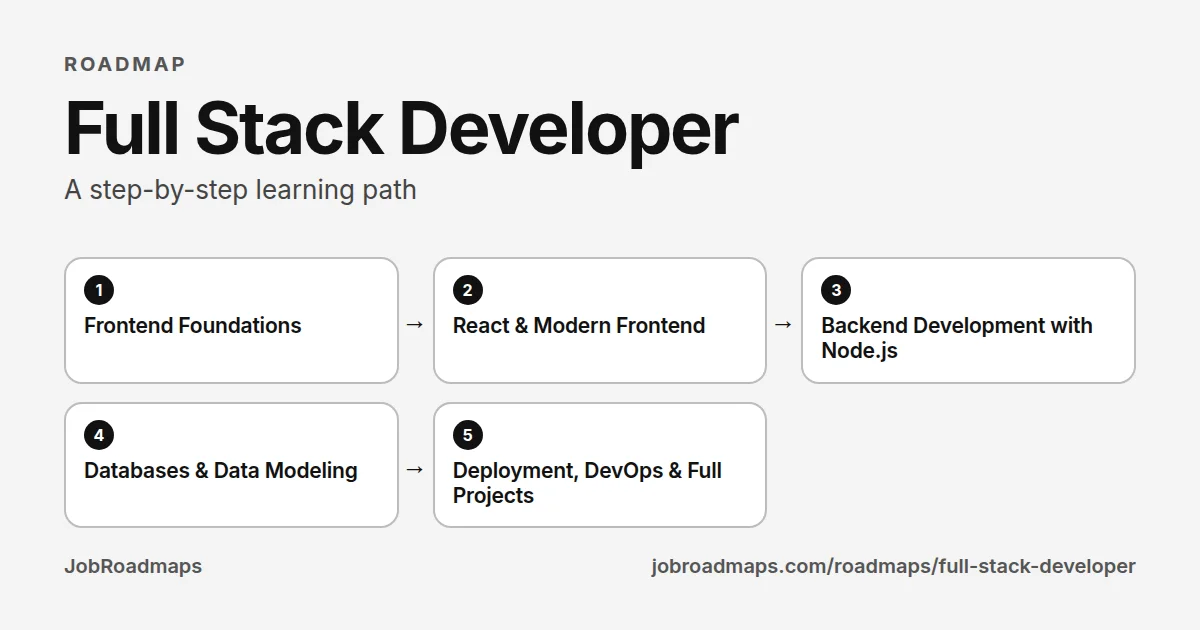
Full Stack Developer learning path
Work down the line, one step at a time. Tick each skill as you can do it.
- 1
Frontend Foundations
6–8 weeksLearn HTML, CSS, and JavaScript thoroughly. Build static sites and simple interactive apps. Master responsive design and browser developer tools.
Skills to learn
- Semantic HTML5
- CSS3 (Flexbox & Grid)
- JavaScript ES6+ Fundamentals
- Responsive Design / Mobile-First
- Browser DevTools
- Git & GitHub
- VS Code Setup
Start with
- 2
React & Modern Frontend
8–10 weeksDeep-dive into React: components, state management, hooks, and Next.js for full-stack React. Learn TypeScript to write safer, more maintainable code.
Skills to learn
- React Hooks (useState, useEffect, useContext)
- TypeScript
- Next.js 15 App Router
- Tailwind CSS
- TanStack Query (server state)
- Zustand (client state)
- Shadcn/UI or Radix UI
- React Hook Form + Zod
- Framer Motion (animations)
Start with
- 3
Backend Development with Node.js
6–8 weeksBuild REST APIs with Express or use Next.js API routes. Understand authentication (sessions, JWT, OAuth), authorization, and rate limiting.
Skills to learn
- Node.js Runtime
- Express.js or Hono
- REST API Design
- JWT + Cookie-based Auth
- NextAuth / Clerk (auth providers)
- Input Validation (Zod)
- Middleware Patterns
- Rate Limiting
- File Uploads (S3, Cloudflare R2)
Start with
- 4
Databases & Data Modeling
5–7 weeksLearn both SQL (PostgreSQL) and NoSQL (MongoDB or Supabase). Practice schema design, normalization, and using ORMs like Prisma. Understand caching strategies with Redis.
Skills to learn
- PostgreSQL
- Prisma ORM
- Supabase (BaaS)
- MongoDB
- Redis (caching, pub/sub)
- Data Modeling & Normalization
- Database Migrations
- Connection Pooling
Start with
- 5
Deployment, DevOps & Full Projects
6–8 weeksDeploy full stack apps to Vercel, Render, or Cloudflare. Set up CI/CD with GitHub Actions. Build 2–3 end-to-end projects: a SaaS app, a marketplace, or a social platform clone.
Skills to learn
- Vercel / Railway / Render
- Docker & Docker Compose
- GitHub Actions CI/CD
- Cloudflare (CDN, R2, Workers)
- Environment Config & Secrets
- Error Monitoring (Sentry)
- Analytics (PostHog, Plausible)
- Core Web Vitals & Lighthouse
- Feature Flags (LaunchDarkly, Growthbook)
Start with
jobroadmaps.com/roadmaps/full-stack-developer · Pay, demand and employer data for this role are further down the page.
Job Market Insights for Full Stack Developer
Data-backed
What do employers actually ask for?
Read from live job postings — how often each credential is named, from rare to almost always.
"Computer Science background" is the most common credential named, yet it appears only rarely in what we could read. Postings that state it are the minority, but these counts are a floor, so do not read this as "no one asks".
Some postings say outright that equivalent experience or a self-taught route is accepted. That wording is worth reading closely when you see it.
Our read: a portfolio that proves the skill, and a referral from someone inside the company, usually carry more weight than a credential match on paper. That is judgement, not something these counts measure.
Requirement
How often named
Computer Science background
Master's degree
Bachelor's degree
Equivalent experience accepted
Our read: how often a credential is named is not how strictly it is enforced. Equivalent experience, a standout portfolio, or a referral often counts for more than the credential listed.
Data-backed
Which skills appear most in job postings?
Read from live job postings, ranked from most to least often named.
TypeScript is the most-named skill. Common, but not universal: many postings do not list it.
Past the fundamentals, 6 specialisation skills (TypeScript included) start separating candidates who can do the job from candidates who have done it. The 14 niche skills are named rarely enough that knowing them is upside, not prerequisite.
Skill
How often named
deployment
security
observability
testing
AI-assisted development
code review
state management
API design
scalability
cloud infrastructure
Salesforce
Sorted by how often named · JobRoadmaps
Data-backed
Which tools and artifacts appear most in job postings?
Read from live job postings, ranked from most to least often named.
Kubernetes is the most-named tool, but no tool is a universal requirement here.
Tool / Artifact
How often named
Claude
Cursor
GitHub
MuleSoft
Sorted by how often named · JobRoadmaps
Industry overlay
Targeting a specific industry?
The core roadmap gets you through the door anywhere. The difference between "qualified" and "they hired someone else" often lives in industry-specific context — the norms, the compliance floors, the tools assumed fluent in that sector.
End-to-end transaction flows
Owning both UI and backend for payment flows requires understanding atomicity, rollback, and idempotency.
Financial data modelling
Ledgers, accounts, and journal entries follow double-entry accounting rules — schema decisions have legal implications.
Compliance-aware development
KYC flows, AML checks, and PCI-DSS requirements touch both frontend form design and backend data handling.
Reconciliation systems
Financial data must balance across systems — building reconciliation jobs and discrepancy reporting is common.
Audit logging
Every state change in a financial system must be traceable — immutable event logs are a compliance requirement.
Companies hiring:
BrexMercuryRampPilotDeelAPI design (REST / GraphQL)
Full-stack engineers own both the UI and the API contract — schema design decisions cascade to all consumers.
Auth & multi-tenancy
Enterprise SaaS requires SAML/SSO, role-based permissions, and strict data isolation between customer orgs.
Database schema evolution
Owning migrations across a live product means understanding backwards compatibility and zero-downtime deploys.
Background job patterns
Email sends, report generation, webhook delivery — async jobs decouple slow work from request paths.
Feature flag infrastructure
SaaS ships continuously — flags enable gradual rollouts and per-customer feature access without redeployments.
Companies hiring:
SalesforceHubSpotZendeskIntercomNotionIndustry premiums based on aggregated job posting data · Updated quarterly
Interactive
How ready are you right now?
Check the skills you already have to see your current job-market fit.
The most-named skill for this role is TypeScript, so a gap there costs you the most. No single skill dominates, but each gap narrows which postings fit you. Check what you already have to see your biggest current gap.
Readiness Check
Check the skills you already have
0/6
base skills
Your biggest gap: TypeScript, the most often named of the skills you have not ticked.
Start there, then work down the list.
Books worth reading as a Full Stack Developer
Where to start, in order. The full list of 12, grouped by career stage, is on its own page.
Getting started

Eloquent JavaScript
by Marijn Haverbeke · 2011
~470 pages~12 hrs to read
A thorough tour of the language itself, then the browser, the DOM and Node, with exercises throughout. Read it in your first months so closures, async code and the event model stop feeling magical.
View book →
Learning SQL
by Alan Beaulieu · 2005
~380 pages~10 hrs to read
Walks through queries, joins, grouping, subqueries and data modification with exercises. Read it early, because nearly every backend job puts you in front of a relational database.
View book →
Doing the job

Learning React
by Alex Banks, Eve Porcello · 2017
~310 pages~8 hrs to read
Components, props, state and hooks, built up through small examples. Read it when you move from plain JavaScript to your first framework and need a clear mental model of how React renders.
View book →Node.js Design Patterns
by Mario Casciaro, Luciano Mammino · 2014
~660 pages~17 hrs to read
Covers asynchronous control flow, streams, modules, scaling and common design patterns in Node.js. Read it when you build your own backends and want to go beyond tutorials.
View book →
Senior and leading

Fundamentals of Software Architecture
by Mark Richards, Neal Ford · 2020
~430 pages~11 hrs to read
Surveys architecture styles, characteristics and decision-making, from layered and event-driven to microservices. Read it when you are asked to choose or defend a system's structure.
View book →
A Philosophy of Software Design
by John Ousterhout · 2018
~190 pages~5 hrs to read
A compact argument for deep modules, simple interfaces and fighting complexity as it creeps in. Read it when you design systems across frontend and backend and want a vocabulary for why a design feels wrong.
View book →
All 12 books for a Full Stack Developer →Browse all books →
Some book links are affiliate links: we earn a small commission if you buy, at no cost to you. It does not affect what we list.
Prerequisites & Education
What credentials do employers look for?
These are the most common paths into this role — no single one is required.
Education Level
View list — coming soon- Bachelor's in Computer Science or Software Engineering
- Bachelor's in any technical discipline with self-taught full-stack skills
- Bootcamp graduate with strong end-to-end project portfolio
- Self-taught — viable with demonstrable full-stack depth
Full-stack roles are often more portfolio-gated than other engineering roles. Companies care that you can ship the whole thing, not where you studied.
Certifications
View list — coming soon- AWS Certified Developer – Associate — relevant once you own deployment
- Microsoft Azure Developer Associate (AZ-204) — covers Azure Functions, App Service, Cosmos DB, and Azure AD; valuable for full-stack roles at Azure-first companies
- Microsoft Azure Fundamentals (AZ-900) — entry-level; good baseline if your stack touches Azure services ($165)
- Meta Full-Stack Engineer Certificate (Coursera)
- GitHub Foundations — validates Git workflows, pull requests, and GitHub Actions basics; useful for any developer role
- Google Cloud Professional Cloud Developer
Certifications matter less here than for DevOps or cloud-specific roles — a deployed full-stack app is a stronger signal. Azure certs are worth adding if your target companies run on Azure.
Bootcamps & Training
View list — coming soon- The Odin Project (Full Stack JavaScript or Ruby) — most comprehensive free path
- Full Stack Open (University of Helsinki) — covers React, Node.js, GraphQL, TypeScript
- App Academy — intensive with job placement support
- Codecademy Full-Stack Engineer career path
A bootcamp that ships a multi-page app with a real database and deployed backend is the gold standard for full-stack job readiness.
Portfolio & Other
View list — coming soon- Deployed SaaS app or multi-user product — the strongest possible signal
- GitHub profile showing both frontend and backend contributions
- Projects using modern stack: Next.js, TypeScript, PostgreSQL or MongoDB
- README documenting architecture decisions and trade-offs
- Any open-source contribution touching both layers of the stack
The full-stack portfolio bar is higher: it needs to demonstrate end-to-end ownership. One great shipped product beats five tutorial clones.
Your Roadmap
5 stepsFrontend Foundations
6–8 weeksLearn HTML, CSS, and JavaScript thoroughly. Build static sites and simple interactive apps. Master responsive design and browser developer tools.
Skills to learn
React & Modern Frontend
8–10 weeksDeep-dive into React: components, state management, hooks, and Next.js for full-stack React. Learn TypeScript to write safer, more maintainable code.
Skills to learn
Backend Development with Node.js
6–8 weeksBuild REST APIs with Express or use Next.js API routes. Understand authentication (sessions, JWT, OAuth), authorization, and rate limiting.
Skills to learn
Databases & Data Modeling
5–7 weeksLearn both SQL (PostgreSQL) and NoSQL (MongoDB or Supabase). Practice schema design, normalization, and using ORMs like Prisma. Understand caching strategies with Redis.
Skills to learn
Deployment, DevOps & Full Projects
6–8 weeksDeploy full stack apps to Vercel, Render, or Cloudflare. Set up CI/CD with GitHub Actions. Build 2–3 end-to-end projects: a SaaS app, a marketplace, or a social platform clone.
Skills to learn
Start here this week
This week: deploy a project that has all three layers — a frontend that makes API calls, a backend that handles them, and a database that persists the results. It doesn't need to be impressive. It needs to work end-to-end. That's the proof of concept your resume needs.
For structured entry, Full Stack Open from the University of Helsinki is the best free curriculum that covers this honestly. It's thorough, it's modern (React, Node, TypeScript, GraphQL), and it's rigorous enough that finishing it signals something real. Most bootcamps cover similar ground for significantly more money.
Pay
U.S. Department of Labor data for the nearest BLS occupation, Software developers. BLS has no occupation for this exact title, so treat these as a benchmark.
Median: U.S. Bureau of Labor Statistics, Occupational Employment and Wage Statistics (median wage, May 2024) and Employment Projections (2024–34). Levels: U.S. Department of Labor Office of Foreign Labor Certification prevailing wage levels (wage year 2025, typical metro), a base-wage benchmark for the metro in the middle of 511 areas, not an offer. See every metro.
Job Titles at Each Level
Entry
Junior Full Stack Developer
Mid
Full Stack Engineer
Senior
Senior Full Stack / Tech Lead
Steps Overview
- 1
Frontend Foundations
6–8 weeks
- 2
React & Modern Frontend
8–10 weeks
- 3
Backend Development with Node.js
6–8 weeks
- 4
Databases & Data Modeling
5–7 weeks
- 5
Deployment, DevOps & Full Projects
6–8 weeks
Explore more roadmaps
Not sure this is the right path? Browse all tech career roadmaps.
View Similar RoadmapsBuilt a project while following this roadmap?
Turn it into a hiring-ready case study in 10 seconds — free.
Ready to explore more?
Browse all career roadmaps across tech, business, and creative fields.