Product Manager Career Roadmap
Product management is the job where you own everything and control nothing — no direct reports, no line of authority over design or engineering, just the uncomfortable responsibility of deciding what gets built next and why. Good PMs are equal parts strategist, therapist, and obsessive customer advocate; they're usually the person in the room who's read the most support tickets, spent the most time watching users fail at tasks they designed, and is hardest to bullshit about what's actually working.
Is this the right path for you?
PMs tend to come from three places: engineering, design, and business. Engineers already speak the language of systems and tradeoffs. Designers bring user empathy and visual thinking. Business and strategy backgrounds bring market framing and stakeholder fluency. None of these is a hard requirement — but one of them usually maps to where you'll feel most at home in the role.
If you can argue both sides of a product decision, sit comfortably with ambiguity, and find yourself genuinely curious about why users make the choices they make — you're already thinking like a PM. The skill you're building is translating that instinct into decisions a team of engineers and designers can actually act on.
One honest note: breaking into PM at a name company is competitive. A whole industry of prep courses, interview bootcamps, and APM coaching exists because the process selects hard. The candidates who get offers aren't always the most experienced — they're the most prepared. Build in 3–6 months of dedicated prep before you start applying.
Career Progression
Where does this role lead?
Click any role to explore timeline, key skills and, where the Department of Labor publishes it, pay.
Entry
Associate PM
~1–2 yrs
You're learning to translate user needs into specifications engineers can build. Clarity and follow-through matter more than clever ideas at this stage.
Key skills
Visual roadmap
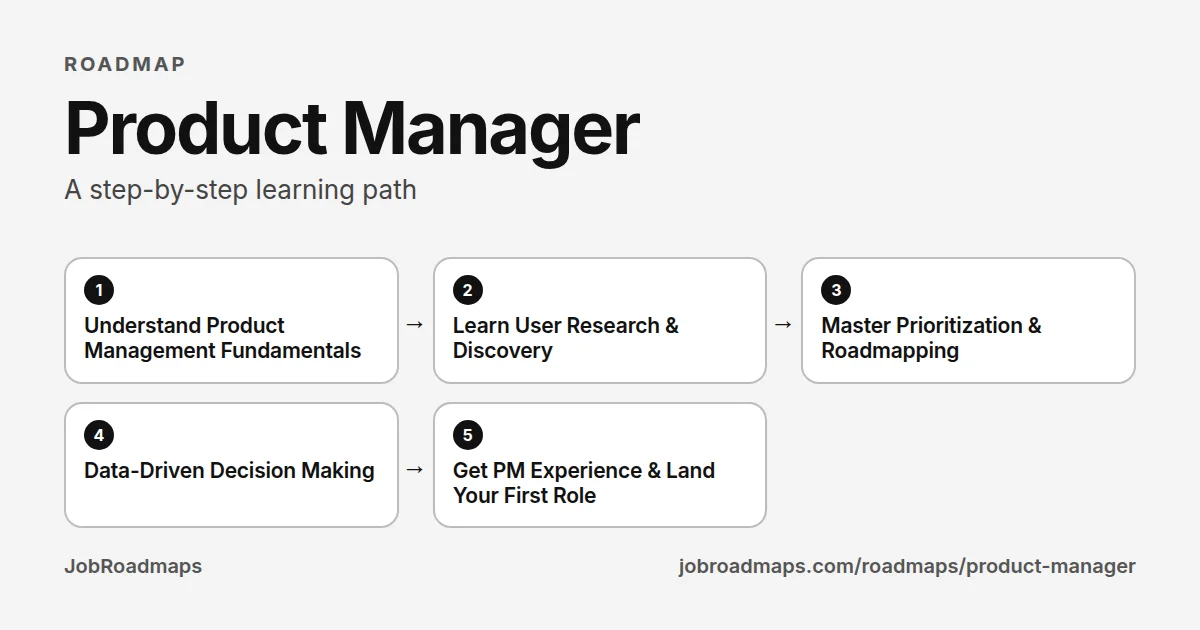
Product Manager learning path
Work down the line, one step at a time. Tick each skill as you can do it.
- 1
Understand Product Management Fundamentals
4–6 weeksLearn what PMs do daily, the product lifecycle, and different PM archetypes (growth, platform, consumer). Read the canonical books: Inspired, The Lean Startup, and Continuous Discovery Habits.
Skills to learn
- Product Thinking
- Agile/Scrum
- Product Lifecycle
- Stakeholder Management
- OKRs
Start with
- 2
Learn User Research & Discovery
4–6 weeksUnderstand how to identify user problems through interviews, surveys, and usability tests. Practice writing user stories and defining acceptance criteria. Learn jobs-to-be-done framework.
Skills to learn
- User Interviews
- Surveys
- JTBD Framework
- User Stories
- Empathy Mapping
- Problem Discovery
Start with
- 3
Master Prioritization & Roadmapping
3–4 weeksLearn frameworks like RICE, ICE, MoSCoW, and Kano model for feature prioritization. Build product roadmaps that communicate strategy without over-promising. Practice with real scenarios.
Skills to learn
- RICE Scoring
- Roadmapping
- MoSCoW
- Kano Model
- Strategy Communication
- Jira/Linear
Start with
- 4
Data-Driven Decision Making
4–5 weeksLearn to use analytics tools: Mixpanel, Amplitude, or Google Analytics. Understand funnels, cohort analysis, and retention metrics. Practice running A/B tests and interpreting results.
Skills to learn
- Product Analytics
- A/B Testing
- Funnel Analysis
- Retention Metrics
- SQL basics
- Amplitude/Mixpanel
Start with
- 5
Get PM Experience & Land Your First Role
8–12 weeksGet hands-on experience through APM programs, building your own product, or transitioning internally. Build a PM portfolio with product teardowns and case studies. Prepare for PM interviews with STAR method.
Skills to learn
- PM Interviews
- Case Studies
- Product Teardowns
- Networking
- APM Programs
- Technical Fluency
Start with
jobroadmaps.com/roadmaps/product-manager · Pay, demand and employer data for this role are further down the page.
Job Market Insights for Product Manager
Data-backed
What do employers actually ask for?
Read from live job postings — how often each credential is named, from rare to almost always.
"Computer Science background" is the most common credential named, yet it appears only rarely in what we could read. Postings that state it are the minority, but these counts are a floor, so do not read this as "no one asks".
Some postings say outright that equivalent experience or a self-taught route is accepted. That wording is worth reading closely when you see it.
Our read: a portfolio that proves the skill, and a referral from someone inside the company, usually carry more weight than a credential match on paper. That is judgement, not something these counts measure.
Requirement
How often named
Computer Science background
Master's degree
Bachelor's degree
Equivalent experience accepted
Certification mentioned
Our read: how often a credential is named is not how strictly it is enforced. Equivalent experience, a standout portfolio, or a referral often counts for more than the credential listed.
Data-backed
Which skills appear most in job postings?
Read from live job postings, ranked from most to least often named.
Postings for this role rarely list skills by name. The most-named, product strategy, is still only occasional, so none of these is a universal requirement.
Skill
How often named
product strategy
product roadmap
developer experience
technical fluency
monetization
security and compliance
customer discovery
data analysis
product-market fit
competitive analysis
OKRs
product thinking
go-to-market strategy
business acumen
Sorted by how often named · JobRoadmaps
Data-backed
Which tools and artifacts appear most in job postings?
Read from live job postings, ranked from most to least often named.
No tool dominates. The most-named, Stripe, is still rare; postings for this role rarely list tools by name.
Tool / Artifact
How often named
Stripe
Salesforce
Google Workspace
Workday
Sorted by how often named · JobRoadmaps
Industry overlay
Targeting a specific industry?
The core roadmap gets you through the door anywhere. The difference between "qualified" and "they hired someone else" often lives in industry-specific context — the norms, the compliance floors, the tools assumed fluent in that sector.
Regulatory constraint navigation
Product changes touching money movement require legal and compliance sign-off before shipping, a gate most software categories never face.
Risk-versus-friction tradeoff framing
Every friction-reducing feature, like instant transfers, must be explicitly weighed against the fraud exposure it opens up.
Bank partnership dependency management
Many fintechs operate through partner banks, so roadmap timelines depend on external institutional approval cycles outside the PM's control.
Trust and disclosure UX design
PMs must design confirmations and disclosures that satisfy both users and regulators simultaneously, a dual audience unique to financial products.
Unit economics fluency
Fintech PMs must model how a feature affects interchange or take rate on every transaction, not just engagement, since margin is razor-thin.
Companies hiring:
StripeChimeRobinhoodPlaidBrexmachine learning product sense
These PMs must understand model capabilities and limitations, fine-tuning trade-offs, and how to design interfaces for AI workflows.
open source and community
Many tools start in open source; PMs must balance community contribution with commercial monetization and manage community adoption.
developer experience optimization
Friction in onboarding or API design kills adoption; PMs obsess over lowering barriers and improving the first-run experience.
Companies hiring:
OpenAIAnthropicCohereTogether AIHiddenLayerAnyscaleScale AIIndustry premiums based on aggregated job posting data · Updated quarterly
Interactive
How ready are you right now?
Check the skills you already have to see your current job-market fit.
The most-named skill for this role is product strategy, so a gap there costs you the most. No single skill dominates, but each gap narrows which postings fit you. Check what you already have to see your biggest current gap.
Readiness Check
Check the skills you already have
0/5
base skills
Your biggest gap: product strategy, the most often named of the skills you have not ticked.
Start there, then work down the list.
Books worth reading as a Product Manager
Where to start, in order. The full list of 12, grouped by career stage, is on its own page.
Getting started

Inspired: How to Create Tech Products Customers Love
by Marty Cagan · 2008
~370 pages~9 hrs to read
Describes how strong product teams discover what to build: opportunity assessment, prototyping, and testing ideas with customers before engineering commits. Read it first to see what the job is meant to be.
View book →
The Mom Test: How to Talk to Customers and Learn If Your Business Is a Good Idea When Everyone Is Lying to You
by Rob Fitzpatrick · 2013
~140 pages~4 hrs to read
A short guide to customer conversations that produce facts instead of polite praise. Read it before your first round of user interviews.
View book →
Doing the job

Continuous Discovery Habits: Discover Products That Create Customer Value and Business Value
by Teresa Torres · 2021
~240 pages~6 hrs to read
Builds a weekly routine of customer interviews, opportunity mapping and small assumption tests. Read it once you own a product area and want discovery to be a habit, not a project.
View book →
Escaping the Build Trap: How Effective Product Management Creates Real Value
by Melissa Perri · 2019
~180 pages~5 hrs to read
Makes the case for managing outcomes rather than shipping features, with guidance on strategy, roadmaps and product-led organizations. Helpful when your team measures output instead of impact.
View book →
Senior and leading

Empowered: Ordinary People, Extraordinary Products
by Marty Cagan, Chris Jones · 2020
~370 pages~9 hrs to read
Describes how to lead product teams and build the leadership layer around them: vision, strategy, coaching and team topology. Read it when you start managing other PMs.
View book →
Transformed: Moving to the Product Operating Model
by Marty Cagan · 2024
~320 pages~8 hrs to read
Explains what changes in funding, roles and decision-making when a company moves from project delivery to product teams. For senior PMs and product leaders driving that shift.
View book →
All 12 books for a Product Manager →Browse all books →
Some book links are affiliate links: we earn a small commission if you buy, at no cost to you. It does not affect what we list.
Prerequisites & Education
What credentials do employers look for?
These are the most common paths into this role — no single one is required.
Education Level
View list — coming soon- Bachelor's in Business, Computer Science, or Engineering — common at tech companies
- Bachelor's in any discipline — PM is one of the least degree-gated tech-adjacent roles
- MBA — accelerates path to senior PM or Group PM at larger companies
- No degree with strong domain expertise and demonstrable product outcomes
PM is more outcomes-gated than credential-gated. Demonstrated ability to ship products and move metrics matters more than any specific degree.
Certifications
View list — coming soon- Product School Certification (CPM) — widely recognised in PM hiring
- Pragmatic Institute certification — valued at B2B/enterprise companies
- PMI-ACP (Agile Certified Practitioner) — useful for process-heavy organisations
- Reforge membership — signals growth and product strategy seriousness
PM certifications are less gatekeeping than engineering ones. Reforge membership and Product School CPM are the most cited in job descriptions.
Bootcamps & Training
View list — coming soon- Exponent PM Interview Prep — structured prep for FAANG-style PM interviews
- Product School PM Bootcamp — intensive, well-networked alumni community
- PM Accelerator — mentored bootcamp with job placement support
- Lenny's Newsletter + community — respected resource for working PMs
An APM (Associate Product Manager) program at a major tech company is the most valued credential for breaking into product management.
Portfolio & Other
View list — coming soon- Product teardowns or case studies — show analytical and design thinking
- Any shipped product — even a side project or internal tool
- Data-backed writeup of a product decision you influenced
- PRD or spec samples — demonstrate structured thinking
- LinkedIn with quantified product outcomes ("increased X by Y%")
A PM portfolio is built around decisions and outcomes, not code. Document the "why" behind product choices and the metrics that followed.
Your Roadmap
5 stepsUnderstand Product Management Fundamentals
4–6 weeksLearn what PMs do daily, the product lifecycle, and different PM archetypes (growth, platform, consumer). Read the canonical books: Inspired, The Lean Startup, and Continuous Discovery Habits.
Skills to learn
Learn User Research & Discovery
4–6 weeksUnderstand how to identify user problems through interviews, surveys, and usability tests. Practice writing user stories and defining acceptance criteria. Learn jobs-to-be-done framework.
Skills to learn
Master Prioritization & Roadmapping
3–4 weeksLearn frameworks like RICE, ICE, MoSCoW, and Kano model for feature prioritization. Build product roadmaps that communicate strategy without over-promising. Practice with real scenarios.
Skills to learn
Data-Driven Decision Making
4–5 weeksLearn to use analytics tools: Mixpanel, Amplitude, or Google Analytics. Understand funnels, cohort analysis, and retention metrics. Practice running A/B tests and interpreting results.
Skills to learn
Get PM Experience & Land Your First Role
8–12 weeksGet hands-on experience through APM programs, building your own product, or transitioning internally. Build a PM portfolio with product teardowns and case studies. Prepare for PM interviews with STAR method.
Skills to learn
Start here this week
This week: find a free preview of Inspired by Marty Cagan and read the first three chapters. Then pick one app you use daily and write two paragraphs — what problem it solves, who it's actually for, and one thing you'd change and why. That's the first artifact of your PM portfolio.
If you're targeting a structured entry path, look up Associate PM programs at companies you admire. Google APM, Microsoft PM Rotation, Meta RPM, Stripe, Figma, and dozens of others run annual cohorts. Most open applications 9–12 months before start dates. The prep window is shorter than it looks — start early.
Job Titles at Each Level
Entry
Associate Product Manager (APM)
Mid
Product Manager
Senior
Senior PM / Group PM / Director of Product
Steps Overview
- 1
Understand Product Management Fundamentals
4–6 weeks
- 2
Learn User Research & Discovery
4–6 weeks
- 3
Master Prioritization & Roadmapping
3–4 weeks
- 4
Data-Driven Decision Making
4–5 weeks
- 5
Get PM Experience & Land Your First Role
8–12 weeks
Explore more roadmaps
Not sure this is the right path? Browse all business career roadmaps.
View Similar RoadmapsBuilt a project while following this roadmap?
Turn it into a hiring-ready case study in 10 seconds — free.
Ready to explore more?
Browse all career roadmaps across tech, business, and creative fields.