Platform Engineer Career Roadmap
Platform engineers build the internal products that other engineers use to ship software: deployment paths, service templates, developer portals and shared infrastructure that let teams work without filing a ticket for every change. The product is the platform, and its users are your own developers. Success means teams move faster on their own, not that you personally run every deploy.
Is this the right path for you?
You come from DevOps, SRE, backend or systems work, and you are tired of running every deploy by hand. Platform engineering turns that frustration into a product: you build the path so the next team does not need you for the same task.
The mindset signal is treating developers as customers. If you enjoy writing docs, watching where people get stuck, and then changing the tool instead of the person, this role suits you. If you only want to fix what breaks, SRE or DevOps is the better fit.
The title is still settling, and many "platform" postings are DevOps jobs with a new name. Read the description for the product itself: an internal user base, a self-service interface, and adoption metrics. Those postings are where the work really is.
Career Progression
Where does this role lead?
Click any role to explore timeline, key skills and, where the Department of Labor publishes it, pay.
Entry
Junior Platform Engineer
~0–2 yrs
$74,464 (Level I)
You maintain pipelines and templates that a senior engineer designed, and you answer the first questions developers ask about them.
Key skills
Pay shown is the U.S. Department of Labor prevailing wage for Level I (entry), Level III (mid) and Level IV (senior) in the nearest BLS occupation, base wage for the typical metro, wage year 2025, shown for the main track only. It is a benchmark, not an offer; branches and lead, staff and executive stages have no official figure.
Visual roadmap
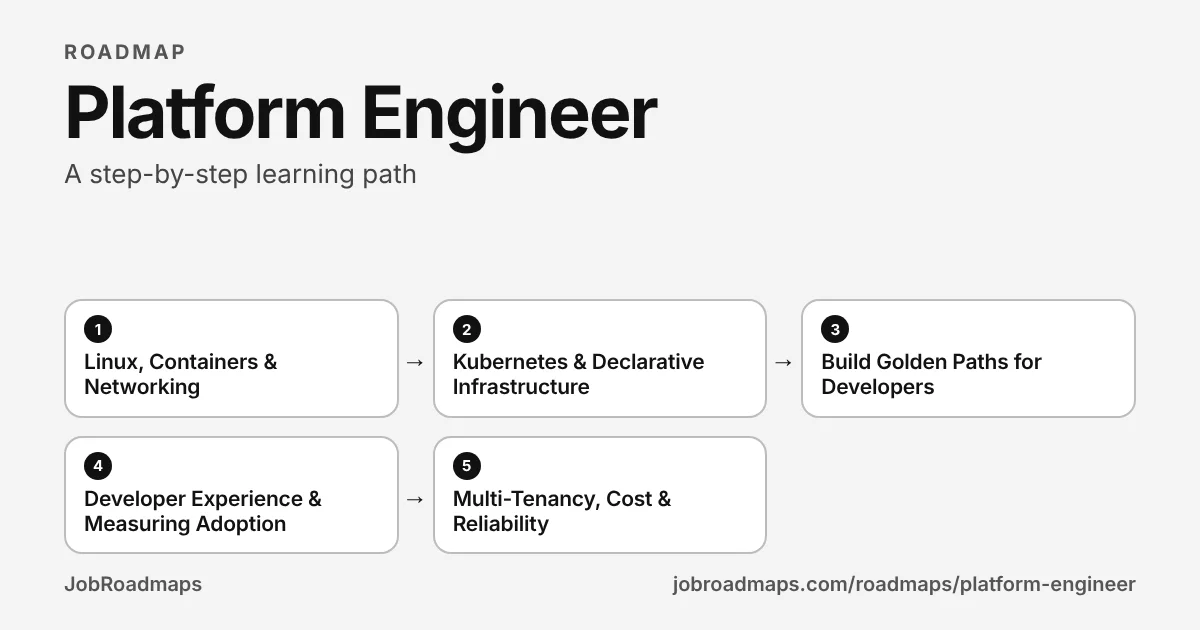
Platform Engineer learning path
Work down the line, one step at a time. Tick each skill as you can do it.
- 1
Linux, Containers & Networking
8–10 weeksA platform is built on the same stack it serves: Linux processes and networking, containers and images, and a clear picture of how a request reaches a service. You will debug other people's deployments through these layers, so know each one before you abstract it away.
Skills to learn
- Linux administration
- Docker & container images
- Networking basics (DNS, TLS, load balancing)
- Git
- Shell scripting
Start with
- 2
Kubernetes & Declarative Infrastructure
8–10 weeksPlatforms are mostly declarations: a cluster, a set of namespaces, and infrastructure described in code and reconciled by a controller. Learn Kubernetes objects well enough to write them by hand, then manage them with Terraform or OpenTofu and a GitOps controller so that every change is reviewed and reversible.
Skills to learn
- Kubernetes objects & manifests
- Helm
- Terraform or OpenTofu
- GitOps with Argo CD or Flux
- Secrets management
Start with
- 3
Build Golden Paths for Developers
6–8 weeksA golden path is the supported way to do a common task: create a service, add a database, ship to production. It bundles a template, a pipeline and the policy checks, so a developer who follows it gets the right defaults without reading a wiki. Build one end to end before you build a second.
Skills to learn
- Service templates & scaffolding
- CI/CD pipelines
- Policy as code (Open Policy Agent)
- Environment promotion
- Secure defaults
Start with
- 4
Developer Experience & Measuring Adoption
4–6 weeksPlatform work fails quietly when nobody uses it. Treat your developers as customers: watch where they get stuck, write the documentation they actually read, and measure adoption and delivery speed. The DORA research gives you a shared set of delivery metrics to measure against.
Skills to learn
- Developer portals
- Self-service APIs
- Documentation as product
- DORA delivery metrics
- Customer interviews with internal teams
Start with
- 5
Multi-Tenancy, Cost & Reliability
6–8 weeksA shared platform has to isolate teams from each other, keep costs visible, and survive its own upgrades. Learn namespace quotas and tenancy models, allocate cluster cost to the teams that spend it, and plan upgrades so that a platform change does not become the outage it was meant to prevent.
Skills to learn
- Namespaces, quotas & tenancy
- Cost allocation (OpenCost)
- Observability for platform users
- Upgrade and rollback strategy
- Incident response for shared services
Start with
jobroadmaps.com/roadmaps/platform-engineer · Pay, demand and employer data for this role are further down the page.
Books worth reading as a Platform Engineer
Where to start, in order. The full list of 8, grouped by career stage, is on its own page.
Getting started
Infrastructure as Code
by Kief Morris · 2021
~350 pages~9 hrs to read
Patterns for managing cloud infrastructure with code: environments, configuration drift, testing and secrets. It describes the declarative layer most platforms are built on.
View book →
Doing the job
Terraform: Up & Running
by Yevgeniy Brikman · 2017
~290 pages~7 hrs to read
A practical guide to Terraform state, modules and team workflows. Read the module chapters when you start writing building blocks that other teams will reuse.
View book →Continuous Delivery: Reliable Software Releases through Build, Test, and Deployment Automation
by Jez Humble, David Farley · 2010
~510 pages~13 hrs to read
The deployment pipeline as a concept: how any change gets from commit to production safely and repeatedly. Platform teams turn these ideas into the paved path developers actually use.
View book →
Senior and leading

Team Topologies
by Matthew Skelton, Manuel Pais · 2019
~240 pages~6 hrs to read
How to organize teams around the services and platforms they own, and why a platform team exists to reduce the cognitive load of the teams that use it. Read it before you design the interface your developers will use.
View book →
Accelerate: The Science of Lean Software and DevOps
by Nicole Forsgren, Jez Humble, Gene Kim · 2018
~290 pages~7 hrs to read
The research behind the DORA delivery metrics and the practices that predict speed and stability. Use it to choose what your platform measures and to argue for changes with evidence.
View book →
All 8 books for a Platform Engineer →Browse all books →
Some book links are affiliate links: we earn a small commission if you buy, at no cost to you. It does not affect what we list.
Courses and certifications for a Platform Engineer
6 courses, tutorials and certifications, each read on the provider's own page. One from each stage to start; the full list, with a guide to choosing, is on its own page.
Getting started · Hands-on tutorial
Learn Kubernetes Basics
Kubernetes
Doing the job · Hands-on tutorial
Terraform tutorials
HashiCorp
Prerequisites & Education
What credentials do employers look for?
These are the most common paths into this role — no single one is required.
Education Level
View list — coming soon- Bachelor's in Computer Science, Software Engineering or Information Systems
- Bachelor's in any discipline with systems administration or DevOps experience
Platform teams hire from infrastructure and software backgrounds. A degree helps, but a working internal tool is the stronger proof.
Certifications
View list — coming soon- Kubernetes and Cloud Native Associate (KCNA) — entry-level Kubernetes credential
- Certified Kubernetes Administrator (CKA) — hands-on cluster administration
- HashiCorp Terraform Associate — infrastructure as code
Kubernetes credentials are the most requested. Pair one with a project you built and can explain.
Bootcamps & Training
View list — coming soon- Kubernetes – official documentation tutorials (free)
- Backstage documentation — open-source developer portal (free)
- Open Policy Agent documentation (free)
The official documentation is the training material for this role. Build against it rather than watching someone else do it.
Portfolio & Other
View list — coming soon- A template repository that deploys a service to a cluster with one command
- A pipeline with policy checks that blocks an insecure change
- A short write-up of the adoption numbers for a tool you built
Show the path a developer would follow, and the number of people who used it.
Your Roadmap
5 stepsLinux, Containers & Networking
8–10 weeksA platform is built on the same stack it serves: Linux processes and networking, containers and images, and a clear picture of how a request reaches a service. You will debug other people's deployments through these layers, so know each one before you abstract it away.
Skills to learn
Kubernetes & Declarative Infrastructure
8–10 weeksPlatforms are mostly declarations: a cluster, a set of namespaces, and infrastructure described in code and reconciled by a controller. Learn Kubernetes objects well enough to write them by hand, then manage them with Terraform or OpenTofu and a GitOps controller so that every change is reviewed and reversible.
Skills to learn
Build Golden Paths for Developers
6–8 weeksA golden path is the supported way to do a common task: create a service, add a database, ship to production. It bundles a template, a pipeline and the policy checks, so a developer who follows it gets the right defaults without reading a wiki. Build one end to end before you build a second.
Skills to learn
Developer Experience & Measuring Adoption
4–6 weeksPlatform work fails quietly when nobody uses it. Treat your developers as customers: watch where they get stuck, write the documentation they actually read, and measure adoption and delivery speed. The DORA research gives you a shared set of delivery metrics to measure against.
Skills to learn
Multi-Tenancy, Cost & Reliability
6–8 weeksA shared platform has to isolate teams from each other, keep costs visible, and survive its own upgrades. Learn namespace quotas and tenancy models, allocate cluster cost to the teams that spend it, and plan upgrades so that a platform change does not become the outage it was meant to prevent.
Skills to learn
Start here this week
This week, pick one repetitive task a developer does in your current job, such as creating a service, rotating a secret or setting up a database, and write down every manual step. That list is your first platform backlog, and it shows what a golden path would have to automate.
Then build the smallest version of that path: a template repository, a pipeline that deploys it to a cluster, and a README a teammate can follow without asking you. Put it in a public repository. Your entry path is the Kubernetes and infrastructure-as-code steps above, followed by one working paved path you can show in an interview.
Pay
U.S. Department of Labor data for the nearest BLS occupation, Software developers. BLS has no occupation for this exact title, so treat these as a benchmark.
Median: U.S. Bureau of Labor Statistics, Occupational Employment and Wage Statistics (median wage, May 2024) and Employment Projections (2024–34). Levels: U.S. Department of Labor Office of Foreign Labor Certification prevailing wage levels (wage year 2025, typical metro), a base-wage benchmark for the metro in the middle of 511 areas, not an offer. See every metro.
Job Titles at Each Level
Entry
Junior Platform Engineer / Associate Platform Engineer
Mid
Platform Engineer
Senior
Senior Platform Engineer / Staff Platform Engineer / Head of Platform Engineering
Steps Overview
- 1
Linux, Containers & Networking
8–10 weeks
- 2
Kubernetes & Declarative Infrastructure
8–10 weeks
- 3
Build Golden Paths for Developers
6–8 weeks
- 4
Developer Experience & Measuring Adoption
4–6 weeks
- 5
Multi-Tenancy, Cost & Reliability
6–8 weeks
Explore more roadmaps
Not sure this is the right path? Browse all tech career roadmaps.
View Similar RoadmapsBuilt a project while following this roadmap?
Turn it into a hiring-ready case study in 10 seconds — free.
Ready to explore more?
Browse all career roadmaps across tech, business, and creative fields.