GPU Performance Engineer Career Roadmap
GPU Performance Engineers make AI models run faster and cheaper on graphics processors. They write and tune the low-level kernels that do the arithmetic, profile where time and memory go, and scale training and inference across many GPUs. Their work decides how much a model costs to train and serve, so teams that build large models hire for it heavily.
Is this the right path for you?
GPU performance roles are filled mostly by people with systems, compiler or high-performance computing backgrounds. Many engineers come from game engines, scientific computing, database internals or embedded systems, and move into GPUs once they can profile and reason about memory. Strong C++ is the entry ticket.
If you look at a slow program and want to know exactly which instruction is waiting on what, you already think like a performance engineer. The work is measuring first, changing one thing at a time, and proving that a speedup is real and still produces correct numbers.
The honest caveat is that the field is small and competitive, and the best roles usually sit at AI labs, GPU vendors and large cloud providers. Most candidates are expected to show optimized code they wrote, not certificates. Expect deep technical interviews on memory access and profiling.
Career Progression
Where does this role lead?
Click any role to explore timeline, key skills and, where the Department of Labor publishes it, pay.
Entry
Junior GPU Software Engineer
~0–2 yrs
$74,464 (Level I)
You write kernels with a senior engineer, profile them, and check that the numbers they return are correct. Entry seats are about measurement and careful testing.
Key skills
Pay shown is the U.S. Department of Labor prevailing wage for Level I (entry), Level III (mid) and Level IV (senior) in the nearest BLS occupation, base wage for the typical metro, wage year 2025, shown for the main track only. It is a benchmark, not an offer; branches and lead, staff and executive stages have no official figure.
Visual roadmap
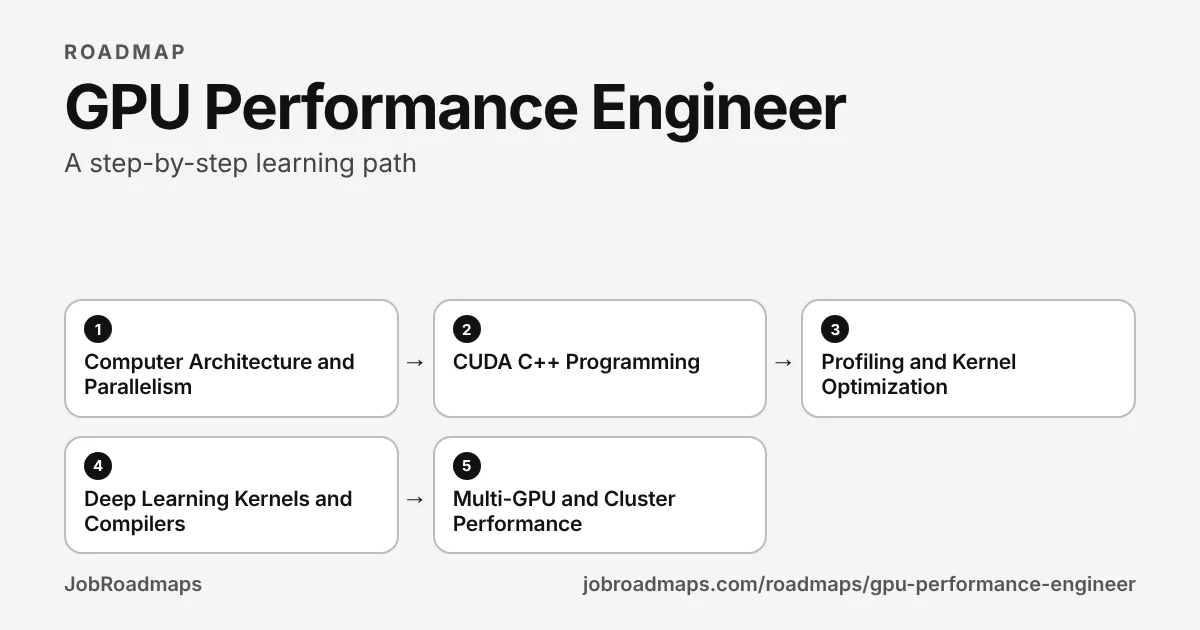
GPU Performance Engineer learning path
Work down the line, one step at a time. Tick each skill as you can do it.
- 1
Computer Architecture and Parallelism
2–3 monthsLearn how a GPU is built: streaming multiprocessors, warps, the memory hierarchy, and the difference between compute-bound and memory-bound code. Use the roofline model to predict the best a kernel could do before you write it.
Skills to learn
- GPU Architecture
- SIMT Execution
- Memory Hierarchy
- Occupancy
- Roofline Model
- Parallel Algorithms
- 2
CUDA C++ Programming
3–4 monthsWrite kernels from scratch: thread and block indexing, global and shared memory, coalesced access and synchronization. Implement a matrix multiply in several versions and measure each one against the last.
Skills to learn
- CUDA C++
- Thread and Block Indexing
- Shared Memory
- Memory Coalescing
- Synchronization
- Matrix Multiplication
- 3
Profiling and Kernel Optimization
3–4 monthsUse a profiler to find where time actually goes, then fix the bottleneck. Work with tensor cores, kernel fusion and precision choices, and keep a log of each change with its measured effect.
Skills to learn
- Nsight Compute
- Nsight Systems
- Tensor Cores
- Kernel Fusion
- Mixed Precision
- Performance Regression Tests
- 4
Deep Learning Kernels and Compilers
3–6 monthsWrite custom operators with a higher-level kernel language such as Triton, and connect them to a deep learning framework. Profile a real model in PyTorch, find the operations that dominate, and replace one with a faster implementation that is checked for correct output.
Skills to learn
- Triton
- PyTorch Profiling
- Custom Operators
- CUDA Graphs
- Numerical Correctness Tests
- Compiler Basics
- 5
Multi-GPU and Cluster Performance
6–12 monthsScale training and inference across many GPUs. Study collective communication, overlap of compute and communication, memory sharding and throughput on real clusters. The job at this stage is making the whole system faster, not only one kernel.
Skills to learn
- NCCL Collectives
- Distributed Training
- Communication Overlap
- Memory Sharding
- Throughput Analysis
- Cluster Scheduling
jobroadmaps.com/roadmaps/gpu-performance-engineer · Pay, demand and employer data for this role are further down the page.
Books worth reading as a GPU Performance Engineer
Where to start, in order. The full list of 7, grouped by career stage, is on its own page.
Getting started

Programming Massively Parallel Processors
by Wen-mei W. Hwu, David B. Kirk, Izzat El Hajj · 2022
~580 pages~15 hrs to read
The standard textbook on GPU programming: the execution model, memory hierarchy, and the parallel patterns that performance work depends on. It is the foundation for the CUDA step.
View book →CUDA by Example
by Jason Sanders, Edward Kandrot · 2010
~310 pages~8 hrs to read
A hands-on introduction to CUDA with complete programs for common parallel problems. The examples are short enough to modify and profile yourself.
View book →
Doing the job
Professional CUDA C Programming
by John Cheng, Max Grossman, Ty McKercher · 2014
CUDA optimization in depth: memory access, streams, multi-GPU work and profiling. It is the book to keep open while tuning a kernel.
View book →Hands-On GPU Programming with Python and CUDA
by Dr. Brian Tuomanen · 2018
~310 pages~8 hrs to read
GPU programming from Python, including PyCUDA and the libraries that wrap it. It is useful for teams whose research code is written in Python but whose bottlenecks sit on the GPU.
View book →
Senior and leading

Systems Performance
by Brendan Gregg · 2020
~930 pages~23 hrs to read
Measurement and analysis of whole systems, from CPU and memory to networks and storage. Leads use it to set performance methods across teams, not only inside one kernel.
View book →
All 7 books for a GPU Performance Engineer →Browse all books →
Some book links are affiliate links: we earn a small commission if you buy, at no cost to you. It does not affect what we list.
Courses and certifications for a GPU Performance Engineer
3 courses, tutorials and certifications, each read on the provider's own page. One from each stage to start; the full list, with a guide to choosing, is on its own page.
Getting started · Hands-on tutorial
CUDA Programming Guide
NVIDIA
Doing the job · Hands-on tutorial
Triton Tutorials
OpenAI Triton
Prerequisites & Education
What credentials do employers look for?
These are the most common paths into this role — no single one is required.
Education Level
View list — coming soon- Bachelor's in Computer Science, Computer Engineering or Electrical Engineering
- Master's in computer architecture or high-performance computing
- Bachelor's in any discipline with strong C++ and systems coursework
GPU performance roles are filled mostly by people with systems, compiler or HPC backgrounds. A degree helps; a measured kernel is the stronger proof.
Certifications
View list — coming soon- No vendor certificate is standard for GPU performance. Hiring teams look for measured kernels.
A certificate helps only when the employer uses that vendor's stack and you can show work on it.
Bootcamps & Training
View list — coming soon- CUDA Programming Guide — free official reference for the programming model
- Triton Tutorials — free worked examples for deep learning kernels
- Nsight Compute User Guide — free profiler documentation
All three are free and official. Use each one to write and measure a kernel.
Portfolio & Other
View list — coming soon- A public CUDA or Triton kernel with before-and-after profiler numbers
- A report explaining the bottleneck you found and the metric that showed it
- A benchmark that checks numerical correctness as well as speed
Show the measurements. A speedup without a correctness check does not count.
Your Roadmap
5 stepsComputer Architecture and Parallelism
2–3 monthsLearn how a GPU is built: streaming multiprocessors, warps, the memory hierarchy, and the difference between compute-bound and memory-bound code. Use the roofline model to predict the best a kernel could do before you write it.
Skills to learn
CUDA C++ Programming
3–4 monthsWrite kernels from scratch: thread and block indexing, global and shared memory, coalesced access and synchronization. Implement a matrix multiply in several versions and measure each one against the last.
Skills to learn
Profiling and Kernel Optimization
3–4 monthsUse a profiler to find where time actually goes, then fix the bottleneck. Work with tensor cores, kernel fusion and precision choices, and keep a log of each change with its measured effect.
Skills to learn
Deep Learning Kernels and Compilers
3–6 monthsWrite custom operators with a higher-level kernel language such as Triton, and connect them to a deep learning framework. Profile a real model in PyTorch, find the operations that dominate, and replace one with a faster implementation that is checked for correct output.
Skills to learn
Multi-GPU and Cluster Performance
6–12 monthsScale training and inference across many GPUs. Study collective communication, overlap of compute and communication, memory sharding and throughput on real clusters. The job at this stage is making the whole system faster, not only one kernel.
Skills to learn
Start here this week
This week: write a naive CUDA matrix multiply, then a version that uses shared memory, and measure both with a profiler. Record the time, the memory throughput and what changed. Put the code and the measurements in a public repository.
Structured entry path: learn the architecture and CUDA basics, then spend a few months profiling and improving small kernels with measured results. Move to Triton and PyTorch once you can explain a roofline plot, and finish by optimizing a real model's bottleneck end to end.
Pay
U.S. Department of Labor data for the nearest BLS occupation, Software developers. BLS has no occupation for this exact title, so treat these as a benchmark.
Median: U.S. Bureau of Labor Statistics, Occupational Employment and Wage Statistics (median wage, May 2024) and Employment Projections (2024–34). Levels: U.S. Department of Labor Office of Foreign Labor Certification prevailing wage levels (wage year 2025, typical metro), a base-wage benchmark for the metro in the middle of 511 areas, not an offer. See every metro.
Job Titles at Each Level
Entry
GPU Software Engineer / Performance Engineer / Accelerator Software Engineer
Mid
Senior GPU Performance Engineer / Kernel Engineer / Training Performance Engineer
Senior
Staff Performance Engineer / GPU Infrastructure Lead / Principal Kernel Engineer
Steps Overview
- 1
Computer Architecture and Parallelism
2–3 months
- 2
CUDA C++ Programming
3–4 months
- 3
Profiling and Kernel Optimization
3–4 months
- 4
Deep Learning Kernels and Compilers
3–6 months
- 5
Multi-GPU and Cluster Performance
6–12 months
Explore more roadmaps
Not sure this is the right path? Browse all tech career roadmaps.
View Similar RoadmapsBuilt a project while following this roadmap?
Turn it into a hiring-ready case study in 10 seconds — free.
Ready to explore more?
Browse all career roadmaps across tech, business, and creative fields.