RAG Engineer Career Roadmap
RAG engineers build retrieval-augmented generation systems. They connect a language model to an organization's documents, databases and tools, so answers come from current, citable sources instead of the model's memory. The work is less about prompts and more about the pipeline: chunking, embeddings, indexes, retrieval quality, reranking and evaluation. Good RAG work is measured, and the measurement is what separates it from a demo.
Is this the right path for you?
You are a backend or data engineer who has been asked to add AI to search, or a Python developer who built a chatbot that answers from documents and now needs it to work reliably. Most entry paths begin with a working demo you can explain line by line.
The mindset signal is treating retrieval as an information-retrieval problem. If you enjoy measuring whether the right passage was found, tuning chunk boundaries, and tracing why a good document never surfaced, this role suits you better than prompt writing alone.
The bar is rising. Many RAG tutorials are a few lines of code and a vector database, which is not enough to ship. Employers look for evaluation, access control and cost work in a portfolio, so build those into your project from the start.
Career Progression
Where does this role lead?
Click any role to explore timeline, key skills and, where the Department of Labor publishes it, pay.
Entry
Junior RAG Engineer
~0–2 yrs
$74,464 (Level I)
You build ingestion and retrieval steps that a senior engineer designed, and you record every failed query you find.
Key skills
Pay shown is the U.S. Department of Labor prevailing wage for Level I (entry), Level III (mid) and Level IV (senior) in the nearest BLS occupation, base wage for the typical metro, wage year 2025, shown for the main track only. It is a benchmark, not an offer; branches and lead, staff and executive stages have no official figure.
Visual roadmap
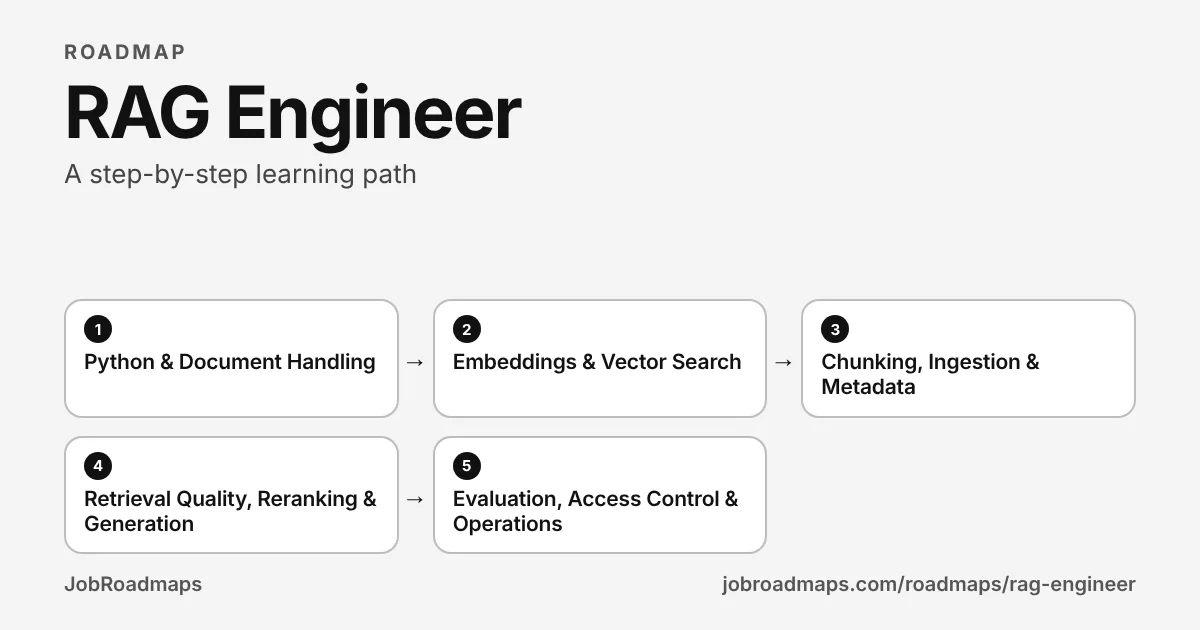
RAG Engineer learning path
Work down the line, one step at a time. Tick each skill as you can do it.
- 1
Python & Document Handling
4–6 weeksRetrieval starts with messy inputs: PDFs with broken tables, HTML with navigation text, Markdown with code blocks. Learn to parse these reliably, call APIs, handle JSON, and write small, tested Python modules. Most of the failures you will debug are parsing failures.
Skills to learn
- Python
- Parsing PDF, HTML & Markdown
- REST APIs & JSON
- Unit testing
- Git
Start with
- 2
Embeddings & Vector Search
4–6 weeksAn embedding turns text into a vector so similar passages sit close together. Learn what embedding models measure, how approximate nearest-neighbor indexes trade accuracy for speed, and how to choose between a vector extension in a database you already run and a dedicated vector store.
Skills to learn
- Embedding models
- Similarity search
- ANN indexes (HNSW)
- pgvector
- Vector stores (FAISS, Qdrant)
Start with
- 3
Chunking, Ingestion & Metadata
4–6 weeksHow you split a document decides what can be retrieved. Learn fixed and structure-aware chunking, overlap, and metadata filters, and build an ingestion job that handles updates and deletions. A document that changed last week must not still answer from its old version.
Skills to learn
- Chunking strategies
- Overlap & context windows
- Metadata filters
- Incremental ingestion
- Deletion and re-indexing
Start with
- 4
Retrieval Quality, Reranking & Generation
4–6 weeksVector search alone often misses exact terms like error codes and product names, so combine it with keyword search and rerank the candidates. Then manage the context you pass to the model: how much to include, in what order, and with citations the user can check.
Skills to learn
- Hybrid search (BM25 + vectors)
- Rerankers
- Query rewriting
- Citation prompting
- Context budgeting
Start with
- 5
Evaluation, Access Control & Operations
6–8 weeksA RAG system is only as good as its evaluation set. Build a set of real questions with known answer passages, measure retrieval recall and ranking, and rerun it on every change. Enforce document permissions at retrieval time, not in the prompt, and watch for instructions hidden inside retrieved documents.
Skills to learn
- Golden question sets
- Recall@k and MRR
- LLM-as-judge checks
- Retrieval-time access control
- Prompt injection through documents
Start with
jobroadmaps.com/roadmaps/rag-engineer · Pay, demand and employer data for this role are further down the page.
Books worth reading as a RAG Engineer
Where to start, in order. The full list of 9, grouped by career stage, is on its own page.
Getting started

Introduction to Information Retrieval
by Christopher D. Manning, Prabhakar Raghavan, Hinrich Schütze · 2008
~480 pages~12 hrs to read
The foundations of indexing, ranking and evaluation for search: inverted indexes, term weighting and precision and recall. Retrieval-augmented generation is still retrieval, and this book explains why the old measures still matter.
View book →
Natural Language Processing with Transformers
by Lewis Tunstall, Leandro von Werra, Thomas Wolf · 2022
How transformer models are trained, fine-tuned and used in practice, with working code. It gives you the model vocabulary you need before you tune an embedding or reranking model.
View book →
Doing the job
Relevant Search: With Applications for Solr and Elasticsearch
by Doug Turnbull, John Berryman · 2016
~360 pages~9 hrs to read
How search relevance is tuned in practice: query understanding, ranking signals and measuring whether results improved. The evaluation habits transfer directly to RAG retrieval.
View book →Generative AI with LangChain
by Ben Auffarth · 2023
Building applications that combine language models with documents, tools and memory. Read it for the integration patterns and the places where they break.
View book →
Senior and leading

AI Engineering: Building Applications with Foundation Models
by Chip Huyen · 2024
~350 pages~9 hrs to read
An overview of building products on foundation models, including retrieval, evaluation and cost. Read it when you are deciding which parts of a system to build and which to buy.
View book →
All 9 books for a RAG Engineer →Browse all books →
Some book links are affiliate links: we earn a small commission if you buy, at no cost to you. It does not affect what we list.
Courses and certifications for a RAG Engineer
5 courses, tutorials and certifications, each read on the provider's own page. One from each stage to start; the full list, with a guide to choosing, is on its own page.
Getting started · Hands-on tutorial
Retrieval Augmented Generation (RAG) with Deep Agents
LangChain
Doing the job · Course
Building and Evaluating Advanced RAG
DeepLearning.AI
Senior and leading · Hands-on tutorial
Retrieve & Re-Rank
Sentence Transformers project
Prerequisites & Education
What credentials do employers look for?
These are the most common paths into this role — no single one is required.
Education Level
View list — coming soon- Bachelor's in Computer Science or a related engineering discipline
- Bachelor's in any field with strong Python and data coursework
RAG work is mostly software engineering on top of retrieval. A degree helps, but a measured retrieval system is what hiring teams ask about.
Certifications
View list — coming soon- No vendor certificate is standard for RAG engineering. Hiring teams look for evaluated systems.
Use the free short courses to learn the vocabulary, then show a system you measured.
Bootcamps & Training
View list — coming soon- DeepLearning.AI short courses — free courses on retrieval and LLM applications
- LangChain RAG tutorial — free worked example
- Hugging Face LLM Course — free course on language models
Each course gives a working pipeline. Extend one of them with your own evaluation.
Portfolio & Other
View list — coming soon- A retrieval pipeline over a real document set, with a golden question set
- A before-and-after table for one retrieval change, with the metric that moved
- A write-up of a failure you found and how you fixed it
Measurement is the differentiator. A retrieval demo without numbers is a prototype.
Your Roadmap
5 stepsPython & Document Handling
4–6 weeksRetrieval starts with messy inputs: PDFs with broken tables, HTML with navigation text, Markdown with code blocks. Learn to parse these reliably, call APIs, handle JSON, and write small, tested Python modules. Most of the failures you will debug are parsing failures.
Skills to learn
Embeddings & Vector Search
4–6 weeksAn embedding turns text into a vector so similar passages sit close together. Learn what embedding models measure, how approximate nearest-neighbor indexes trade accuracy for speed, and how to choose between a vector extension in a database you already run and a dedicated vector store.
Skills to learn
Chunking, Ingestion & Metadata
4–6 weeksHow you split a document decides what can be retrieved. Learn fixed and structure-aware chunking, overlap, and metadata filters, and build an ingestion job that handles updates and deletions. A document that changed last week must not still answer from its old version.
Skills to learn
Retrieval Quality, Reranking & Generation
4–6 weeksVector search alone often misses exact terms like error codes and product names, so combine it with keyword search and rerank the candidates. Then manage the context you pass to the model: how much to include, in what order, and with citations the user can check.
Skills to learn
Evaluation, Access Control & Operations
6–8 weeksA RAG system is only as good as its evaluation set. Build a set of real questions with known answer passages, measure retrieval recall and ranking, and rerun it on every change. Enforce document permissions at retrieval time, not in the prompt, and watch for instructions hidden inside retrieved documents.
Skills to learn
Start here this week
This week, take a document set you know, such as your own notes, a public documentation site or an open-source project's docs, and build the smallest retrieval pipeline you can: ingest, chunk, embed, search, and answer with citations. Then write ten questions and check by hand whether the right passage comes back.
Then add an evaluation script that records retrieval hits for each question, change one thing (chunk size, a reranker, or hybrid search), and run it again. Publish the before-and-after table. That comparison is your entry proof.
Pay
U.S. Department of Labor data for the nearest BLS occupation, Software developers. BLS has no occupation for this exact title, so treat these as a benchmark.
Median: U.S. Bureau of Labor Statistics, Occupational Employment and Wage Statistics (median wage, May 2024) and Employment Projections (2024–34). Levels: U.S. Department of Labor Office of Foreign Labor Certification prevailing wage levels (wage year 2025, typical metro), a base-wage benchmark for the metro in the middle of 511 areas, not an offer. See every metro.
Job Titles at Each Level
Entry
Junior RAG Engineer / Associate Retrieval Engineer
Mid
RAG Engineer / Retrieval Engineer
Senior
Senior RAG Engineer / Staff Retrieval Engineer / Search and Retrieval Lead
Steps Overview
- 1
Python & Document Handling
4–6 weeks
- 2
Embeddings & Vector Search
4–6 weeks
- 3
Chunking, Ingestion & Metadata
4–6 weeks
- 4
Retrieval Quality, Reranking & Generation
4–6 weeks
- 5
Evaluation, Access Control & Operations
6–8 weeks
Explore more roadmaps
Not sure this is the right path? Browse all tech career roadmaps.
View Similar RoadmapsBuilt a project while following this roadmap?
Turn it into a hiring-ready case study in 10 seconds — free.
Ready to explore more?
Browse all career roadmaps across tech, business, and creative fields.