Application Security Engineer Career Roadmap
Application security engineers find and prevent flaws in the software a company builds: insecure designs, broken authentication, injection, unsafe dependencies and secrets committed to code. They work with developers rather than around them, through code review, threat modeling, secure libraries and automated scanning. The goal is fewer vulnerabilities reaching production, and the measure is whether the teams they support actually fix what they find.
Is this the right path for you?
You are a software engineer who keeps spotting security problems in code review, a penetration tester who wants to work on the build side, or a security analyst who wants to be inside the development process. The usual route is a developer or security background and a deliberate move into AppSec.
The mindset signal is patience with developers. The job is persuasion through good tooling and clear fixes, not gatekeeping. If you enjoy explaining a vulnerability so an engineer fixes it the same day, you will do well. If you want a purely offensive role, penetration testing is closer.
Entry roles are fewer than the people who want them, and many postings bundle AppSec with cloud or network security. Look for postings that name code review, threat modeling or CI scanning, since those are the parts that define the job.
Career Progression
Where does this role lead?
Click any role to explore timeline, key skills and, where the Department of Labor publishes it, pay.
Entry
Junior Application Security Engineer
~0–2 yrs
$70,117 (Level I)
You triage scanner output, reproduce findings, and write them so developers can fix them without a meeting.
Key skills
Pay shown is the U.S. Department of Labor prevailing wage for Level I (entry), Level III (mid) and Level IV (senior) in the nearest BLS occupation, base wage for the typical metro, wage year 2025, shown for the main track only. It is a benchmark, not an offer; branches and lead, staff and executive stages have no official figure.
Visual roadmap
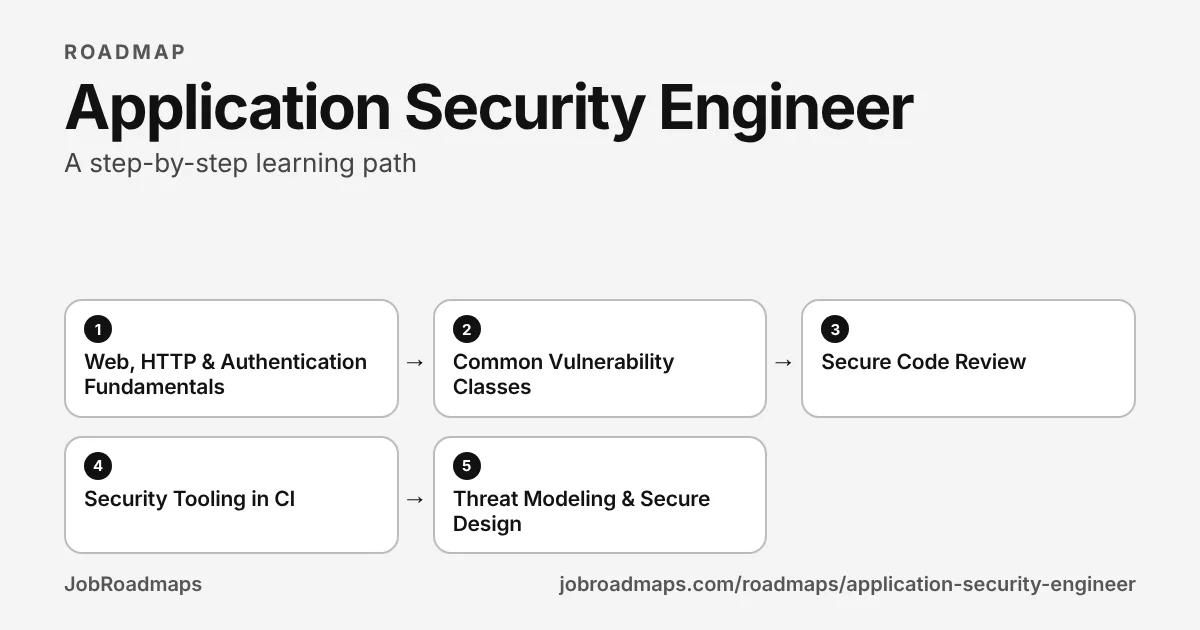
Application Security Engineer learning path
Work down the line, one step at a time. Tick each skill as you can do it.
- 1
Web, HTTP & Authentication Fundamentals
6–8 weeksYou cannot secure what you do not understand. Learn how HTTP requests, cookies and sessions behave, how OAuth 2.0 and OpenID Connect issue and check tokens, and where JSON Web Token implementations go wrong. Most authentication bugs are misunderstandings of one of these.
Skills to learn
- HTTP & cookies
- Sessions
- OAuth 2.0 & OpenID Connect
- JWT pitfalls
- TLS basics
Start with
- 2
Common Vulnerability Classes
6–8 weeksInjection, cross-site scripting, cross-site request forgery, server-side request forgery, broken access control and unsafe deserialization make up most real findings. Work through the labs until you can explain each one, and then explain the one-line change that fixes it.
Skills to learn
- Injection (SQL, command)
- XSS & CSRF
- SSRF
- Broken access control
- Unsafe deserialization
- OWASP Top Ten
Start with
- 3
Secure Code Review
6–8 weeksCode review is the core of AppSec. Read code in at least one language looking for dangerous sinks and trust boundaries, check how the framework's security features are used, and write the finding so the developer can fix it without a meeting. Learn Semgrep rules so you can encode what you find.
Skills to learn
- Reading code for sinks & trust boundaries
- Framework security features
- Writing actionable findings
- Semgrep rules
- OWASP Cheat Sheet Series
Start with
- 4
Security Tooling in CI
4–6 weeksScanners run on every change so people do not have to remember. Set up static analysis, dependency scanning, secret detection and a dynamic scan against a test environment, then spend most of your time triaging false positives so the tools stay trusted.
Skills to learn
- SAST (Semgrep, CodeQL)
- Dependency scanning
- Secret scanning
- DAST with OWASP ZAP
- False-positive triage
Start with
- 5
Threat Modeling & Secure Design
4–6 weeksThe cheapest vulnerability is the one that never gets written. Draw data-flow diagrams, list what an attacker could do at each boundary using STRIDE, and set security requirements before the code exists. Review designs as well as pull requests.
Skills to learn
- Data-flow diagrams
- STRIDE
- Abuse cases
- Security requirements
- Design review
Start with
jobroadmaps.com/roadmaps/application-security-engineer · Pay, demand and employer data for this role are further down the page.
Books worth reading as a Application Security Engineer
Where to start, in order. The full list of 10, grouped by career stage, is on its own page.
Getting started

The Web Application Hacker's Handbook: Finding and Exploiting Security Flaws
by Dafydd Stuttard, Marcus Pinto · 2007
~910 pages~23 hrs to read
The standard hands-on guide to finding authentication, session and injection flaws in web applications. Read it alongside the labs, and note which fix each attack class needs.
View book →
Alice and Bob Learn Application Security
by Tanya Janca · 2020
~300 pages~8 hrs to read
A friendly introduction to secure design, authentication and secure coding for developers. It is a good first book to give to an engineer you are about to work with.
View book →
Doing the job
The Tangled Web: A Guide to Securing Modern Web Applications
by Michal Zalewski · 2011
~300 pages~8 hrs to read
Why browsers and web standards behave the way they do, and how that creates security problems. Useful when a finding depends on a browser quirk.
View book →
Hacking APIs: Breaking Web Application Programming Interfaces
by Corey J. Ball · 2022
API-specific attack classes such as broken object-level authorization and mass assignment. Read it when your review scope is an API rather than a web page.
View book →
Senior and leading

Designing Secure Software: A Guide for Developers
by Loren Kohnfelder · 2021
~310 pages~8 hrs to read
How to reason about threats and trust boundaries when you design a system, written for the engineers who will build it. Read it when you are running design reviews rather than only code reviews.
View book →Security Engineering: A Guide to Building Dependable Distributed Systems
by Ross Anderson · 2001
~1000 pages~25 hrs to read
A systems-wide view of security: access control, cryptography, economics and failure. The third edition is the one to read, and it explains why controls fail in practice.
View book →
All 10 books for a Application Security Engineer →Browse all books →
Some book links are affiliate links: we earn a small commission if you buy, at no cost to you. It does not affect what we list.
Courses and certifications for a Application Security Engineer
6 courses, tutorials and certifications, each read on the provider's own page. One from each stage to start; the full list, with a guide to choosing, is on its own page.
Getting started · Course
Web Security Academy
PortSwigger
Doing the job · Hands-on tutorial
OWASP Juice Shop
OWASP Foundation
Senior and leading · Certification
Certified Secure Software Lifecycle Professional (CSSLP)
ISC2
Prerequisites & Education
What credentials do employers look for?
These are the most common paths into this role — no single one is required.
Education Level
View list — coming soon- Bachelor's in Computer Science, Cybersecurity or Information Systems
- Bachelor's in any discipline with software development experience
AppSec hires often come from software engineering. Experience reading production code counts for more than the degree title.
Certifications
View list — coming soon- CompTIA Security+ — foundational security certificate
- Offensive Security Web Expert (OSWE) — advanced web application testing
- ISC2 CSSLP — secure software lifecycle, usually for experienced candidates
Security+ is a common entry credential. OSWE and CSSLP matter more once you have a few years of application security work.
Bootcamps & Training
View list — coming soon- PortSwigger Web Security Academy — free labs on web vulnerabilities
- OWASP Top Ten — free reference for the most common risks
- OWASP Web Security Testing Guide — free testing methodology
The free labs are the strongest starting point. Solve them, then write up each one.
Portfolio & Other
View list — coming soon- A responsibly disclosed issue in an open-source project, with the timeline and fix
- A threat model for a sample service, with the controls you recommended
- A Semgrep rule you wrote that catches a real vulnerability class
Disclosed, fixed issues show judgment as well as skill. Keep the write-ups professional and specific.
Your Roadmap
5 stepsWeb, HTTP & Authentication Fundamentals
6–8 weeksYou cannot secure what you do not understand. Learn how HTTP requests, cookies and sessions behave, how OAuth 2.0 and OpenID Connect issue and check tokens, and where JSON Web Token implementations go wrong. Most authentication bugs are misunderstandings of one of these.
Skills to learn
Common Vulnerability Classes
6–8 weeksInjection, cross-site scripting, cross-site request forgery, server-side request forgery, broken access control and unsafe deserialization make up most real findings. Work through the labs until you can explain each one, and then explain the one-line change that fixes it.
Skills to learn
Secure Code Review
6–8 weeksCode review is the core of AppSec. Read code in at least one language looking for dangerous sinks and trust boundaries, check how the framework's security features are used, and write the finding so the developer can fix it without a meeting. Learn Semgrep rules so you can encode what you find.
Skills to learn
Security Tooling in CI
4–6 weeksScanners run on every change so people do not have to remember. Set up static analysis, dependency scanning, secret detection and a dynamic scan against a test environment, then spend most of your time triaging false positives so the tools stay trusted.
Skills to learn
Threat Modeling & Secure Design
4–6 weeksThe cheapest vulnerability is the one that never gets written. Draw data-flow diagrams, list what an attacker could do at each boundary using STRIDE, and set security requirements before the code exists. Review designs as well as pull requests.
Skills to learn
Start here this week
This week, work through the first two modules of the PortSwigger Web Security Academy and solve five labs. Write up each one in two sentences: the flaw, and the one-line code change that would fix it. Those write-ups become your first security notes.
Then pick an open-source web application you use, read its authentication and input-handling code, and report one real issue through its security policy. Document the process. A responsibly handled disclosure is stronger entry evidence than any certificate.
Pay
U.S. Department of Labor data for the nearest BLS occupation, Information security analysts. BLS has no occupation for this exact title, so treat these as a benchmark.
Median: U.S. Bureau of Labor Statistics, Occupational Employment and Wage Statistics (median wage, May 2024) and Employment Projections (2024–34). Levels: U.S. Department of Labor Office of Foreign Labor Certification prevailing wage levels (wage year 2025, typical metro), a base-wage benchmark for the metro in the middle of 303 areas, not an offer. See every metro.
Job Titles at Each Level
Entry
Junior Application Security Engineer / AppSec Analyst
Mid
Application Security Engineer / AppSec Engineer
Senior
Senior Application Security Engineer / Staff AppSec Engineer / AppSec Lead
Steps Overview
- 1
Web, HTTP & Authentication Fundamentals
6–8 weeks
- 2
Common Vulnerability Classes
6–8 weeks
- 3
Secure Code Review
6–8 weeks
- 4
Security Tooling in CI
4–6 weeks
- 5
Threat Modeling & Secure Design
4–6 weeks
Explore more roadmaps
Not sure this is the right path? Browse all tech career roadmaps.
View Similar RoadmapsBuilt a project while following this roadmap?
Turn it into a hiring-ready case study in 10 seconds — free.
Ready to explore more?
Browse all career roadmaps across tech, business, and creative fields.