UX Designer Career Roadmap
UX design is the practice of making the complex feel obvious — an act of radical empathy that begins with sitting with real humans, watching where they hesitate, understanding why, and then designing the friction out of their path. The prevailing orthodoxy calls it a 'soft skill.' Engineers who've shipped a confusing product will tell you it's the most expensive kind of technical debt: invisible in code reviews, catastrophic in user behavior data.
Is this the right path for you?
UX designers come from graphic design (the visual instinct is already there, the research piece has to be built), from psychology and human factors backgrounds (the theory is there, the craft has to be built), from product roles where the design gap became obvious, and from people who taught themselves via Figma tutorials and bootcamps. Each background has a different ceiling and a different gap to fill.
If watching users fail at an interface bothers you more than it bothers everyone else in the room — if you find yourself wanting to watch the user rather than defend the design — you're already thinking like a UX designer. The instinct is empathy with rigor. The craft is translating that empathy into decisions the engineering team can implement.
UX is portfolio-gated. A degree from an HCI program helps at larger companies with formal hiring criteria, but the portfolio decides in most processes. Three case studies done well — including the research that informed the design decisions and the metrics that validated them — will outperform ten beautiful mockups with no rationale. The research process is the proof of work.
Career Progression
Where does this role lead?
Click any role to explore timeline, key skills and, where the Department of Labor publishes it, pay.
Entry
Junior UX Designer
~1 yr
$42,182 (Level I)
You're building the craft — translating a brief into a wireframe, then a prototype. Getting feedback early and iterating fast is the core loop.
Key skills
Pay shown is the U.S. Department of Labor prevailing wage for Level I (entry), Level III (mid) and Level IV (senior) in the nearest BLS occupation, base wage for the typical metro, wage year 2025, shown for the main track only. It is a benchmark, not an offer; branches and lead, staff and executive stages have no official figure.
Visual roadmap
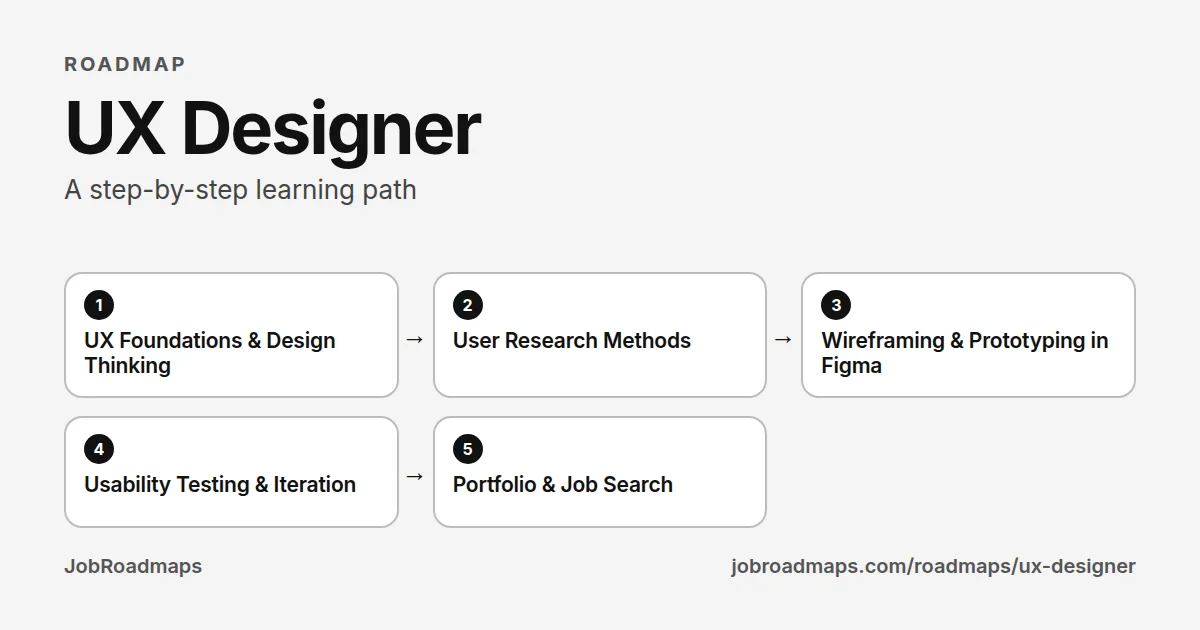
UX Designer learning path
Work down the line, one step at a time. Tick each skill as you can do it.
- 1
UX Foundations & Design Thinking
3–4 weeksUnderstand the UX design process: empathize, define, ideate, prototype, and test. Learn the principles of human-centered design. Study classic UX heuristics by Jakob Nielsen.
Skills to learn
- Design Thinking
- Human-Centered Design
- Nielsen's Heuristics
- UX Principles
- Accessibility
- Design Ethics
Start with
- 2
User Research Methods
4–6 weeksLearn how to plan and conduct user research: interviews, surveys, contextual inquiry, card sorting, and tree testing. Practice synthesizing findings into insights, personas, and user journey maps.
Skills to learn
- User Interviews
- Usability Testing
- Personas
- Journey Mapping
- Affinity Mapping
- Card Sorting
Start with
- 3
Wireframing & Prototyping in Figma
6–8 weeksFigma is the industry-standard tool. Learn frames, auto layout, components, and prototyping. Create low-fidelity wireframes and high-fidelity mockups. Build interactive prototypes to simulate user flows.
Skills to learn
- Figma
- Wireframing
- Prototyping
- Auto Layout
- Components & Variants
- Design Systems
Start with
- 4
Usability Testing & Iteration
3–5 weeksConduct moderated and unmoderated usability tests on your prototypes. Learn to analyze session recordings (Hotjar, FullStory), interpret metrics, and iterate on designs based on evidence.
Skills to learn
- Moderated Testing
- Unmoderated Testing
- Hotjar/FullStory
- Heatmaps
- Design Iteration
- Stakeholder Feedback
Start with
- 5
Portfolio & Job Search
6–8 weeksBuild a UX portfolio with 3–5 case studies that walk through your process: research, synthesis, ideation, prototyping, and results. Quality matters more than quantity. Apply to product-led companies.
Skills to learn
- Case Study Writing
- Portfolio Site
- Storytelling
- Presentation Skills
- Networking
- Interview Prep
Start with
jobroadmaps.com/roadmaps/ux-designer · Pay, demand and employer data for this role are further down the page.
Job Market Insights for UX Designer
Data-backed
What do employers actually ask for?
Read from live job postings — how often each credential is named, from rare to almost always.
"Bachelor's degree" is the most common credential named, yet it appears only rarely in what we could read. Postings that state it are the minority, but these counts are a floor, so do not read this as "no one asks".
Some postings say outright that equivalent experience or a self-taught route is accepted. That wording is worth reading closely when you see it.
Our read: a portfolio that proves the skill, and a referral from someone inside the company, usually carry more weight than a credential match on paper. That is judgement, not something these counts measure.
Requirement
How often named
Bachelor's degree
Computer Science background
Equivalent experience accepted
Our read: how often a credential is named is not how strictly it is enforced. Equivalent experience, a standout portfolio, or a referral often counts for more than the credential listed.
Data-backed
Which skills appear most in job postings?
Read from live job postings, ranked from most to least often named.
interaction design is the most-named skill. Common, but not universal: many postings do not list it.
Past the fundamentals, 3 specialisation skills (interaction design included) start separating candidates who can do the job from candidates who have done it. The 17 niche skills are named rarely enough that knowing them is upside, not prerequisite.
Skill
How often named
interaction design
prototyping
systems thinking
visual design
design systems
user research
storytelling
feedback and critique
product thinking
accessibility
content design
information architecture
design leadership
data visualization
design to code
developer experience
motion design
mobile design
design thinking
responsive design
Sorted by how often named · JobRoadmaps
Data-backed
Which tools and artifacts appear most in job postings?
Read from live job postings, ranked from most to least often named.
Figma is the most-named tool, but no tool is a universal requirement here.
Industry overlay
Targeting a specific industry?
The core roadmap gets you through the door anywhere. The difference between "qualified" and "they hired someone else" often lives in industry-specific context — the norms, the compliance floors, the tools assumed fluent in that sector.
Complex information architecture
Enterprise SaaS surfaces deep feature sets — IA decisions around navigation, hierarchy, and progressive disclosure are high-stakes.
Design system thinking
B2B products demand consistency at scale — UX designers own the system that ensures coherence across hundreds of screens.
User research with power users
SaaS power users have nuanced, opinionated needs — qualitative research and contextual inquiry uncover the real job-to-be-done.
Dashboard & data visualisation UX
Analytics dashboards are the flagship feature of many B2B tools — chart selection, layout density, and progressive disclosure matter.
Onboarding & activation design
Time-to-value is the key metric in PLG SaaS — UX designers own the empty states, tooltips, and guided tours that activate users.
Companies hiring:
FigmaNotionLinearAirtableMiroFinancial data visualisation
Portfolio performance, spending breakdowns, and transaction histories must be legible under stress — clarity over decoration.
Trust & anxiety-reduction UX
Users are anxious about their money — micro-copy, progressive disclosure, and confirmation patterns reduce errors and build confidence.
Regulatory disclosure design
Terms, risk disclosures, and fee transparency are legally required — designers make them comprehensible without hiding them.
Biometric & security UX
Face ID, PIN entry, and step-up authentication flows must be fast and frictionless while maintaining security perception.
Accessibility for financial inclusion
Neobanks serve underbanked populations — screen reader support, high-contrast modes, and plain language are business priorities.
Companies hiring:
RobinhoodChimeRevolutCash AppBettermentIndustry premiums based on aggregated job posting data · Updated quarterly
Interactive
How ready are you right now?
Check the skills you already have to see your current job-market fit.
The most-named skill for this role is interaction design, so a gap there costs you the most. No single skill dominates, but each gap narrows which postings fit you. Check what you already have to see your biggest current gap.
Readiness Check
Check the skills you already have
0/5
base skills
Your biggest gap: interaction design, the most often named of the skills you have not ticked.
Start there, then work down the list.
Books worth reading as a UX Designer
Where to start, in order. The full list of 12, grouped by career stage, is on its own page.
Getting started

Don't Make Me Think, Revisited: A Common Sense Approach to Web Usability
by Steve Krug · 2000
~220 pages~6 hrs to read
A short, funny primer on why people scan, guess and muddle through screens, and how to design for that. Read it in your first weeks, before you have opinions about layout.
View book →
The Design of Everyday Things
by Don Norman · 1988
~370 pages~9 hrs to read
Affordances, signifiers, feedback and the gap between how a thing works and how people think it works. The vocabulary every design critique draws on.
View book →
Doing the job
Interviewing Users: How to Uncover Compelling Insights, 2nd Edition
by Steve Portigal · 2013
~140 pages~4 hrs to read
How to run a user interview: asking open questions, handling silence, and turning transcripts into insight. Pick it up when you start running sessions yourself.
View book →Lean UX: Designing Great Products with Agile Teams
by Jeff Gothelf, Josh Seiden · 2013
~260 pages~7 hrs to read
Frames design work as hypotheses to test with small experiments instead of large specs. Useful for designers on agile product teams who need to show evidence, not just mockups.
View book →
Senior and leading
Org Design for Design Orgs: Building and Managing In-House Design Teams
by Peter Merholz, Kristin Skinner · 2016
~180 pages~5 hrs to read
Covers how design teams are structured, staffed, leveled and embedded in a company. Read it when you move toward leading designers or setting up a team.
View book →
Design Is a Job
by Mike Monteiro · 2012
~140 pages~4 hrs to read
Blunt advice on contracts, client relationships, presenting work and taking responsibility for what you ship. For designers moving into senior roles or running their own engagements.
View book →
All 12 books for a UX Designer →Browse all books →
Some book links are affiliate links: we earn a small commission if you buy, at no cost to you. It does not affect what we list.
Prerequisites & Education
What credentials do employers look for?
These are the most common paths into this role — no single one is required.
Education Level
View list — coming soon- Bachelor's in Human-Computer Interaction, Interaction Design, or Graphic Design
- Bachelor's in Psychology or Cognitive Science — strong foundation for UX research
- Bachelor's in any discipline with a design bootcamp or self-taught path
- No degree — UX is one of the most portfolio-gated disciplines in tech
UX is almost entirely portfolio-gated. Interviewers want to see your design process and decision-making, not a degree certificate.
Certifications
View list — coming soon- Google UX Design Professional Certificate (Coursera) — widely recognised entry cert
- Nielsen Norman Group UX Certification — the most respected credential in the field
- Interaction Design Foundation (IxDF) membership and course certificates
- Figma certifications — demonstrates tool proficiency
The NN/g UX certification is the most respected third-party credential. The Google certificate is a good starting point and is mentioned by name in many entry-level JDs.
Bootcamps & Training
View list — coming soon- CareerFoundry UX Design Program — mentored, job-guarantee, thorough portfolio output
- Springboard UX Career Track — mentor-led with job placement support
- Interaction Design Foundation — subscription-based, thorough, industry-respected
- Designlab UX Academy — structured curriculum with mentor reviews
UX bootcamps with portfolio mentorship are particularly valuable — the output (3–5 case studies) is what gets you hired, not the certificate.
Portfolio & Other
View list — coming soon- UX portfolio site with 3–5 case studies documenting full design process
- Each case study: research → synthesis → wireframes → prototype → tested outcome
- Figma files demonstrating component design and prototyping skill
- Any usability test recordings or research synthesis documents
- Redesign project on an existing product with clear "before/after" rationale
UX portfolios live and die by the quality of case studies. Interviewers want to understand your thinking process, not just see polished mockups.
Your Roadmap
5 stepsUX Foundations & Design Thinking
3–4 weeksUnderstand the UX design process: empathize, define, ideate, prototype, and test. Learn the principles of human-centered design. Study classic UX heuristics by Jakob Nielsen.
Skills to learn
User Research Methods
4–6 weeksLearn how to plan and conduct user research: interviews, surveys, contextual inquiry, card sorting, and tree testing. Practice synthesizing findings into insights, personas, and user journey maps.
Skills to learn
Wireframing & Prototyping in Figma
6–8 weeksFigma is the industry-standard tool. Learn frames, auto layout, components, and prototyping. Create low-fidelity wireframes and high-fidelity mockups. Build interactive prototypes to simulate user flows.
Skills to learn
Usability Testing & Iteration
3–5 weeksConduct moderated and unmoderated usability tests on your prototypes. Learn to analyze session recordings (Hotjar, FullStory), interpret metrics, and iterate on designs based on evidence.
Skills to learn
Portfolio & Job Search
6–8 weeksBuild a UX portfolio with 3–5 case studies that walk through your process: research, synthesis, ideation, prototyping, and results. Quality matters more than quantity. Apply to product-led companies.
Skills to learn
Start here this week
This week: run a usability test on any app with two real people who aren't designers. Give them a task, watch them try to do it, and write down every place they hesitate, click the wrong thing, or express confusion. That observation document is your first UX artifact — more valuable than any Figma mockup you could make without doing it.
For structured entry, Google's UX Design Certificate on Coursera is the most accessible formal credential and covers the core toolkit (research, wireframing, prototyping, usability testing). The Nielsen Norman Group has certification programs that are respected at enterprise companies. But neither replaces the portfolio — start building case studies from real or self-initiated projects simultaneously.
Pay
U.S. Department of Labor data for the nearest BLS occupation, Web and digital interface designers. BLS has no occupation for this exact title, so treat these as a benchmark.
Median: U.S. Bureau of Labor Statistics, Occupational Employment and Wage Statistics (median wage, May 2024) and Employment Projections (2024–34). Levels: U.S. Department of Labor Office of Foreign Labor Certification prevailing wage levels (wage year 2025, typical metro), a base-wage benchmark for the metro in the middle of 213 areas, not an offer. See every metro.
Job Titles at Each Level
Entry
Junior UX Designer / UX Associate
Mid
UX Designer / Product Designer
Senior
Senior UX Designer / Lead Designer / Design Director
Steps Overview
- 1
UX Foundations & Design Thinking
3–4 weeks
- 2
User Research Methods
4–6 weeks
- 3
Wireframing & Prototyping in Figma
6–8 weeks
- 4
Usability Testing & Iteration
3–5 weeks
- 5
Portfolio & Job Search
6–8 weeks
Explore more roadmaps
Not sure this is the right path? Browse all creative career roadmaps.
View Similar RoadmapsBuilt a project while following this roadmap?
Turn it into a hiring-ready case study in 10 seconds — free.
Ready to explore more?
Browse all career roadmaps across tech, business, and creative fields.