Quantum Software Engineer Career Roadmap
Quantum Software Engineers write the programs, compilers and cloud workflows that run on quantum computers and their simulators. They build quantum circuits, map them onto noisy hardware, combine quantum and classical code into hybrid algorithms, and measure whether a result is real or noise. The field is early, most hardware is accessed through cloud services, and the people who build the software layer are in short supply.
Is this the right path for you?
Quantum software hiring draws on physics, mathematics, computer science and chemistry. Many engineers come from a graduate program in one of those fields and add software delivery on top. Software engineers with strong linear algebra can make the switch, but expect to study the physics properly.
If you can accept a result that is probabilistic and want to know exactly how much noise sits behind it, you already think like a quantum engineer. The work is careful measurement of systems that do not behave like classical ones, plus honest reporting of what the hardware can and cannot do today.
The honest caveat is the job market. Much of the available work is in research labs, hardware companies and large technology firms, and many openings are for applications scientists or enablement engineers rather than pure software roles. Quantum advantage over classical methods is still unproven for most problems, so the strongest candidates say so plainly.
Career Progression
Where does this role lead?
Click any role to explore timeline, key skills and, where the Department of Labor publishes it, pay.
Entry
Junior Quantum Software Engineer
~0–2 yrs
You build and simulate circuits, check them against expected outputs, and run small experiments on cloud hardware. Entry seats are about careful verification.
Key skills
Visual roadmap
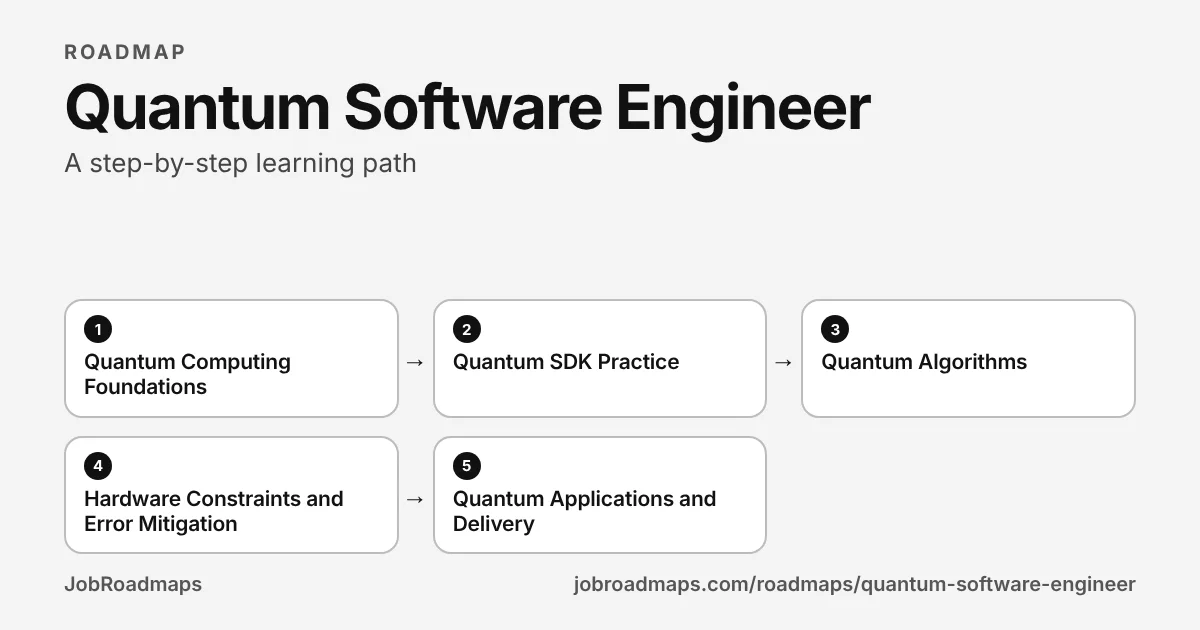
Quantum Software Engineer learning path
Work down the line, one step at a time. Tick each skill as you can do it.
- 1
Quantum Computing Foundations
2–3 monthsLearn the model before the code: qubits, superposition, entanglement, quantum gates and measurement. Work through the linear algebra of state vectors and unitary matrices until you can predict a small circuit's output by hand.
Skills to learn
- Qubits and Superposition
- Entanglement
- Quantum Gates
- Measurement
- Linear Algebra
- Bra-Ket Notation
- 2
Quantum SDK Practice
2–3 monthsBuild and simulate circuits in an open-source toolkit such as Qiskit or Cirq. Learn to read circuit diagrams, choose a simulator, run transpilation, and compare the results of two equivalent circuits.
Skills to learn
- Qiskit
- Cirq
- Circuit Construction
- Transpilation
- Simulators
- Python
- 3
Quantum Algorithms
3–4 monthsImplement the standard algorithms and understand where they help: Deutsch-Jozsa, Grover search, phase estimation, and variational methods such as VQE and QAOA. Build one hybrid loop where a classical optimizer tunes a quantum circuit.
Skills to learn
- Grover Search
- Phase Estimation
- VQE
- QAOA
- Hybrid Algorithms
- Optimization Loops
- 4
Hardware Constraints and Error Mitigation
3–4 monthsRun the same circuit on a simulator and a cloud quantum device, then explain the gap. Learn device topology, gate error rates, readout error, noise models and error mitigation techniques, and report results with their uncertainty.
Skills to learn
- Noise Models
- Device Topology
- Error Mitigation
- Benchmarking
- Readout Calibration
- Cloud Quantum Services
- 5
Quantum Applications and Delivery
6–12 monthsConnect a quantum method to a real problem, such as chemistry simulation or combinatorial optimization, and package it as a repeatable service. Write tests that check results against a classical baseline, and document where the quantum approach does not beat the classical one.
Skills to learn
- Problem Formulation
- Classical Baselines
- Reproducible Experiments
- Cloud APIs
- Testing
- Domain Modeling
jobroadmaps.com/roadmaps/quantum-software-engineer · Pay, demand and employer data for this role are further down the page.
Books worth reading as a Quantum Software Engineer
Where to start, in order. The full list of 5, grouped by career stage, is on its own page.
Getting started
Quantum Computing for Computer Scientists
by Noson S. Yanofsky, Mirco A. Mannucci · 2008
~380 pages~10 hrs to read
Quantum computing written for people who already program: qubits, gates, algorithms and the complexity questions behind them. A good first book before the physics-heavy texts.
View book →Quantum Computation and Quantum Information
by Michael A. Nielsen, Isaac L. Chuang · 2000
~680 pages~17 hrs to read
The standard textbook on quantum information. Dense, but it is the reference the rest of the field cites for states, channels, entanglement and error correction.
View book →
Doing the job
Programming Quantum Computers
by Eric R. Johnston, Nic Harrigan, Mercedes Gimeno-Segovia · 2019
~340 pages~9 hrs to read
Hands-on programming of quantum computers, with circuits and algorithms implemented and run on simulators and hardware. It is the most direct route into writing quantum software.
View book →
Senior and leading
Supervised Learning with Quantum Computers
by Maria Schuld, Francesco Petruccione · 2018
~290 pages~7 hrs to read
The hybrid models and learning methods that most near-term quantum applications rely on, with a clear view of what is and is not known about their advantage. Useful when a lead has to set honest expectations.
View book →
All 5 books for a Quantum Software Engineer →Browse all books →
Some book links are affiliate links: we earn a small commission if you buy, at no cost to you. It does not affect what we list.
Courses and certifications for a Quantum Software Engineer
3 courses, tutorials and certifications, each read on the provider's own page. One from each stage to start; the full list, with a guide to choosing, is on its own page.
Getting started · Course
Basics of Quantum Information
IBM Quantum Learning
Doing the job · Course
Use a Quantum Computer Today
IBM Quantum Learning
Prerequisites & Education
What credentials do employers look for?
These are the most common paths into this role — no single one is required.
Education Level
View list — coming soon- Bachelor's or master's in physics, mathematics, computer science or chemistry
- PhD in a quantum-related field for research-leaning roles
- Bachelor's in computer science with strong linear algebra coursework
Quantum employers weigh the physics and mathematics heavily. A degree in one of those fields, or demonstrated equivalent work, is the usual entry point.
Certifications
View list — coming soon- IBM Quantum Learning badges, each awarded after an exam at IBM Training; the Basics of Quantum Information course leads to one
A badge shows you finished a structured course. It helps most when you are changing careers.
Bootcamps & Training
View list — coming soon- IBM Quantum Learning: Basics of Quantum Information — structured course with an exam
- IBM Quantum Learning: Use a Quantum Computer Today — notebook-based hardware course
- Qiskit Tutorials — worked programs on IBM hardware
The IBM courses are the most direct route. The tutorials are free documentation.
Portfolio & Other
View list — coming soon- A circuit you predicted, ran on hardware, and explained with its error
- A small algorithm implementation checked against a classical baseline
- A written note on where the quantum method did not beat the classical one
Show the predictions and the misses. Hiring managers look for honest error analysis first.
Your Roadmap
5 stepsQuantum Computing Foundations
2–3 monthsLearn the model before the code: qubits, superposition, entanglement, quantum gates and measurement. Work through the linear algebra of state vectors and unitary matrices until you can predict a small circuit's output by hand.
Skills to learn
Quantum SDK Practice
2–3 monthsBuild and simulate circuits in an open-source toolkit such as Qiskit or Cirq. Learn to read circuit diagrams, choose a simulator, run transpilation, and compare the results of two equivalent circuits.
Skills to learn
Quantum Algorithms
3–4 monthsImplement the standard algorithms and understand where they help: Deutsch-Jozsa, Grover search, phase estimation, and variational methods such as VQE and QAOA. Build one hybrid loop where a classical optimizer tunes a quantum circuit.
Skills to learn
Hardware Constraints and Error Mitigation
3–4 monthsRun the same circuit on a simulator and a cloud quantum device, then explain the gap. Learn device topology, gate error rates, readout error, noise models and error mitigation techniques, and report results with their uncertainty.
Skills to learn
Quantum Applications and Delivery
6–12 monthsConnect a quantum method to a real problem, such as chemistry simulation or combinatorial optimization, and package it as a repeatable service. Write tests that check results against a classical baseline, and document where the quantum approach does not beat the classical one.
Skills to learn
Start here this week
This week: work through the Basics of Quantum Information course on IBM Quantum Learning, build a two-qubit Bell state by hand, and run it on a simulator. Then predict the measurement counts before you run it, and write down the difference. That prediction log is the habit the field rewards.
Structured entry path: master the foundations and one SDK first, then implement two standard algorithms and compare them on a simulator. Move to real hardware once you can explain the noise in your results, and finish with a small application that is checked against a classical baseline.
Job Titles at Each Level
Entry
Quantum Software Engineer / Quantum Developer / Quantum Software Developer
Mid
Senior Quantum Software Engineer / Quantum Applications Engineer / Quantum Algorithm Engineer
Senior
Staff Quantum Engineer / Quantum Software Lead / Quantum Platform Lead
Steps Overview
- 1
Quantum Computing Foundations
2–3 months
- 2
Quantum SDK Practice
2–3 months
- 3
Quantum Algorithms
3–4 months
- 4
Hardware Constraints and Error Mitigation
3–4 months
- 5
Quantum Applications and Delivery
6–12 months
Explore more roadmaps
Not sure this is the right path? Browse all tech career roadmaps.
View Similar RoadmapsBuilt a project while following this roadmap?
Turn it into a hiring-ready case study in 10 seconds — free.
Ready to explore more?
Browse all career roadmaps across tech, business, and creative fields.