Backend Developer Career Roadmap
Backend development is the discipline of building things no one can see and everyone depends on. The databases, the APIs, the authentication flows, the job queues, the caching layers, the rate limiters — the plumbing. Nobody applauds the plumbing until it breaks. Your job is to make absolutely certain it doesn't, and to architect systems that stay alive under the specific kind of pressure that comes from millions of requests and not enough sleep.
Is this the right path for you?
Backend developers come from CS degrees, from frontend roles that expanded, and from people who built things and kept pulling the thread until they were writing servers. The self-taught path is real and common here — backend is less visually dependent than frontend, which means the work is easier to do quietly in a terminal and harder to explain to non-technical people.
If you're more interested in what happens when 10,000 users hit the same endpoint simultaneously than in what the button looks like — you're already thinking like a backend engineer. The appeal is systems: data moving between processes, persistence, latency, failure modes.
SQL and system design are the real gatekeepers at backend interviews, not the language you learned. Most companies don't care whether you know Python or Go — they care whether you can model a database schema correctly and explain what happens when a cache goes stale. Language preference is noise. Data modeling and distributed systems fundamentals are the signal.
Career Progression
Where does this role lead?
Click any role to explore timeline, key skills and, where the Department of Labor publishes it, pay.
Entry
Junior Backend
~1 yr
$74,464 (Level I)
Focus on understanding request/response cycles, basic CRUD APIs, and writing code that doesn't break other people's work.
Key skills
Pay shown is the U.S. Department of Labor prevailing wage for Level I (entry), Level III (mid) and Level IV (senior) in the nearest BLS occupation, base wage for the typical metro, wage year 2025, shown for the main track only. It is a benchmark, not an offer; branches and lead, staff and executive stages have no official figure.
Visual roadmap
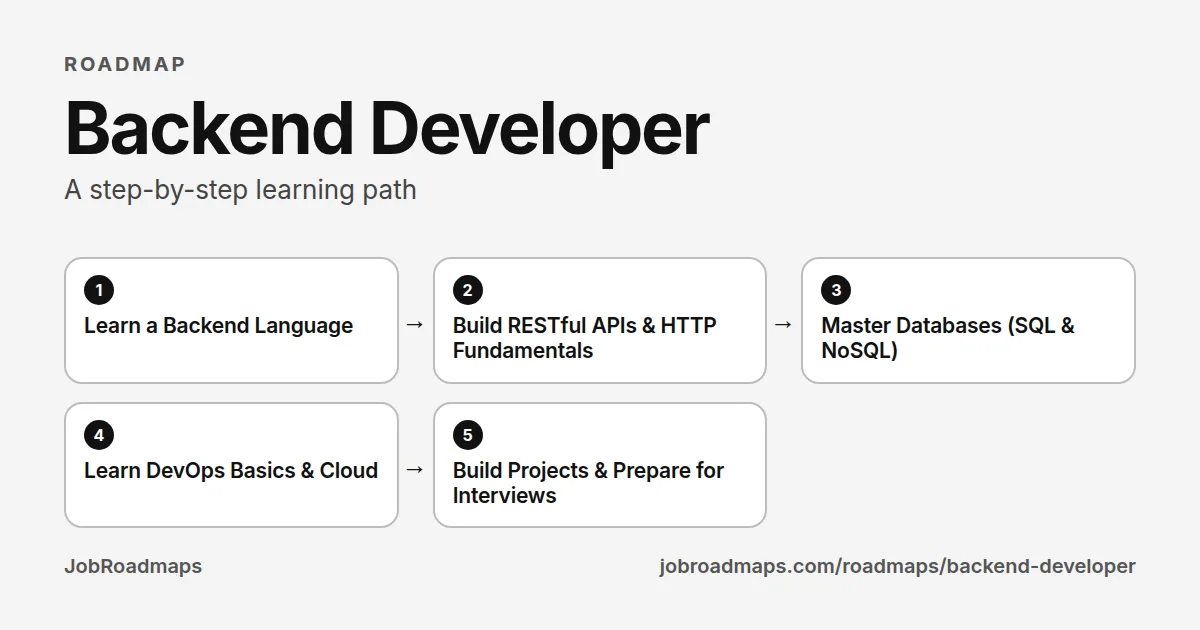
Backend Developer learning path
Work down the line, one step at a time. Tick each skill as you can do it.
- 1
Learn a Backend Language
6–8 weeksChoose one language to master first. Node.js (JavaScript) is a natural progression from frontend. Python is beginner-friendly and versatile. Study the language fundamentals: data structures, OOP, error handling, and file I/O.
Skills to learn
- Python 3 (type hints, dataclasses)
- Node.js (Event Loop model)
- Data Structures (arrays, maps, trees)
- OOP Principles
- Functional Programming Basics
- Error Handling Patterns
- pip / npm / Poetry
- Virtual Environments (venv)
Start with
- 2
Build RESTful APIs & HTTP Fundamentals
4–6 weeksUnderstand HTTP methods, status codes, headers, and REST principles. Build a CRUD API using Express (Node) or FastAPI (Python). Learn about authentication with JWT and API security basics.
Skills to learn
- HTTP Methods & Status Codes
- REST API Design Principles
- FastAPI (Python)
- Express.js (Node)
- JWT Authentication
- OAuth 2.0 / Session Auth
- Input Validation (Pydantic, Zod)
- OpenAPI / Swagger Docs
- Rate Limiting & Throttling
- CORS Configuration
Start with
- 3
Master Databases (SQL & NoSQL)
6–8 weeksLearn relational databases with PostgreSQL — schema design, joins, indexes, and transactions. Then explore NoSQL with MongoDB for document-based storage. Understand when to use each.
Skills to learn
- PostgreSQL
- SQL Joins, Indexes & Aggregations
- Database Schema Design
- ACID Transactions
- SQLAlchemy / Prisma ORM
- Database Migrations (Alembic)
- MongoDB (document model)
- Redis (caching, sessions)
- Query Optimization & EXPLAIN
- Connection Pooling (PgBouncer)
Start with
- 4
Learn DevOps Basics & Cloud
4–6 weeksUnderstand Docker containers, environment variables, and CI/CD pipelines. Deploy a backend API to AWS, Render, or Railway. Learn basics of Linux, SSH, and server management.
Skills to learn
- Docker & Dockerfile
- Docker Compose
- Linux CLI & SSH
- AWS EC2, S3, RDS basics
- Nginx (reverse proxy)
- GitHub Actions CI/CD
- Environment Variables & .env
- Structured Logging (Winston, loguru)
Start with
- 5
Build Projects & Prepare for Interviews
6–8 weeksBuild 2–3 backend projects: a REST API with authentication, a real-time feature with WebSockets, and a microservice. Practice data structures & algorithms on LeetCode. Write clean code, tests, and documentation.
Skills to learn
- System Design (CAP theorem, load balancing)
- LeetCode DSA (arrays, trees, graphs)
- WebSockets & Server-Sent Events
- Message Queues (BullMQ, Celery)
- Unit Testing (pytest, Jest)
- Integration Testing
- Background Job Processing
- API Documentation
- Caching Strategies (TTL, cache aside)
Start with
jobroadmaps.com/roadmaps/backend-developer · Pay, demand and employer data for this role are further down the page.
Job Market Insights for Backend Developer
Data-backed
What do employers actually ask for?
Read from live job postings — how often each credential is named, from rare to almost always.
"Computer Science background" is the most common credential named, yet it appears only occasionally in what we could read. Postings that state it are the minority, but these counts are a floor, so do not read this as "no one asks".
Some postings say outright that equivalent experience or a self-taught route is accepted. That wording is worth reading closely when you see it.
Our read: a portfolio that proves the skill, and a referral from someone inside the company, usually carry more weight than a credential match on paper. That is judgement, not something these counts measure.
Requirement
How often named
Computer Science background
Bachelor's degree
Equivalent experience accepted
Master's degree
PhD / doctorate
Certification mentioned
Our read: how often a credential is named is not how strictly it is enforced. Equivalent experience, a standout portfolio, or a referral often counts for more than the credential listed.
Data-backed
Which skills appear most in job postings?
Read from live job postings, ranked from most to least often named.
Distributed systems is the most-named skill. Common, but not universal: many postings do not list it.
Past the fundamentals, 3 specialisation skills (Distributed systems included) start separating candidates who can do the job from candidates who have done it. The 17 niche skills are named rarely enough that knowing them is upside, not prerequisite.
Skill
How often named
Distributed systems
observability
testing
code review
authentication
CI CD
API design
authorization
incident response
REST APIs
Sorted by how often named · JobRoadmaps
Data-backed
Which tools and artifacts appear most in job postings?
Read from live job postings, ranked from most to least often named.
AWS is the most-named tool, but no tool is a universal requirement here.
Tool / Artifact
How often named
Sorted by how often named · JobRoadmaps
Industry overlay
Targeting a specific industry?
The core roadmap gets you through the door anywhere. The difference between "qualified" and "they hired someone else" often lives in industry-specific context — the norms, the compliance floors, the tools assumed fluent in that sector.
Idempotency key design
Retried payment requests must never double-charge a customer — every mutating endpoint needs idempotency guarantees baked in.
Double-entry ledger modelling
Money movement is tracked as immutable, reconciled journal entries, not simple row updates — a data model unique to financial systems.
Saga/distributed transaction patterns
Transfers spanning multiple services need atomicity without two-phase commit at scale, requiring compensating-transaction design.
PCI-DSS scoping
Services that touch card data must be network-segmented and tokenised — backend engineers decide what falls in and out of scope.
API-layer fraud and rate-limit signals
Card testing and account-takeover attempts hit the API directly, so backend engineers build velocity checks most other industries never need.
Companies hiring:
StripeBlockAffirmPlaidMarqetamulti tenancy
Essential architecture pattern for isolating customer data while sharing infrastructure efficiently.
api ecosystem
SaaS platforms are built on robust APIs for customer integrations, webhooks, and third-party extensions.
scalability
Must support exponential user and data growth without redesign; requires planning for high concurrency and large datasets.
Companies hiring:
AsanaDatadogOktaFigmaClickUpIndustry premiums based on aggregated job posting data · Updated quarterly
Interactive
How ready are you right now?
Check the skills you already have to see your current job-market fit.
The most-named skill for this role is Distributed systems, so a gap there costs you the most. No single skill dominates, but each gap narrows which postings fit you. Check what you already have to see your biggest current gap.
Readiness Check
Check the skills you already have
0/5
base skills
Your biggest gap: Distributed systems, the most often named of the skills you have not ticked.
Start there, then work down the list.
Books worth reading as a Backend Developer
Where to start, in order. The full list of 12, grouped by career stage, is on its own page.
Getting started

Learning SQL
by Alan Beaulieu · 2005
~380 pages~10 hrs to read
Walks through queries, joins, grouping, subqueries and data modification with exercises. Read it early, because nearly every backend job puts you in front of a relational database.
View book →
Clean Code
by Robert C. Martin · 2008
~430 pages~11 hrs to read
A set of opinionated guidelines on naming, functions, comments and error handling, with worked refactorings in Java. Read it in your first year to sharpen how you read and review code, and treat its rules as arguments to weigh.
View book →
Doing the job

Designing Data-Intensive Applications
by Martin Kleppmann · 2017
~620 pages~16 hrs to read
Explains storage engines, replication, partitioning, transactions and stream processing, and the trade-offs behind each. Read it once you run production services, then reread chapters as your systems grow.
View book →
SQL Performance Explained
by Markus Winand · 2012
~200 pages~5 hrs to read
Shows how indexes work and how to write queries that use them across the major relational databases. Read it when a page you built gets slow and the database is the suspect.
View book →
Senior and leading

Building Microservices
by Sam Newman · 2015
~250 pages~6 hrs to read
Covers service boundaries, communication, deployment, testing and splitting up a monolith, with the costs spelled out. Read it before you propose or inherit a distributed architecture.
View book →
Fundamentals of Software Architecture
by Mark Richards, Neal Ford · 2020
~430 pages~11 hrs to read
Surveys architecture styles, characteristics and decision-making, from layered and event-driven to microservices. Read it when you are asked to choose or defend a system's structure.
View book →
All 12 books for a Backend Developer →Browse all books →
Some book links are affiliate links: we earn a small commission if you buy, at no cost to you. It does not affect what we list.
Prerequisites & Education
What credentials do employers look for?
These are the most common paths into this role — no single one is required.
Education Level
View list — coming soon- Bachelor's in Computer Science, Software Engineering, or related field
- Bachelor's in Mathematics or Physics — common for systems-focused roles
- Self-taught with strong systems knowledge — harder path but achievable
- No formal degree with demonstrable open-source or project history
Backend roles at product companies weigh demonstrated systems ability heavily. Finance and infrastructure roles tend to require a CS degree more strictly.
Certifications
View list — coming soon- AWS Certified Developer – Associate — highly valued across cloud-hosted backends
- AWS Solutions Architect – Associate — signals infrastructure thinking
- Microsoft Azure Developer Associate (AZ-204) — valued for backend roles at Azure-first companies; covers Azure Functions, App Service, and Cosmos DB
- Google Cloud Professional Cloud Developer — covers building scalable applications on GCP using Cloud Run, Pub/Sub, and Cloud SQL; strong signal for Google-stack backend roles ($200)
- Docker Certified Associate — useful for containerisation-heavy roles
- MongoDB Certified Developer — helpful for NoSQL-heavy stacks
- GitHub Foundations — entry-level Microsoft/GitHub credential; validates Git, pull requests, and collaboration workflows
AWS certifications in particular have strong signal for backend roles at startups and scale-ups deploying on cloud infrastructure. AZ-204 is the Azure equivalent for developer roles.
Bootcamps & Training
View list — coming soon- Full Stack Open (University of Helsinki) — rigorous, free, industry-respected
- App Academy / Hack Reactor — intensive, project-heavy bootcamps
- The Odin Project — full-stack path covers backend thoroughly
- CS50 (Harvard/edX) — strong computer science foundations course
A bootcamp that ends with a deployed API project with auth and a database is more useful than one focused on frontend polish.
Portfolio & Other
View list — coming soon- GitHub with a deployed REST or GraphQL API — must include a live URL
- Open source contributions to backend frameworks or libraries
- Database schema design samples — shows data modelling thinking
- Any system design writeup or architecture diagram — rare and impressive at entry level
- Side projects with real traffic or users — demonstrates production thinking
Backend portfolios are rarer than frontend ones — a well-documented deployed API immediately sets you apart from most applicants.
Your Roadmap
5 stepsLearn a Backend Language
6–8 weeksChoose one language to master first. Node.js (JavaScript) is a natural progression from frontend. Python is beginner-friendly and versatile. Study the language fundamentals: data structures, OOP, error handling, and file I/O.
Skills to learn
Build RESTful APIs & HTTP Fundamentals
4–6 weeksUnderstand HTTP methods, status codes, headers, and REST principles. Build a CRUD API using Express (Node) or FastAPI (Python). Learn about authentication with JWT and API security basics.
Skills to learn
Master Databases (SQL & NoSQL)
6–8 weeksLearn relational databases with PostgreSQL — schema design, joins, indexes, and transactions. Then explore NoSQL with MongoDB for document-based storage. Understand when to use each.
Skills to learn
Learn DevOps Basics & Cloud
4–6 weeksUnderstand Docker containers, environment variables, and CI/CD pipelines. Deploy a backend API to AWS, Render, or Railway. Learn basics of Linux, SSH, and server management.
Skills to learn
Build Projects & Prepare for Interviews
6–8 weeksBuild 2–3 backend projects: a REST API with authentication, a real-time feature with WebSockets, and a microservice. Practice data structures & algorithms on LeetCode. Write clean code, tests, and documentation.
Skills to learn
Start here this week
This week: build a REST API that reads and writes to a real database — PostgreSQL, SQLite, anything — and deploy it somewhere people can actually hit it. Render, Railway, and Fly.io have free tiers. The gap between 'I built an API locally' and 'I deployed an API' is where most beginners stall.
For structured entry, the CS50 Web Programming course (free on edX) covers backend fundamentals well. If you want to specialize, pick one language (Python + FastAPI, or Node.js + Express, or Go) and go deep rather than sampling everything. The companies that pay well don't care which language — they care how deeply you understand the one you chose.
Pay
U.S. Department of Labor data for the nearest BLS occupation, Software developers. BLS has no occupation for this exact title, so treat these as a benchmark.
Median: U.S. Bureau of Labor Statistics, Occupational Employment and Wage Statistics (median wage, May 2024) and Employment Projections (2024–34). Levels: U.S. Department of Labor Office of Foreign Labor Certification prevailing wage levels (wage year 2025, typical metro), a base-wage benchmark for the metro in the middle of 511 areas, not an offer. See every metro.
Job Titles at Each Level
Entry
Junior Backend Developer
Mid
Backend Engineer
Senior
Senior Backend / Platform Engineer
Steps Overview
- 1
Learn a Backend Language
6–8 weeks
- 2
Build RESTful APIs & HTTP Fundamentals
4–6 weeks
- 3
Master Databases (SQL & NoSQL)
6–8 weeks
- 4
Learn DevOps Basics & Cloud
4–6 weeks
- 5
Build Projects & Prepare for Interviews
6–8 weeks
Explore more roadmaps
Not sure this is the right path? Browse all tech career roadmaps.
View Similar RoadmapsBuilt a project while following this roadmap?
Turn it into a hiring-ready case study in 10 seconds — free.
Ready to explore more?
Browse all career roadmaps across tech, business, and creative fields.