AI Evaluation Engineer Career Roadmap
AI Evaluation Engineers decide whether an AI system is good enough to ship. They design test sets, write rubrics and automated judges, run evaluations in continuous integration, and turn failures into clear reports for product and research teams. As teams ship LLM features, evaluation has become its own engineering discipline, and the people who build it sit between research, product engineering and safety.
Is this the right path for you?
Most AI evaluation engineers come from software engineering, data science or quality assurance, and add the LLM-specific skills on top. A background in testing is an advantage: the habit of asking what a test does not cover carries straight over. Teams also hire people from applied AI and product engineering who have already shipped an LLM feature and got tired of finding its failures by hand.
If you want to know why a model failed, not just that it did, and you enjoy building the instrument that measures quality, you are already thinking like an evaluator. The work is structured doubt: writing tests that could fail, checking your own graders, and reporting results with their limits stated.
The competition is growing but the field is young, so there is no single accepted syllabus. Expect to build your own evaluation suite, publish it, and explain what it misses. Pure prompt tweaking without measurement is the weakest signal on a resume for this role.
Career Progression
Where does this role lead?
Click any role to explore timeline, key skills and, where the Department of Labor publishes it, pay.
Entry
Junior AI Evaluation Engineer
~0–2 yrs
$54,101 (Level I)
You build and run test sets, check the graders, and report results with their limits. Entry seats are about careful measurement and clear write-ups.
Key skills
Pay shown is the U.S. Department of Labor prevailing wage for Level I (entry), Level III (mid) and Level IV (senior) in the nearest BLS occupation, base wage for the typical metro, wage year 2025, shown for the main track only. It is a benchmark, not an offer; branches and lead, staff and executive stages have no official figure.
Visual roadmap
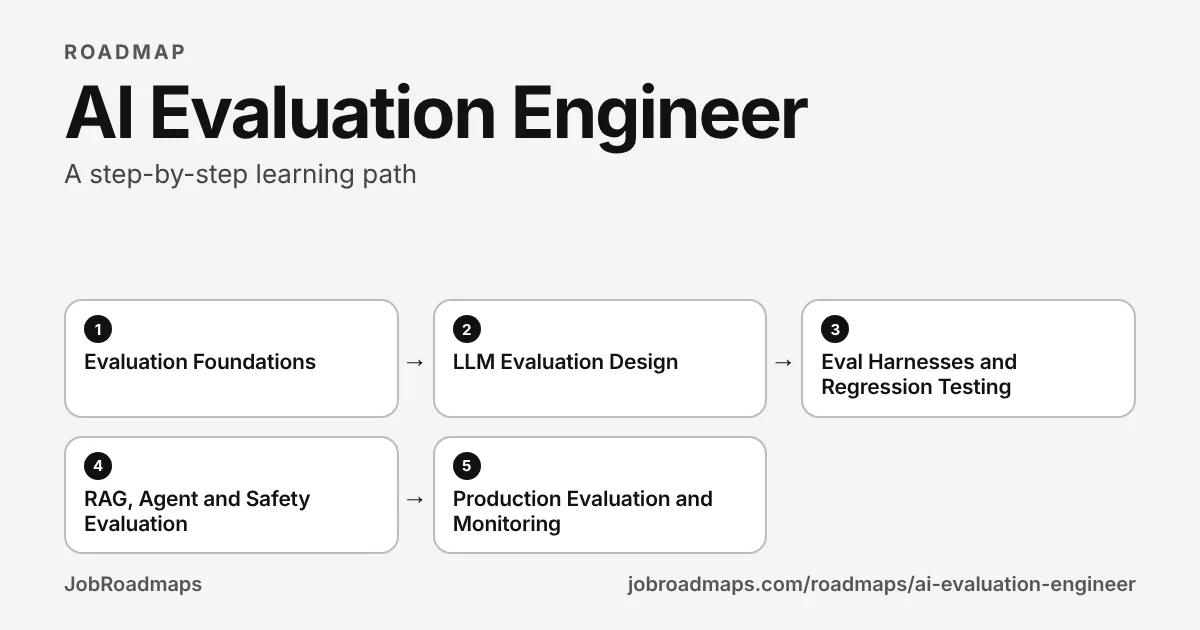
AI Evaluation Engineer learning path
Work down the line, one step at a time. Tick each skill as you can do it.
- 1
Evaluation Foundations
2–3 monthsLearn the statistics behind a trustworthy evaluation: precision and recall, confusion matrices, confidence intervals, significance testing and sample size. Build a small test set from scratch and show how much a result would move if the set were a little different.
Skills to learn
- Evaluation Metrics
- Statistical Significance
- Confidence Intervals
- Confusion Matrices
- Python
- Test Set Design
- 2
LLM Evaluation Design
3–4 monthsWrite rubrics that a human and a model can apply the same way. Use reference answers, pairwise comparison and LLM-as-a-judge graders, then measure how well each judge agrees with human labels and where it is biased, for example toward longer answers or its own style.
Skills to learn
- Rubric Design
- LLM-as-a-Judge
- Pairwise Comparison
- Reference Answers
- Judge Calibration
- Bias Detection
- 3
Eval Harnesses and Regression Testing
2–3 monthsRun evaluations as code. Work with an open-source harness such as Promptfoo or OpenAI Evals, version your datasets, and run the suite on every change in continuous integration so a prompt or model update that breaks a behavior fails the build.
Skills to learn
- Promptfoo
- OpenAI Evals
- CI Pipelines
- Regression Testing
- Dataset Versioning
- Assertion Design
- 4
RAG, Agent and Safety Evaluation
3–4 monthsEvaluate the parts of an LLM system separately. Measure retrieval with recall and ranking metrics, check whether answers are faithful to the retrieved context using a framework such as Ragas, test agents on whole task trajectories, and build red-team prompt sets for misuse and failure cases.
Skills to learn
- Retrieval Metrics
- Faithfulness Scoring
- Ragas
- Agent Trajectory Evaluation
- Red-Team Test Sets
- Failure Taxonomies
- 5
Production Evaluation and Monitoring
6–12 monthsConnect offline tests to live systems: sample production traces, run online evaluations, set release gates, and run error analysis at scale. The job at this stage is to make evaluation a standing part of how the team ships, not a one-off report before launch.
Skills to learn
- Tracing
- Online Evaluation
- Release Gates
- Error Analysis
- Observability
- Evaluation Dashboards
jobroadmaps.com/roadmaps/ai-evaluation-engineer · Pay, demand and employer data for this role are further down the page.
Books worth reading as a AI Evaluation Engineer
Where to start, in order. The full list of 11, grouped by career stage, is on its own page.
Getting started
AI Snake Oil
by Arvind Narayanan, Sayash Kapoor · 2024
~380 pages~10 hrs to read
How to test an AI claim before believing it: what a benchmark measures, what it misses, and why a good demo is not evidence. It frames the questions an evaluation has to answer.
View book →
Data Science for Business
by Foster Provost, Tom Fawcett · 2013
~410 pages~10 hrs to read
How to frame a model evaluation around the decision it supports: expected value, cost of errors and how to compare models on the outcomes that matter.
View book →
Doing the job

Designing Machine Learning Systems
by Chip Huyen · 2022
~390 pages~10 hrs to read
How models are evaluated, monitored and retrained once they serve real traffic. It connects offline metrics to the production decisions that depend on them.
View book →
AI Engineering
by Chip Huyen · 2025
~350 pages~9 hrs to read
Building applications on foundation models, with a substantial section on evaluation methods, including AI judges and how to design them.
View book →
Senior and leading

The Alignment Problem
by Brian Christian · 2020
~360 pages~9 hrs to read
The history of how machine learning systems come to optimize the wrong thing. It is the background for deciding what an evaluation should measure beyond accuracy.
View book →
Weapons of Math Destruction
by Cathy O'Neil · 2016
~270 pages~7 hrs to read
How opaque scoring systems cause harm when nobody audits their outcomes. It gives a lead the case for evaluating impact across groups, not only average scores.
View book →
All 11 books for a AI Evaluation Engineer →Browse all books →
Some book links are affiliate links: we earn a small commission if you buy, at no cost to you. It does not affect what we list.
Courses and certifications for a AI Evaluation Engineer
6 courses, tutorials and certifications, each read on the provider's own page. One from each stage to start; the full list, with a guide to choosing, is on its own page.
Getting started · Course
Machine Learning Crash Course
Google for Developers
Doing the job · Course
LLM Course
Hugging Face
Senior and leading · Hands-on tutorial
Ragas documentation
Ragas
Prerequisites & Education
What credentials do employers look for?
These are the most common paths into this role — no single one is required.
Education Level
View list — coming soon- Bachelor's in Computer Science, Statistics or Mathematics
- Master's or PhD in machine learning or a related field, for research-leaning evaluation roles
- Bachelor's in any discipline with strong Python and statistics coursework
Evaluation work rewards careful reasoning about error. A quantitative degree helps, but a published test suite with a written method is the stronger signal.
Certifications
View list — coming soon- No vendor certificate is standard for this role. The courses and reading on this page are the reference points hiring teams look for.
Pick a certificate only when the team runs its evaluations on that platform. A test suite you built is worth more than a completion badge.
Bootcamps & Training
View list — coming soon- Google Machine Learning Crash Course — free; covers classification metrics and dataset problems
- Hugging Face LLM Course — free; covers fine-tuning and dataset curation
- Promptfoo getting-started tutorial — free open-source eval harness walkthrough
All three are free and documented. Work through them with your own test set so the course becomes a project.
Portfolio & Other
View list — coming soon- A public test set for one LLM feature, with the rubric and the grader's agreement with human labels
- An eval harness run in continuous integration, with a log of the regressions it caught
- A short failure analysis: what the suite misses and how you would measure it next
Hiring managers read these for judgment. Show the failures you found, not only the scores.
Your Roadmap
5 stepsEvaluation Foundations
2–3 monthsLearn the statistics behind a trustworthy evaluation: precision and recall, confusion matrices, confidence intervals, significance testing and sample size. Build a small test set from scratch and show how much a result would move if the set were a little different.
Skills to learn
LLM Evaluation Design
3–4 monthsWrite rubrics that a human and a model can apply the same way. Use reference answers, pairwise comparison and LLM-as-a-judge graders, then measure how well each judge agrees with human labels and where it is biased, for example toward longer answers or its own style.
Skills to learn
Eval Harnesses and Regression Testing
2–3 monthsRun evaluations as code. Work with an open-source harness such as Promptfoo or OpenAI Evals, version your datasets, and run the suite on every change in continuous integration so a prompt or model update that breaks a behavior fails the build.
Skills to learn
RAG, Agent and Safety Evaluation
3–4 monthsEvaluate the parts of an LLM system separately. Measure retrieval with recall and ranking metrics, check whether answers are faithful to the retrieved context using a framework such as Ragas, test agents on whole task trajectories, and build red-team prompt sets for misuse and failure cases.
Skills to learn
Production Evaluation and Monitoring
6–12 monthsConnect offline tests to live systems: sample production traces, run online evaluations, set release gates, and run error analysis at scale. The job at this stage is to make evaluation a standing part of how the team ships, not a one-off report before launch.
Skills to learn
Start here this week
This week: take a small LLM feature you have built or can run, write 20 test cases with expected behavior, and grade the outputs twice, once by hand and once with a simple rubric. Record where the two grades disagree and why. Put the test set and the disagreement log in a public repository.
Structured entry path: learn evaluation statistics first, then design rubrics and judges on a single task. Add an open-source harness and run it in continuous integration. After that, extend the suite to retrieval and agent behavior, and finish by connecting it to production traces so failures reach the team that fixes them.
Pay
U.S. Department of Labor data for the nearest BLS occupation, Software quality assurance analysts and testers. BLS has no occupation for this exact title, so treat these as a benchmark.
Median: U.S. Bureau of Labor Statistics, Occupational Employment and Wage Statistics (median wage, May 2024) and Employment Projections (2024–34). Levels: U.S. Department of Labor Office of Foreign Labor Certification prevailing wage levels (wage year 2025, typical metro), a base-wage benchmark for the metro in the middle of 267 areas, not an offer. See every metro.
Job Titles at Each Level
Entry
AI Evaluation Engineer / Evals Engineer / Model Quality Analyst
Mid
Senior AI Evaluation Engineer / LLM Evaluation Engineer / Evaluation Infrastructure Engineer
Senior
Staff AI Evaluation Engineer / Head of Evals / Evaluation Platform Lead
Steps Overview
- 1
Evaluation Foundations
2–3 months
- 2
LLM Evaluation Design
3–4 months
- 3
Eval Harnesses and Regression Testing
2–3 months
- 4
RAG, Agent and Safety Evaluation
3–4 months
- 5
Production Evaluation and Monitoring
6–12 months
Explore more roadmaps
Not sure this is the right path? Browse all tech career roadmaps.
View Similar RoadmapsBuilt a project while following this roadmap?
Turn it into a hiring-ready case study in 10 seconds — free.
Ready to explore more?
Browse all career roadmaps across tech, business, and creative fields.