Edge Machine Learning Engineer Career Roadmap
Edge machine learning engineers put models on devices with little memory, power or connectivity: phones, cameras, cars, industrial sensors and embedded boards. They shrink models through quantization and pruning, convert them to runtimes built for the target chip, and measure latency and battery on real hardware. A model that is accurate on a server means little if it misses its frame deadline on the device.
Is this the right path for you?
You are an embedded or mobile developer who wants to run models inside your products, or a machine learning engineer whose models have never left a GPU server. Entry usually comes from one of those backgrounds, and a small physical device project is the best bridge between them.
The mindset signal is comfort with constraints. If you like working out what fits in 256 MB, measuring frame times on real hardware, and accepting a small accuracy loss for a large speed gain, you will enjoy this work. If you need unlimited compute and fast iteration, cloud ML is the better fit.
These roles cluster in a few industries (automotive, consumer devices, industrial and robotics), so the market is narrower than general ML. Many postings also ask for C++ and a specific vendor toolchain. Check which chips and runtimes a posting names before you tailor your portfolio to it.
Career Progression
Where does this role lead?
Click any role to explore timeline, key skills and, where the Department of Labor publishes it, pay.
Entry
Junior Edge ML Engineer
~0–2 yrs
$74,464 (Level I)
You convert and benchmark models that a senior engineer chose, and you report the latency and memory of every build.
Key skills
Pay shown is the U.S. Department of Labor prevailing wage for Level I (entry), Level III (mid) and Level IV (senior) in the nearest BLS occupation, base wage for the typical metro, wage year 2025, shown for the main track only. It is a benchmark, not an offer; branches and lead, staff and executive stages have no official figure.
Visual roadmap
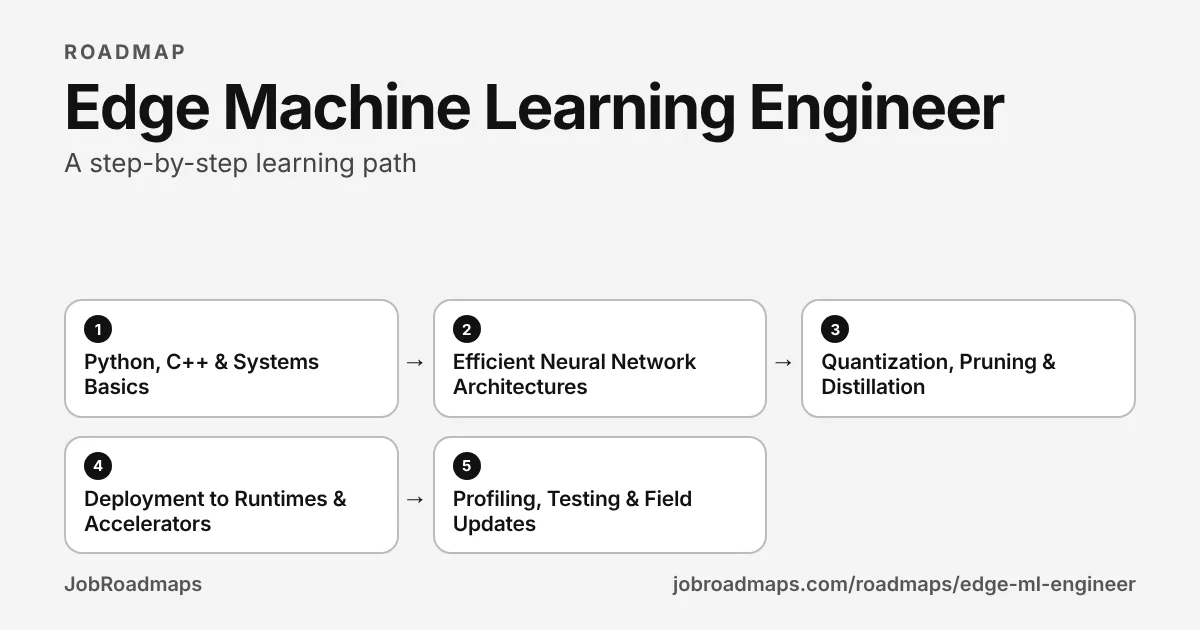
Edge Machine Learning Engineer learning path
Work down the line, one step at a time. Tick each skill as you can do it.
- 1
Python, C++ & Systems Basics
6–8 weeksTraining code is usually Python, but the code that runs on a device is often C or C++, and it runs with fixed memory and no garbage collector. Learn enough C++ to read and integrate a runtime, understand memory and threads, and get comfortable with Linux on a small board.
Skills to learn
- Python for training code
- C++ for runtime integration
- Memory and threading basics
- Linux on embedded boards
- Git
Start with
- 2
Efficient Neural Network Architectures
6–8 weeksSome architectures are designed to run on small hardware, such as MobileNet-style networks. Learn to train and evaluate convolutional models, compare them on operations and memory rather than only accuracy, and use transfer learning so you do not start from nothing.
Skills to learn
- CNN training & evaluation
- Efficient architectures
- FLOPs and memory trade-offs
- Transfer learning
- PyTorch
Start with
- 3
Quantization, Pruning & Distillation
6–8 weeksThese are the main tools for making a model fit. Post-training quantization is the fastest to try, quantization-aware training recovers more accuracy, and pruning and distillation go further. Every change needs an accuracy check against a fixed test set, or you will not know what you lost.
Skills to learn
- Post-training quantization
- Quantization-aware training
- Pruning
- Knowledge distillation
- Accuracy regression tests
Start with
- 4
Deployment to Runtimes & Accelerators
6–8 weeksEach target has its own runtime and its own gaps in operator support: TensorFlow Lite, ONNX Runtime, ExecuTorch, Core ML, and the vendor SDKs for GPUs and neural processing units. Learn to convert a model, find the operators the target does not support, and move them to the CPU or rewrite them.
Skills to learn
- TensorFlow Lite
- ONNX Runtime
- ExecuTorch
- Core ML
- Hardware delegates (GPU, NPU)
- Operator support gaps
Start with
- 5
Profiling, Testing & Field Updates
4–6 weeksMeasure on the device you ship, not on your laptop. Build a benchmark harness that records latency, memory and power, add golden tests against the server model, and plan how models reach devices in the field: staged rollouts, rollback, and updates that do not break older app versions.
Skills to learn
- On-device latency & power profiling
- Benchmark harnesses
- Golden tests against the server model
- Staged rollouts
- Model versioning
Start with
jobroadmaps.com/roadmaps/edge-ml-engineer · Pay, demand and employer data for this role are further down the page.
Books worth reading as a Edge Machine Learning Engineer
Where to start, in order. The full list of 8, grouped by career stage, is on its own page.
Getting started
TinyML: Machine Learning with TensorFlow Lite on Arduino and Ultra-Low-Power Microcontrollers
by Pete Warden, Daniel Situnayake · 2020
~500 pages~13 hrs to read
Running machine learning on microcontrollers with a few kilobytes of memory. It is the clearest introduction to the constraints that define edge work.
View book →Making Embedded Systems: Design Patterns for Great Software
by Elecia White · 2011
~330 pages~8 hrs to read
How embedded software is structured: real-time constraints, hardware interfaces and testing on target. Read it before you integrate a model into a device's firmware.
View book →
Doing the job
Embedded Systems Architecture: A Comprehensive Guide for Engineers and Programmers
by Tammy Noergaard · 2013
~670 pages~17 hrs to read
The hardware and software layers of an embedded product, from processors and memory to operating systems and drivers. It helps you read a datasheet and understand what a runtime can use.
View book →
Deep Learning with PyTorch
by Eli Stevens, Luca Antiga, Thomas Viehmann · 2020
~520 pages~13 hrs to read
Training and modifying neural networks in PyTorch, which is the usual starting point before a model is exported to an edge runtime. Read the training chapters before you quantize anything.
View book →
Senior and leading
AI at the Edge: Solving Real-World Problems with Embedded Machine Learning
by Daniel Situnayake, Jenny Plunkett · 2023
Product-level decisions for embedded AI: where inference runs, how models are updated and how a team measures success on a device. Read it when you are deciding what runs locally and what does not.
View book →
All 8 books for a Edge Machine Learning Engineer →Browse all books →
Some book links are affiliate links: we earn a small commission if you buy, at no cost to you. It does not affect what we list.
Courses and certifications for a Edge Machine Learning Engineer
6 courses, tutorials and certifications, each read on the provider's own page. One from each stage to start; the full list, with a guide to choosing, is on its own page.
Getting started · Hands-on tutorial
LiteRT: High-Performance On-Device Machine Learning Framework
Google AI Edge
Doing the job · Hands-on tutorial
ONNX Runtime Tutorials
ONNX Runtime
Senior and leading · Hands-on tutorial
Arm Learning Paths
Arm Developer
Prerequisites & Education
What credentials do employers look for?
These are the most common paths into this role — no single one is required.
Education Level
View list — coming soon- Bachelor's in Electrical Engineering, Computer Engineering or Computer Science
- Bachelor's in any discipline with embedded systems or machine learning coursework
Edge ML sits between embedded systems and machine learning. An electrical or computer engineering background is common, and a measured device project shows the rest.
Certifications
View list — coming soon- No vendor certificate is standard for edge ML. Hiring teams look for models running on hardware.
A vendor course helps when a posting names that chip or SDK. Otherwise, a benchmark on real hardware is stronger.
Bootcamps & Training
View list — coming soon- TensorFlow Lite documentation — free guides for mobile and embedded inference
- ONNX Runtime documentation — free guides for cross-platform deployment
- Arm Developer learning paths — free embedded and optimization courses
Each resource covers one runtime. Deploy one model with each runtime you list on your resume.
Portfolio & Other
View list — coming soon- A quantized model running on a phone or single-board computer, with latency and memory numbers
- An accuracy regression test that fails when the on-device model drifts
- A benchmark table comparing two runtimes on the same hardware
Hardware numbers are the proof. Name the device, the runtime and the measurement method.
Your Roadmap
5 stepsPython, C++ & Systems Basics
6–8 weeksTraining code is usually Python, but the code that runs on a device is often C or C++, and it runs with fixed memory and no garbage collector. Learn enough C++ to read and integrate a runtime, understand memory and threads, and get comfortable with Linux on a small board.
Skills to learn
Efficient Neural Network Architectures
6–8 weeksSome architectures are designed to run on small hardware, such as MobileNet-style networks. Learn to train and evaluate convolutional models, compare them on operations and memory rather than only accuracy, and use transfer learning so you do not start from nothing.
Skills to learn
Quantization, Pruning & Distillation
6–8 weeksThese are the main tools for making a model fit. Post-training quantization is the fastest to try, quantization-aware training recovers more accuracy, and pruning and distillation go further. Every change needs an accuracy check against a fixed test set, or you will not know what you lost.
Skills to learn
Deployment to Runtimes & Accelerators
6–8 weeksEach target has its own runtime and its own gaps in operator support: TensorFlow Lite, ONNX Runtime, ExecuTorch, Core ML, and the vendor SDKs for GPUs and neural processing units. Learn to convert a model, find the operators the target does not support, and move them to the CPU or rewrite them.
Skills to learn
Profiling, Testing & Field Updates
4–6 weeksMeasure on the device you ship, not on your laptop. Build a benchmark harness that records latency, memory and power, add golden tests against the server model, and plan how models reach devices in the field: staged rollouts, rollback, and updates that do not break older app versions.
Skills to learn
Start here this week
This week, convert one small image classifier to a mobile or edge format, run it on a phone or single-board computer, and record its latency and memory use in a table. You have just found the constraints the rest of this roadmap is about.
Then apply post-training quantization, rerun the table, and add a regression test that fails when accuracy drops past a threshold you choose. Publish the repository with the device model and the numbers. That project is your entry proof.
Pay
U.S. Department of Labor data for the nearest BLS occupation, Software developers. BLS has no occupation for this exact title, so treat these as a benchmark.
Median: U.S. Bureau of Labor Statistics, Occupational Employment and Wage Statistics (median wage, May 2024) and Employment Projections (2024–34). Levels: U.S. Department of Labor Office of Foreign Labor Certification prevailing wage levels (wage year 2025, typical metro), a base-wage benchmark for the metro in the middle of 511 areas, not an offer. See every metro.
Job Titles at Each Level
Entry
Junior Edge ML Engineer / Embedded ML Engineer
Mid
Edge Machine Learning Engineer / On-Device ML Engineer
Senior
Senior Edge ML Engineer / Staff Embedded ML Engineer / Edge AI Lead
Steps Overview
- 1
Python, C++ & Systems Basics
6–8 weeks
- 2
Efficient Neural Network Architectures
6–8 weeks
- 3
Quantization, Pruning & Distillation
6–8 weeks
- 4
Deployment to Runtimes & Accelerators
6–8 weeks
- 5
Profiling, Testing & Field Updates
4–6 weeks
Explore more roadmaps
Not sure this is the right path? Browse all tech career roadmaps.
View Similar RoadmapsBuilt a project while following this roadmap?
Turn it into a hiring-ready case study in 10 seconds — free.
Ready to explore more?
Browse all career roadmaps across tech, business, and creative fields.