Will AI Replace Software Engineers? What the Hiring Data Shows
JR Editorial Team · Based on Anthropic, PwC, SIEPR and Workday reports
Published
What the 2026 hiring evidence shows about AI and software engineers: entry-level hiring, new-graduate unemployment, applicant competition and where demand moved, and what the sources cannot tell you.
Searches asking whether AI will replace software engineers rose sharply in February 2026. The question is reasonable, but the sources available so far do not measure replacement directly. They measure something narrower: who companies hire, how many applicants compete for each job and how new graduates are doing.
This article reads those sources in turn. It separates what they show from what they do not, and it links to the official projections for software developers so you can read them next to the studies.
Sources
- Ubersuggest keyword overview for “will AI replace software engineers,” United States, retrieved November 2026. Search volumes are estimates.
- Anthropic, “How employment is changing at Anthropic,” technical report, October 2026, based on the company’s internal hiring and usage data.
- Stanford Institute for Economic Policy Research (SIEPR), policy brief “What is really happening to jobs? Separating AI hype from reality,” 2026.
- PwC, “2026 Global AI Jobs Barometer,” full report.
- Workday, “Global Workforce Report,” press release dated October 5, 2026, based on about 550 employers and a separate survey of job seekers.
01What the question is really asking
Replacement can mean several things: fewer software engineers employed in total, fewer new engineers hired, or the same engineers doing work that used to take more of them. The sources below speak to the second and third. None of them reports a fall in total software engineering employment that can be attributed to AI.
Our read is that the change is most visible at the point of hiring, where the entry-level path is narrowing, rather than in the number of engineers already employed.
02Entry-level hiring is where the change shows
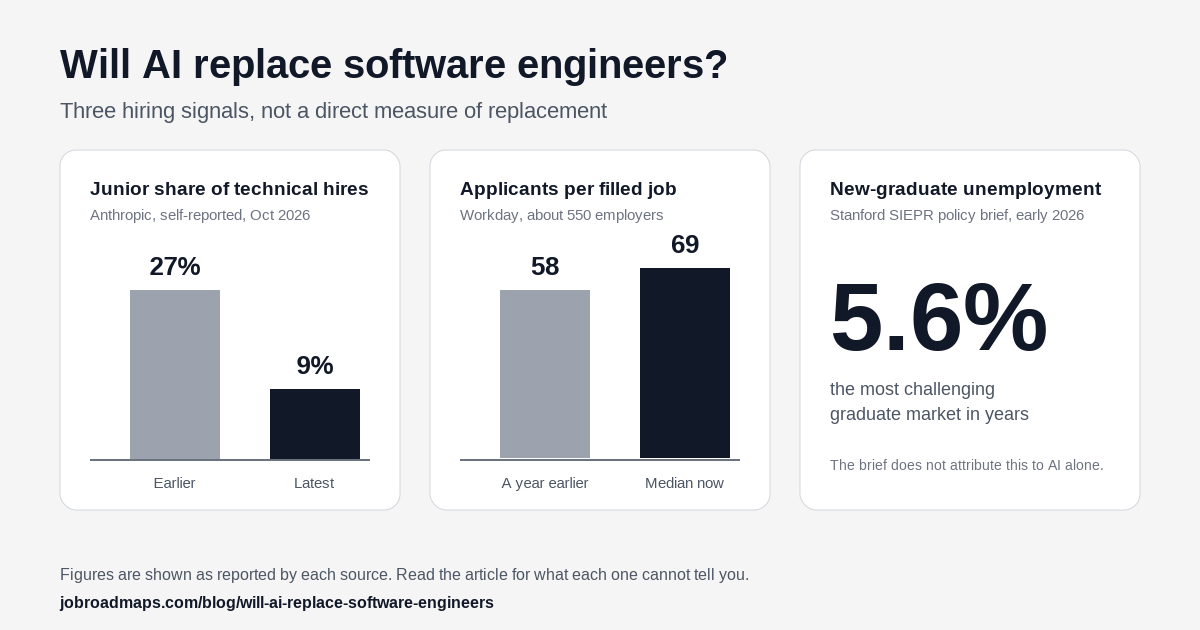
Anthropic’s internal data, published in October 2026, shows that the junior share of its technical hires fell from 27% to 9%. The same report says AI agent hours were outnumbering employees six to one by August. This is one company, which sells AI and has an unusual hiring mix, so it cannot stand for the whole industry.
PwC’s barometer points the same way across its wider sample. It reports that the number of entry-level jobs in roles highly exposed to AI has flattened, while jobs that have been “seniorised,” meaning they now ask for more experience, have grown by 35%. PwC also reports that AI specialist hiring grew eight times faster than hiring in all jobs in 2025.
03New graduates face a harder market
The SIEPR policy brief reports that new-graduate unemployment reached 5.6% in early 2026. It also calls the market for recent graduates the most challenging in years. The brief does not isolate software engineering or attribute the rise to AI alone, so read it as context for entry-level hiring rather than as proof of replacement.
04More applicants per job, not fewer jobs
Workday’s job requisition data shows a median of 69 applicants for each filled job, up from 58 a year earlier. Workday links part of that rise to AI making it easier to apply for more roles at once, and 84% of job seekers say they used AI during their search.
That is a competition story. It says that getting hired is harder, which is a different claim from saying the work is gone.
05Where demand moved
Workday reports that demand for hands-on AI skills, including building AI tools, automating workflows and AI engineering, rose 51% between September 2025 and July 2026. Lightcast reports that AI skills appear in job postings more often each year. In that sense, the work changed toward building and operating AI-enabled systems, and the engineers who do it are in demand.
The Department of Labor publishes employment projections for software developers, which cover the whole occupation rather than AI work. Our software developer salary page shows those projections next to the wage data, and the limits of both apply.
06What the evidence does not tell you
No source here shows which skills protect an engineer from replacement, and we do not claim that any does. Workday reports that heavy AI users expect their current skills to lose value, while also expecting new opportunities. That is a survey result, not a forecast.
Frequently asked questions
Will AI replace software engineers?
No source we checked measures replacement of software engineers directly. The evidence shows fewer entry-level hires at some AI-focused employers, more applicants competing for each job and rising demand for engineers who build AI systems. Our read is that the change is concentrated in hiring and in the entry path.
Is it harder for new graduates to get a software job now?
The SIEPR policy brief reports new-graduate unemployment of 5.6% in early 2026 and describes the market as the most challenging in years. It does not attribute the rise to AI alone. PwC reports that entry-level roles in AI-exposed jobs have flattened.
What do the software developer projections say?
The Department of Labor publishes projections for the software developer occupation, which covers AI and non-AI work. Our software developer salary page shows the projections with the source and date. They describe the whole occupation, not the AI part of it.
Keep reading
Disclosure: This post was produced with AI assistance and reviewed by the JR editorial team. Figures are attributed to their source and date in the text. Interpretation labeled “our read” is opinion. This is not career advice.