How to Become an AI Engineer in 2027: A Path Built From Job Postings
JR Editorial Team · Based on Lightcast, Workday and our live job postings
Published
What AI engineer postings ask for, based on Lightcast’s analysis of 2025 US postings and our own live postings: the skills employers name first, and a learning sequence we would follow.
AI engineer is not an official job category. The U.S. Department of Labor does not count it, and job titles vary from company to company. So the most reliable way to learn what the role requires is to read what employers ask for, count it, and compare the counts over time.
This guide does that. It draws on the Stanford AI Index 2026, which Lightcast prepared from billions of job postings, on Workday’s October 2026 workforce report, and on our own live postings. It proposes a learning sequence, labels that sequence as our suggestion, and says where no source gives an answer.
Sources
- Lightcast, “The Stanford AI Index Report 2026” (2026 edition, covering 2025 US job postings), lightcast.io.
- Workday, “Global Workforce Report: AI Is Rewriting Jobs More Than It’s Cutting Them,” press release dated October 5, 2026, based on skills data from about 550 employers using Workday Recruiting, September 2025 to July 2026.
- JobRoadmaps live postings: 194 AI Engineer postings as of October 4, 2026. Counts are lower bounds because only the first ~3,000 characters of each posting are stored.
01Start with the language employers name first
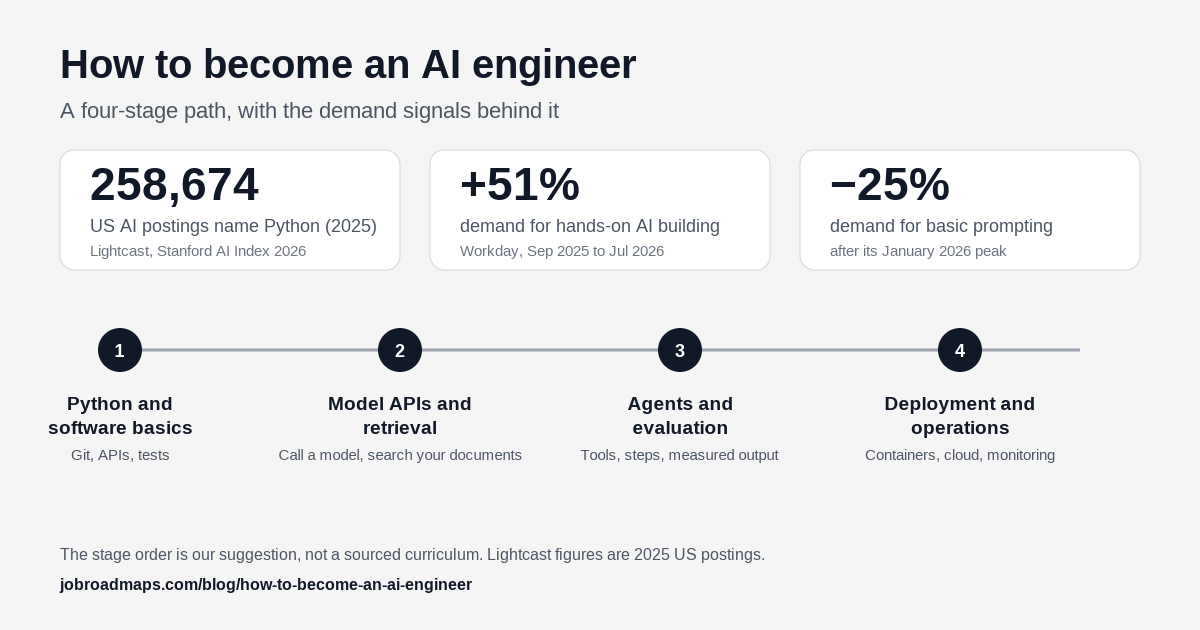
Python is the most in-demand specialized skill in US AI job postings, according to Lightcast. It appeared in 258,674 postings in 2025, up nearly 30% from 2024 and up 391% from the 2013–15 baseline.
In our own count of 194 live AI Engineer postings, Python is named in about 9% of them, TypeScript in about 7%, and fine-tuning in about 7%. These are lower bounds, and they reflect the employers in our data, which lean toward tech companies. Python leads in both sources, so it is the first thing to learn well.
02Learn to build systems, not just to prompt them
Workday reports that demand for basic AI skills, such as simple prompting, peaked in January 2026 and then fell 25% over the following months. Over the same period, demand for hands-on skills (building AI tools, automating workflows and AI engineering) rose 51% between September 2025 and July 2026.
Lightcast points the same way. Its agentic AI skill cluster rose more than 280% in one year, to roughly 90,000 US postings in 2025. Some of the fastest long-term growth came from deployment-oriented skills such as Amazon Web Services, scalability and workflow management. Our read is that employers now hire people who can make an AI system work reliably, and that a prompt alone no longer shows that.
03A learning sequence we would follow
This order is our suggestion, not a sourced curriculum. Each stage should end with something you can run and show.
Stage one is Python and software basics: functions, data handling, version control with Git, calling web APIs and writing simple tests. Stage two is working with model APIs and retrieval, which means calling a model from code and building a search over your own documents. Stage three is agents and evaluation: tools that let a model take steps, and a repeatable way to measure whether the output is right. Stage four is deployment and operations: containers, a cloud platform, logging and monitoring.
Our AI Engineer roadmap lists these areas in more detail, and the AI Agent Architect roadmap covers the agent stage on its own.
04Show the work
Hiring teams cannot check a list of tools. A small project that calls a model, retrieves documents, is tested and runs in a public repository shows more than a certificate does. Keep the repository readable: a short README that states the problem, the design choice you made and what failed.
Our portfolio catalog shows how working engineers present their projects, and our DevOps portfolio article explains what a reviewer can check in a public portfolio.
05What no source tells you
None of the sources above gives a typical time to become an AI engineer, and we do not publish one. Study hours depend on the background you start from.
Degree requirements are also not counted in this article. Before you apply, read ten postings for the role you want and note which requirements repeat. That is a small sample, but it is a real one, and it is more reliable than a general claim.
Pay is not covered here either. Our AI Engineer salary article uses Department of Labor figures and explains why no single number describes the role.
Frequently asked questions
Do I need a computer science degree to become an AI engineer?
The sources in this article do not count degree requirements for AI engineer postings, so we cannot give a sourced answer. Read postings for the role you want and note what they require. Working code and a clear project record can matter more than a degree for many employers, but that is our read, not a counted finding.
Which programming language should I learn first?
Python. Lightcast counts it in 258,674 US AI job postings in 2025, the most of any specialized skill, and it is also the most named language in our own count of live AI Engineer postings.
Is an AI engineer the same as a machine learning engineer?
The titles overlap but are not the same. Machine learning engineers usually train and serve models, while AI engineers often build products on top of existing models. Postings blur the line, so read the responsibilities in each job rather than relying on the title.
How long does it take to become an AI engineer?
We do not have a sourced timeframe, and we do not publish one. It depends on your starting skills, the hours you can give, and the kind of role you aim for.
Keep reading
Disclosure: This post was produced with AI assistance and reviewed by the JR editorial team. Figures are attributed to their source and date in the text. Interpretation labeled “our read” is opinion. This is not career advice.