AI Agent Architect Career Roadmap
AI Agent Architects design and build autonomous AI systems that take multi-step actions to accomplish complex goals. They work at the frontier of agentic AI — defining orchestration patterns, tool ecosystems, memory architectures, and safety constraints for production agents.
Is this the right path for you?
AI agent architects come from software engineering backgrounds that shipped LLM applications and kept hitting the limits of single-shot prompting, from ML engineering roles interested in autonomy and multi-step reasoning, and from AI engineers who went deeper into system design. The role is genuinely new — most of the production patterns are less than two years old.
If the gap between 'the model can do this' and 'the system reliably does this at scale' is where you focus — if you find error recovery, tool orchestration, and long-running context management more interesting than model selection — you're already thinking like an agent architect. The job rewards systematic thinking about non-deterministic systems.
The field is moving fast enough that most production patterns are less than two years old. Academic curricula haven't caught up — which means learning from people who are building (GitHub repos, technical blog posts, paper implementations, conference talks) is more valuable right now than formal coursework. Being current matters more here than in most technical fields.
Career Progression
Where does this role lead?
Click any role to explore timeline, key skills and, where the Department of Labor publishes it, pay.
Entry
AI Engineer
~1–2 yrs
$94,286 (Level I)
Build, ship, and debug AI agents. Most of this stage is learning what actually works: when agents fail, why they fail, and how to make them reliable enough to ship to users.
Key skills
Pay shown is the U.S. Department of Labor prevailing wage for Level I (entry), Level III (mid) and Level IV (senior) in the nearest BLS occupation, base wage for the typical metro, wage year 2025, shown for the main track only. It is a benchmark, not an offer; branches and lead, staff and executive stages have no official figure.
Visual roadmap
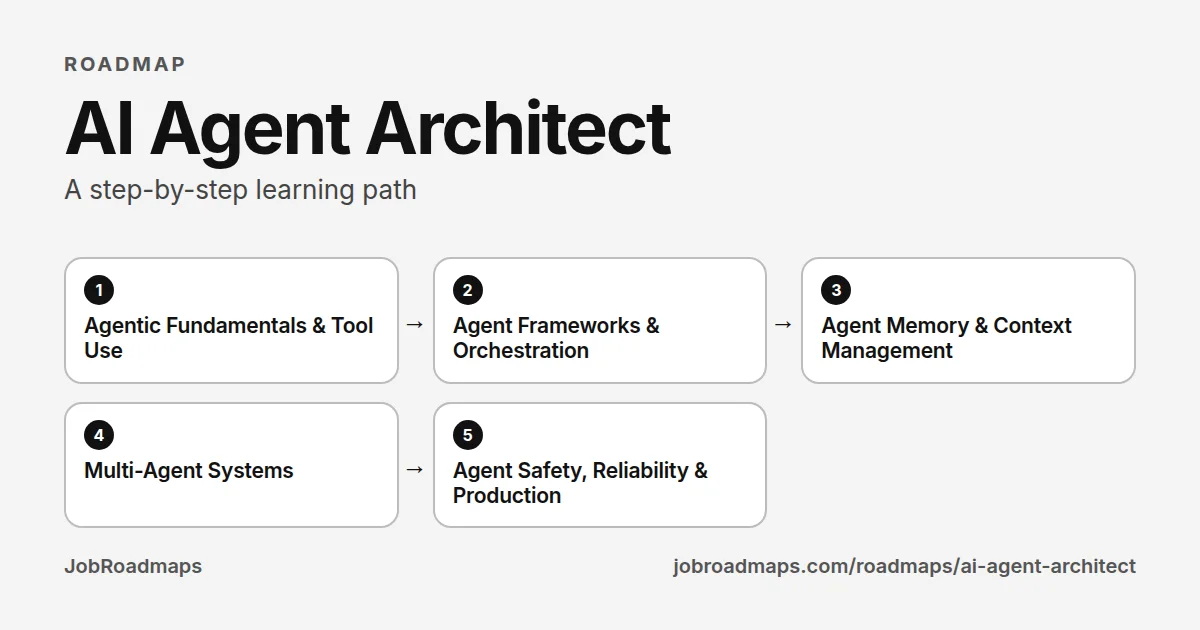
AI Agent Architect learning path
Work down the line, one step at a time. Tick each skill as you can do it.
- 1
Agentic Fundamentals & Tool Use
4–6 weeksMaster function calling and tool use with Claude, GPT-4, and Gemini. Build ReAct agents that reason and act in loops. Understand agentic failure modes: infinite loops, hallucinated tool calls, and compounding errors.
Skills to learn
- Function Calling
- ReAct Pattern
- Tool Use
- Structured Outputs
- Anthropic Tool Use
- OpenAI Function Calling
- 2
Agent Frameworks & Orchestration
6–8 weeksLearn the major agent frameworks: LangGraph for stateful agents, CrewAI for role-based multi-agent systems, AutoGen for conversational agents, and the Anthropic Agent SDK. Understand when to use each and how to avoid framework lock-in.
Skills to learn
- LangGraph
- CrewAI
- AutoGen
- Anthropic Agent SDK
- Workflow Graphs
- State Machines for Agents
- 3
Agent Memory & Context Management
5–7 weeksDesign memory architectures: in-context (scratch pad), external (vector store retrieval), episodic (conversation history), and semantic (entity extraction). Solve context window limits with summarisation and compression strategies.
Skills to learn
- In-Context Memory
- Vector Memory
- Memory Compression
- Entity Extraction
- Session Management
- Long-Horizon Planning
- 4
Multi-Agent Systems
6–8 weeksBuild systems where specialised agents collaborate: orchestrator-worker patterns, debate and critique loops, parallel execution, and agent handoffs. Design communication protocols between agents and handle disagreement and recovery.
Skills to learn
- Orchestrator-Worker Pattern
- Agent Communication Protocols
- Parallel Agent Execution
- Agent Handoffs
- Subagent Spawning
- Hierarchical Planning
- 5
Agent Safety, Reliability & Production
6–8 weeksBuild safe agents: human-in-the-loop confirmation, action sandboxing, permission scoping, and rollback mechanisms. Implement observability with full action traces. Design circuit breakers and cost caps. Test agents with adversarial inputs.
Skills to learn
- Human-in-the-Loop
- Action Sandboxing
- Permission Scoping
- Agent Observability
- Cost Caps
- Adversarial Testing
jobroadmaps.com/roadmaps/ai-agent-architect · Pay, demand and employer data for this role are further down the page.
Job Market Insights for AI Agent Architect
Data-backed
What do employers actually ask for?
Read from live job postings — how often each credential is named, from rare to almost always.
"Computer Science background" is the most common credential named, yet it appears only rarely in what we could read. Postings that state it are the minority, but these counts are a floor, so do not read this as "no one asks".
Some postings say outright that equivalent experience or a self-taught route is accepted. That wording is worth reading closely when you see it.
Our read: a portfolio that proves the skill, and a referral from someone inside the company, usually carry more weight than a credential match on paper. That is judgement, not something these counts measure.
Requirement
How often named
Computer Science background
Bachelor's degree
Equivalent experience accepted
Master's degree
Certification mentioned
Our read: how often a credential is named is not how strictly it is enforced. Equivalent experience, a standout portfolio, or a referral often counts for more than the credential listed.
Data-backed
Which skills appear most in job postings?
Read from live job postings, ranked from most to least often named.
Postings for this role rarely list skills by name. The most-named, Evaluation frameworks, is still only occasional, so none of these is a universal requirement.
Skill
How often named
Evaluation frameworks
Production systems
Large language models
Solution architecture
Agent design
Mentorship
Data pipelines
API design
Multi-agent orchestration
Code review
Context engineering
Distributed systems
Retrieval-augmented generation
Workflow automation
Sorted by how often named · JobRoadmaps
Data-backed
Which tools and artifacts appear most in job postings?
Read from live job postings, ranked from most to least often named.
Claude is the most-named tool, but no tool is a universal requirement here.
Tool / Artifact
How often named
Claude
LangGraph
Salesforce
Elastic
GitHub
Cursor
Notion
Sorted by how often named · JobRoadmaps
Industry overlay
Targeting a specific industry?
The core roadmap gets you through the door anywhere. The difference between "qualified" and "they hired someone else" often lives in industry-specific context — the norms, the compliance floors, the tools assumed fluent in that sector.
Agent safety for B2B contexts
Agents acting on behalf of business users must have strict permission scoping — the blast radius of an error in a CRM is far higher than in a consumer app.
Tool ecosystem design
SaaS agents need large tool libraries (API integrations, data lookups, email, calendar). Designing discoverable, reliable tool ecosystems is a core architectural challenge.
Companies hiring:
SalesforceHubSpotNotionZapierMakeAgent runtime design
Building the execution environment for agents at platform level is a distributed systems challenge — fault tolerance, sandboxing, and resource limits are first-class concerns.
Developer SDK design
Agent frameworks are developer tools — the usability and ergonomics of the SDK directly affects adoption among the engineers who build agents on the platform.
Companies hiring:
AnthropicOpenAILangChainE2BComposioIndustry premiums based on aggregated job posting data · Updated quarterly
Interactive
How ready are you right now?
Check the skills you already have to see your current job-market fit.
The most-named skill for this role is Evaluation frameworks, so a gap there costs you the most. No single skill dominates, but each gap narrows which postings fit you. Check what you already have to see your biggest current gap.
Readiness Check
Check the skills you already have
0/5
base skills
Your biggest gap: Evaluation frameworks, the most often named of the skills you have not ticked.
Start there, then work down the list.
Books worth reading as a AI Agent Architect
Where to start, in order. The full list of 11, grouped by career stage, is on its own page.
Getting started

Hands-On Large Language Models
by Jay Alammar, Maarten Grootendorst · 2024
~400 pages~10 hrs to read
A visual, code-first tour of tokens, embeddings, text generation, semantic search, RAG and fine-tuning. Read it first if you can program but have not yet built on language models.
View book →
Prompt Engineering for LLMs
by John Berryman, Albert Ziegler · 2024
~250 pages~6 hrs to read
Covers how models read a prompt and how to assemble context, structure instructions and build prompts into applications. Good early on, when most of your output is prompts and the glue around them.
View book →
Doing the job
Building Applications with AI Agents
by Michael Albada · 2025
~350 pages~9 hrs to read
Covers designing agentic systems: tools, planning, memory, multi-agent orchestration, evaluation and safety. Read it when you move from single-prompt features to systems that take actions on their own.
View book →AI Agents and Applications: With LangChain, LangGraph, and MCP
by Roberto Infante · 2025
Builds agents and agent-powered applications using LangChain, LangGraph and the Model Context Protocol. Use it to practise tool use and orchestration patterns in code.
View book →
Senior and leading

Artificial Intelligence: A Modern Approach
by Stuart Russell, Peter Norvig · 1995
~1140 pages~29 hrs to read
The standard survey of the field, organised around rational agents: search, planning, knowledge, uncertainty, learning and acting. Read the agent and planning chapters to ground modern LLM agents in decades of prior work.
View book →
An Introduction to MultiAgent Systems
by Michael Wooldridge · 2002
~460 pages~12 hrs to read
Covers agent architectures, communication, coordination, negotiation and cooperation among autonomous agents. Read it before you design multi-agent systems, so you start from known problems rather than rediscovering them.
View book →
All 11 books for a AI Agent Architect →Browse all books →
Some book links are affiliate links: we earn a small commission if you buy, at no cost to you. It does not affect what we list.
Prerequisites & Education
What credentials do employers look for?
These are the most common paths into this role — no single one is required.
Education
View list — coming soon- BS/MS in Computer Science or AI — formal CS training helps with the algorithmic thinking required for reliable agent design
- Self-taught with deep LLM API experience — viable if you have shipped production agent systems
- DeepLearning.AI short courses on agents and multi-agent systems — strong accelerator for working engineers
AI Agent Architecture is a frontier role. Demonstrated shipped systems matter far more than credentials at this stage of the field.
Certifications
View list — coming soon- DeepLearning.AI — AI Agents in LangGraph (free–$49/mo) — the most directly relevant course for agent architecture
- DeepLearning.AI — Multi-Agent Systems with CrewAI (free–$49/mo) — covers orchestration patterns
- DeepLearning.AI — Agentic RAG (free–$49/mo) — essential for agents that need external knowledge retrieval
Formal certifications carry less weight than demonstrable built systems. The field moves faster than certification bodies can track.
Bootcamps & Self-Study Paths
View list — coming soon- Anthropic Claude Agent SDK documentation + examples — free, self-paced, best starting point for Claude-based agents
- LangGraph documentation and tutorials — the leading framework for stateful multi-agent systems
- Hugging Face Agents Course — free, practical, covers tool use, memory, and multi-agent patterns
The best training is building agents and documenting what breaks. Open-source agent projects with detailed READMEs build reputation faster than any structured programme.
Portfolio
View list — coming soon- Production multi-agent system with documented architecture, failure modes, and recovery strategies
- Agent memory system comparison: in-context vs. vector vs. episodic — with benchmarked results
- Human-in-the-loop agent with full audit trail and rollback demonstration
- Adversarial agent testing report documenting attack vectors and mitigations
Agent architecture is still frontier territory — blog posts, meetup talks, and open-source contributions to agent frameworks are powerful differentiators. Show you're doing original thinking, not just using existing frameworks.
Your Roadmap
5 stepsAgentic Fundamentals & Tool Use
4–6 weeksMaster function calling and tool use with Claude, GPT-4, and Gemini. Build ReAct agents that reason and act in loops. Understand agentic failure modes: infinite loops, hallucinated tool calls, and compounding errors.
Skills to learn
Agent Frameworks & Orchestration
6–8 weeksLearn the major agent frameworks: LangGraph for stateful agents, CrewAI for role-based multi-agent systems, AutoGen for conversational agents, and the Anthropic Agent SDK. Understand when to use each and how to avoid framework lock-in.
Skills to learn
Agent Memory & Context Management
5–7 weeksDesign memory architectures: in-context (scratch pad), external (vector store retrieval), episodic (conversation history), and semantic (entity extraction). Solve context window limits with summarisation and compression strategies.
Skills to learn
Multi-Agent Systems
6–8 weeksBuild systems where specialised agents collaborate: orchestrator-worker patterns, debate and critique loops, parallel execution, and agent handoffs. Design communication protocols between agents and handle disagreement and recovery.
Skills to learn
Agent Safety, Reliability & Production
6–8 weeksBuild safe agents: human-in-the-loop confirmation, action sandboxing, permission scoping, and rollback mechanisms. Implement observability with full action traces. Design circuit breakers and cost caps. Test agents with adversarial inputs.
Skills to learn
Start here this week
This week: build an agent that uses at least two tools and has to make a decision about which one to use. Then break one of the tools deliberately — return an error, return wrong data — and observe what the agent does. Document the failure behavior. That failure analysis is the beginning of agent reliability engineering.
For structured entry, Anthropic's documentation on tool use and agentic patterns, LangChain's agent documentation, and the AutoGen project from Microsoft Research are the best current references. The short courses from DeepLearning.AI on agentic AI cover the core patterns. Read the academic papers on ReAct, Toolformer, and HuggingGPT — the implementation details matter.
Pay
U.S. Department of Labor data for the nearest BLS occupation, Computer and information research scientists. BLS has no occupation for this exact title, so treat these as a benchmark.
Median: U.S. Bureau of Labor Statistics, Occupational Employment and Wage Statistics (median wage, May 2024) and Employment Projections (2024–34). Levels: U.S. Department of Labor Office of Foreign Labor Certification prevailing wage levels (wage year 2025, typical metro), a base-wage benchmark for the metro in the middle of 77 areas, not an offer. See every metro.
Job Titles at Each Level
Entry
AI Engineer / Agent Engineer
Mid
AI Agent Architect / Senior AI Engineer
Senior
Principal AI Architect / Head of Agentic AI
Steps Overview
- 1
Agentic Fundamentals & Tool Use
4–6 weeks
- 2
Agent Frameworks & Orchestration
6–8 weeks
- 3
Agent Memory & Context Management
5–7 weeks
- 4
Multi-Agent Systems
6–8 weeks
- 5
Agent Safety, Reliability & Production
6–8 weeks
Explore more roadmaps
Not sure this is the right path? Browse all tech career roadmaps.
View Similar RoadmapsBuilt a project while following this roadmap?
Turn it into a hiring-ready case study in 10 seconds — free.
Ready to explore more?
Browse all career roadmaps across tech, business, and creative fields.