QA Engineer (SDET) Career Roadmap
A QA engineer is the person who finds out what the software really does before customers do. You design tests from a requirement, run them by hand where judgement is needed, automate the ones worth repeating, and report defects in a form a developer can act on without a follow-up. At the engineering end of the same track the title becomes SDET (software development engineer in test): you write the test frameworks, the tooling and the pipeline checks that let a whole team ship quickly without breaking things. It is software work with a sceptical mind. Not hardware or supplier quality, not compliance auditing, and not IT support.
Is this the right path for you?
The routes in are varied. Manual testers who learn to code and move into automation. Support and IT staff who already reproduce bugs for a living. Junior developers who enjoy breaking things more than building them. Graduates with a computer science or related degree, and career changers with a portfolio of automated tests on a real app. What every route shares is evidence you can find defects and write them up clearly, plus enough code to automate the repetitive ones. Expect to start with some experience: in the live postings we track, 135 carry QA or SDET titles across 42 companies, and only 7 use intern or associate wording.
The temperament is a sceptical optimist who cares about the user. You want the product to be good, so you assume it is not yet and go and look. You like edge cases, you can disagree with a developer without a fight, and you can explain a problem to a product manager and to an engineer in different words. If you want to build features rather than guard them, a development role is a better fit; if you like finding the weak seam, this is a real career with a technical ceiling.
Honest note: the title is a family, not a single job. Postings say QA Engineer, QA Analyst, Test Engineer, Quality Engineer, SDET and Software Engineer in Test, and the same words are used for hardware, manufacturing and supplier quality, which are different careers and are not covered here. Read the requirements, not just the title. Of the 135 titles, 50 are SDET, software-engineer-in-test or test-automation roles and only 8 say manual; 66 carry senior-level words (senior, staff, principal, lead). Of the 134 postings with stored text, 53 name a programming language and 30 mention CI/CD or a pipeline tool. The demand we see is also concentrated: Ubiquiti (22) and Veeva (15) post the most, ahead of Circle (8) and Okta (7), and our sample leans toward software and infrastructure companies, so seats in banks, retailers or agencies will read differently.
Career Progression
Where does this role lead?
Click any role to explore timeline, key skills and, where the Department of Labor publishes it, pay.
Entry
Junior QA Engineer / QA Analyst
~0–2 yrs
$54,101 (Level I)
You run test plans, find defects and write them up so a developer can reproduce them. Entry seats are often more manual than the postings for later levels, so use them to learn the product deeply and start automating your own repetitive checks.
Key skills
Pay shown is the U.S. Department of Labor prevailing wage for Level I (entry), Level III (mid) and Level IV (senior) in the nearest BLS occupation, base wage for the typical metro, wage year 2025, shown for the main track only. It is a benchmark, not an offer; branches and lead, staff and executive stages have no official figure.
Visual roadmap
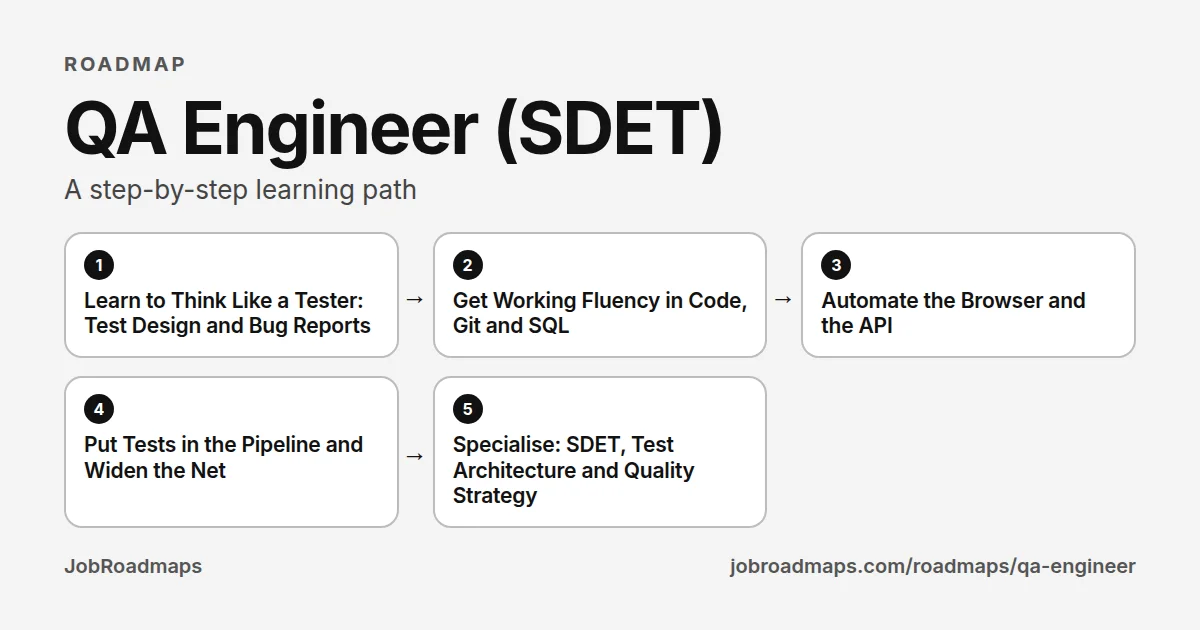
QA Engineer learning path
Work down the line, one step at a time. Tick each skill as you can do it.
- 1
Learn to Think Like a Tester: Test Design and Bug Reports
4–6 weeksBefore any tool, learn the thinking. Turn a requirement into test cases with equivalence classes, boundaries and decision tables; explore a feature without a script and note what surprised you; write a bug report that a developer can reproduce from your steps alone. This is what interviewers probe first, and it is what separates a tester from someone who clicks through a checklist. Practise on real software: pick an app you use and write ten test cases and three bug reports for it.
Skills to learn
- Test case design (equivalence classes, boundary values, decision tables)
- Exploratory testing
- Writing a reproducible bug report
- Severity, priority and risk
- Test plans and regression suites
- Reading requirements and user stories
- Testing vocabulary (ISTQB)
Start with
- 2
Get Working Fluency in Code, Git and SQL
8–12 weeksAutomation is programming, and the postings we track ask for it by name. Pick one language and stay with it: Python, JavaScript or TypeScript, or Java, whichever your target employers use. Learn enough to write functions, read other people's code and use a test runner (pytest, JUnit or Jest). Add Git for branches and pull requests, and SQL so you can check what a test actually wrote to the database.
Skills to learn
- One language: Python, JavaScript/TypeScript or Java
- Unit testing with pytest, JUnit or Jest
- Git branches and pull requests
- SQL queries to verify test data
- Reading a stack trace
- Command line basics
Start with
- 3
Automate the Browser and the API
8–12 weeksNow automate what is worth repeating. Learn one UI tool well (Playwright, Selenium or Cypress), organise tests so they survive UI changes, and learn to tell a real failure from a flaky test. Then test the API underneath the UI: cheaper, faster and more stable. Build one portfolio project that tests a public web app both ways and runs on every commit.
Skills to learn
- Playwright, Selenium or Cypress
- Locators and waiting strategies
- Page objects and test structure
- Diagnosing flaky tests
- API testing (REST, JSON, authentication)
- Postman and scripted API checks
- Test data setup and cleanup
Start with
- 4
Put Tests in the Pipeline and Widen the Net
6–10 weeksTests only protect a team when they run automatically. Wire your suite into continuous integration so every pull request runs it, keep it fast enough that people do not skip it, and report results where developers will see them. Then widen what you cover: performance under load, accessibility, basic security checks and, if your target employers ship apps, mobile.
Skills to learn
- CI pipelines (GitHub Actions, Jenkins or GitLab CI)
- Running tests in containers
- Test reporting and failure triage
- Performance testing basics (k6, JMeter)
- Accessibility checks
- Security testing basics
- Mobile test automation (Appium)
Start with
- 5
Specialise: SDET, Test Architecture and Quality Strategy
OngoingSenior seats stop asking how many tests you wrote and start asking how reliably the team ships. SDET roles expect you to design the framework others write tests in, build test infrastructure and fixtures, and choose what to test at which level (unit, integration, end to end) instead of defaulting to the browser. Pick a direction: test architecture, performance and reliability, security testing, or quality leadership for a product area.
Skills to learn
- Test framework and tooling design
- Test strategy and the test pyramid
- Contract and integration testing
- Test infrastructure and environments
- Quality metrics that drive decisions
- Testing in production and observability
- Mentoring and influencing engineers
Start with
jobroadmaps.com/roadmaps/qa-engineer · Pay, demand and employer data for this role are further down the page.
Job Market Insights for QA Engineer
Data-backed
What do employers actually ask for?
Read from live job postings — how often each credential is named, from rare to almost always.
"Certification mentioned" is the most common credential named, yet it appears only rarely in what we could read. Postings that state it are the minority, but these counts are a floor, so do not read this as "no one asks".
Some postings say outright that equivalent experience or a self-taught route is accepted. That wording is worth reading closely when you see it.
Our read: a portfolio that proves the skill, and a referral from someone inside the company, usually carry more weight than a credential match on paper. That is judgement, not something these counts measure.
Requirement
How often named
Certification mentioned
Computer Science background
Equivalent experience accepted
Bachelor's degree
Master's degree
Our read: how often a credential is named is not how strictly it is enforced. Equivalent experience, a standout portfolio, or a referral often counts for more than the credential listed.
Data-backed
Which skills appear most in job postings?
Read from live job postings, ranked from most to least often named.
test automation is the most-named skill. Common, but not universal: many postings do not list it.
Past the fundamentals, 2 specialisation skills (test automation included) start separating candidates who can do the job from candidates who have done it. The 18 niche skills are named rarely enough that knowing them is upside, not prerequisite.
Skill
How often named
test automation
manual testing
test strategy
Jira
Selenium
quality metrics
code review
regression testing
Appium
integration testing
Sorted by how often named · JobRoadmaps
Data-backed
Which tools and artifacts appear most in job postings?
Read from live job postings, ranked from most to least often named.
No tool dominates. The most-named, Jenkins, is still rare; postings for this role rarely list tools by name.
Industry overlay
Targeting a specific industry?
The core roadmap gets you through the door anywhere. The difference between "qualified" and "they hired someone else" often lives in industry-specific context — the norms, the compliance floors, the tools assumed fluent in that sector.
Database and data-pipeline testing
Fivetran posts SDET roles for database automation, where correctness of data movement is the product.
Test automation as a core engineering job
Veeva posts test-automation seats from associate engineer to lead engineer, and Appian a Test Automation Engineer role, so automation is the main career line rather than a side skill.
Agent and AI feature testing
Dialpad posts SDET roles marked agentic, which means checking AI-driven behaviour that does not return the same answer twice.
Endpoint and agent software testing
Kaseya posts a senior staff SDET role for its endpoint agent, software that runs on customers' machines and must be tested across environments.
Companies hiring:
FivetranVeevaAppianZeta GlobalDialpadKaseyaConnectWiseMobile application testing
Coinbase posts a Senior Software Engineer, Mobile QA role, which combines app development skill with test strategy.
Quality engineering for financial platforms
Stripe posts a Software Quality Assurance Engineer role and Circle posts Senior Quality Engineer roles, where tests have to cover payment and ledger behaviour.
Support-quality operations
Adyen posts a Quality Assurance team lead role in support excellence, a reminder that QA titles also exist outside engineering.
Companies hiring:
StripeCoinbaseCircleAdyenIndustry premiums based on aggregated job posting data · Updated quarterly
Interactive
How ready are you right now?
Check the skills you already have to see your current job-market fit.
The most-named skill for this role is test automation, so a gap there costs you the most. No single skill dominates, but each gap narrows which postings fit you. Check what you already have to see your biggest current gap.
Readiness Check
Check the skills you already have
0/5
base skills
Your biggest gap: test automation, the most often named of the skills you have not ticked.
Start there, then work down the list.
Books worth reading as a QA Engineer
Where to start, in order. The full list of 12, grouped by career stage, is on its own page.
Getting started

Lessons Learned in Software Testing: A Context-Driven Approach
by Cem Kaner, James Bach, Bret Pettichord · 2001
~320 pages~8 hrs to read
Short numbered lessons from three working testers on designing tests, finding bugs, writing reports and working with developers. Read it in your first months to pick up a tester's habits and arguments before you have strong ones of your own.
View book →
Agile Testing: A Practical Guide for Testers and Agile Teams
by Lisa Crispin, Janet Gregory · 2009
~580 pages~15 hrs to read
Shows how testers work inside agile teams: what to test at which level, how to plan, and how to collaborate with developers instead of acting as a gate. Useful when you join a team that ships every sprint.
View book →
Doing the job
Python Testing with pytest: Simple, Rapid, Effective, and Scalable
by Brian Okken · 2017
Covers writing, organising and parameterising tests with pytest, including fixtures and plugins. Read it when you automate in Python and your tests are growing past a single file.
View book →Experiences of Test Automation: Case Studies of Software Test Automation
by Dorothy Graham, Mark Fewster · 2012
Case studies from teams that built test automation, including what went wrong and why. Useful before you design your first framework, or when keeping the suite alive is taking most of your week.
View book →
Senior and leading

How Google Tests Software
by James Whittaker, Jason Arbon, Jeff Carollo · 2012
~310 pages~8 hrs to read
Describes how a large engineering organisation structures testing roles, test sizes and release readiness. Helps senior engineers think about test strategy beyond a single team.
View book →
Software Engineering at Google: Lessons Learned from Programming Over Time
by Titus Winters, Tom Manshreck, Hyrum Wright · 2020
~600 pages~15 hrs to read
Has chapters on testing at scale, including test sizes, flaky tests and test infrastructure. Useful when you design frameworks and need arguments for how a large codebase stays testable.
View book →
All 12 books for a QA Engineer →Browse all books →
Some book links are affiliate links: we earn a small commission if you buy, at no cost to you. It does not affect what we list.
Courses and certifications for a QA Engineer
12 courses, tutorials and certifications, each read on the provider's own page. One from each stage to start; the full list, with a guide to choosing, is on its own page.
Getting started · Course
Test Automation University
Applitools
Doing the job · Course
Software Testing and Automation Specialization
University of Minnesota (on Coursera)
Senior and leading · Certification
ISTQB Certified Tester Advanced Level, Test Automation Engineering (CTAL-TAE v2.0)
ISTQB
Prerequisites & Education
What credentials do employers look for?
These are the most common paths into this role — no single one is required.
Education Level
View list — coming soon- Bachelor's in computer science, software engineering or a related field — the clearest signal, and the usual one for SDET seats
- Bachelor's in any field plus automated tests you have written and published — a common route for career changers
- Associate degree, bootcamp or self-taught with a portfolio of working test automation — possible when the code is public and good
- Experience in support, IT or manual testing plus a clear path into automation — often how people move across inside a company
Check the requirements in the postings you target: some name a degree, many accept equivalent experience, and SDET postings tend to read like software engineering ones. A repository of well-structured tests is the strongest single piece of evidence you can show.
Certifications
View list — coming soon- ISTQB Certified Tester Foundation Level (CTFL) — the common vocabulary of testing and a structured way to learn test design
- ISTQB Certified Tester Advanced Level, Test Automation Engineering — worth considering once you design frameworks
- Postman API Fundamentals Student Expert — free, and a quick credential for API testing
- AWS Certified Cloud Practitioner — useful when your tests run against cloud environments
Certifications are a modest signal in this field, and the choice depends on the employer. Most hiring managers care more about a working framework you can walk them through than about a certificate.
Bootcamps & Training
View list — coming soon- Test Automation University (Applitools) — free, language-specific courses from practising automation engineers
- Playwright and Selenium official documentation and tutorials — the quickest way to learn the tool you will be using
- Ministry of Testing — articles, talks and a community focused on the craft of testing
- Google Testing Blog — free articles on test design and engineering practice from a large engineering organisation
A paid bootcamp is rarely necessary. Free courses plus a public project give you the same evidence at no cost.
Portfolio & Other
View list — coming soon- A repository that tests a public web app with Playwright, Selenium or Cypress, with a README that says what is covered and why
- An API test suite that runs in CI on every commit, with results visible in the repo
- Five well-written bug reports for a real product, each with steps, expected result, actual result and evidence
- A short test strategy for a feature you know: risks, test levels, what you would automate and what you would not
- A write-up of a flaky test you diagnosed: symptoms, cause and fix
Hiring managers cannot see your judgement on a CV. A public test repository and clear bug reports show how you think, which is the part of the job that is hardest to fake.
Your Roadmap
5 stepsLearn to Think Like a Tester: Test Design and Bug Reports
4–6 weeksBefore any tool, learn the thinking. Turn a requirement into test cases with equivalence classes, boundaries and decision tables; explore a feature without a script and note what surprised you; write a bug report that a developer can reproduce from your steps alone. This is what interviewers probe first, and it is what separates a tester from someone who clicks through a checklist. Practise on real software: pick an app you use and write ten test cases and three bug reports for it.
Skills to learn
Get Working Fluency in Code, Git and SQL
8–12 weeksAutomation is programming, and the postings we track ask for it by name. Pick one language and stay with it: Python, JavaScript or TypeScript, or Java, whichever your target employers use. Learn enough to write functions, read other people's code and use a test runner (pytest, JUnit or Jest). Add Git for branches and pull requests, and SQL so you can check what a test actually wrote to the database.
Skills to learn
Automate the Browser and the API
8–12 weeksNow automate what is worth repeating. Learn one UI tool well (Playwright, Selenium or Cypress), organise tests so they survive UI changes, and learn to tell a real failure from a flaky test. Then test the API underneath the UI: cheaper, faster and more stable. Build one portfolio project that tests a public web app both ways and runs on every commit.
Skills to learn
Put Tests in the Pipeline and Widen the Net
6–10 weeksTests only protect a team when they run automatically. Wire your suite into continuous integration so every pull request runs it, keep it fast enough that people do not skip it, and report results where developers will see them. Then widen what you cover: performance under load, accessibility, basic security checks and, if your target employers ship apps, mobile.
Skills to learn
Specialise: SDET, Test Architecture and Quality Strategy
OngoingSenior seats stop asking how many tests you wrote and start asking how reliably the team ships. SDET roles expect you to design the framework others write tests in, build test infrastructure and fixtures, and choose what to test at which level (unit, integration, end to end) instead of defaulting to the browser. Pick a direction: test architecture, performance and reliability, security testing, or quality leadership for a product area.
Skills to learn
Start here this week
This week: pick a small web app you use and write ten test cases for one feature, using boundaries and invalid inputs, not just the happy path. Run them, then write up any failure as a bug report a stranger could reproduce. That one loop, design, run, report, is the core of the job and gives you something to show.
For structure: spend the first month on test design and the ISTQB Foundation syllabus, the next two on one language and Git, then automate your own tests with Playwright and run them on every commit with GitHub Actions. Put the project on GitHub with a README that says what you tested and what you found. Apply to QA Engineer and QA Automation roles, and aim for SDET once you can design a framework, not just write tests.
Pay
U.S. Department of Labor data for the nearest BLS occupation, Software quality assurance analysts and testers. BLS has no occupation for this exact title, so treat these as a benchmark.
Median: U.S. Bureau of Labor Statistics, Occupational Employment and Wage Statistics (median wage, May 2024) and Employment Projections (2024–34). Levels: U.S. Department of Labor Office of Foreign Labor Certification prevailing wage levels (wage year 2025, typical metro), a base-wage benchmark for the metro in the middle of 267 areas, not an offer. See every metro.
Job Titles at Each Level
Entry
Junior QA Engineer / QA Analyst
Mid
QA Engineer / QA Automation Engineer
Senior
Senior QA Engineer / SDET / Staff Quality Engineer
Steps Overview
- 1
Learn to Think Like a Tester: Test Design and Bug Reports
4–6 weeks
- 2
Get Working Fluency in Code, Git and SQL
8–12 weeks
- 3
Automate the Browser and the API
8–12 weeks
- 4
Put Tests in the Pipeline and Widen the Net
6–10 weeks
- 5
Specialise: SDET, Test Architecture and Quality Strategy
Ongoing
Explore more roadmaps
Not sure this is the right path? Browse all tech career roadmaps.
View Similar RoadmapsBuilt a project while following this roadmap?
Turn it into a hiring-ready case study in 10 seconds — free.
Ready to explore more?
Browse all career roadmaps across tech, business, and creative fields.