Implementation Consultant Career Roadmap
An implementation consultant takes a customer from a signed contract to a working system. You gather the requirements, configure the product, plan and move the customer's data, connect it to their other systems, train the people who will use it and carry the project to go-live. The postings use several names for the same job: implementation consultant, implementation engineer, solution implementation manager and implementation specialist. It is not a software developer's job, not a customer success manager's (which continues after go-live), not a support engineer's, and not a project manager of the customer's whole programme.
Is this the right path for you?
The routes in are varied. Support engineers and analysts who like projects with an end date. Customer success and onboarding staff who want more technical ownership. Consultants and project coordinators moving into software. Graduates in information systems, business or engineering who can show a real rollout. We track 72 postings with implementation titles across 16 companies, and Veeva (23), Samsara (14), Brex (10), Adyen (8) and Stripe (5) post the most. Several employers post early-career seats, including Veeva's intern role and Brex's level-one consultant, but most expect some delivery experience.
The temperament is a steady organiser who enjoys making a messy change land. You like checklists and also know when to depart from them, you can ask a customer the same question three ways until the real requirement appears, and you stay calm when go-live is two days away and data is wrong. If you want to write product code, a development role fits better; if you want a long account relationship after go-live, look at customer success or technical account management.
Honest note: the title covers different jobs, so read the requirements. Of the 72 titles, 21 carry senior-level words and 4 are manager or director roles. In the stored text of the postings, 33 mention travel, 27 mention project management or planning, 23 mention healthcare or life sciences, 21 mention integrations, 19 mention stakeholders, 17 mention requirements and 17 mention configuration. Our sample leans toward software and infrastructure companies, and Veeva alone supplies nearly a third of the postings, so consulting firms and in-house implementation teams will read differently.
Career Progression
Where does this role lead?
Click any role to explore timeline, key skills and, where the Department of Labor publishes it, pay.
Entry
Associate Implementation Consultant
~0–2 yrs
You support a lead consultant on live projects: configuring parts of the product, preparing data and running training sessions. Entry seats are scarce, so many people arrive from support, analyst or coordinator roles.
Key skills
Visual roadmap
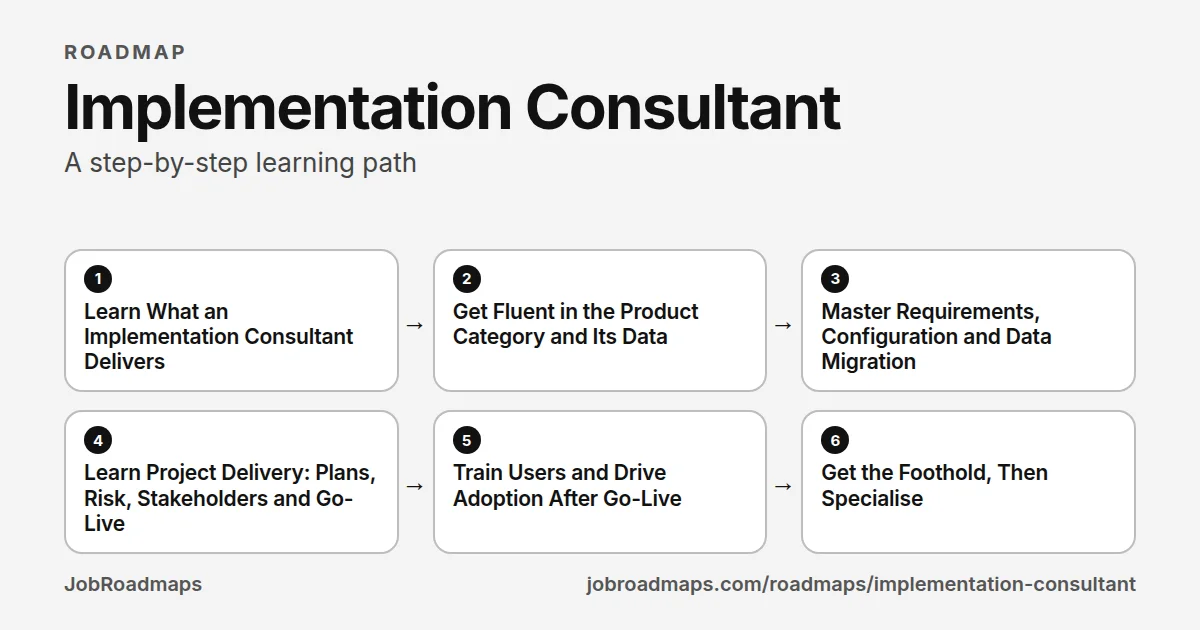
Implementation Consultant learning path
Work down the line, one step at a time. Tick each skill as you can do it.
- 1
Learn What an Implementation Consultant Delivers
1–2 weeksStart with the project, not the tool. An implementation runs in phases: kickoff, requirements, configuration, data migration, integration, testing, training, go-live and handover. Read two or three postings from the companies you want and note which phase they stress, because the title covers very different work. Some seats are configuration-heavy and close to a business analyst; others are integration-heavy and close to a software engineer.
Skills to learn
- Implementation phases from kickoff to handover
- Implementation consultant versus project manager, support engineer and customer success manager
- Statements of work, scope and change requests
- Customer onboarding versus implementation
- Reading a posting for the real balance of the job
Start with
- 2
Get Fluent in the Product Category and Its Data
8–12 weeksYou cannot configure what you cannot read. Pick the product category you want to implement (life-sciences software, payments, fleet and operations platforms, planning tools or developer platforms) and learn how its data is organised: the objects, the fields, the relationships and the workflows. Learn enough SQL and spreadsheet skill to inspect a customer's data and spot problems before migration, and enough about APIs to follow an integration.
Skills to learn
- One product category and its data model
- SQL for inspecting and checking data
- Spreadsheet analysis for data clean-up
- REST APIs and authentication basics
- Reading integration documentation
- Configuration versus customisation
Start with
- 3
Master Requirements, Configuration and Data Migration
8–12 weeksThis is the core craft. Turn a customer's messy description of how they work into requirements you can configure against, and tell what the product does out of the box from what needs custom work. Plan data migration as its own workstream: map fields, clean the source, load in rehearsals, reconcile the result. Most implementations that slip, slip here, so keep a written trail of decisions the customer signed off.
Skills to learn
- Requirements gathering and workshops
- Process mapping and fit-gap analysis
- Product configuration against requirements
- Data mapping, cleansing and migration rehearsals
- Integration design and testing
- Documenting decisions and sign-offs
Start with
- 4
Learn Project Delivery: Plans, Risk, Stakeholders and Go-Live
6–10 weeksMany postings ask you to manage the project as well as the product, and a large share mention stakeholders, timelines and travel to the customer. Learn to build a plan with dependencies, keep a risk and issue log, report status honestly and hold a go/no-go decision. Practise managing the customer's team as well as your own: who has to decide, who is blocking, and who needs a push.
Skills to learn
- Project plans, milestones and dependencies
- Risk and issue management
- Status reporting for executives and for working teams
- Stakeholder management on the customer side
- Go-live planning and cutover
- Handling scope changes and difficult sponsors
Start with
- 5
Train Users and Drive Adoption After Go-Live
4–6 weeksA system that goes live and is not used has not been implemented. Learn to train different audiences (administrators, daily users, executives), to write short job aids people actually use and to watch early adoption for signs of trouble. Hand over cleanly to the support engineer, the technical account manager or the customer success manager, with a document that says what was built, what was decided and what is still open.
Skills to learn
- Training design for different audiences
- Job aids and short guides
- Change management and adoption
- Hypercare after go-live
- Handover documents
- Working with support, TAM and customer success
Start with
- 6
Get the Foothold, Then Specialise
6–12 monthsEntry seats are uncommon but real: Veeva posts an implementation consultant intern seat and several employers post associate or level-one consultants. Most people arrive from support, analyst, consulting, project coordination or customer success work. Choose a specialism that matches the demand you see: regulated industries like life sciences, payments and integrations, or operations and IoT platforms. Domain knowledge is what lets you move from configuring screens to advising on how the customer should work.
Skills to learn
- Entry routes: support, analyst, coordinator, consulting
- A regulated or technical domain (life sciences, payments, operations platforms)
- Presenting a past rollout as a clear story
- Moving between implementation, solutions and account roles
- Choosing travel, remote or hybrid delivery
Start with
jobroadmaps.com/roadmaps/implementation-consultant · Pay, demand and employer data for this role are further down the page.
Books worth reading as a Implementation Consultant
Where to start, in order. The full list of 12, grouped by career stage, is on its own page.
Getting started

Flawless Consulting: A Guide to Getting Your Expertise Used
by Peter Block · 1981
~350 pages~9 hrs to read
Teaches how to be useful as an outside expert: contracting, handling resistance and getting your advice used. Implementation consultants spend their days in this situation, so read it before your first customer workshop.
View book →
The Pyramid Principle: Logic in Writing and Thinking
by Barbara Minto · 1978
~180 pages~5 hrs to read
A method for structuring a message so the answer comes first and the reasons follow. Use it for status reports, requirement summaries and executive updates, where a busy reader must grasp the point in a minute.
View book →
Doing the job
Project Management for the Unofficial Project Manager
by Kory Kogon, Suzette Blakemore, James Wood · 2015
~260 pages~7 hrs to read
A plain guide to running projects when project management is not your job title: scope, schedule, risk and communication. It fits consultants who must plan and report without a project manager beside them.
View book →
Making Things Happen: Mastering Project Management
by Scott Berkun · 2008
~400 pages~10 hrs to read
Short, practical chapters on planning, estimating, tracking and communicating. Good for building the habit of a plan with owners and dates that survives contact with a customer.
View book →
Senior and leading

The Manager's Path
by Camille Fournier · 2017
~240 pages~6 hrs to read
A level-by-level guide from technical lead to executive. Read it when you are asked to lead other consultants or a delivery team and need to know how the job changes.
View book →
All 12 books for a Implementation Consultant →Browse all books →
Some book links are affiliate links: we earn a small commission if you buy, at no cost to you. It does not affect what we list.
Courses and certifications for a Implementation Consultant
8 courses, tutorials and certifications, each read on the provider's own page. One from each stage to start; the full list, with a guide to choosing, is on its own page.
Getting started · Course
Google Project Management Professional Certificate
Google (Coursera)
Doing the job · Hands-on tutorial
The Prosci ADKAR Model
Prosci
Prerequisites & Education
What credentials do employers look for?
These are the most common paths into this role — no single one is required.
Education Level
View list — coming soon- Bachelor's in information systems, business, engineering or computer science: common, and it signals comfort with systems and data
- Bachelor's in any field plus a delivered rollout or a strong project record: a regular route, since the skills are learned on projects
- Associate degree or self-taught with project and data skills: possible when you can show a real implementation
- Experience in support, analysis, consulting, coordination or customer success: how most people actually enter
Check the requirements in the postings you target. Many name years of customer-facing delivery experience rather than a specific degree, and industries like life sciences value domain knowledge.
Certifications
View list — coming soon- Google Project Management Certificate: a structured introduction to planning, risk and delivery
- PMP (Project Management Professional): worth it once you run larger projects and your employer values it
- IIBA ECBA or CCBA: useful for requirements and analysis work
- The vendor's own product certification: the strongest signal when you target one company or ecosystem
Certifications are a modest signal. Postings more often ask for implementation experience and customer-facing skill than a named certificate.
Bootcamps & Training
View list — coming soon- Product vendor academies and documentation: the quickest route to configuration skill
- SQLBolt and similar free SQL practice: enough to inspect and check customer data
- Postman Learning Center: for reading and testing integrations
- Prosci ADKAR material: a practical vocabulary for adoption and change
A paid bootcamp is rarely required. A written implementation plan and a clear account of a past rollout carry more weight.
Portfolio & Other
View list — coming soon- A one-page implementation plan for a real tool and team: goal, phases, risks, data, rollback and go-live
- A data-mapping sheet that moves messy sample data into a target structure, with the rules written down
- A requirements workshop agenda and the notes you would produce from it
- A short training guide or job aid for a tool you know
- A handover document template covering what was built, what was decided and what is open
This role is judged on judgement and reliability. Written plans and handover documents show how you run a project better than a certificate does.
Your Roadmap
6 stepsLearn What an Implementation Consultant Delivers
1–2 weeksStart with the project, not the tool. An implementation runs in phases: kickoff, requirements, configuration, data migration, integration, testing, training, go-live and handover. Read two or three postings from the companies you want and note which phase they stress, because the title covers very different work. Some seats are configuration-heavy and close to a business analyst; others are integration-heavy and close to a software engineer.
Skills to learn
Get Fluent in the Product Category and Its Data
8–12 weeksYou cannot configure what you cannot read. Pick the product category you want to implement (life-sciences software, payments, fleet and operations platforms, planning tools or developer platforms) and learn how its data is organised: the objects, the fields, the relationships and the workflows. Learn enough SQL and spreadsheet skill to inspect a customer's data and spot problems before migration, and enough about APIs to follow an integration.
Skills to learn
Master Requirements, Configuration and Data Migration
8–12 weeksThis is the core craft. Turn a customer's messy description of how they work into requirements you can configure against, and tell what the product does out of the box from what needs custom work. Plan data migration as its own workstream: map fields, clean the source, load in rehearsals, reconcile the result. Most implementations that slip, slip here, so keep a written trail of decisions the customer signed off.
Skills to learn
Learn Project Delivery: Plans, Risk, Stakeholders and Go-Live
6–10 weeksMany postings ask you to manage the project as well as the product, and a large share mention stakeholders, timelines and travel to the customer. Learn to build a plan with dependencies, keep a risk and issue log, report status honestly and hold a go/no-go decision. Practise managing the customer's team as well as your own: who has to decide, who is blocking, and who needs a push.
Skills to learn
Train Users and Drive Adoption After Go-Live
4–6 weeksA system that goes live and is not used has not been implemented. Learn to train different audiences (administrators, daily users, executives), to write short job aids people actually use and to watch early adoption for signs of trouble. Hand over cleanly to the support engineer, the technical account manager or the customer success manager, with a document that says what was built, what was decided and what is still open.
Skills to learn
Get the Foothold, Then Specialise
6–12 monthsEntry seats are uncommon but real: Veeva posts an implementation consultant intern seat and several employers post associate or level-one consultants. Most people arrive from support, analyst, consulting, project coordination or customer success work. Choose a specialism that matches the demand you see: regulated industries like life sciences, payments and integrations, or operations and IoT platforms. Domain knowledge is what lets you move from configuring screens to advising on how the customer should work.
Skills to learn
Start here this week
This week: pick any tool you could imagine rolling out to a small team (a CRM, a help desk, a planning tool). Write a one-page implementation plan: the goal, the people involved, what data must move, the three biggest risks and a go-live date with a rollback plan. Then read two implementation postings from different companies and compare the phases they stress. That plan is close to what the first interview will ask you to talk through.
For structure: spend the first month on project delivery basics and one product's data model, the next two on SQL, integrations and requirements workshops, and then look for an adjacent seat (support, analyst, coordinator) at a company that has an implementation team. Keep a private file of every rollout you touch, what went wrong and how you fixed it. It becomes your interview stories.
Job Titles at Each Level
Entry
Associate Implementation Consultant / Implementation Consultant I
Mid
Implementation Consultant / Implementation Engineer
Senior
Senior Implementation Consultant / Principal Implementation Engineer / Implementation Manager
Steps Overview
- 1
Learn What an Implementation Consultant Delivers
1–2 weeks
- 2
Get Fluent in the Product Category and Its Data
8–12 weeks
- 3
Master Requirements, Configuration and Data Migration
8–12 weeks
- 4
Learn Project Delivery: Plans, Risk, Stakeholders and Go-Live
6–10 weeks
- 5
Train Users and Drive Adoption After Go-Live
4–6 weeks
- 6
Get the Foothold, Then Specialise
6–12 months
Explore more roadmaps
Not sure this is the right path? Browse all tech career roadmaps.
View Similar RoadmapsBuilt a project while following this roadmap?
Turn it into a hiring-ready case study in 10 seconds — free.
Ready to explore more?
Browse all career roadmaps across tech, business, and creative fields.