Web Developer Career Roadmap
Every business on earth needs a website, and most of them need it fixed. Web development is the generalist's trade: one week you're hand-coding a landing page, the next you're wrestling a WordPress plugin conflict for a dentist, the next you're shipping a React feature for a startup. It's less prestigious than 'software engineer' and more employable than almost anything else — the developer who can talk to a small-business owner and ship something that works occupies a niche the specialists abandoned. Freelance, agency, or in-house: this path has more doors than any other in tech.
Is this the right path for you?
Web development suits generalists and career changers who want the widest possible surface area: designers who want to build what they mock up, marketers tired of waiting on dev teams, and self-taught tinkerers who have already customized a WordPress theme at 1 AM. Unlike the frontend-specialist track, this path includes the small-business economy — client sites, CMS work, freelance gigs — which means you can start earning before you're "finished" learning.
The signal to look for in yourself: you enjoy shipping complete things more than perfecting one layer. Web developers touch design, content, hosting, SEO, and a client's business problem all in the same afternoon. If juggling contexts energizes you and you can explain a technical decision to a non-technical person without condescension, you have the temperament. If you crave deep specialization in one framework, look at the frontend developer roadmap instead.
Honest note: the junior market is crowded and 'web developer' is the most common title in it. The counter-move is the generalist's edge — most bootcamp graduates cannot set up WordPress, configure DNS, or talk to a client, and most WordPress freelancers cannot write React. Sitting in the middle of that Venn diagram is genuinely rare. It also means freelance income can bridge the gap while you hunt for a full-time role, an option pure-framework juniors don't have.
Career Progression
Where does this role lead?
Click any role to explore timeline, key skills and, where the Department of Labor publishes it, pay.
Entry
Junior Web Dev
~0–2 yrs
$55,910 (Level I)
Ship small features, break things safely, and ask questions early. Your portfolio matters more than your resume at this stage — keep building in public.
Key skills
Pay shown is the U.S. Department of Labor prevailing wage for Level I (entry), Level III (mid) and Level IV (senior) in the nearest BLS occupation, base wage for the typical metro, wage year 2025, shown for the main track only. It is a benchmark, not an offer; branches and lead, staff and executive stages have no official figure.
Visual roadmap
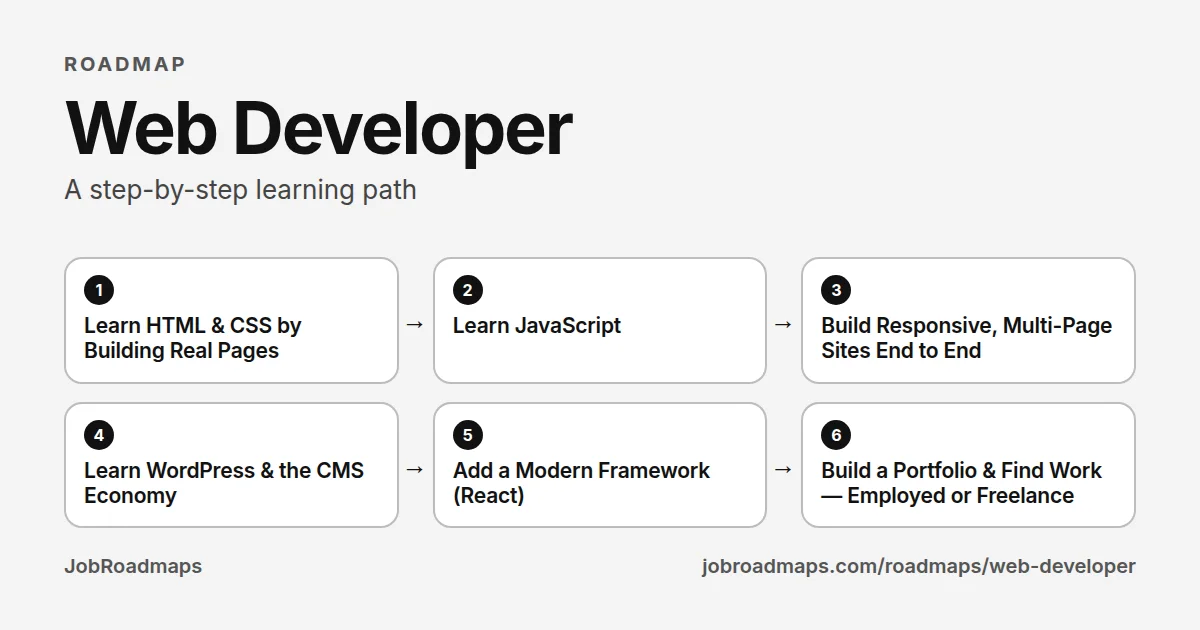
Web Developer learning path
Work down the line, one step at a time. Tick each skill as you can do it.
- 1
Learn HTML & CSS by Building Real Pages
4–6 weeksHTML and CSS are the entire visible web. Learn semantic markup, the box model, flexbox, and grid — then build actual pages: a restaurant site, a personal page, a landing page for an imaginary product. Volume matters more than perfection at this stage.
Skills to learn
- Semantic HTML5
- CSS Box Model & Selectors
- Flexbox & CSS Grid
- Responsive / Mobile-First Design
- Media Queries
- CSS Custom Properties
- Forms & Validation Attributes
- Accessibility Basics (alt text, labels, contrast)
- Browser DevTools
Start with
- 2
Learn JavaScript
6–8 weeksJavaScript turns pages into applications. Work through variables, functions, arrays, DOM manipulation, events, and fetch — then build interactive projects: a calculator, a form with live validation, a page that pulls data from a public API.
Skills to learn
- JavaScript ES6+ Syntax
- DOM Manipulation & Events
- Functions, Scope & Closures
- Arrays & Objects (map, filter, reduce)
- Fetch API & JSON
- Async/Await & Promises
- Error Handling
- LocalStorage
- Debugging with DevTools
Start with
- 3
Build Responsive, Multi-Page Sites End to End
4–5 weeksMove from single pages to complete sites: navigation, multiple layouts, contact forms, image optimization, and deployment. Learn Git along the way and put everything on GitHub — every project public, every commit message readable.
Skills to learn
- Multi-Page Site Architecture
- Git & GitHub Workflow
- Netlify / Vercel Deployment
- Custom Domains & DNS Basics
- Image Optimization (WebP, lazy loading)
- Web Forms & Form Handling Services
- SEO Fundamentals (titles, meta, headings)
- Lighthouse & Core Web Vitals
Start with
- 4
Learn WordPress & the CMS Economy
3–4 weeksWordPress still powers roughly 40% of the web, and small businesses pay real money for people who can bend it. Learn themes, plugins, the block editor, and enough PHP to customize templates. This is the unglamorous skill that funds many developers through their first two years — and the entire freelance market runs on it.
Skills to learn
- WordPress Installation & Hosting
- Theme Customization & Child Themes
- Block Editor (Gutenberg)
- Essential Plugins (SEO, caching, forms, security)
- PHP Template Basics
- MySQL Fundamentals
- Site Migration & Backups
- Client Handoff & Maintenance Plans
Start with
- 5
Add a Modern Framework (React)
5–7 weeksFramework skills separate the template site builder from the developer. Learn React components, props, state, and hooks, then build an app that talks to an API. You do not need to master the whole ecosystem — one solid React project plus your CMS work makes a versatile portfolio.
Skills to learn
- React Components & JSX
- Props & State
- useState & useEffect
- React Router
- Consuming REST APIs
- npm & Vite Tooling
- Tailwind CSS
- Component-Based Thinking
Start with
- 6
Build a Portfolio & Find Work — Employed or Freelance
4–8 weeksShip 4–5 real projects: a business site, a WordPress build, a React app, and ideally one site for an actual human — a local business, a nonprofit, a friend with a side hustle. Real clients, even free ones, produce the stories interviews are made of. Then run both tracks at once: apply to junior roles while quoting small freelance jobs.
Skills to learn
- Portfolio Site Design
- Case Study Writing
- Finding First Clients (local outreach)
- Scoping & Quoting Small Projects
- Junior Role Applications & ATS Resumes
- Freelance Contracts & Invoicing Basics
- Interview Prep (live coding, take-homes)
Start with
jobroadmaps.com/roadmaps/web-developer · Pay, demand and employer data for this role are further down the page.
Job Market Insights for Web Developer
Data-backed
Which skills appear most in job postings?
Read from live job postings, ranked from most to least often named.
accessibility leads the list and is named almost always. If you are only going to learn one thing before applying, the postings say start here.
The 2 base skills sit at the top of the scale, appearing across company sizes and seniority levels. Treat them as the baseline an application is read against.
Skill
How often named
accessibility
web performance
Sorted by how often named · JobRoadmaps
Industry overlay
Targeting a specific industry?
The core roadmap gets you through the door anywhere. The difference between "qualified" and "they hired someone else" often lives in industry-specific context — the norms, the compliance floors, the tools assumed fluent in that sector.
open source development
The core mission depends on open source software, so contribution norms and public workflows matter.
internationalization
A globally distributed user base needs translated, locale-aware pages.
technical documentation
Technical audiences expect clear documentation alongside marketing pages.
Linux
The products and development environments run on Linux.
Companies hiring:
CanonicalLanding page A/B testing
Marketing sites exist to convert visitors to trials — building and instrumenting experiments is a weekly rhythm.
Design system fluency
SaaS brands enforce consistency through component libraries — you build within a system rather than styling from scratch.
Jamstack & modern frameworks
Marketing sites are commonly Next.js or Astro deployed to edge platforms — static-plus-dynamic architecture is the default.
Third-party API integrations
Signup flows touch CRMs, analytics, and email tools — gluing HubSpot, Segment, and Marketo together falls to the web team.
Docs site development
Documentation is a product surface in SaaS — building fast, searchable docs sites is a recurring and visible project.
Companies hiring:
HubSpotWebflowMailchimpSquarespaceZapierIndustry premiums based on aggregated job posting data · Updated quarterly
Interactive
How ready are you right now?
Check the skills you already have to see your current job-market fit.
The most-named skill for this role is accessibility, so a gap there costs you the most. Skills at the top of the scale appear across most postings, so a single gap there narrows your options more than a gap in a rarer skill. Check what you already have to see your biggest current gap.
Readiness Check
Check the skills you already have
0/2
base skills
Your biggest gap: accessibility, the most often named of the skills you have not ticked.
Start there, then work down the list.
Books worth reading as a Web Developer
Where to start, in order. The full list of 12, grouped by career stage, is on its own page.
Getting started
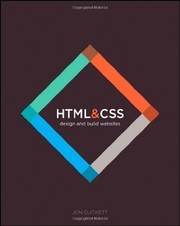
HTML and CSS: Design and Build Websites
by Jon Duckett · 2011
~510 pages~13 hrs to read
A visually laid-out introduction to markup and styling, one topic per spread. Read it in your first weeks if you learn best from pictures and short, focused pages.
View book →Learning Web Design
by Jennifer Robbins, Aaron Gustafson · 2001
~750 pages~19 hrs to read
A patient introduction to HTML, CSS, layout, images and publishing a site. Read it first if you are coming to the browser from scratch, and keep it as the gentle companion to your own first pages.
View book →
Doing the job
CSS in Depth, Second Edition
by Keith J. Grant · 2018
~540 pages~14 hrs to read
Explains how the cascade, specificity, layout, Grid and custom properties actually work, with worked examples. Read it once you can build a page and want to stop fighting your own stylesheets.
View book →
JavaScript: The Definitive Guide
by David Flanagan · 1996
~710 pages~18 hrs to read
A comprehensive reference to the language and the browser and Node APIs. Use it to look things up properly once you have written enough JavaScript to ask precise questions.
View book →
Senior and leading

Design Is a Job
by Mike Monteiro · 2012
~140 pages~4 hrs to read
A short, blunt book on working with clients: contracts, presenting work, handling feedback and pricing. Read it when you start taking on freelance or agency projects.
View book →
Working Effectively with Legacy Code
by Michael Feathers · 2004
~460 pages~12 hrs to read
Techniques for adding tests to and safely changing code you did not write and cannot yet trust. Read it when you inherit an old site and are asked to change it without breaking it.
View book →
All 12 books for a Web Developer →Browse all books →
Some book links are affiliate links: we earn a small commission if you buy, at no cost to you. It does not affect what we list.
Prerequisites & Education
What credentials do employers look for?
These are the most common paths into this role — no single one is required.
Education Level
View list — coming soon- Bachelor's in Computer Science or related field — common but far from mandatory
- Bachelor's in any discipline — a large share of working web developers are career changers
- Associate's degree with a strong deployed portfolio
- No degree — self-taught developers with live projects are hired every day
Web development is the most portfolio-driven role in tech. A URL that works outweighs a transcript at nearly every company below the FAANG tier.
Certifications
View list — coming soon- Meta Front-End Developer Certificate (Coursera) — structured and recognised by resume screeners
- freeCodeCamp certifications — Responsive Web Design and JavaScript Algorithms carry community weight
- Meta Back-End Developer Certificate — pairs well for full-stack positioning
- AWS Certified Cloud Practitioner — useful signal if you deploy your own projects to the cloud
No certification is required for web development. They help pass automated filters, but interviewers will ask about your projects, not your certificates.
Bootcamps & Training
View list — coming soon- The Odin Project — free, full-stack curriculum widely respected by hiring managers
- freeCodeCamp — free, self-paced, with verifiable certifications along the way
- Scrimba Full-Stack Path — interactive, affordable alternative to full bootcamps
- General Assembly or Flatiron School — accredited immersive programs if you want structure and career services
Free options now rival paid bootcamps in curriculum quality. Pay for a bootcamp only if you need the accountability and job-search support.
Portfolio & Other
View list — coming soon- Three to five deployed projects with live URLs — Vercel, Netlify, or Cloudflare Pages
- At least one project with real users — a tool for a club, a local business site, anything with traffic
- GitHub profile with consistent commits and readable READMEs
- Freelance or contract work — real client requirements and deadlines add strong credibility
- Open source contributions — even documentation fixes demonstrate collaboration
The portfolio is the credential. One polished, deployed project with real users is worth more than ten tutorial clones.
Your Roadmap
6 stepsLearn HTML & CSS by Building Real Pages
4–6 weeksHTML and CSS are the entire visible web. Learn semantic markup, the box model, flexbox, and grid — then build actual pages: a restaurant site, a personal page, a landing page for an imaginary product. Volume matters more than perfection at this stage.
Skills to learn
Learn JavaScript
6–8 weeksJavaScript turns pages into applications. Work through variables, functions, arrays, DOM manipulation, events, and fetch — then build interactive projects: a calculator, a form with live validation, a page that pulls data from a public API.
Skills to learn
Build Responsive, Multi-Page Sites End to End
4–5 weeksMove from single pages to complete sites: navigation, multiple layouts, contact forms, image optimization, and deployment. Learn Git along the way and put everything on GitHub — every project public, every commit message readable.
Skills to learn
Learn WordPress & the CMS Economy
3–4 weeksWordPress still powers roughly 40% of the web, and small businesses pay real money for people who can bend it. Learn themes, plugins, the block editor, and enough PHP to customize templates. This is the unglamorous skill that funds many developers through their first two years — and the entire freelance market runs on it.
Skills to learn
Add a Modern Framework (React)
5–7 weeksFramework skills separate the template site builder from the developer. Learn React components, props, state, and hooks, then build an app that talks to an API. You do not need to master the whole ecosystem — one solid React project plus your CMS work makes a versatile portfolio.
Skills to learn
Build a Portfolio & Find Work — Employed or Freelance
4–8 weeksShip 4–5 real projects: a business site, a WordPress build, a React app, and ideally one site for an actual human — a local business, a nonprofit, a friend with a side hustle. Real clients, even free ones, produce the stories interviews are made of. Then run both tracks at once: apply to junior roles while quoting small freelance jobs.
Skills to learn
Start here this week
This week: buy a domain ($10), start freeCodeCamp's Responsive Web Design certification, and build a one-page site for someone real — yourself, your cousin's food truck, anyone. Deploy it on Netlify's free tier and put the URL in your bio. A live site you made this week beats a certificate you might finish next year.
For structure, run The Odin Project's Foundations path as your spine — it forces real-world tooling (Git, the terminal, actual deployment) from day one, which is exactly what tutorial-only learners lack. Supplement with freeCodeCamp for extra reps. Six focused months on one curriculum beats eighteen scattered months across five — pick the path, finish the path.
Pay
U.S. Department of Labor data for the nearest BLS occupation, Web developers. BLS has no occupation for this exact title, so treat these as a benchmark.
Median: U.S. Bureau of Labor Statistics, Occupational Employment and Wage Statistics (median wage, May 2024) and Employment Projections (2024–34). Levels: U.S. Department of Labor Office of Foreign Labor Certification prevailing wage levels (wage year 2025, typical metro), a base-wage benchmark for the metro in the middle of 217 areas, not an offer. See every metro.
Job Titles at Each Level
Entry
Junior Web Developer
Mid
Web Developer
Senior
Senior Web Developer
Steps Overview
- 1
Learn HTML & CSS by Building Real Pages
4–6 weeks
- 2
Learn JavaScript
6–8 weeks
- 3
Build Responsive, Multi-Page Sites End to End
4–5 weeks
- 4
Learn WordPress & the CMS Economy
3–4 weeks
- 5
Add a Modern Framework (React)
5–7 weeks
- 6
Build a Portfolio & Find Work — Employed or Freelance
4–8 weeks
Explore more roadmaps
Not sure this is the right path? Browse all tech career roadmaps.
View Similar RoadmapsBuilt a project while following this roadmap?
Turn it into a hiring-ready case study in 10 seconds — free.
Ready to explore more?
Browse all career roadmaps across tech, business, and creative fields.