Support Engineer Career Roadmap
A support engineer is the person a developer reaches when the product breaks and the docs don't cover it. You read the customer's logs, reproduce the bug, work out whether it is their code, their config or your company's defect, and either fix the problem or hand engineering a ticket good enough to act on. It is customer-facing technical work for a software product, API or platform: not an IT help desk, not site reliability, not pre-sales. The job runs on written clarity and calm under pressure. The customer is usually a developer, and they can tell when you are guessing.
Is this the right path for you?
Almost nobody enters through a "junior" posting. In the live postings we track, 145 carry Support Engineer titles across 33 companies, and only 1 has an early-career word in the title. The real routes are sideways: customer support, IT support, QA or a junior developer role, then a move into a Technical Support Engineer or "Support Engineer I" seat once you can read logs and write SQL. Titles with levels (I, II, III) show where the first rung is: several employers number their support seats.
The temperament is a detective who likes people. You get a half-described problem from a developer who is annoyed, and your job is to turn it into a reproducible case without making them feel interrogated. If you would rather build features than answer for them, you will be unhappy; if you enjoy being the person who finally finds the cause, this is one of the faster ways into a software company. Expect queues, targets and, at several employers, weekend or night shifts.
Honest note: the demand we see is concentrated. Our sample is about a hundred tech-company job boards, skewed to AI, infrastructure and SaaS scale-ups, and OpenAI has the most Support Engineer postings (26), with Datadog (11), Supabase, Snowflake and GitLab (9 each) next. Of the 145, 39 carry senior-level words (senior, staff, principal, lead, director, head of), so experienced people are what most employers want. Your edge as a newcomer is evidence: a public record of reproduced bugs and clear written answers.
Career Progression
Where does this role lead?
Click any role to explore timeline, key skills and, where the Department of Labor publishes it, pay.
Entry
Technical Support Engineer
~0–2 yrs
You work the queue: first diagnosis, known fixes, clean escalations. Most people arrive from customer support, IT support or QA rather than hiring in as a junior. Your reputation is built on replies a developer can act on without asking twice.
Key skills
What the postings say you’ll do
Lines copied word for word from live Support Engineer postings we track, read September 30, 2026. They show how employers word the job, not what every Support Engineer does. Postings change and expire.
“Providing end-to-end ownership through debugging logs, analyzing system behavior, reproducing issues, and delivering expert guidance.”
“Triage support cases including directing users to previous answers, code examples, documentation, or escalating to specific technical or business team members.”
“Reproducing customer issues to verify problems and provide feedback to Engineering and Operations teams”
“Troubleshoot any issues that arise from customers and diagnose any blockers. Escalate issues with customer context to the engineering team.”
“Analyze and tune query performance, and provide clear recommendations for improvement”
“Leading the investigation of complex technical puzzles and working collaboratively to understand and resolve customer issues via live troubleshooting calls and emails in an enterprise environment”
“Support customer-facing communications for outages and incidents and swiftly report ongoing bugs for Eng to triage and fix.”
Who is hiring right now
Drawn from live postings across many employers today. Employers with live postings we tag to this roadmap, counted today. The sample is about a hundred tech-company job boards, tilted toward AI, data and infrastructure companies, so agencies, consultancies and most non-tech employers are not represented.
| Employer | Live postings | Early-career titles | Most common title |
|---|---|---|---|
| OpenAI | 25 | 0 | AI Support Engineer - Dublin |
| Twilio | 10 | 0 | Technical Support Engineer 2 |
| Supabase | 9 | 0 | Database Support Engineer (AMER) |
| Replit | 8 | 0 | Premium Support Engineer (Foster City, Weekend Shift) |
| Snowflake | 8 | 0 | Senior Technical Support Engineer, Observe by Snowflake |
| Crusoe | 7 | 0 | Senior Cloud Support Engineer |
| GitLab | 7 | 0 | Senior Support Engineer |
| Verkada | 7 | 2 | Technical Support Engineer |
| ClickHouse | 6 | 0 | Senior Technical Customer Support Engineer - Japan |
| Zscaler | 6 | 0 | Designated Support Engineer III |
| Canonical | 5 | 1 | Associate Linux Support Engineer |
| Databricks | 5 | 0 | Sr. Designated Support Engineer, Apache Spark™ |
“Early-career titles” are roles whose title signals an entry-level or new-graduate position. Top 12 of 52 employers shown.
Look-alike roles, compared
Neighbouring titles read very differently once you open the posting. One line from a real posting for each, with how many live postings we track under that title and how many carry early-career wording.
Support Engineer
200 live postings · 54 employers · 6 with early-career wording
“Providing end-to-end ownership through debugging logs, analyzing system behavior, reproducing issues, and delivering expert guidance.”
OpenAI · AI Support Engineer - San Francisco posting
IT Support / Help Desk
34 live postings · 23 employers · 3 with early-career wording
“Diagnose and resolve issues across macOS, ChromeOS, iOS, Android, and our core SaaS platforms (Google Workspace, Slack, GitHub, Atlassian)”
Anthropic · IT Support Engineer posting
Solutions / Sales Engineer
419 live postings · 65 employers · 10 with early-career wording
“You will provide technical expertise through sales presentations, product demonstrations, and supporting technical evaluations (POCs).”
Datadog · Commercial Sales Engineer (AMER - West) posting
Site Reliability Engineer
168 live postings · 50 employers · 1 with early-career wording
“Build self-service systems that automate managing, deploying and operating services. This includes our custom Kubernetes operators that support language model deployments.”
Cohere · Site Reliability Engineer, Inference Infrastructure posting
Quotes read September 30, 2026, from the live postings we track.
Visual roadmap
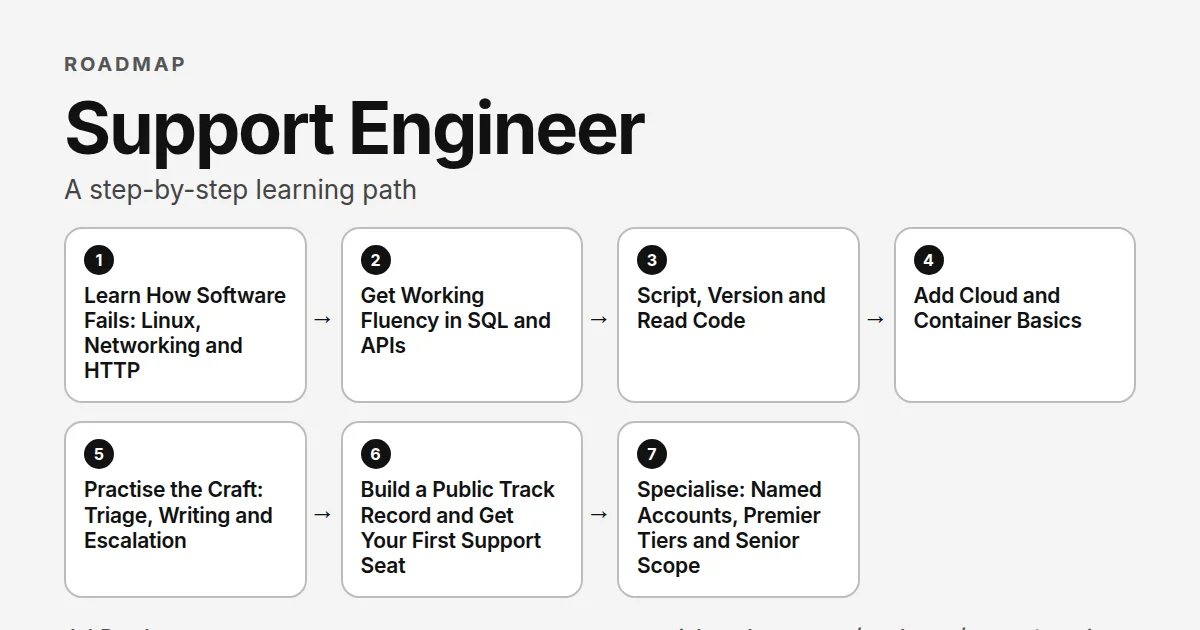
Support Engineer learning path
Work down the line, one step at a time. Tick each skill as you can do it.
- 1
Learn How Software Fails: Linux, Networking and HTTP
6–8 weeksMost support tickets reduce to one question: what did the request actually do? Get comfortable on a Linux command line, learn what DNS, TLS and HTTP status codes mean in practice, and be able to reproduce an API call with curl before touching a GUI. Skip the theory-heavy courses; you want fluency, not trivia.
Skills to learn
- Linux command line
- File permissions and processes
- DNS, TCP and TLS basics
- HTTP methods, headers and status codes
- curl and request inspection
- Reading system logs
- Packet capture basics (Wireshark)
Start with
- 2
Get Working Fluency in SQL and APIs
4–6 weeksDatabase and platform vendors ask for SQL in the live postings we track, and API products ask for the ability to call and read an API. You do not need to build either, but you must be able to query a table to find what a customer's data looks like and send a request in Postman to reproduce their problem. Do both against a real hosted project, not a toy.
Skills to learn
- SELECT, JOIN, GROUP BY, filtering
- Reading query plans at a basic level
- REST and JSON
- Authentication errors (API keys, tokens, OAuth)
- Postman collections
- Reproducing a request from a customer description
Start with
- 3
Script, Version and Read Code
6–10 weeksSupport engineering postings ask you to reproduce bugs, write small tools and sometimes read the product's source. Learn enough Python or Bash to automate a repetitive check, enough Git to read a repository's history and open an issue or a small fix, and enough code-reading to follow a stack trace into someone else's project.
Skills to learn
- Python scripting for log parsing and API calls
- Bash one-liners (grep, awk, jq)
- Git history and pull requests
- Reading stack traces
- Writing a minimal reproduction
- GitHub Issues and Discussions etiquette
Start with
- 4
Add Cloud and Container Basics
6–8 weeksThe products you will support run in someone else's cloud and increasingly in containers. You will not run production, but you must recognise a failing pod, a permissions error on a storage bucket or a misconfigured load balancer when a customer pastes it. One cloud, one container tool, enough to read the error.
Skills to learn
- Core cloud concepts (compute, storage, IAM)
- Docker images and containers
- Kubernetes pods, services and logs
- Environment variables and config
- Reading cloud error messages
- Basic networking in the cloud (VPCs, security groups)
Start with
- 5
Practise the Craft: Triage, Writing and Escalation
6–10 weeksThis is the part that separates a support engineer from someone who knows tools. Learn to triage by impact, ask the one question that narrows the problem, write replies a developer can act on without a follow-up, and escalate with logs, steps and a clear ask. The live postings we track mention docs, knowledge-base articles and feedback to engineering as routine parts of the job.
Skills to learn
- Ticket triage and prioritisation
- Clear technical writing
- Asking diagnostic questions
- Writing an escalation engineering can act on
- Knowledge-base articles
- Incident communication
- Staying calm with frustrated customers
Start with
- 6
Build a Public Track Record and Get Your First Support Seat
8–12 weeksAlmost none of the Support Engineer postings we track are labelled junior, so the common route is a step sideways: customer support, IT support, QA or a junior developer job, then into a Technical Support Engineer or Support Engineer I seat. Make that jump visible. Answer questions in a product's public forum or issue tracker, write up three bugs you reproduced end to end, and apply for roles at companies whose product you already use.
Skills to learn
- Public issue and forum answers
- Written bug reproductions
- Portfolio of support write-ups
- Tailoring a CV to a product
- Interviewing with a live troubleshooting exercise
- Shift and on-call expectations
Start with
- 7
Specialise: Named Accounts, Premier Tiers and Senior Scope
OngoingAbove the first-line seat the titles split. Many employers run numbered levels (I, II, III), and several have named-account or premium tiers (Designated, Dedicated, Premier, Assigned) where you own a handful of large customers. Senior and staff seats expect deep expertise in one product, comfort in its code, and the habit of fixing the cause rather than closing the ticket. Pick a product area and become the person engineering pings.
Skills to learn
- Deep product expertise
- Named-account ownership
- Reading and patching product code
- Incident leadership
- Mentoring newer engineers
- Support tooling and automation
- Moving into engineering, SRE or solutions roles
Start with
jobroadmaps.com/roadmaps/support-engineer · Pay, demand and employer data for this role are further down the page.
Job Market Insights for Support Engineer
Data-backed
What do employers actually ask for?
Read from live job postings — how often each credential is named, from rare to almost always.
"Computer Science background" is the most common credential named, yet it appears only rarely in what we could read. Postings that state it are the minority, but these counts are a floor, so do not read this as "no one asks".
Some postings say outright that equivalent experience or a self-taught route is accepted. That wording is worth reading closely when you see it.
Our read: a portfolio that proves the skill, and a referral from someone inside the company, usually carry more weight than a credential match on paper. That is judgement, not something these counts measure.
Requirement
How often named
Computer Science background
Equivalent experience accepted
Bachelor's degree
Master's degree
Our read: how often a credential is named is not how strictly it is enforced. Equivalent experience, a standout portfolio, or a referral often counts for more than the credential listed.
Data-backed
Which skills appear most in job postings?
Read from live job postings, ranked from most to least often named.
debugging is the most-named skill. Common, but not universal: many postings do not list it.
Past the fundamentals, 1 specialisation skill (debugging included) start separating candidates who can do the job from candidates who have done it. The 13 niche skills are named rarely enough that knowing them is upside, not prerequisite.
Skill
How often named
debugging
customer support
technical troubleshooting
security and compliance
incident response
relationship building
performance tuning
email security
web technologies
Sorted by how often named · JobRoadmaps
Data-backed
Which tools and artifacts appear most in job postings?
Read from live job postings, ranked from most to least often named.
Slack is the most-named tool, but no tool is a universal requirement here.
Tool / Artifact
How often named
Slack
Zendesk
Okta
GitHub
Jira
Salesforce
Google Workspace
Confluence
Sorted by how often named · JobRoadmaps
Industry overlay
Targeting a specific industry?
The core roadmap gets you through the door anywhere. The difference between "qualified" and "they hired someone else" often lives in industry-specific context — the norms, the compliance floors, the tools assumed fluent in that sector.
LLM API integration
Customers need guidance on prompt engineering, token accounting, rate limits, and cost optimization when deploying models at scale.
agentic system debugging
Emerging use case where support engineers debug agent failures, tool integration issues, and unexpected model behavior in autonomous systems.
context window and embeddings
Supporting RAG systems and long-context applications requires understanding vector databases, chunking strategies, and embedding quality.
Companies hiring:
AnthropicOpenAIdistributed systems debugging
Support engineers diagnose Spark, Kubernetes, and streaming pipeline failures across multiple nodes, including network and resource contention issues.
data pipeline optimization
Customers running petabyte-scale analytics demand help with query optimization, cost reduction, and performance tuning of data processes.
container and orchestration troubleshooting
Deep expertise in pod failures, resource allocation, networking in Kubernetes, and debugging containerized applications is critical.
Companies hiring:
DatabricksSnowflakeElasticClickHouseTogether AIIndustry premiums based on aggregated job posting data · Updated quarterly
Interactive
How ready are you right now?
Check the skills you already have to see your current job-market fit.
The most-named skill for this role is debugging, so a gap there costs you the most. No single skill dominates, but each gap narrows which postings fit you. Check what you already have to see your biggest current gap.
Readiness Check
Check the skills you already have
0/5
base skills
Your biggest gap: debugging, the most often named of the skills you have not ticked.
Start there, then work down the list.
Books worth reading as a Support Engineer
Where to start, in order. The full list of 12, grouped by career stage, is on its own page.
Getting started

Debugging: The 9 Indispensable Rules for Finding Even the Most Elusive Software and Hardware Problems
by David J. Agans · 2002
~190 pages~5 hrs to read
Nine plain rules for finding faults: understand the system, make it fail, quit thinking and look, change one thing at a time. A good first-month read when every ticket is a bug you have to reproduce before you can explain it.
View book →
The Linux Command Line
by William E. Shotts · 2011
~500 pages~13 hrs to read
A tour of the shell, files, permissions, processes, text processing and basic scripting. Read it early so reading logs, grepping and running commands on a customer's box stops being slow.
View book →
Doing the job

How Linux Works: What Every Superuser Should Know
by Brian Ward · 2004
~390 pages~10 hrs to read
Explains how a Linux system boots, manages devices, runs services and handles networking and storage. Read it when tickets start to hinge on what the operating system is doing underneath the product.
View book →
High Performance Browser Networking
by Ilya Grigorik · 2013
~400 pages~10 hrs to read
Covers TCP, TLS, HTTP/1.1, HTTP/2, WebSockets and the behaviour of mobile and wireless networks. Helps you explain latency, timeouts and dropped connections when a customer's API calls fail only from some networks.
View book →
Senior and leading

Site Reliability Engineering: How Google Runs Production Systems
by Betsy Beyer, Chris Jones, Jennifer Petoff · 2016
~520 pages~13 hrs to read
Essays on monitoring, incident response, postmortems, on-call and service-level objectives. Read it when you help run incidents or shape how support and engineering share ownership of outages.
View book →
Release It!: Design and Deploy Production-Ready Software
by Michael T. Nygard · 2007
~380 pages~10 hrs to read
Case studies of how production systems fail, with patterns such as timeouts, circuit breakers and bulkheads. Gives senior support engineers a vocabulary for recurring failure modes and for pressing engineers on fixes.
View book →
All 12 books for a Support Engineer →Browse all books →
Some book links are affiliate links: we earn a small commission if you buy, at no cost to you. It does not affect what we list.
Prerequisites & Education
What credentials do employers look for?
These are the most common paths into this role — no single one is required.
Education Level
View list — coming soon- Bachelor's in computer science, IT or a related field — common in the postings we see, but rarely the deciding factor
- Any degree plus a demonstrated technical record: reproduced bugs, scripts, public answers
- No degree — a customer support, IT support or QA background with technical depth gets into this role
- Associate's degree or equivalent hands-on training with ticketing-tool experience
Postings ask for a technical background and customer-support experience far more often than for a specific degree. Some list a computer science degree as a plus rather than a requirement.
Certifications
View list — coming soon- Google IT Support Professional Certificate — a recognised first step into technical support if you are starting from outside IT
- CompTIA A+ — IT-support credential; useful if your route runs through an IT or help-desk seat first
- AWS Certified Cloud Practitioner — proves you speak cloud, which most product platforms run on
- Linux Foundation Certified System Administrator (LFCS) — practical Linux, relevant to infrastructure and developer-platform support
Certifications are tie-breakers here, not gates. A reproduced bug and a clear written explanation outweigh any badge. Product-vendor training (a database, observability or identity platform) helps most once you target a specific employer.
Bootcamps & Training
View list — coming soon- Google IT Support Professional Certificate (Coursera) — structured start for career changers
- The Missing Semester (MIT) — free course on the shell, version control and debugging tools
- Vendor learning centres, such as Datadog's Learning Center — product-specific training that matches what employers support
- Zendesk Academy — practice with a ticketing tool most support teams use
You do not need a paid bootcamp. Free, practical material on Linux, SQL and APIs covers the technical base; the rest is practice on real tickets.
Portfolio & Other
View list — coming soon- Public answers in a product forum or issue tracker — a reproduction plus a clear explanation
- Bug reproductions written up step by step, with logs and the cause
- A small script or tool that automates a support check, in a public repository
- Knowledge-base style articles you wrote for a product you use
- Your support, IT or QA record with ticket volumes and escalations you owned, stated without client names
A hiring manager reads three things: can you find the cause, can you explain it, and can you stay calm. A portfolio that shows all three beats a certificate list.
Your Roadmap
7 stepsLearn How Software Fails: Linux, Networking and HTTP
6–8 weeksMost support tickets reduce to one question: what did the request actually do? Get comfortable on a Linux command line, learn what DNS, TLS and HTTP status codes mean in practice, and be able to reproduce an API call with curl before touching a GUI. Skip the theory-heavy courses; you want fluency, not trivia.
Skills to learn
Get Working Fluency in SQL and APIs
4–6 weeksDatabase and platform vendors ask for SQL in the live postings we track, and API products ask for the ability to call and read an API. You do not need to build either, but you must be able to query a table to find what a customer's data looks like and send a request in Postman to reproduce their problem. Do both against a real hosted project, not a toy.
Skills to learn
Script, Version and Read Code
6–10 weeksSupport engineering postings ask you to reproduce bugs, write small tools and sometimes read the product's source. Learn enough Python or Bash to automate a repetitive check, enough Git to read a repository's history and open an issue or a small fix, and enough code-reading to follow a stack trace into someone else's project.
Skills to learn
Add Cloud and Container Basics
6–8 weeksThe products you will support run in someone else's cloud and increasingly in containers. You will not run production, but you must recognise a failing pod, a permissions error on a storage bucket or a misconfigured load balancer when a customer pastes it. One cloud, one container tool, enough to read the error.
Skills to learn
Practise the Craft: Triage, Writing and Escalation
6–10 weeksThis is the part that separates a support engineer from someone who knows tools. Learn to triage by impact, ask the one question that narrows the problem, write replies a developer can act on without a follow-up, and escalate with logs, steps and a clear ask. The live postings we track mention docs, knowledge-base articles and feedback to engineering as routine parts of the job.
Skills to learn
Build a Public Track Record and Get Your First Support Seat
8–12 weeksAlmost none of the Support Engineer postings we track are labelled junior, so the common route is a step sideways: customer support, IT support, QA or a junior developer job, then into a Technical Support Engineer or Support Engineer I seat. Make that jump visible. Answer questions in a product's public forum or issue tracker, write up three bugs you reproduced end to end, and apply for roles at companies whose product you already use.
Skills to learn
Specialise: Named Accounts, Premier Tiers and Senior Scope
OngoingAbove the first-line seat the titles split. Many employers run numbered levels (I, II, III), and several have named-account or premium tiers (Designated, Dedicated, Premier, Assigned) where you own a handful of large customers. Senior and staff seats expect deep expertise in one product, comfort in its code, and the habit of fixing the cause rather than closing the ticket. Pick a product area and become the person engineering pings.
Skills to learn
Start here this week
This week: pick one developer product you already use (a database, an API, a deployment tool) and answer two real questions about it in its public forum or issue tracker. Reproduce each problem yourself first, then post the steps and the cause. That one habit, a reproduction plus a clear explanation, is what a support engineer is paid for, and it gives you something concrete to show.
For structure: spend the first two months on Linux, HTTP and SQL, then add scripting and one cloud. Meanwhile, if you are not already in a support, IT or QA seat, take one and aim to move up inside a year; the Google IT Support certificate is a reasonable way to get a first interview. Apply to Technical Support Engineer and numbered-level "I" roles and prepare for a live troubleshooting exercise.
Job Titles at Each Level
Entry
Junior Support Engineer / Technical Support Engineer
Mid
Support Engineer / Customer Support Engineer
Senior
Senior Support Engineer / Staff Support Engineer
Steps Overview
- 1
Learn How Software Fails: Linux, Networking and HTTP
6–8 weeks
- 2
Get Working Fluency in SQL and APIs
4–6 weeks
- 3
Script, Version and Read Code
6–10 weeks
- 4
Add Cloud and Container Basics
6–8 weeks
- 5
Practise the Craft: Triage, Writing and Escalation
6–10 weeks
- 6
Build a Public Track Record and Get Your First Support Seat
8–12 weeks
- 7
Specialise: Named Accounts, Premier Tiers and Senior Scope
Ongoing
Explore more roadmaps
Not sure this is the right path? Browse all tech career roadmaps.
View Similar RoadmapsBuilt a project while following this roadmap?
Turn it into a hiring-ready case study in 10 seconds — free.
Ready to explore more?
Browse all career roadmaps across tech, business, and creative fields.