Site Reliability Engineer (SRE) Career Roadmap
A site reliability engineer treats uptime as an engineering problem with a number attached. You define what "working" means (an SLO), measure it, decide how much failure the business can afford (the error budget), and write software to keep the system inside that line. When it breaks anyway, you run the incident, then write the postmortem that makes the next one less likely. It is not DevOps with a different badge: the deliverable is a measured level of reliability, not a deploy pipeline. And it is not for people who want a quiet pager.
Is this the right path for you?
SREs mostly arrive from somewhere else. The common routes are software engineers who got pulled into production ownership, sysadmins and IT operations staff who learned to code, DevOps engineers who moved toward SLOs and incident leadership, and support engineers who got tired of escalating to someone else. Titles also blur: in the postings we track, "site reliability", "reliability engineer", "platform engineer" and "infrastructure engineer" are used for overlapping work, so read the description before assuming the job.
If you stay calm when a dashboard turns red, and your instinct is to ask "what changed?" rather than "whose fault is it?", you have the right temperament. You also need to like writing: postmortems, SLO docs and design reviews are a large share of the output. And you need to be comfortable being interrupted. On-call is a real part of the job, and the work is half prevention, half recovery.
Honest note: this is not a true entry-level field. In the live postings we track, 268 carry site-reliability, reliability-engineer, platform-engineer or infrastructure-engineer titles across 61 companies, but only 11 carry early-career words, and about 99 carry senior ones. Those postings come from roughly 100 tech-company job boards, skewed toward AI, infrastructure and SaaS scale-ups, so treat it as a picture of that segment, not of every employer. The practical read: most people reach SRE after a first job in software, operations or DevOps. Plan for that route rather than waiting for a junior posting.
Career Progression
Where does this role lead?
Click any role to explore timeline, key skills and, where the Department of Labor publishes it, pay.
Entry
Associate SRE
~0–2 yrs
$74,464 (Level I)
Junior reliability roles are rare; many people get here from software, sysadmin or support jobs. You shadow on-call, fix alerts that should not exist, and automate the repeated task you keep doing by hand.
Key skills
Pay shown is the U.S. Department of Labor prevailing wage for Level I (entry), Level III (mid) and Level IV (senior) in the nearest BLS occupation, base wage for the typical metro, wage year 2025, shown for the main track only. It is a benchmark, not an offer; branches and lead, staff and executive stages have no official figure.
What the postings say you’ll do
Lines copied word for word from live Site Reliability Engineer postings we track, read September 30, 2026. They show how employers word the job, not what every Site Reliability Engineer does. Postings change and expire.
“Define, measure, and improve Service Level Indicators (SLIs), Service Level Objectives (SLOs), and error budgets.”
“Participate in on-call rotations and lead incident response efforts for critical production systems.”
“Reduce the burden of toil with iterative development of tooling and automation”
“Build self-service systems that automate managing, deploying and operating services. This includes our custom Kubernetes operators that support language model deployments.”
“Run blameless postmortems and drive corrective actions to closed, not filed.”
“Operating and scaling Kubernetes platforms, including governance and support for multi-tenant workloads”
“Monitoring and maintaining complex cloud-based infrastructure, systems, and services and ensuring their uptime to help millions of patients get the care they need”
Who is hiring right now
Drawn from live postings across many employers today. Employers with live postings we tag to this roadmap, counted today. The sample is about a hundred tech-company job boards, tilted toward AI, data and infrastructure companies, so agencies, consultancies and most non-tech employers are not represented.
| Employer | Live postings | Early-career titles | Most common title |
|---|---|---|---|
| Okta | 30 | 0 | Senior Site Reliability Engineer |
| MongoDB | 18 | 0 | Manager, Site Reliability Engineering - Storage Layer Service |
| Anthropic | 10 | 0 | Staff Software Engineer, AI Reliability Engineering |
| Palantir | 9 | 0 | Platform Engineer - Identity Infrastructure |
| Zscaler | 9 | 0 | Sr. Staff Site Reliability Engineer-Federal, Security Clearance |
| ClickHouse | 7 | 0 | Database Reliability Engineer - Core Team |
| GitLab | 7 | 0 | Principal Site Reliability Engineer, Platform Engineering: Dedicated |
| Real Work From Anywhere (DevOps & Sysadmin) | 7 | 0 | Cloud Platform Engineer at Supabase |
| Fivetran | 6 | 0 | Staff Site Reliability Engineer |
| Supabase | 6 | 0 | AI Platform Engineer |
| Grafana Labs | 5 | 0 | Staff Software Engineer - Databases SRE | Germany | Remote |
| Mistral AI | 5 | 0 | Applied AI Engineer, Site Reliability Engineer - EMEA |
“Early-career titles” are roles whose title signals an entry-level or new-graduate position. Top 12 of 69 employers shown.
Look-alike roles, compared
Neighbouring titles read very differently once you open the posting. One line from a real posting for each, with how many live postings we track under that title and how many carry early-career wording.
Site Reliability Engineer
174 live postings · 54 employers · 1 with early-career wording
“Drive adoption of SRE best practices including SLIs, SLOs, error budgets, capacity planning, and operational readiness reviews.”
Reddit · Senior Site Reliability Engineer, Ads posting
Platform / Infrastructure Engineer
149 live postings · 60 employers · 11 with early-career wording
“Build programmable, API-driven routing logic to dynamically steer customer traffic”
Supabase · Platform Engineer, Edge & Networking posting
DevOps Engineer
39 live postings · 24 employers · 0 with early-career wording
“Design and implement safe, progressive delivery mechanisms (canary, blue/green, feature flags, automated rollback).”
Webflow · Staff DevOps Engineer, Delivery Loop posting
Support Engineer
233 live postings · 66 employers · 7 with early-career wording
“Respond to client requests (phone / chat / tickets) on our fast paced team while continuing to educate our clients on the use of the platform”
Datadog · Technical Support Engineer 3, Premier - Sao Paulo posting
Quotes read September 30, 2026, from the live postings we track.
Visual roadmap
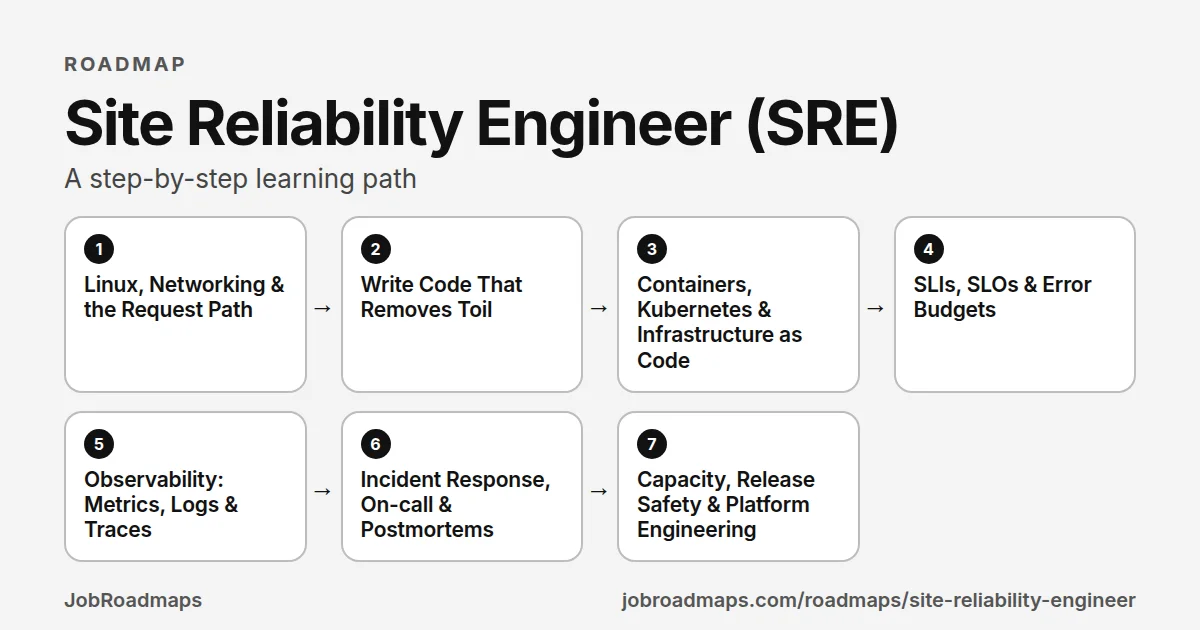
Site Reliability Engineer learning path
Work down the line, one step at a time. Tick each skill as you can do it.
- 1
Linux, Networking & the Request Path
8–10 weeksReliability work starts with knowing what a server actually does when it is unhappy. Processes, memory, file descriptors, disks, and the full path of a request: DNS, TCP, TLS, load balancer, application, database. You will spend incidents reading logs and tracing symptoms down this stack, so the fundamentals are not optional.
Skills to learn
- Linux processes, memory & systemd
- Disk, filesystem & I/O basics
- TCP/IP, DNS & TLS
- HTTP & load balancing
- Reading logs & strace-level debugging
- Bash scripting
- Git
Start with
- 2
Write Code That Removes Toil
6–8 weeksThe defining difference between an SRE and a classic operations job is that you are expected to automate yourself out of repetitive work. Google's own framing: toil is manual, repetitive work that scales with the service and has no lasting value. Learn Python or Go well enough to build small tools, bots and controllers, not just glue scripts.
Skills to learn
- Python or Go for tooling
- Writing CLIs & small services
- APIs & JSON
- Unit testing your automation
- Identifying & measuring toil
- Runbooks to scripts to self-healing
Start with
- 3
Containers, Kubernetes & Infrastructure as Code
10–12 weeksMost production systems you will be asked to keep alive run in containers on Kubernetes and are defined in code. Learn enough to explain how a pod gets scheduled, why it gets evicted, and how a Terraform change reaches production. Depth beats breadth: one cloud, one cluster you have broken on purpose, one module you can review.
Skills to learn
- Docker & container images
- Kubernetes: pods, deployments, services, probes
- Resource requests, limits & eviction
- Terraform: modules, state & drift
- One major cloud in depth
- GitOps-style deploys
Start with
- 4
SLIs, SLOs & Error Budgets
4–6 weeksThis is the step that makes the job SRE rather than general infrastructure. Pick the indicators that reflect what users feel, set a target, and use the remaining budget to decide whether to ship or stabilise. Then learn to alert on how fast you are burning that budget instead of paging on every CPU spike. Practise on a service you own, even a toy one.
Skills to learn
- Choosing SLIs (availability, latency, correctness)
- Setting & negotiating SLOs
- Error budgets & policy
- Burn-rate alerting
- Risk and the cost of each extra nine
- Writing SLO docs stakeholders sign off on
Start with
- 5
Observability: Metrics, Logs & Traces
6–8 weeksYou cannot hold a service to an SLO you cannot measure, and you cannot debug an incident you cannot see. Stand up Prometheus and Grafana against a real app, add OpenTelemetry instrumentation, and learn to move from a firing alert to a root cause using all three signals. Alert quality matters as much as coverage: noisy pagers are a reliability problem too.
Skills to learn
- Prometheus & PromQL
- Grafana dashboards
- OpenTelemetry instrumentation
- Distributed tracing
- Structured logging
- Alert design: symptoms over causes
- Cardinality & cost of telemetry
Start with
- 6
Incident Response, On-call & Postmortems
4–6 weeksThe part of the job nobody can fake in an interview loop. Learn incident roles, communication cadence, and how to mitigate first and diagnose second. Then learn the blameless postmortem: a written account of what happened, why the system allowed it, and what changes. Read public postmortems until the patterns (bad config push, retry storm, cascading failure) look familiar.
Skills to learn
- Incident command & roles
- Mitigate first, root-cause second
- Status communication
- Blameless postmortems
- Cascading failures & retry storms
- Sustainable on-call practices
- Game days & failure drills
Start with
- 7
Capacity, Release Safety & Platform Engineering
OngoingThis is where mid-level engineers separate themselves. Plan capacity before the traffic arrives, make releases reversible (canaries, progressive rollouts, fast rollback), and test failure deliberately. Many teams that hire for SRE also want a platform engineer: someone who turns recurring operational pain into a self-service internal platform that product teams use without filing tickets.
Skills to learn
- Capacity planning & load testing
- Canary & progressive rollouts
- Rollback design
- Chaos engineering basics
- Internal developer platforms
- Golden paths & self-service tooling
- Reliability reviews of new services
Start with
jobroadmaps.com/roadmaps/site-reliability-engineer · Pay, demand and employer data for this role are further down the page.
Job Market Insights for Site Reliability Engineer
Data-backed
What do employers actually ask for?
Read from live job postings — how often each credential is named, from rare to almost always.
"Computer Science background" is the most common credential named, yet it appears only rarely in what we could read. Postings that state it are the minority, but these counts are a floor, so do not read this as "no one asks".
Some postings say outright that equivalent experience or a self-taught route is accepted. That wording is worth reading closely when you see it.
Our read: a portfolio that proves the skill, and a referral from someone inside the company, usually carry more weight than a credential match on paper. That is judgement, not something these counts measure.
Requirement
How often named
Computer Science background
Bachelor's degree
Master's degree
Equivalent experience accepted
Our read: how often a credential is named is not how strictly it is enforced. Equivalent experience, a standout portfolio, or a referral often counts for more than the credential listed.
Data-backed
Which skills appear most in job postings?
Read from live job postings, ranked from most to least often named.
Automation leads the list and is named frequent. If you are only going to learn one thing before applying, the postings say start here.
Past the fundamentals, 6 specialisation skills (Automation included) start separating candidates who can do the job from candidates who have done it. The 14 niche skills are named rarely enough that knowing them is upside, not prerequisite.
Skill
How often named
Automation
Observability
Distributed systems
Incident response
Networking
Infrastructure as Code
Capacity planning
High availability
On-call rotations
Root cause analysis
Debugging
Configuration management
CI/CD pipelines
Sorted by how often named · JobRoadmaps
Data-backed
Which tools and artifacts appear most in job postings?
Read from live job postings, ranked from most to least often named.
No tool dominates. The most-named, Grafana, is still rare; postings for this role rarely list tools by name.
Tool / Artifact
How often named
CloudFormation
Jenkins
ELK Stack
Vault
Sorted by how often named · JobRoadmaps
Industry overlay
Targeting a specific industry?
The core roadmap gets you through the door anywhere. The difference between "qualified" and "they hired someone else" often lives in industry-specific context — the norms, the compliance floors, the tools assumed fluent in that sector.
SLOs tied to customer commitments
Business customers buy these services with availability promises attached, so internal SLOs have to sit tighter than the external ones.
Multi-tenant blast-radius control
One shared system serves many customers. Limiting how far one bad deploy or one noisy tenant can spread is a core design concern.
Release safety and progressive delivery
Frequent deploys to a live service make canaries, feature flags and fast rollback part of everyday reliability work.
Customer-facing incident communication
Status updates and post-incident write-ups are read by customers, so clear writing under pressure is part of the role.
Companies hiring:
OktaZscalerGitLabFivetranSaviyntFinancial compliance
Fintech SREs must maintain audit trails, ensure data integrity, and support regulatory reporting; infrastructure changes require compliance validation.
Payment processing reliability
Downtime directly impacts revenue and customer trust; SREs engineer fault-tolerant payment systems with transaction guarantees.
Fraud detection infrastructure
SREs operate real-time ML systems for fraud prevention; requires low-latency infrastructure and rapid model deployment.
Companies hiring:
StripeAdyenBlockZeta GlobalIndustry premiums based on aggregated job posting data · Updated quarterly
Interactive
How ready are you right now?
Check the skills you already have to see your current job-market fit.
The most-named skill for this role is Automation, so a gap there costs you the most. Skills at the top of the scale appear across most postings, so a single gap there narrows your options more than a gap in a rarer skill. Check what you already have to see your biggest current gap.
Readiness Check
Check the skills you already have
0/6
base skills
Your biggest gap: Automation, the most often named of the skills you have not ticked.
Start there, then work down the list.
Books worth reading as a Site Reliability Engineer
Where to start, in order. The full list of 12, grouped by career stage, is on its own page.
Getting started

Site Reliability Engineering: How Google Runs Production Systems
by Betsy Beyer, Chris Jones, Jennifer Petoff, Niall Richard Murphy · 2016
~520 pages~13 hrs to read
The founding text on SLOs, error budgets, toil, monitoring and incident response. Read it in your first months to learn the vocabulary the rest of the field uses; skim chapters outside your stack.
View book →Incident Management for Operations
by Rob Schnepp, Ron Vidal, Chris Hawley · 2017
~160 pages~4 hrs to read
Adapts the incident command model from emergency services to IT operations: roles, communication, handoffs. Useful before your first on-call rotation and when you start running incidents.
View book →
Doing the job

The Site Reliability Workbook: Practical Ways to Implement SRE
by Niall Richard Murphy, Betsy Beyer, David K. Rensin, Kent Kawahara, Stephen Thorne · 2018
~500 pages~13 hrs to read
Companion to the first book with worked examples: SLO engineering, alerting on SLOs, canarying, on-call and incident response. Pick it up when you are writing real SLOs and alerts for your own services.
View book →
Implementing Service Level Objectives
by Alex Hidalgo · 2020
~350 pages~9 hrs to read
A full treatment of choosing SLIs, setting targets, computing error budgets and using them in planning. Read it when you need to turn SLOs from a slide into decisions your team makes.
View book →
Senior and leading

Chaos Engineering: System Resiliency in Practice
by Casey Rosenthal, Nora Jones · 2020
~400 pages~10 hrs to read
Practitioner accounts of designing and running failure experiments, from hypotheses to organisational buy-in. For senior SREs introducing resilience testing and game days to a team.
View book →
Platform Engineering: A Guide for Technical, Product, and People Leaders
by Camille Fournier, Ian Nowland · 2024
~330 pages~8 hrs to read
Covers building and staffing an internal platform team, treating the platform as a product, and measuring its value. For SREs moving into platform work or leading a team that supports other engineers.
View book →
All 12 books for a Site Reliability Engineer →Browse all books →
Some book links are affiliate links: we earn a small commission if you buy, at no cost to you. It does not affect what we list.
Prerequisites & Education
What credentials do employers look for?
These are the most common paths into this role — no single one is required.
Education Level
View list — coming soon- Bachelor's in computer science or software engineering — the most common route, since the job is software engineering aimed at operations
- Bachelor's in IT, networking or another field plus real operations or sysadmin experience
- Self-taught with production experience from support, IT operations or DevOps work — viable, but the experience has to be demonstrable
- Software engineer who picked up on-call ownership and moved across — often the fastest internal transfer
Most people reach SRE after a first role elsewhere, so a degree matters less than evidence you have kept something running. Skills in code, systems and incident handling are what the work tests.
Certifications
View list — coming soon- Certified Kubernetes Administrator (CKA), Linux Foundation — a hands-on exam, and the most widely recognised cloud-native operations credential
- Linux Foundation Certified System Administrator (LFCS) — a practical Linux exam that suits people coming from software or support
- Prometheus Certified Associate (PCA), CNCF — covers observability concepts, PromQL, instrumentation and alerting
- Google Cloud Professional Cloud DevOps Engineer — its exam outline includes applying site reliability engineering practices and observability
- HashiCorp Terraform Associate — a baseline for infrastructure as code; AWS Certified CloudOps Engineer – Associate covers cloud operations on AWS
No certification makes someone an SRE. The most useful ones (CKA, LFCS) are practical and prove you can operate systems, but a story about a real incident you handled outweighs any of them.
Bootcamps & Training
View list — coming soon- No bootcamp is built around reliability engineering as a discipline, and any program claiming to place you directly into an SRE role deserves scepticism
- Google's Site Reliability Engineering book and Site Reliability Workbook are free and the closest thing the field has to a shared textbook
- Linux Foundation training for Kubernetes and system administration — structured courses that feed the CKA and LFCS exams
- Killercoda and similar browser-based labs — practise cluster debugging without paying for infrastructure
Skip generic DevOps bootcamps unless they include real on-call-style practice. Reading the SRE books, then breaking and fixing your own deployment, teaches more of what interviews probe.
Portfolio & Other
View list — coming soon- A small service with a written SLO, a dashboard, and burn-rate alerts built from it — shows you can define reliability, not just monitor it
- A Kubernetes deployment defined in Terraform and a public repo showing how you provision, update and roll it back
- Two or three blameless postmortems on outages you caused and fixed in your own project, written in the standard format
- An automation tool that replaced a manual task you used to do, with before/after evidence of the time saved
- Public write-ups or conference talks on reliability topics, if you have them
The strongest signal is a postmortem. It shows how you think under failure, whether you blame systems rather than people, and whether you can write clearly — all things interviewers cannot test with a quiz.
Your Roadmap
7 stepsLinux, Networking & the Request Path
8–10 weeksReliability work starts with knowing what a server actually does when it is unhappy. Processes, memory, file descriptors, disks, and the full path of a request: DNS, TCP, TLS, load balancer, application, database. You will spend incidents reading logs and tracing symptoms down this stack, so the fundamentals are not optional.
Skills to learn
Write Code That Removes Toil
6–8 weeksThe defining difference between an SRE and a classic operations job is that you are expected to automate yourself out of repetitive work. Google's own framing: toil is manual, repetitive work that scales with the service and has no lasting value. Learn Python or Go well enough to build small tools, bots and controllers, not just glue scripts.
Skills to learn
Containers, Kubernetes & Infrastructure as Code
10–12 weeksMost production systems you will be asked to keep alive run in containers on Kubernetes and are defined in code. Learn enough to explain how a pod gets scheduled, why it gets evicted, and how a Terraform change reaches production. Depth beats breadth: one cloud, one cluster you have broken on purpose, one module you can review.
Skills to learn
SLIs, SLOs & Error Budgets
4–6 weeksThis is the step that makes the job SRE rather than general infrastructure. Pick the indicators that reflect what users feel, set a target, and use the remaining budget to decide whether to ship or stabilise. Then learn to alert on how fast you are burning that budget instead of paging on every CPU spike. Practise on a service you own, even a toy one.
Skills to learn
Observability: Metrics, Logs & Traces
6–8 weeksYou cannot hold a service to an SLO you cannot measure, and you cannot debug an incident you cannot see. Stand up Prometheus and Grafana against a real app, add OpenTelemetry instrumentation, and learn to move from a firing alert to a root cause using all three signals. Alert quality matters as much as coverage: noisy pagers are a reliability problem too.
Skills to learn
Incident Response, On-call & Postmortems
4–6 weeksThe part of the job nobody can fake in an interview loop. Learn incident roles, communication cadence, and how to mitigate first and diagnose second. Then learn the blameless postmortem: a written account of what happened, why the system allowed it, and what changes. Read public postmortems until the patterns (bad config push, retry storm, cascading failure) look familiar.
Skills to learn
Capacity, Release Safety & Platform Engineering
OngoingThis is where mid-level engineers separate themselves. Plan capacity before the traffic arrives, make releases reversible (canaries, progressive rollouts, fast rollback), and test failure deliberately. Many teams that hire for SRE also want a platform engineer: someone who turns recurring operational pain into a self-service internal platform that product teams use without filing tickets.
Skills to learn
Start here this week
This week: pick one service you can actually measure (a side project, a homelab app, a free-tier deployment), write down one SLI and one SLO for it, and put a simple uptime or latency check against it. Then read the SLO chapter of the Google SRE Book. Defining "working" with a number, and then watching it, is the whole discipline in miniature.
For a structured route: spend two months on Linux, networking and one scripting language, then build and break a small Kubernetes deployment defined in Terraform. Add Prometheus, Grafana and OpenTelemetry, set alerts from your SLO, and write a postmortem every time you break it on purpose. If you already work in software, support or IT operations, ask to join your team's on-call as a shadow. Time inside real incidents is the credential that moves you into a reliability role fastest.
Pay
U.S. Department of Labor data for the nearest BLS occupation, Software developers. BLS has no occupation for this exact title, so treat these as a benchmark.
Median: U.S. Bureau of Labor Statistics, Occupational Employment and Wage Statistics (median wage, May 2024) and Employment Projections (2024–34). Levels: U.S. Department of Labor Office of Foreign Labor Certification prevailing wage levels (wage year 2025, typical metro), a base-wage benchmark for the metro in the middle of 511 areas, not an offer. See every metro.
Job Titles at Each Level
Entry
Junior Site Reliability Engineer / Associate SRE
Mid
Site Reliability Engineer / Platform Engineer
Senior
Senior Site Reliability Engineer / Staff Site Reliability Engineer
Steps Overview
- 1
Linux, Networking & the Request Path
8–10 weeks
- 2
Write Code That Removes Toil
6–8 weeks
- 3
Containers, Kubernetes & Infrastructure as Code
10–12 weeks
- 4
SLIs, SLOs & Error Budgets
4–6 weeks
- 5
Observability: Metrics, Logs & Traces
6–8 weeks
- 6
Incident Response, On-call & Postmortems
4–6 weeks
- 7
Capacity, Release Safety & Platform Engineering
Ongoing
Explore more roadmaps
Not sure this is the right path? Browse all tech career roadmaps.
View Similar RoadmapsBuilt a project while following this roadmap?
Turn it into a hiring-ready case study in 10 seconds — free.
Ready to explore more?
Browse all career roadmaps across tech, business, and creative fields.