Sales Engineer Career Roadmap
A sales engineer is the technical half of a sales pair. The account executive owns the relationship and the commercial terms; you own the answer to "will this actually work for us?" That means discovery calls, tailored demos, proofs of concept, technical Q&A with sceptical engineers, and the security questionnaire that arrives with a deadline attached. You are paid to translate a product into a business outcome without lying about either one. It suits people who like engineering but get more energy from a customer's problem than from a ticket queue.
Is this the right path for you?
There is no clean front door. In the live job postings we track, about 227–251 titles across 32 companies say sales engineer, solutions engineer, solutions consultant or pre-sales. Only 2 of them carry entry-level words. About 90 say senior, and 20 say staff, principal, director or head. So people arrive sideways: support and solutions-support engineers who already talk to customers all day, software engineers who would rather be in the room where the product is explained, technical consultants, customer success managers with real technical depth, and the occasional SDR who taught themselves the product better than the AEs did.
The temperament signal is comfort with being wrong in public. You will be put in front of a sceptical architect with a half-working demo environment and asked something you do not know. If you can say "I don't know, here is how I'll find out" and mean it, you will do well. You should also enjoy the sales motion itself: deal cycles, forecasting, a quota-carrying partner whose success is tied to yours. If you want to write code all day and never sit in a commercial conversation, this is the wrong job.
Honest note: our postings come from about 100 tech-company job boards, skewed toward AI, infrastructure and SaaS scale-ups, so this describes that slice of the market and not every employer. Within it, the volume is concentrated in a handful of large vendors, and the titles carry far more senior words than entry-level ones. Expect to be judged on demonstrated technical breadth plus proof you can run a customer conversation, and a recorded demo is the most direct way to show the second.
Career Progression
Where does this role lead?
Click any role to explore timeline, key skills and, where the Department of Labor publishes it, pay.
Entry
Associate Sales Engineer
varies
Few companies hire straight into this seat, and most people arrive from support, consulting or engineering. You shadow calls, run the simple demos, and learn the product well enough to be trusted alone in front of a customer.
Key skills
What the postings say you’ll do
Lines copied word for word from live Sales Engineer postings we track, read September 30, 2026. They show how employers word the job, not what every Sales Engineer does. Postings change and expire.
“Partner with sales and partner engineering teams to drive opportunities for our largest customers, leading solution strategy and laying groundwork for successful implementations.”
“You would work with your Account Executives in lockstep through key phases of the sales cycle, including technical discovery, product presentations, collaborative solution design sessions, proofs of concept, and more.”
“As a Sales Engineer, you will help qualify and close opportunities with customers and partners and provide technical expertise through sales presentations, product demonstrations, and supporting technical evaluations.”
“Run pre-sales technical evaluations end-to-end: deliver tailored deep-dive demos, proof-of-concepts, security and architecture reviews, and integration workshops that remove deal risk and accelerate time to close.”
“You have a breadth of technical knowledge and the ability to discuss technical concepts at any level. You can explain and discuss complex ideas with executives, lawyers, and experienced security engineers.”
“Identify, develop, and leverage technical champions across multi-stakeholder environments, building a structured plan for champion cultivation and influence throughout the deal cycle”
“Gain excitement from clients about Databricks through hands-on evaluation and Spark programming, integrating with the wider cloud ecosystem and 3rd party applications.”
Who is hiring right now
Drawn from live postings across many employers today. Employers with live postings we tag to this roadmap, counted today. The sample is about a hundred tech-company job boards, tilted toward AI, data and infrastructure companies, so agencies, consultancies and most non-tech employers are not represented.
| Employer | Live postings | Early-career titles | Most common title |
|---|---|---|---|
| Zscaler | 60 | 0 | Senior Sales Engineer |
| Datadog | 39 | 0 | Commercial & Mid-Market Sales Engineer |
| Netskope | 31 | 0 | Solutions Engineer |
| Veeva Systems | 31 | 0 | Solution Consultant - Quality |
| Databricks | 25 | 0 | Sr. Solutions Engineer |
| Pure Storage | 20 | 0 | AI/HPC/NeoCloud Pre-Sales System Engineer UAE |
| Braze | 19 | 0 | Senior Solutions Consultant |
| Samsara | 18 | 5 | Associate Sales Engineer, SE Desk (French Bilingual) |
| Notion | 17 | 0 | Commercial Solutions Consultant |
| Verkada | 17 | 1 | Enterprise Solutions Engineer |
| Navan | 13 | 0 | Enterprise, Solutions Consultant |
| Sierra | 13 | 0 | Enterprise Sales Engineer |
“Early-career titles” are roles whose title signals an entry-level or new-graduate position. Top 12 of 83 employers shown.
Look-alike roles, compared
Neighbouring titles read very differently once you open the posting. One line from a real posting for each, with how many live postings we track under that title and how many carry early-career wording.
Sales / Solutions Engineer
572 live postings · 80 employers · 13 with early-career wording
“Partner closely with sales teams as the go-to identity authority, aligning Auth0 solutions directly with developer pain points and business goals through tailored, value-driven product demonstrations.”
Okta · Associate Solutions Engineer, Okta posting
Solutions Architect
428 live postings · 49 employers · 0 with early-career wording
“Act as a technical advisor to our most strategic customers, deeply embedding with them to support the ideation and development of innovative applications using OSS models on Together AI”
Together AI · Solutions Architect posting
Technical Account Manager
56 live postings · 18 employers · 1 with early-career wording
“Deliver technical workshops and training sessions to help customers confidently use sophisticated platform features”
Figma · Technical Account Manager posting
Forward Deployed Engineer
371 live postings · 43 employers · 37 with early-career wording
“Work within customer systems to build production applications with Claude models, ensuring that these products meet customer requirements.”
Anthropic · Forward Deployed Engineer posting
Quotes read September 30, 2026, from the live postings we track.
Visual roadmap
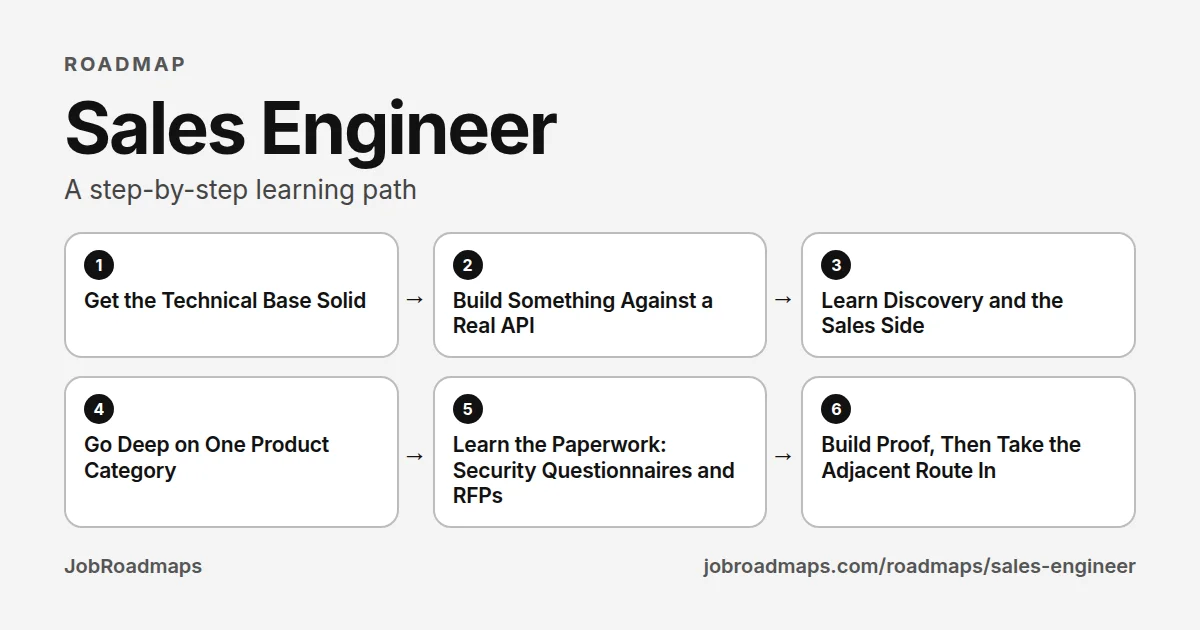
Sales Engineer learning path
Work down the line, one step at a time. Tick each skill as you can do it.
- 1
Get the Technical Base Solid
8–12 weeksYou do not need to be a staff engineer, but you must be able to talk to one without flinching. Know how a request travels from browser to API to database, how authentication works, what a cloud account actually contains, and enough SQL and Linux to poke at a system yourself. Breadth beats depth here: the person on the other side of the call will ask something outside your product, and "let me get back to you" is only credible if it is the exception.
Skills to learn
- HTTP, REST and API basics
- Authentication (OAuth, SSO concepts)
- SQL fundamentals
- Linux command line
- Cloud basics (compute, storage, networking, IAM)
- Reading logs and error messages
- Containers at a conceptual level
Start with
- 2
Build Something Against a Real API
4–8 weeksPre-sales credibility comes from having touched the thing customers touch. Pick a developer-facing product, read its docs, and build a small working integration: authenticate, call the API, handle an error, wire up a webhook. Save it as a Postman collection or a short repo. That artefact is what you will demo from, and what you will point to in interviews when someone asks whether you can get hands-on.
Skills to learn
- Postman collections and requests
- OAuth flows in practice
- Webhooks and event-driven integrations
- Docker for reproducible demo environments
- Reading API documentation critically
- Scripting a small integration (Python or JavaScript)
Start with
- 3
Learn Discovery and the Sales Side
4–6 weeksThis is the part engineers skip and the part that decides whether you get hired. A demo without discovery is a feature tour. Learn how deals are qualified, what an account executive actually needs from you, and how to ask questions that expose the customer's real problem before you touch the product. MEDDICC-style frameworks give you the vocabulary; the Great Demo! approach gives you the habit of demoing to a problem instead of to a feature list.
Skills to learn
- Discovery questioning
- Qualification frameworks (MEDDICC)
- Demo-to-problem storytelling
- Business value versus feature language
- Working a deal alongside an account executive
- Handling objections honestly
Start with
- 4
Go Deep on One Product Category
6–10 weeksSales engineers are hired to know a category, not the whole of tech. In the live postings we track, the biggest volumes sit with observability, data-platform and developer-infrastructure vendors, with identity, communications and payments companies behind them. Pick one lane, take the vendor-run training, and learn the competitors' pitch as well as your own. Being able to explain why a customer would choose a rival for a specific use case is what makes buyers trust everything else you say.
Skills to learn
- Category vocabulary and architecture patterns
- Vendor training and product certifications
- Competitive positioning
- Common integration and migration patterns
- Building a technical narrative for one product
Start with
- 5
Learn the Paperwork: Security Questionnaires and RFPs
3–4 weeksEvery enterprise deal eventually produces a spreadsheet of security and architecture questions, and the sales engineer usually owns the technical answers. You do not need to be a security specialist, but you do need to recognise what a control question is really asking, know where the honest answer lives, and never guess. Read a published control framework and a SOC report overview once, and the questionnaires stop looking like noise.
Skills to learn
- Security questionnaire response
- RFP and RFI technical answers
- Compliance vocabulary (SOC 2, ISO-style controls)
- Data residency, encryption and access-control basics
- Knowing when to escalate to security or legal
- Keeping an answer library current
Start with
- 6
Build Proof, Then Take the Adjacent Route In
8–12 weeks, then the job searchRecord a short demo of your integration to a made-up customer problem, with a discovery summary in front of it. Post it. Then be realistic about the door: the live postings we track contain very few explicitly entry-level sales engineer titles, so most people get in sideways: from support or solutions support, engineering, technical consulting, customer success, or a technically sharp SDR seat. Target the associate title where it exists, and target the adjacent role at a company with a pre-sales team you can move into.
Skills to learn
- Recorded demo delivery
- Presentation and speaking confidence
- Written discovery summaries and POC plans
- Networking with practising SEs
- Interview demos and technical case exercises
- Positioning a lateral move
Start with
jobroadmaps.com/roadmaps/sales-engineer · Pay, demand and employer data for this role are further down the page.
Job Market Insights for Sales Engineer
Data-backed
What do employers actually ask for?
Read from live job postings — how often each credential is named, from rare to almost always.
"Bachelor's degree" is the most common credential named, yet it appears only rarely in what we could read. Postings that state it are the minority, but these counts are a floor, so do not read this as "no one asks".
Some postings say outright that equivalent experience or a self-taught route is accepted. That wording is worth reading closely when you see it.
Our read: a portfolio that proves the skill, and a referral from someone inside the company, usually carry more weight than a credential match on paper. That is judgement, not something these counts measure.
Requirement
How often named
Bachelor's degree
Certification mentioned
Equivalent experience accepted
Computer Science background
Master's degree
Our read: how often a credential is named is not how strictly it is enforced. Equivalent experience, a standout portfolio, or a referral often counts for more than the credential listed.
Data-backed
Which skills appear most in job postings?
Read from live job postings, ranked from most to least often named.
Postings for this role rarely list skills by name. The most-named, Product demonstrations, is still only occasional, so none of these is a universal requirement.
Skill
How often named
Product demonstrations
Technical discovery
Solution design
Customer discovery
Sales enablement
Proof of concept
Deal strategy
Scripting languages
Cross-functional collaboration
Pipeline qualification
Partner ecosystem
Technical presentation
Sorted by how often named · JobRoadmaps
Data-backed
Which tools and artifacts appear most in job postings?
Read from live job postings, ranked from most to least often named.
AWS is the most-named tool, but no tool is a universal requirement here.
Industry overlay
Targeting a specific industry?
The core roadmap gets you through the door anywhere. The difference between "qualified" and "they hired someone else" often lives in industry-specific context — the norms, the compliance floors, the tools assumed fluent in that sector.
Developer and API demos
Twilio, Contentful, ElevenLabs and OpenAI sell largely to developers, so a working API call on screen carries more weight than slides.
Identity, SSO and security posture
Enterprise buyers of SaaS products ask about authentication, provisioning and admin controls early, and identity vendors sell exactly that.
Mixed-audience communication
A single call can include an engineer, a security reviewer and a business sponsor, and you have to answer each in their own language.
Enterprise rollout and adoption planning
Buyers of collaboration and design tools want to know how a rollout works across teams, not just how features behave.
Use-case-led demo storytelling
Broad products can do many things, so winning demos pick one customer problem and stay on it.
Companies hiring:
NotionOktaScale AIElevenLabsTwilioContentfulIntercomFigmaOpenAIArchitecture whiteboarding
Infrastructure buyers want to see how the product fits into their stack, not a tour of the interface, so you will sketch integrations and data flows live.
Proof-of-concept design
Technical evaluations are usually run as a scoped trial in the customer's own environment, and defining success criteria up front is what turns them into deals.
Cloud and Kubernetes fluency
Customers run on the major clouds and container platforms, and you need to talk about deployment, agents, networking and scale in their terms.
Competitive technical positioning
These categories are crowded and buyers often run bake-offs, so you need an honest account of where the product wins and where a rival does.
Migration and integration planning
Most infrastructure purchases replace or sit beside an existing tool, and buyers ask early how hard the switch will be.
Companies hiring:
DatadogDatabricksMongoDBCloudflarePagerDutyUbiquitiIndustry premiums based on aggregated job posting data · Updated quarterly
Interactive
How ready are you right now?
Check the skills you already have to see your current job-market fit.
The most-named skill for this role is Product demonstrations, so a gap there costs you the most. No single skill dominates, but each gap narrows which postings fit you. Check what you already have to see your biggest current gap.
Readiness Check
Check the skills you already have
0/5
base skills
Your biggest gap: Product demonstrations, the most often named of the skills you have not ticked.
Start there, then work down the list.
Books worth reading as a Sales Engineer
Where to start, in order. The full list of 12, grouped by career stage, is on its own page.
Getting started

SPIN Selling
by Neil Rackham · 1988
~200 pages~5 hrs to read
Built on research into sales calls, it teaches the Situation, Problem, Implication and Need-payoff question sequence. A solid base for discovery calls before you demo anything.
View book →
The Mom Test
by Rob Fitzpatrick · 2013
~140 pages~4 hrs to read
A short guide to asking about a customer's real problems without leading them toward the answer you want. Useful for sharpening technical discovery questions when you are new to pre-sales.
View book →
Doing the job

Designing Data-Intensive Applications
by Martin Kleppmann · 2017
~620 pages~16 hrs to read
Explains replication, partitioning, transactions and stream processing in depth. A strong technical foundation if you sell databases, data platforms or infrastructure software.
View book →
The Challenger Sale
by Matthew Dixon, Brent Adamson · 2011
~220 pages~6 hrs to read
Argues that top reps teach customers something new, tailor the message and take control of the conversation. Gives you a model for running a technical session alongside your account executive.
View book →
Senior and leading

The Trusted Advisor
by David H. Maister, Charles H. Green, Robert M. Galford · 2000
~260 pages~7 hrs to read
Covers how advisers earn and keep client trust over years. Worth reading as you take on strategic accounts and mentor newer sales engineers in being advisers rather than demo operators.
View book →
Crossing the Chasm
by Geoffrey A. Moore · 1991
~270 pages~7 hrs to read
Describes how technology products move from early adopters to the mainstream market. Helps senior sales engineers read where a buyer sits and shape the pitch and proof points accordingly.
View book →
All 12 books for a Sales Engineer →Browse all books →
Some book links are affiliate links: we earn a small commission if you buy, at no cost to you. It does not affect what we list.
Prerequisites & Education
What credentials do employers look for?
These are the most common paths into this role — no single one is required.
Education Level
View list — coming soon- Bachelor's in computer science, engineering, or IT — a common baseline and the easiest way to clear a resume screen
- Bachelor's in any field plus proven technical work in support, consulting, or implementation
- No degree — possible if you have hands-on technical experience with the product category and can demo it convincingly
- Bachelor's in business or communications plus real technical depth from a prior technical role
Pre-sales hiring screens for two things: can you understand the product, and can you explain it to a stranger. A degree is a proxy for the first. A recorded demo or a live call is the proof of the second.
Certifications
View list — coming soon- AWS Certified Cloud Practitioner — the low-friction cloud baseline; useful when your customers run on AWS
- AWS Certified Solutions Architect – Associate — stronger signal of architectural fluency for infrastructure and data-platform vendors
- Google Cloud Digital Leader or Microsoft Azure Fundamentals — cloud-literacy credentials if your target vendors sell into those ecosystems
- Vendor product certifications (Databricks publishes a certification programme) — where an employer publishes one, it is the most relevant credential you can hold
No certification is required to be hired as a sales engineer, and none replaces a good demo. Cloud and vendor certs help most for career changers who need to show technical breadth quickly. Pick the cloud your target vendors' customers use.
Bootcamps & Training
View list — coming soon- Great Demo! training — a demo methodology built around showing customers their problem solved, not a feature tour
- MEDDICC training — qualification and deal-management vocabulary that many technology sales teams use
- Vendor academies (Datadog Learning Center, Databricks training, MongoDB University) — product-specific, self-paced, and directly relevant to the employers that post most roles
- PreSales Collective — a community for pre-sales professionals; useful for meeting working SEs and learning how teams hire
We could not verify a recognised sales-engineering bootcamp, so this list sticks to methodology training, vendor academies and a community. Treat any programme that promises a guaranteed pre-sales job with suspicion.
Portfolio & Other
View list — coming soon- A recorded short demo aimed at a specific fictional customer problem — the single best interview asset you can make
- A working API integration saved as a Postman collection or short repo, with a README that explains the customer story behind it
- A short discovery summary and proof-of-concept plan for a made-up prospect, with success criteria that could be tested
- A sample security-questionnaire answer set for a small side project, mapped to a public control framework
- Evidence of speaking practice — a Toastmasters record, internal talks, or conference or meetup presentations
Hiring managers cannot easily judge a pre-sales candidate from a resume. A recording of you running a clear demo and handling a hostile question settles it faster than any credential.
Your Roadmap
6 stepsGet the Technical Base Solid
8–12 weeksYou do not need to be a staff engineer, but you must be able to talk to one without flinching. Know how a request travels from browser to API to database, how authentication works, what a cloud account actually contains, and enough SQL and Linux to poke at a system yourself. Breadth beats depth here: the person on the other side of the call will ask something outside your product, and "let me get back to you" is only credible if it is the exception.
Skills to learn
Build Something Against a Real API
4–8 weeksPre-sales credibility comes from having touched the thing customers touch. Pick a developer-facing product, read its docs, and build a small working integration: authenticate, call the API, handle an error, wire up a webhook. Save it as a Postman collection or a short repo. That artefact is what you will demo from, and what you will point to in interviews when someone asks whether you can get hands-on.
Skills to learn
Learn Discovery and the Sales Side
4–6 weeksThis is the part engineers skip and the part that decides whether you get hired. A demo without discovery is a feature tour. Learn how deals are qualified, what an account executive actually needs from you, and how to ask questions that expose the customer's real problem before you touch the product. MEDDICC-style frameworks give you the vocabulary; the Great Demo! approach gives you the habit of demoing to a problem instead of to a feature list.
Skills to learn
Go Deep on One Product Category
6–10 weeksSales engineers are hired to know a category, not the whole of tech. In the live postings we track, the biggest volumes sit with observability, data-platform and developer-infrastructure vendors, with identity, communications and payments companies behind them. Pick one lane, take the vendor-run training, and learn the competitors' pitch as well as your own. Being able to explain why a customer would choose a rival for a specific use case is what makes buyers trust everything else you say.
Skills to learn
Learn the Paperwork: Security Questionnaires and RFPs
3–4 weeksEvery enterprise deal eventually produces a spreadsheet of security and architecture questions, and the sales engineer usually owns the technical answers. You do not need to be a security specialist, but you do need to recognise what a control question is really asking, know where the honest answer lives, and never guess. Read a published control framework and a SOC report overview once, and the questionnaires stop looking like noise.
Skills to learn
Build Proof, Then Take the Adjacent Route In
8–12 weeks, then the job searchRecord a short demo of your integration to a made-up customer problem, with a discovery summary in front of it. Post it. Then be realistic about the door: the live postings we track contain very few explicitly entry-level sales engineer titles, so most people get in sideways: from support or solutions support, engineering, technical consulting, customer success, or a technically sharp SDR seat. Target the associate title where it exists, and target the adjacent role at a company with a pre-sales team you can move into.
Skills to learn
Start here this week
This week: pick one developer-facing product you find interesting and watch or read a real discovery-to-demo flow for it. Then write a short summary of a fictional customer problem it would solve, plus the questions you would ask before showing any product. Send it to a practising sales engineer you find through the PreSales Collective community and ask what they would add. One real conversation with a working SE will teach you more about the job than another week of reading.
For structure, follow the steps above in order: technical base, a real API integration, discovery and demo craft, one product category in depth, security questionnaires, then a recorded demo and a deliberate lateral route in. Realistically that is a year or two from a standing start, and shorter if you already work in support, consulting or engineering at a company that has a pre-sales team. Ask that team what they hire from; most will tell you.
Pay
U.S. Department of Labor data for the nearest BLS occupation, Sales engineers. BLS has no occupation for this exact title, so treat these as a benchmark.
Median: U.S. Bureau of Labor Statistics, Occupational Employment and Wage Statistics (median wage, May 2024) and Employment Projections (2024–34). No Level I–IV wages are published for this occupation in our tables.
Job Titles at Each Level
Entry
Associate Sales Engineer / Associate Solutions Engineer
Mid
Sales Engineer / Solutions Engineer
Senior
Senior Sales Engineer / Principal Solutions Engineer
Steps Overview
- 1
Get the Technical Base Solid
8–12 weeks
- 2
Build Something Against a Real API
4–8 weeks
- 3
Learn Discovery and the Sales Side
4–6 weeks
- 4
Go Deep on One Product Category
6–10 weeks
- 5
Learn the Paperwork: Security Questionnaires and RFPs
3–4 weeks
- 6
Build Proof, Then Take the Adjacent Route In
8–12 weeks, then the job search
Explore more roadmaps
Not sure this is the right path? Browse all tech career roadmaps.
View Similar RoadmapsBuilt a project while following this roadmap?
Turn it into a hiring-ready case study in 10 seconds — free.
Ready to explore more?
Browse all career roadmaps across tech, business, and creative fields.