Network Engineer Career Roadmap
Everything in tech — every API call, every video stream, every cloud region — rides on networks that someone designed, configured, and gets paged for at 3 AM. Network engineering is the discipline that treats connectivity as a craft: routing protocols, switching fabrics, subnet math done in your head. It's one of the last corners of tech where a certification — the CCNA — genuinely functions as a hiring credential rather than resume decoration. The engineers who add Python automation to that foundation are quietly becoming some of the most valuable people in infrastructure.
Is this the right path for you?
Network engineers commonly arrive from three directions: help desk and IT support people leveling up (the most common route), military veterans with communications or signal backgrounds (heavily represented in this field), and career changers drawn by the cert-driven ladder — study, pass, get hired — that requires no degree and no portfolio theater. If you're already in IT support, this is one of the cleanest promotions available: the Network+ to CCNA sequence maps directly onto job titles.
The aptitude test is subnetting. Some people find binary math and addressing logic tedious; a smaller group finds it weirdly satisfying, like sudoku with career prospects. That second group becomes network engineers. The work also rewards calm, methodical people — when the network is down, the entire company is watching, and the engineer who follows the OSI model down the stack instead of panicking is the one who gets promoted.
Honest note: pure route-and-switch jobs are slowly consolidating as cloud absorbs infrastructure, and the CCNA alone no longer guarantees interviews the way it did in 2015. The market is fine — every hospital, ISP, school district, and factory still runs a physical network — but the growth jobs demand automation. Learn Python alongside the CCNA, not after it, and you'll leapfrog the engineers who spent fifteen years refusing to script.
Career Progression
Where does this role lead?
Click any role to explore timeline, key skills and, where the Department of Labor publishes it, pay.
Entry
Network Technician
~0–2 yrs
$61,027 (Level I)
Hands-on grunt work — patch panels, device swaps, first-line troubleshooting. Get your CCNA done here; it's the ticket to the next level.
Key skills
Pay shown is the U.S. Department of Labor prevailing wage for Level I (entry), Level III (mid) and Level IV (senior) in the nearest BLS occupation, base wage for the typical metro, wage year 2025, shown for the main track only. It is a benchmark, not an offer; branches and lead, staff and executive stages have no official figure.
Visual roadmap
Network Engineer learning path
Work down the line, one step at a time. Tick each skill as you can do it.
- 1
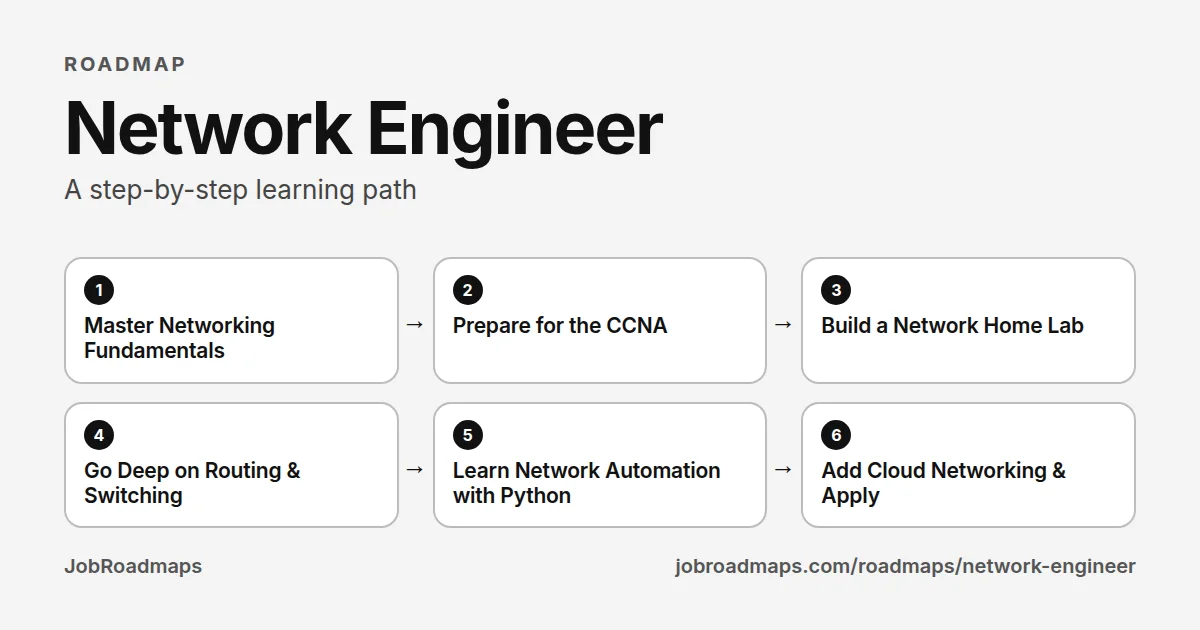
Master Networking Fundamentals
4–6 weeksLearn the OSI and TCP/IP models until they stop being trivia and start being a debugging framework. Subnetting is the rite of passage: drill it until you can carve a /24 into /27s without a calculator. Everything else in this career sits on this foundation.
Skills to learn
- OSI Model (as a troubleshooting tool)
- TCP/IP Stack
- IPv4 Subnetting (fluent, no calculator)
- IPv6 Fundamentals
- MAC Addressing & ARP
- DNS, DHCP, NAT
- Common Ports & Protocols
- Ethernet & Cabling Standards
- Wireshark Packet Analysis Basics
Start with
- 2
Prepare for the CCNA
10–16 weeksThe CCNA (200-301) is the anchor certification of this entire career — it covers routing, switching, wireless, security fundamentals, and automation concepts. Treat it like a part-time job: a structured video course, daily labs, and practice exams until you score consistently above 85%.
Skills to learn
- VLANs & Trunking
- Spanning Tree Protocol
- OSPF Fundamentals
- Static & Default Routing
- ACLs (Access Control Lists)
- NAT/PAT Configuration
- Wireless LAN Fundamentals
- Network Security Fundamentals
- Automation & Programmability Concepts
Start with
- 3
Build a Network Home Lab
4–6 weeks (parallel with CCNA prep)Configuration knowledge that only exists in flashcards evaporates in interviews. Build topologies in Cisco Packet Tracer (free) and graduate to GNS3 or Cisco Modeling Labs for real IOS images. Break routing on purpose, then fix it — that loop is the entire skill.
Skills to learn
- Cisco Packet Tracer
- GNS3 / Cisco Modeling Labs (CML)
- IOS CLI Fluency
- Multi-Router Topology Design
- Config Backup & Restore (TFTP)
- Troubleshooting Methodology (show / debug commands)
- Lab Documentation & Network Diagrams
- Optional: Used Physical Switches (eBay lab)
Start with
- 4
Go Deep on Routing & Switching
8–12 weeksAfter the CCNA, depth is what separates technicians from engineers. Study OSPF multi-area design, BGP fundamentals, first-hop redundancy (HSRP/VRRP), and QoS. This is the knowledge that carries you through NOC escalations and into design conversations.
Skills to learn
- OSPF Multi-Area Design
- BGP Fundamentals (eBGP/iBGP)
- EtherChannel & Link Aggregation
- HSRP / VRRP Redundancy
- QoS Concepts & Queuing
- IPsec & Site-to-Site VPNs
- Network Monitoring (SNMP, NetFlow, syslog)
- Campus & Branch Design Patterns
Start with
- 5
Learn Network Automation with Python
6–8 weeksThe engineer who configures one switch at a time is being replaced by the engineer who configures five hundred with a script. Learn Python basics, then Netmiko for SSH automation, and Ansible for declarative config management. This is the highest-leverage skill add in networking today.
Skills to learn
- Python Fundamentals
- Netmiko (SSH automation)
- Ansible for Network Devices
- REST APIs & JSON
- Jinja2 Config Templates
- Git for Config Version Control
- Nornir (Python automation framework)
- Source-of-Truth Concepts (NetBox)
Start with
- 6
Add Cloud Networking & Apply
4–6 weeksEnterprise networks now end in a cloud VPC, and hiring managers know it. Learn AWS or Azure networking — VPCs, subnets, security groups, VPN gateways, Direct Connect — then apply for NOC, network technician, and junior network engineer roles. ISPs, MSPs, hospitals, and universities hire more junior network people than famous tech companies do.
Skills to learn
- AWS VPC Design (subnets, route tables)
- Security Groups & NACLs
- VPN Gateway & Direct Connect Concepts
- Azure Virtual Networks
- Hybrid Connectivity Patterns
- DNS in the Cloud (Route 53)
- Resume Framing (labs + certs as experience)
- NOC Interview Scenarios
Start with
jobroadmaps.com/roadmaps/network-engineer · Pay, demand and employer data for this role are further down the page.
Job Market Insights for Network Engineer
Data-backed
Which skills appear most in job postings?
Read from live job postings, ranked from most to least often named.
Network automation leads the list and is named frequent. If you are only going to learn one thing before applying, the postings say start here.
Past the fundamentals, 5 specialisation skills (Network automation included) start separating candidates who can do the job from candidates who have done it. The 15 niche skills are named rarely enough that knowing them is upside, not prerequisite.
Skill
How often named
Network automation
Switching
Network monitoring
BGP
OSPF
TCP/IP
Firewall
WAN
Wireless
VXLAN
EVPN
DNS
DHCP
VLAN
ECMP
LAN
Infrastructure as Code
Routing protocols
Network security
Zero Trust
Sorted by how often named · JobRoadmaps
Data-backed
Which tools and artifacts appear most in job postings?
Read from live job postings, ranked from most to least often named.
Ansible is the most-named tool, but no tool is a universal requirement here.
Tool / Artifact
How often named
Zscaler
Sorted by how often named · JobRoadmaps
Industry overlay
Targeting a specific industry?
The core roadmap gets you through the door anywhere. The difference between "qualified" and "they hired someone else" often lives in industry-specific context — the norms, the compliance floors, the tools assumed fluent in that sector.
Multi-cloud and hybrid networking
SaaS platforms operate across AWS, GCP, Azure requiring seamless interconnection and failover.
Zero Trust architecture
Critical for protecting cloud-hosted services and enforcing identity-based access policies.
Network automation and infrastructure-as-code
Enables rapid deployment and configuration changes across distributed global infrastructure.
Companies hiring:
CloudflareMongoDBOktaTwilioSnowflakeZscalerOpenTableBrazeHigh-speed interconnects
Critical for GPU cluster fabric design requiring InfiniBand, Ethernet fabric, and sub-microsecond latency.
OT networking
Essential for operating data center power, cooling, and electrical infrastructure at AI scale.
Supercompute networking
Specialized skills for designing networks that support massive parallel GPU training clusters.
Companies hiring:
OpenAITogether AIxAIRobloxIndustry premiums based on aggregated job posting data · Updated quarterly
Interactive
How ready are you right now?
Check the skills you already have to see your current job-market fit.
The most-named skill for this role is Network automation, so a gap there costs you the most. Skills at the top of the scale appear across most postings, so a single gap there narrows your options more than a gap in a rarer skill. Check what you already have to see your biggest current gap.
Readiness Check
Check the skills you already have
0/5
base skills
Your biggest gap: Network automation, the most often named of the skills you have not ticked.
Start there, then work down the list.
Books worth reading as a Network Engineer
Where to start, in order. The full list of 11, grouped by career stage, is on its own page.
Getting started

Computer Networking: A Top-Down Approach, 7th Edition
by James F. Kurose, Keith W. Ross · 2000
~860 pages~22 hrs to read
A university-level textbook that works from applications down through transport, network and link layers. Read it to understand why networks behave as they do before memorizing vendor commands.
View book →CCNA 200-301 Official Cert Guide, Volume 1, 2nd Edition
by Wendell Odom · 2019
The main study text for the CCNA exam: switching, IP addressing, routing and the core of Cisco IOS. Use it with a lab to build the fundamentals that most entry-level network jobs test.
View book →
Doing the job

TCP/IP Illustrated, Volume 1: The Protocols
by Kevin R. Fall, W. Richard Stevens · 1994
~1060 pages~27 hrs to read
A detailed, packet-level study of IP, ARP, ICMP, TCP and DNS. A reference for when an outage needs explaining at the protocol level.
View book →
Network Warrior
by Gary A. Donahue · 2007
~760 pages~19 hrs to read
Field-oriented coverage of switches, routers, VLANs, spanning tree, routing protocols and failover on real Cisco gear. Read it when you move from exam topics to running production networks.
View book →
Senior and leading

Computer Networking Problems and Solutions
by Russ White, Ethan Banks · 2017
~830 pages~21 hrs to read
Frames networking as a set of recurring design problems, such as reachability, scale and resilience, and the protocols that solve them. Read it when you design networks and need to explain trade-offs.
View book →
Building Secure and Reliable Systems
by Heather Adkins, Betsy Beyer, Paul Blankinship, Piotr Lewandowski, Ana Oprea, Adam Stubblefield · 2020
~560 pages~14 hrs to read
Shows how security and reliability are designed together, covering least privilege, recovery and incident response. Read it when you own network design that others depend on.
View book →
All 11 books for a Network Engineer →Browse all books →
Some book links are affiliate links: we earn a small commission if you buy, at no cost to you. It does not affect what we list.
Prerequisites & Education
What credentials do employers look for?
These are the most common paths into this role — no single one is required.
Education Level
View list — coming soon- Associate's degree in networking or IT — a common and sufficient entry point
- Bachelor's in computer science, IT, or network engineering — preferred at large enterprises
- High school diploma plus CCNA — a proven path through help desk and NOC roles
- WGU or similar programs that bundle a degree with embedded certifications
Networking is a cert-driven discipline. A CCNA holder with a home lab routinely beats a degree holder without one at the interview stage.
Certifications
View list — coming soon- Cisco CCNA — the anchor certification; the de facto entry requirement for network roles
- CompTIA Network+ — a gentler on-ramp before CCNA; valued in government environments
- Cisco CCNP Enterprise — the senior-level credential that unlocks network engineer (not technician) titles
- Juniper JNCIA or AWS Advanced Networking — differentiators for service-provider and cloud-heavy shops
CCNA is close to non-negotiable. Plan for it within your first year, then let your employer fund the CCNP.
Bootcamps & Training
View list — coming soon- Cisco Networking Academy — official, low-cost, and often available through community colleges
- Free video courses — Jeremy's IT Lab and NetworkChuck cover the full CCNA blueprint at no cost
- CBT Nuggets or INE — subscription-based structured paths for CCNA through CCNP
- Per Scholas IT Support to network specialisation — free with employer partnerships
Networking has the best free training ecosystem in IT. Spend money on lab gear or practice exams before paying for courses.
Portfolio & Other
View list — coming soon- Home lab — Cisco Packet Tracer (free), GNS3, or EVE-NG for virtual routers and switches
- Secondhand Cisco gear from eBay — physical rack experience still impresses interviewers
- Documented lab writeups — subnetting plans, OSPF/BGP configs, and network diagrams on GitHub or a blog
- Network automation samples — Python with Netmiko or Ansible playbooks set you apart early
- Help desk or NOC experience — the standard first rung; 6–18 months there is normal, not a setback
Interviewers ask you to talk through topologies and failure scenarios. A documented home lab gives you real stories instead of textbook answers.
Your Roadmap
6 stepsMaster Networking Fundamentals
4–6 weeksLearn the OSI and TCP/IP models until they stop being trivia and start being a debugging framework. Subnetting is the rite of passage: drill it until you can carve a /24 into /27s without a calculator. Everything else in this career sits on this foundation.
Skills to learn
Prepare for the CCNA
10–16 weeksThe CCNA (200-301) is the anchor certification of this entire career — it covers routing, switching, wireless, security fundamentals, and automation concepts. Treat it like a part-time job: a structured video course, daily labs, and practice exams until you score consistently above 85%.
Skills to learn
Build a Network Home Lab
4–6 weeks (parallel with CCNA prep)Configuration knowledge that only exists in flashcards evaporates in interviews. Build topologies in Cisco Packet Tracer (free) and graduate to GNS3 or Cisco Modeling Labs for real IOS images. Break routing on purpose, then fix it — that loop is the entire skill.
Skills to learn
Go Deep on Routing & Switching
8–12 weeksAfter the CCNA, depth is what separates technicians from engineers. Study OSPF multi-area design, BGP fundamentals, first-hop redundancy (HSRP/VRRP), and QoS. This is the knowledge that carries you through NOC escalations and into design conversations.
Skills to learn
Learn Network Automation with Python
6–8 weeksThe engineer who configures one switch at a time is being replaced by the engineer who configures five hundred with a script. Learn Python basics, then Netmiko for SSH automation, and Ansible for declarative config management. This is the highest-leverage skill add in networking today.
Skills to learn
Add Cloud Networking & Apply
4–6 weeksEnterprise networks now end in a cloud VPC, and hiring managers know it. Learn AWS or Azure networking — VPCs, subnets, security groups, VPN gateways, Direct Connect — then apply for NOC, network technician, and junior network engineer roles. ISPs, MSPs, hospitals, and universities hire more junior network people than famous tech companies do.
Skills to learn
Start here this week
This week: download Cisco Packet Tracer (free through NetAcad), start Jeremy's IT Lab free CCNA course on YouTube, and do the day-one lab — connecting two PCs through a switch. Then drill ten subnetting problems at subnettingpractice.com every morning with your coffee. Two weeks of that and the addressing math that scares off most beginners becomes automatic.
For structure, commit to the CCNA as your single target: Jeremy's IT Lab (free, includes labs) or a Boson practice exam bundle if you want paid rigor, with a booked exam date 4–6 months out. Skip Network+ if money is tight and you can handle a steeper ramp — the CCNA supersedes it in hiring value. Apply for NOC and network technician roles as soon as the cert lands; the first job matters more than a perfect study streak.
Pay
U.S. Department of Labor data for the nearest BLS occupation, Network and computer systems administrators. BLS has no occupation for this exact title, so treat these as a benchmark.
Median: U.S. Bureau of Labor Statistics, Occupational Employment and Wage Statistics (median wage, May 2024) and Employment Projections (2024–34). Levels: U.S. Department of Labor Office of Foreign Labor Certification prevailing wage levels (wage year 2025, typical metro), a base-wage benchmark for the metro in the middle of 511 areas, not an offer. See every metro.
Job Titles at Each Level
Entry
Network Technician
Mid
Network Engineer
Senior
Senior Network Engineer
Steps Overview
- 1
Master Networking Fundamentals
4–6 weeks
- 2
Prepare for the CCNA
10–16 weeks
- 3
Build a Network Home Lab
4–6 weeks (parallel with CCNA prep)
- 4
Go Deep on Routing & Switching
8–12 weeks
- 5
Learn Network Automation with Python
6–8 weeks
- 6
Add Cloud Networking & Apply
4–6 weeks
Explore more roadmaps
Not sure this is the right path? Browse all tech career roadmaps.
View Similar RoadmapsBuilt a project while following this roadmap?
Turn it into a hiring-ready case study in 10 seconds — free.
Ready to explore more?
Browse all career roadmaps across tech, business, and creative fields.