GTM Engineer Career Roadmap
A GTM engineer (go-to-market engineer) is the builder on the revenue team. You find where sales, marketing and customer success lose time or leads, then fix it with software: enrichment and scoring pipelines, routing rules, CRM integrations, automations and, increasingly, AI agents that do the repetitive work for reps. The role sits between revenue operations and software engineering. It is not a sales engineer's job (technical help in a live deal), not a marketing technologist who only configures tools, and not a product engineer shipping the company's own product.
Is this the right path for you?
The routes in are mostly sideways. Revenue operations and sales operations staff who already automate their own work. Marketing-ops specialists who outgrew drag-and-drop tools. SDRs and account executives who learned to script. Software engineers who want to build for the business. We track 18 postings with GTM engineering titles across 11 companies, including Adyen, Baseten, LangChain, Navan, OpenAI, Runway, Sierra, Snowflake, Toast, Together AI and Vanta, and most of them are AI-focused or fast-growing technology companies. Only four carry senior-level words and four are management roles.
The temperament is a builder who likes a business problem. You enjoy sitting with reps and watching where the process breaks, you can ship a first version in days and you care whether it was used. If you want to build the company's own product, a software engineering role fits better; if you want to sell, a sales role does. This job is about making a revenue team faster with software.
Honest note: the title is new and the scope varies, so read each posting. In the stored text, 14 mention AI, agents or language models, 10 mention APIs or webhooks, 10 mention evaluation, 8 mention Salesforce, 8 mention revenue operations, 7 mention Clay, 6 mention enrichment, 4 mention AI coding assistants and 4 mention low-code or no-code tools, while only 3 name Python and 2 name SQL, so the stack is tool-led rather than language-led. The demand is concentrated in technology companies, and our sample leans toward them, so seats in other industries will read differently.
Career Progression
Where does this role lead?
Click any role to explore timeline, key skills and, where the Department of Labor publishes it, pay.
Entry
GTM / Revenue Operations Analyst
~0–2 yrs
Many GTM engineers start in operations, keeping the CRM clean and building reports. The step up comes when you automate your own work and show a team what it saved.
Key skills
Visual roadmap
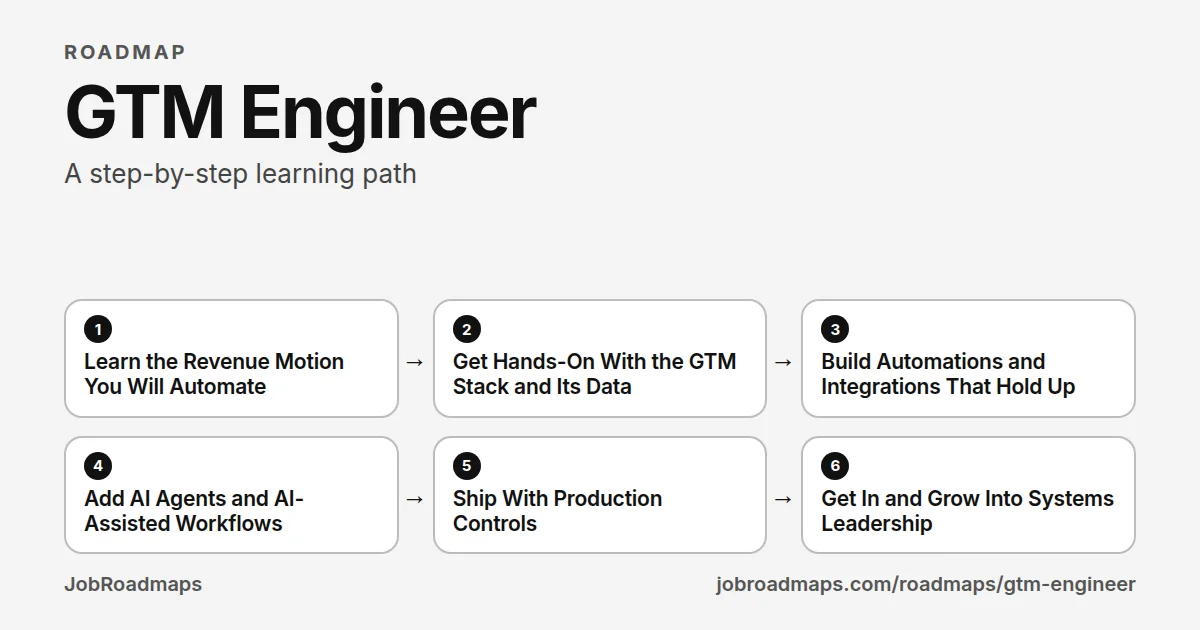
GTM Engineer learning path
Work down the line, one step at a time. Tick each skill as you can do it.
- 1
Learn the Revenue Motion You Will Automate
2–3 weeksBefore building anything, learn how revenue actually moves through a software company: a signup or inbound lead is enriched and scored, routed to a rep, worked by an SDR, qualified, handed to an account executive, closed and passed to customer success. Learn who owns each step, what a good handoff looks like and where leads and deals get stuck. The postings say you should understand the rep's day as well as the stack, and the people who do are the ones who build things reps use.
Skills to learn
- Lead-to-revenue funnel and stages
- Roles: SDR, account executive, customer success, revenue operations
- Lead scoring, routing and handoffs
- Pipeline, forecast and conversion metrics
- Where reps lose time
Start with
- 2
Get Hands-On With the GTM Stack and Its Data
6–10 weeksLearn the systems the work happens in. A CRM such as Salesforce or HubSpot is the centre: objects, fields, workflows and permissions. Around it sit enrichment and prospecting tools (Clay, ZoomInfo), marketing automation and a data warehouse. Learn enough SQL to ask the warehouse real questions and enough about CRM data models to know why records go missing, duplicate or fall out of sync. Practise on a free developer org or a free-tier tool.
Skills to learn
- Salesforce or HubSpot objects, fields and flows
- Data enrichment and waterfall sources
- SQL against a warehouse such as Snowflake
- Deduplication and data hygiene
- Lead and account scoring models
- Reporting for sales leaders
Start with
- 3
Build Automations and Integrations That Hold Up
8–12 weeksThis is the core engineering craft. Learn to connect systems with APIs and webhooks, to choose between a low-code tool and code, and to write Python for the parts that do not fit a canvas. Build a real workflow: a new signup is enriched, scored, routed and posted to Slack with an owner and a next step. Handle the failure cases, because a workflow that silently drops leads is worse than none.
Skills to learn
- REST APIs, webhooks and authentication
- Python for glue code and data work
- Low-code and automation platforms (n8n, Zapier, native flows)
- Middleware and queues for reliable delivery
- Error handling, retries and alerts
- Version control and code review for internal tools
Start with
- 4
Add AI Agents and AI-Assisted Workflows
6–10 weeksMost of the postings we track mention AI or agents. Learn to call a language-model API, write prompts that give consistent results and build an agent that does a bounded job: researches an account, drafts a follow-up, updates a CRM record or summarises a call. Learn where an agent should stop and ask a person. Use AI coding assistants to build faster, and be able to explain what the generated code does.
Skills to learn
- Language-model APIs and structured outputs
- Prompt design for reliable results
- Agent workflows with tools and approvals
- Retrieval over call transcripts, notes and documents
- AI coding assistants as a build tool
- Choosing between a low-code tool and custom code
Start with
- 5
Ship With Production Controls
4–8 weeksWhat separates a GTM engineer from someone with a clever demo is operating the system. Ten of the 18 postings we track mention evaluation. Learn to test an agent against examples before reps see it, keep a human in the loop where the cost of a mistake is high, watch what it does in production and tie the numbers to pipeline and revenue. Handle permissions and sensitive customer data carefully, and keep an audit trail.
Skills to learn
- Evaluating agents against test cases
- Human review and approval gates
- Observability and alerts
- Permissions and sensitive-data handling
- Measuring impact on pipeline and revenue
- Rollout and change management with sales teams
Start with
- 6
Get In and Grow Into Systems Leadership
6–12 monthsThere is rarely a graduate entry route, so most people arrive from revenue operations, sales operations, an SDR or marketing-ops seat where they started automating their own work, or from software engineering with an interest in business problems. Build a public or portfolio example (a scoring workflow, an enrichment pipeline, an agent for account research) and describe the result in revenue terms. From there the path leads to senior builder, GTM engineering manager or head of GTM systems.
Skills to learn
- Routes in: revenue operations, sales ops, marketing ops, software engineering
- A portfolio of workflows with measured outcomes
- Describing technical work in revenue terms
- Working with sales, marketing, data and security teams
- Leading GTM engineering as a team
Start with
jobroadmaps.com/roadmaps/gtm-engineer · Pay, demand and employer data for this role are further down the page.
Books worth reading as a GTM Engineer
Where to start, in order. The full list of 12, grouped by career stage, is on its own page.
Getting started

Predictable Revenue
by Aaron Ross, Marylou Tyler · 2011
The book that shaped modern outbound sales: how teams split roles and build a repeatable pipeline. Read it to understand the process you will be automating before you touch a tool.
View book →The Sales Acceleration Formula
by Mark Roberge · 2015
~200 pages~5 hrs to read
A practical look at how revenue teams are structured, measured and scaled. It gives you the vocabulary of funnel stages, roles and metrics that the people you build for use every day.
View book →
Doing the job

Data Pipelines Pocket Reference: Moving and Processing Data for Analytics
by James Densmore · 2021
~280 pages~7 hrs to read
A compact reference for moving and processing data between systems. Helpful when you build enrichment, sync and reporting pipelines and need patterns for loads, quality checks and orchestration.
View book →
Developing Data Migrations and Integrations with Salesforce: Patterns and Best Practices
by David Masri · 2018
~370 pages~9 hrs to read
Patterns for moving data into and out of Salesforce and integrating it with other systems. It targets the most common platform in the postings and the failure points of syncs and migrations.
View book →
Senior and leading

Lean Analytics: Use Data to Build a Better Startup Faster
by Alistair Croll, Benjamin Yoskovitz · 2013
~410 pages~10 hrs to read
Shows how to choose the metrics that matter and measure them honestly. It helps you describe a workflow's effect on pipeline in numbers that a revenue leader will trust.
View book →Trustworthy Online Controlled Experiments: A Practical Guide to A/B Testing
by Ron Kohavi, Diane Tang, Ya Xu · 2020
~200 pages~5 hrs to read
The standard text on running reliable experiments. Lead-level GTM engineers decide whether a change to scoring, routing or messaging actually worked, and this book keeps those conclusions honest.
View book →
All 12 books for a GTM Engineer →Browse all books →
Some book links are affiliate links: we earn a small commission if you buy, at no cost to you. It does not affect what we list.
Courses and certifications for a GTM Engineer
8 courses, tutorials and certifications, each read on the provider's own page. One from each stage to start; the full list, with a guide to choosing, is on its own page.
Getting started · Hands-on tutorial
The Python Tutorial
Python Software Foundation
Doing the job · Course
Clay University
Clay
Prerequisites & Education
What credentials do employers look for?
These are the most common paths into this role — no single one is required.
Education Level
View list — coming soon- Bachelor's in computer science, information systems, engineering or a related field: a clear signal for the engineering side of the job
- Bachelor's in business, marketing or economics plus working scripts and automations you have built: a common route
- Associate degree or self-taught with a public portfolio of working workflows: possible when the results are measurable
- Experience in revenue operations, sales operations or marketing operations plus coding skill: how many people actually move in
The title is new, and postings rarely insist on a degree. They ask for evidence that you build things: systems that run, integrations that hold and results you can describe in revenue terms.
Certifications
View list — coming soon- Salesforce Certified Platform Administrator: the common base for CRM-centred seats
- HubSpot Academy certifications: useful for marketing and CRM tooling at HubSpot shops
- Clay University and platform certifications: increasingly relevant where Clay is part of the stack
- Cloud or data-warehouse certifications (for example Snowflake): helpful when the role centres on data pipelines
Certifications are a light signal here. A working workflow with before-and-after numbers carries more weight than a badge.
Bootcamps & Training
View list — coming soon- Salesforce Trailhead: free hands-on modules and a developer org
- Clay University: free training on enrichment and workflow building
- Python Tutorial and SQLBolt: free, and enough for most glue code and data checks
- Model-provider documentation (Anthropic, OpenAI): the primary source for building agents
A paid bootcamp is rarely needed. Free platform training plus one real workflow in production is a stronger story.
Portfolio & Other
View list — coming soon- An enrichment, scoring and routing workflow for sample leads, with the logic written down and failure cases handled
- An agent that researches an account and drafts a brief, with an evaluation set and a review step
- A write-up of a revenue workflow you changed: what was broken, what you built and what moved
- A dashboard or pipeline that joins CRM and product-usage data to flag accounts worth a rep's time
- A short note on controls: how you evaluate, review and monitor an automated workflow
This role is judged on shipped systems and their effect. Describe each project in terms a revenue leader cares about: time saved, leads routed, pipeline created.
Your Roadmap
6 stepsLearn the Revenue Motion You Will Automate
2–3 weeksBefore building anything, learn how revenue actually moves through a software company: a signup or inbound lead is enriched and scored, routed to a rep, worked by an SDR, qualified, handed to an account executive, closed and passed to customer success. Learn who owns each step, what a good handoff looks like and where leads and deals get stuck. The postings say you should understand the rep's day as well as the stack, and the people who do are the ones who build things reps use.
Skills to learn
Get Hands-On With the GTM Stack and Its Data
6–10 weeksLearn the systems the work happens in. A CRM such as Salesforce or HubSpot is the centre: objects, fields, workflows and permissions. Around it sit enrichment and prospecting tools (Clay, ZoomInfo), marketing automation and a data warehouse. Learn enough SQL to ask the warehouse real questions and enough about CRM data models to know why records go missing, duplicate or fall out of sync. Practise on a free developer org or a free-tier tool.
Skills to learn
Build Automations and Integrations That Hold Up
8–12 weeksThis is the core engineering craft. Learn to connect systems with APIs and webhooks, to choose between a low-code tool and code, and to write Python for the parts that do not fit a canvas. Build a real workflow: a new signup is enriched, scored, routed and posted to Slack with an owner and a next step. Handle the failure cases, because a workflow that silently drops leads is worse than none.
Skills to learn
Add AI Agents and AI-Assisted Workflows
6–10 weeksMost of the postings we track mention AI or agents. Learn to call a language-model API, write prompts that give consistent results and build an agent that does a bounded job: researches an account, drafts a follow-up, updates a CRM record or summarises a call. Learn where an agent should stop and ask a person. Use AI coding assistants to build faster, and be able to explain what the generated code does.
Skills to learn
Ship With Production Controls
4–8 weeksWhat separates a GTM engineer from someone with a clever demo is operating the system. Ten of the 18 postings we track mention evaluation. Learn to test an agent against examples before reps see it, keep a human in the loop where the cost of a mistake is high, watch what it does in production and tie the numbers to pipeline and revenue. Handle permissions and sensitive customer data carefully, and keep an audit trail.
Skills to learn
Get In and Grow Into Systems Leadership
6–12 monthsThere is rarely a graduate entry route, so most people arrive from revenue operations, sales operations, an SDR or marketing-ops seat where they started automating their own work, or from software engineering with an interest in business problems. Build a public or portfolio example (a scoring workflow, an enrichment pipeline, an agent for account research) and describe the result in revenue terms. From there the path leads to senior builder, GTM engineering manager or head of GTM systems.
Skills to learn
Start here this week
This week: pick one repetitive task a sales rep does, such as researching an account before a call, and build a small workflow for it. Use a free-tier automation tool, a spreadsheet of sample accounts and a language-model API to produce a one-paragraph account brief. Write down what it gets right, where it fails and what a person must still check. That is close to what the first interview will ask you to walk through.
For structure: spend the first month on the revenue funnel and one CRM, the next two on APIs, Python and an automation platform, then add an AI agent with evaluation and a review step. Ship one workflow that a real person uses, even a friend running a small business, and measure what it changed. Put it in a short write-up. It becomes your portfolio.
Job Titles at Each Level
Entry
Associate GTM Engineer / GTM Operations Analyst
Mid
GTM Engineer
Senior
Senior GTM Engineer / Staff GTM Engineer / GTM Engineering Manager
Steps Overview
- 1
Learn the Revenue Motion You Will Automate
2–3 weeks
- 2
Get Hands-On With the GTM Stack and Its Data
6–10 weeks
- 3
Build Automations and Integrations That Hold Up
8–12 weeks
- 4
Add AI Agents and AI-Assisted Workflows
6–10 weeks
- 5
Ship With Production Controls
4–8 weeks
- 6
Get In and Grow Into Systems Leadership
6–12 months
Explore more roadmaps
Not sure this is the right path? Browse all tech career roadmaps.
View Similar RoadmapsBuilt a project while following this roadmap?
Turn it into a hiring-ready case study in 10 seconds — free.
Ready to explore more?
Browse all career roadmaps across tech, business, and creative fields.