Forward Deployed Engineer (FDE) Career Roadmap
A forward deployed engineer works inside the customer's environment, not the vendor's office. You take your company's platform (a data platform, a model API, a network) and make it run against the customer's messy systems, half-documented data, and unclear goals. It is part software engineering and part consulting: you write production code, and you also run the discovery call and say out loud what will and won't work. It is not a sales engineer's job (pre-sales demos and proofs of concept) and not an architect's (designing from a distance); the postings are blunt that you ship code on the customer's infrastructure. Palantir says in its own job postings that it pioneered the position, and AI labs and data-infrastructure companies have adopted it since.
Is this the right path for you?
There are two real entry paths. The visible early-career one is Palantir: most of the new-grad and internship titles we see are its forward deployed software engineer and deployment strategist programs, which ask for an engineering degree and solid programming rather than years of experience. A few smaller companies post a new-grad or junior FDE title too, but rarely. The other is lateral. Software engineers, data engineers and support or solutions engineers at platform companies move customer-side once they have shipped and operated real systems. Across the live job postings we track, about 410 have "forward deployed" or "deployment strategist" in the title, spread over roughly 30 companies; about one in ten carries entry-level wording.
You need to be comfortable being the person in the room who does not know the answer yet. The postings from AI labs and data platforms repeat the same phrases: operate autonomously, thrive under ambiguity, own the outcome end to end. Palantir's early-career posting says it plainly: you will not be handed a ticket queue. Travel or long on-site stretches are stated in postings from Palantir, Anthropic, Databricks, Scale AI and MongoDB, and the amount varies by team, so read each posting's own terms. If you want a stable team and a defined backlog, this is the wrong job. If a customer's ugly data and vague goal sounds like the good part, it is the right one.
Honest note: this is not a beginner's job. Of those postings, roughly a quarter carry senior wording and about one in twenty staff, principal, director or head wording, against about one in ten with entry-level words, and Palantir's programs account for most of the early-career titles we have seen. Our postings come from about a hundred tech-company job boards, skewed to AI, infrastructure and SaaS scale-ups, so this says nothing about consultancies or systems integrators that use the title differently. Some employers frame the role as billable professional services delivery, and that changes the day-to-day. Expect to earn the title with a first engineering job, not to start with it.
Where this role sits
Three jobs in one seat
A forward deployed engineer works inside the customer’s environment. The role is the overlap of three kinds of work that are usually split across different people.
Software engineering
- Write production code
- Ship it end to end
- Run it on the customer’s infrastructure
Consulting
- Run the discovery call
- Learn the unclear goals
- Say what will and won’t work
Platform integration
- Take the vendor’s platform
- Connect messy, half-documented systems
- Make it run against real data
Where all three meet
Forward Deployed Engineer
Builds it, explains it, and stays until it works.
What it is not: a sales engineer, whose work is pre-sales demos and proofs of concept, or an architect, who designs from a distance. The postings are blunt that you ship code on the customer’s infrastructure.
Career Progression
Where does this role lead?
Click any role to explore timeline, key skills and, where the Department of Labor publishes it, pay.
Entry
Associate FDE / Deployment Strategist
Early career
Early-career titles in the postings we track come mostly from Palantir's new-grad and internship programs. You are handed real customer responsibility quickly, so the learning curve is the job. Deployment strategist and engineer tracks split early; pick on whether you want to write the code or shape the problem.
Key skills
What the postings say you’ll do
Lines copied word for word from live Forward Deployed Engineer postings we track, read September 30, 2026. They show how employers word the job, not what every Forward Deployed Engineer does. Postings change and expire.
“Work within customer systems to build production applications with Claude models, ensuring that these products meet customer requirements.”
“Deliver technical artifacts for customers like MCP servers, sub-agents, and agent skills that will be used in production workflows.”
“Serve as a trusted advisor to key enterprise customers, providing technical insights, best practices, and strategic recommendations that support their business goals”
“Sit in their standups, design reviews, and incident reviews. Earn a seat on their architecture review board and security council for agent risk decisions.”
“Develop configuration updates to win critical POCs, benchmarks, and optimize customer deployments”
“Embed with partner teams to deeply understand workflows, including shadowing and learning different job functions.”
“You will not be handed a ticket queue. You will not be shielded from the customer, the chaos, or the consequences.”
Who is hiring right now
Drawn from live postings across many employers today. Employers with live postings we tag to this roadmap, counted today. The sample is about a hundred tech-company job boards, tilted toward AI, data and infrastructure companies, so consultancies and integrators are not represented.
| Employer | Live postings | Early-career titles | Most common title |
|---|---|---|---|
| Databricks | 122 | 0 | Sr. Forward Deployed Engineer (FDE) - Communications, Media, Entertainment & Games |
| Palantir | 111 | 37 | Deployment Strategist |
| Mistral AI | 37 | 1 | AI Deployment Strategist |
| Scale AI | 32 | 0 | Forward Deployed Product Manager, Enterprise |
| OpenAI | 31 | 0 | Deployment Lead (DL), FDE - Singapore |
| LangChain | 19 | 2 | Deployed Engineer (Atlanta) |
| Anthropic | 16 | 0 | Forward Deployed Engineer |
| Cognition | 15 | 0 | Deployed Engineer - LATAM |
| Cohere | 13 | 0 | Forward Deployed Engineer, Agentic Platform |
| Cloudflare | 12 | 0 | Senior Forward Deployed Engineer |
| ElevenLabs | 12 | 0 | Deployment Strategist - Argentina |
| Cursor | 11 | 0 | Forward Deployed Engineer |
“Early-career titles” are roles whose title signals an entry-level or new-graduate position. Top 12 of 48 employers shown.
Same words, different jobs
Look-alike titles read very differently once you open the posting. One line from a real posting for each, with how many live postings we track under that title and how many carry entry-level wording.
Forward Deployed Engineer
371 live postings · 43 employers · 37 with early-career wording
“Work within customer systems to build production applications with Claude models, ensuring that these products meet customer requirements.”
Anthropic · Forward Deployed Engineer posting
Deployment Strategist
77 live postings · 7 employers · 4 with early-career wording
“You will be part of the founding team, embedded with our most strategic customers from the very first sales call, all the way through to a production-ready solution.”
Databricks · Deployment Strategist posting
Sales / Solutions Engineer
487 live postings · 68 employers · 12 with early-career wording
“Partner closely with sales teams as the go-to identity authority, aligning Auth0 solutions directly with developer pain points and business goals through tailored, value-driven product demonstrations.”
Okta · Associate Solutions Engineer, Okta posting
Software Engineer
3,108 live postings · 134 employers · 157 with early-career wording
“Develop scalable computer systems that manage a large volume of information and use them to fulfill business goals for Stripe and its partners.”
Stripe · Software Engineer posting
“Deployment Strategist” is not one job
The same title covers a customer-embedded delivery role at one company and a quota-carrying sales role at another. Read the posting, not the title.
“Carry and exceed a multi-million dollar annual revenue quota across NRO and NGA.”
“…work as part of a diverse, generative, and creative team of Engineers, Product Designers, and other Deployment Strategists to deploy software against the most important problems our world faces.”
Quotes read September 30, 2026, from the live postings we track.
Visual roadmap
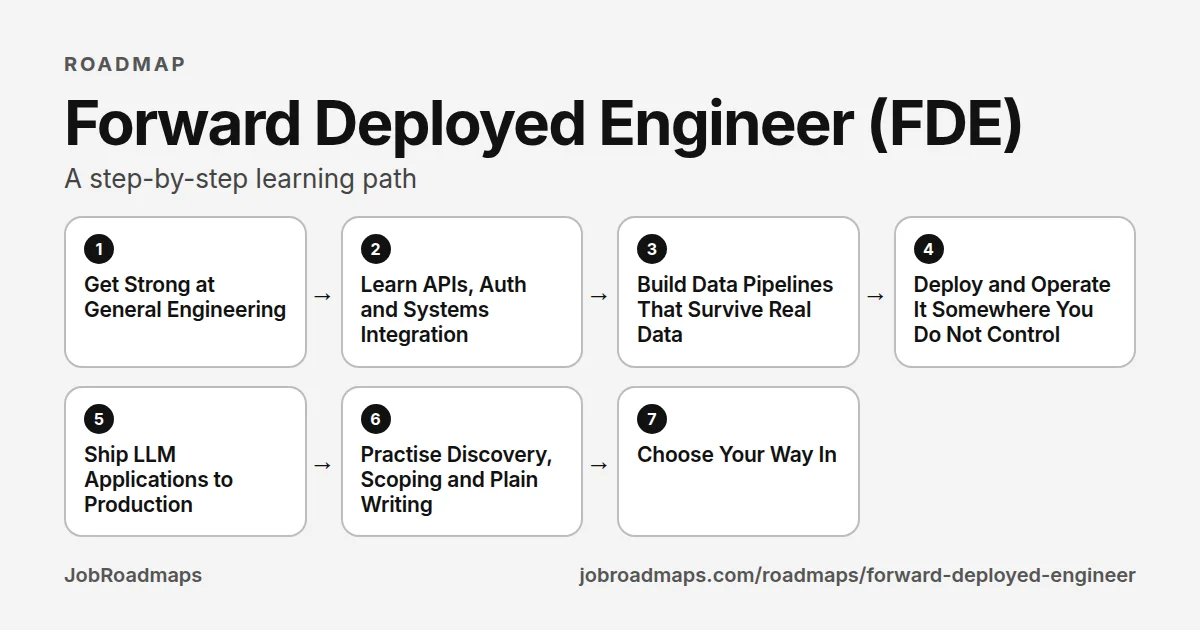
Forward Deployed Engineer learning path
Work down the line, one step at a time. Tick each skill as you can do it.
- 1
Get Strong at General Engineering
6–9 monthsThe postings we read consistently ask for real coding ability first, in Python, TypeScript, Java or similar. FDEs are not judged on knowing one product; they are judged on whether they can pick up any stack the customer happens to run. Get fluent in one language, comfortable in a Linux shell, and good with git and SQL before you touch anything customer-facing.
Skills to learn
- Python
- TypeScript / JavaScript
- SQL and relational modelling
- Git and code review
- Linux command line
- Reading unfamiliar codebases
- Debugging without a debugger you chose
- Data structures and algorithms basics
Start with
- 2
Learn APIs, Auth and Systems Integration
6–10 weeksThe job is connecting things that were never designed to be connected. Learn how HTTP APIs actually behave (pagination, rate limits, retries, auth flows, webhooks), how to read an OpenAPI spec, and how to build an integration that fails loudly instead of silently. Customer systems will be older, stranger and less documented than anything in a tutorial.
Skills to learn
- HTTP and REST
- OpenAPI / Swagger
- OAuth and SSO basics
- Webhooks and retries
- Idempotency
- Rate limiting and pagination
- Reading vendor documentation critically
- Integration testing
Start with
- 3
Build Data Pipelines That Survive Real Data
8–12 weeksSeveral postings we read describe the same problem: wrestle customer data into something a platform can use. Learn ingestion, transformation, scheduling and validation on deliberately ugly inputs. Employers here sell data and AI platforms, so the ability to move data from a customer's systems into stable, tested pipelines is the daily work, not a side skill.
Skills to learn
- ETL / ELT design
- Data cleaning and validation
- Workflow orchestration
- Change data capture concepts
- Batch vs streaming
- Apache Spark basics
- Data modelling
- Pipeline monitoring
Start with
- 4
Deploy and Operate It Somewhere You Do Not Control
10–14 weeksWriting the code is half of it; getting it to run inside someone else's cloud account, cluster or locked-down network is the other half. Learn containers, infrastructure as code and the basics of running a service: logging, health checks, rollbacks. Some customer environments are restricted or on-premises, so practise deploying without assuming the internet or your favourite tooling is there.
Skills to learn
- Docker
- Kubernetes basics
- Terraform / infrastructure as code
- A major cloud (AWS, Azure or GCP)
- CI/CD
- Secrets and least-privilege access
- Logging and observability
- Deploying to restricted networks
Start with
- 5
Ship LLM Applications to Production
8–12 weeksMany current FDE postings are about putting AI into a customer's workflow: retrieval over their documents, tool-calling against their systems, agents with guardrails. The demo is easy. The skill employers ask for is the rest: evaluation, monitoring, cost and latency, and knowing when the model should not be trusted. Build one small application and measure whether it works.
Skills to learn
- Prompting and structured outputs
- Retrieval-augmented generation
- Tool use and agent design
- Model Context Protocol (MCP)
- Evaluation harnesses and test sets
- Latency, cost and failure handling
- Guardrails and human-in-the-loop design
- Data privacy in customer environments
Start with
- 6
Practise Discovery, Scoping and Plain Writing
OngoingThis is what separates an FDE from a strong backend engineer. You will be asked to work out what the customer actually needs (which is rarely what they first say), scope a pilot you can finish, say no to the rest, and explain trade-offs to people who do not code. Practise it deliberately: interview real users, write one-page scopes, and write documentation a stranger could follow. Then prove it with one capstone for a real small organisation (a club, a local business, a nonprofit) that has a messy export or spreadsheet. Deliver five things: a one-page scope, agreed with them in writing, that says what you will not do; an ingestion pipeline with tests that fail loudly on bad rows; one LLM-assisted feature with a labelled evaluation set and a written account of where it fails; a deployment they can run without you, with a short runbook; and a recorded 15-minute handover. A hiring manager can score that in ten minutes against those five items.
Skills to learn
- Customer discovery interviews
- Scoping and cutting scope
- Technical writing
- Presenting to non-technical stakeholders
- Handling stakeholder conflict
- Estimating under uncertainty
- Training and handover
- Feeding field findings back to product teams
Start with
- 7
Choose Your Way In
OngoingThere is no single front door. Palantir runs new-grad and internship programs for both forward deployed software engineers and deployment strategists. Elsewhere, the postings we track mostly ask for engineers who have already shipped, so the usual route is lateral: software engineer, data engineer, or support or solutions engineer at a platform company, then a move to the customer-embedded team. "Deployment strategist" also means different jobs at different employers: at Palantir it is a role that works alongside forward deployed engineers, at Databricks it reads like a product-and-delivery role. Read the requirements, not just the title. Public-sector roles can add clearance requirements.
Skills to learn
- Reading a posting for the real job
- Tailoring a portfolio to one employer
- Case-study write-ups
- Technical interviews in Python or TypeScript
- Talking through a customer scenario
- Clearance eligibility (public sector)
Start with
jobroadmaps.com/roadmaps/forward-deployed-engineer · Pay, demand and employer data for this role are further down the page.
Job Market Insights for Forward Deployed Engineer
Data-backed
What do employers actually ask for?
Read from live job postings — how often each credential is named, from rare to almost always.
"Computer Science background" is the most common credential named, yet it appears only rarely in what we could read. Postings that state it are the minority, but these counts are a floor, so do not read this as "no one asks".
Some postings say outright that equivalent experience or a self-taught route is accepted. That wording is worth reading closely when you see it.
Our read: a portfolio that proves the skill, and a referral from someone inside the company, usually carry more weight than a credential match on paper. That is judgement, not something these counts measure.
Requirement
How often named
Computer Science background
Certification mentioned
PhD / doctorate
Equivalent experience accepted
Bachelor's degree
Our read: how often a credential is named is not how strictly it is enforced. Equivalent experience, a standout portfolio, or a referral often counts for more than the credential listed.
Data-backed
Which skills appear most in job postings?
Read from live job postings, ranked from most to least often named.
Postings for this role rarely list skills by name. The most-named, Python, is still only occasional, so none of these is a universal requirement.
Skill
How often named
data integration
technical discovery
fine-tuning
cross-functional collaboration
documentation
change management
production deployment
Sorted by how often named · JobRoadmaps
Data-backed
Which tools and artifacts appear most in job postings?
Read from live job postings, ranked from most to least often named.
No tool dominates. The most-named, AWS, is still rare; postings for this role rarely list tools by name.
Industry overlay
Targeting a specific industry?
The core roadmap gets you through the door anywhere. The difference between "qualified" and "they hired someone else" often lives in industry-specific context — the norms, the compliance floors, the tools assumed fluent in that sector.
Shipping LLM applications into customer workflows
Anthropic's FDE postings describe building production applications with Claude inside customer systems, including MCP servers and sub-agents. The demo is not the deliverable; the workflow that keeps working is.
Evaluation and reliability for model-backed features
Postings from AI employers ask for evaluation frameworks and deployment at scale. Customers judge you on whether the output is trustworthy next month, not on the first impressive run.
Enterprise integration and identity
Deploying a SaaS product inside a large organisation means single sign-on, permissions, and connecting to internal systems that were not built for it.
Feeding field findings back to product
Anthropic's and Scale AI's postings both describe passing repeatable patterns and product gaps back to the product and engineering teams. The best FDEs turn one customer's fix into a capability.
Companies hiring:
OpenAIAnthropicCohereElevenLabsNotionIntercomSalesforceOktacompliance and audit
Financial systems require strict audit trails, regulatory adherence, and governance; FDEs must design with these constraints.
transaction data analysis
FDEs build ML/AI agents on spending patterns, risk signals, and transactional flows to surface insights or automate decisions.
fraud detection and risk
Fintech deployments often involve agents flagging or preventing fraudulent activity; requires domain knowledge.
Companies hiring:
BrexRampStripeAdyenIndustry premiums based on aggregated job posting data · Updated quarterly
Interactive
How ready are you right now?
Check the skills you already have to see your current job-market fit.
The most-named skill for this role is Python, so a gap there costs you the most. No single skill dominates, but each gap narrows which postings fit you. Check what you already have to see your biggest current gap.
Readiness Check
Check the skills you already have
0/5
base skills
Your biggest gap: Python, the most often named of the skills you have not ticked.
Start there, then work down the list.
Books worth reading as a Forward Deployed Engineer
Where to start, in order. The full list of 12, grouped by career stage, is on its own page.
Getting started

The Pragmatic Programmer: Your Journey to Mastery
by David Thomas, Andy Hunt · 1999
~350 pages~9 hrs to read
Habits for working on code you do not fully control: tracer bullets, small reversible decisions, debugging. Useful when you are dropped into a customer's codebase and expected to ship within weeks.
View book →
Flawless Consulting: A Guide to Getting Your Expertise Used
by Peter Block · 1981
~350 pages~9 hrs to read
Covers contracting with a client, handling resistance and defining what you will and will not do. Read it before your first scoping call, when you are the only engineer in the customer's room.
View book →
Doing the job

Designing Data-Intensive Applications
by Martin Kleppmann · 2017
~620 pages~16 hrs to read
Explains storage, replication, batch and stream processing and the trade-offs between them. Reach for it when you must pull customer data out of unfamiliar systems and keep it correct as it moves.
View book →
Enterprise Integration Patterns: Designing, Building, and Deploying Messaging Solutions
by Gregor Hohpe, Bobby Woolf · 2003
~680 pages~17 hrs to read
A catalogue of messaging patterns for connecting systems that were never built to talk to each other: routing, transformation, retries. Directly useful for wiring a product into a customer's legacy stack.
View book →
Senior and leading

Site Reliability Engineering: How Google Runs Production Systems
by Betsy Beyer, Chris Jones, Jennifer Petoff, Niall Richard Murphy · 2016
~520 pages~13 hrs to read
Chapters on monitoring, incident response, postmortems and service level objectives. Helps once you own a customer's live deployment and must set reliability expectations with their team.
View book →
The Trusted Advisor
by David H. Maister, Charles H. Green, Robert M. Galford · 2000
~260 pages~7 hrs to read
Examines how advisers earn and lose client trust over a long engagement. Suited to senior deployed engineers who manage executive relationships, expansion conversations and bad news delivery.
View book →
All 12 books for a Forward Deployed Engineer →Browse all books →
Some book links are affiliate links: we earn a small commission if you buy, at no cost to you. It does not affect what we list.
Prerequisites & Education
What credentials do employers look for?
These are the most common paths into this role — no single one is required.
Education Level
View list — coming soon- Bachelor's in computer science, software engineering, mathematics, physics or data science — the fields named in Palantir's early-career postings
- Bachelor's in another quantitative field plus shipped engineering work — the lateral route via a software or data engineering job
- Graduate degree in a quantitative field — some AI-focused FDE postings at Databricks list one, "or equivalent practical experience"
- No degree — postings such as Anthropic's accept "an equivalent combination of education, training, and/or experience", but expect the bar to be production work you can show
Early-career programs screen on an engineering degree; experienced hires are screened on what they have shipped. Either way, the interview tests whether you can code and whether you can talk to a customer.
Certifications
View list — coming soon- AWS Certified Solutions Architect – Associate — cloud breadth; a Cloudflare FDE-management posting lists AWS Solutions Architect or GCP Cloud Architect as an industry certification
- Databricks Certified Data Engineer Associate — validates ETL with PySpark, jobs, CI/CD and governance on the platform of one of the biggest FDE employers
- HashiCorp Certified: Terraform Associate (004) — infrastructure as code, which Cloudflare's FDE postings name in the duties
- CompTIA Security+ — Palantir's US Government infrastructure and reliability postings list DoD 8570 IAT Level II or greater (CISSP, Security+) as preferred
Certifications are supporting evidence here, not entry tickets: in the postings we read they show up as preferred items at a few employers, never as the main requirement. Take one only when it matches the stack you are targeting.
Bootcamps & Training
View list — coming soon- Anthropic Academy — courses including Building with the Claude API and Introduction to Model Context Protocol
- Databricks Academy — official training on the data and AI platform that many FDE openings are built around
- MongoDB University — vendor training for a database platform that hires forward deployed engineers for migration and integration work
- Cloudflare developer docs and tutorials — Workers and Workers AI are named in Cloudflare's FDE duties
Skip generic coding bootcamps as your entry route. The postings ask for engineering depth plus customer judgement; vendor academies are useful for learning a target employer's platform once you already code.
Portfolio & Other
View list — coming soon- A deployed integration project — pull messy data from an external API, run it through a tested pipeline, and show what happens when the source misbehaves
- An LLM application with retrieval, tool use and an evaluation set — with a README that lists where it fails, not just where it works
- A customer-style case study — the problem as first stated, your discovery questions, the scope you agreed, what you cut, and the handover document
- A reproducible deployment — Docker and Terraform that another engineer can run from a clean account without asking you anything
- Open-source contributions to a data or infrastructure tool — documentation fixes and integration bugs count, and show you can work in a codebase you did not write
FDE hiring rewards evidence of the whole loop: understand a vague problem, build, deploy, explain. A case study written like a customer deliverable shows the half of the job that code alone does not.
Your Roadmap
7 stepsGet Strong at General Engineering
6–9 monthsThe postings we read consistently ask for real coding ability first, in Python, TypeScript, Java or similar. FDEs are not judged on knowing one product; they are judged on whether they can pick up any stack the customer happens to run. Get fluent in one language, comfortable in a Linux shell, and good with git and SQL before you touch anything customer-facing.
Skills to learn
Learn APIs, Auth and Systems Integration
6–10 weeksThe job is connecting things that were never designed to be connected. Learn how HTTP APIs actually behave (pagination, rate limits, retries, auth flows, webhooks), how to read an OpenAPI spec, and how to build an integration that fails loudly instead of silently. Customer systems will be older, stranger and less documented than anything in a tutorial.
Skills to learn
Build Data Pipelines That Survive Real Data
8–12 weeksSeveral postings we read describe the same problem: wrestle customer data into something a platform can use. Learn ingestion, transformation, scheduling and validation on deliberately ugly inputs. Employers here sell data and AI platforms, so the ability to move data from a customer's systems into stable, tested pipelines is the daily work, not a side skill.
Skills to learn
Deploy and Operate It Somewhere You Do Not Control
10–14 weeksWriting the code is half of it; getting it to run inside someone else's cloud account, cluster or locked-down network is the other half. Learn containers, infrastructure as code and the basics of running a service: logging, health checks, rollbacks. Some customer environments are restricted or on-premises, so practise deploying without assuming the internet or your favourite tooling is there.
Skills to learn
Ship LLM Applications to Production
8–12 weeksMany current FDE postings are about putting AI into a customer's workflow: retrieval over their documents, tool-calling against their systems, agents with guardrails. The demo is easy. The skill employers ask for is the rest: evaluation, monitoring, cost and latency, and knowing when the model should not be trusted. Build one small application and measure whether it works.
Skills to learn
Practise Discovery, Scoping and Plain Writing
OngoingThis is what separates an FDE from a strong backend engineer. You will be asked to work out what the customer actually needs (which is rarely what they first say), scope a pilot you can finish, say no to the rest, and explain trade-offs to people who do not code. Practise it deliberately: interview real users, write one-page scopes, and write documentation a stranger could follow. Then prove it with one capstone for a real small organisation (a club, a local business, a nonprofit) that has a messy export or spreadsheet. Deliver five things: a one-page scope, agreed with them in writing, that says what you will not do; an ingestion pipeline with tests that fail loudly on bad rows; one LLM-assisted feature with a labelled evaluation set and a written account of where it fails; a deployment they can run without you, with a short runbook; and a recorded 15-minute handover. A hiring manager can score that in ten minutes against those five items.
Skills to learn
Choose Your Way In
OngoingThere is no single front door. Palantir runs new-grad and internship programs for both forward deployed software engineers and deployment strategists. Elsewhere, the postings we track mostly ask for engineers who have already shipped, so the usual route is lateral: software engineer, data engineer, or support or solutions engineer at a platform company, then a move to the customer-embedded team. "Deployment strategist" also means different jobs at different employers: at Palantir it is a role that works alongside forward deployed engineers, at Databricks it reads like a product-and-delivery role. Read the requirements, not just the title. Public-sector roles can add clearance requirements.
Skills to learn
Start here this week
This week: open three current forward deployed postings from different kinds of employers (an AI lab, a data-platform company, and Palantir) and paste every requirement into one list. Count which items repeat. That list is your syllabus, written by the people who hire for the job. Circle the three you cannot yet do, and start the first one today.
For structure: spend the first six to nine months getting genuinely strong in one language plus SQL, then build one portfolio project that behaves like a customer engagement. Pull messy data from an external API, load it through a tested pipeline, add an LLM feature with an evaluation set, deploy it with Docker, and write the one-page scope and handover document you would give the customer. Then apply along whichever route fits: early-career programs if you are finishing a degree, or a software or data engineering role at a platform company if you are not. Add a certification only where an employer's own stack calls for it.
Job Titles at Each Level
Entry
Associate Forward Deployed Engineer / Deployment Strategist
Mid
Forward Deployed Engineer
Senior
Senior Forward Deployed Engineer / Lead Forward Deployed Engineer
Steps Overview
- 1
Get Strong at General Engineering
6–9 months
- 2
Learn APIs, Auth and Systems Integration
6–10 weeks
- 3
Build Data Pipelines That Survive Real Data
8–12 weeks
- 4
Deploy and Operate It Somewhere You Do Not Control
10–14 weeks
- 5
Ship LLM Applications to Production
8–12 weeks
- 6
Practise Discovery, Scoping and Plain Writing
Ongoing
- 7
Choose Your Way In
Ongoing
Explore more roadmaps
Not sure this is the right path? Browse all tech career roadmaps.
View Similar RoadmapsBuilt a project while following this roadmap?
Turn it into a hiring-ready case study in 10 seconds — free.
Ready to explore more?
Browse all career roadmaps across tech, business, and creative fields.