Books › Data Scientist roadmap
Best books for Data Scientists
A statistics-first list. It starts with data wrangling in Python, the statistics a working data scientist uses and a field guide to the career. The build set adds practical machine learning, feature engineering, communication of findings and the underlying theory. The lead set is about decisions: business framing, production systems, controlled experiments and causal reasoning. It assumes comfort with basic programming and algebra.
12 books in 3 stages, about 5,490 pages (137 hours of reading). The notes are ours, with no ratings or sales claims.
How to choose your books
A short method, so you read the right book for where you are instead of the longest list.
Find your stage
Getting started · 4 books
Wrangling data, the statistics you need to choose a method, and an honest picture of the career.
Jump to this stage ↓Doing the job · 4 books
Modelling and communication: practical machine learning, building better inputs, explaining findings and understanding the theory.
Jump to this stage ↓Senior and leading · 4 books
Decisions that stick: framing business problems, shipping models, running controlled experiments and arguing cause rather than correlation.
Jump to this stage ↓
If you are unsure, start one stage lower than you think. Books in a later stage assume the working knowledge the earlier ones give you.
Begin with one book
Our starting pick
Python for Data Analysis, 3rd Edition
by Wes McKinney · 2011
Nearly every later task begins by loading, cleaning and reshaping data. Work through it with a real dataset in hand.
See the book ↓Then pick by your situation
Choose the next book by the problem in front of you, not by its place in the list.
If you can wrangle data and need to know which method fits the question
read Practical Statistics for Data Scientists, 2nd Edition (getting started)
If your analysis is right but nobody acts on it
read Storytelling with Data (doing the job)
If you are being asked to prove whether a change caused an effect
read Trustworthy Online Controlled Experiments (senior and leading)
Check it against what Data Scientist postings ask for
These skills come from our analysis of live Data Scientist job postings. If one is new to you, its book list sits one click away.
Each step on the scale reflects how often live job postings name the skill, tool or credential, based on our analysis of those postings.
Set a time budget
| Stage | Books | Pages | Reading | At 3 hrs a week |
|---|---|---|---|---|
| Getting started | 4 | 1,790 | 45 hrs | 15 wks |
| Doing the job | 4 | 2,120 | 53 hrs | 18 wks |
| Senior and leading | 4 | 1,580 | 40 hrs | 13 wks |
| All 3 stages | 12 | 5,490 | 137 hrs | 46 wks |
Treat this as a ceiling, not a target. Read one book at a time, apply it, then move on; read reference-style books in sections.
Judge any book before you buy it
Age
This list runs from 2001 (The Elements of Statistical Learning) to 2022 (Designing Machine Learning Systems). Older books earn their place by teaching principles that do not change. For tools and platforms, buy the latest edition.
Level
Check the stage before the title. A book from a later stage will make sense only once you have faced the problems it solves.
Format
The longest book here, Hands-On Machine Learning with Scikit-Learn, Keras & TensorFlow, 3rd Edition, runs about 860 pages. Read very long books as references: pick the chapter that matches the problem you have.
Fit
Ask what you will do differently the week after you finish. If you cannot answer, the book is for a different moment. Come back to it when the situation arrives.
Getting started
Wrangling data, the statistics you need to choose a method, and an honest picture of the career.
 Start here
Python for Data Analysis, 3rd Edition
by Wes McKinney · 2011
~550 pages~14 hrs to read
Written by the creator of pandas, it covers loading, cleaning, reshaping and summarising tabular data in Python. Read it early, alongside real datasets, because nearly every later data task starts with these skills.
View book →
Practical Statistics for Data Scientists, 2nd Edition
by Peter Bruce, Andrew Bruce, Peter Gedeck · 2017
~370 pages~9 hrs to read
Explains the statistics a working data scientist needs: sampling, distributions, A/B testing, regression and classification, with code in R and Python. Read it when you can already wrangle data and want to know which method fits the question.
View book →An Introduction to Statistical Learning: with Applications in Python
by Gareth James, Daniela Witten, Trevor Hastie, Robert Tibshirani, Jonathan Taylor · 2013
~620 pages~16 hrs to read
A clear first course in regression, classification, resampling, trees and other core statistical learning methods, with Python labs. It is the best place to build the intuition behind the models you will fit every day.
View book →
Build a Career in Data Science
by Emily Robinson, Jacqueline Nolis · 2020
~250 pages~6 hrs to read
Covers the job itself: finding a first role, interviewing, working with stakeholders, managing projects and moving up. Read it in your first months, or while job hunting, to learn what the work looks like beyond the modelling.
View book →
Doing the job
Modelling and communication: practical machine learning, building better inputs, explaining findings and understanding the theory.

Hands-On Machine Learning with Scikit-Learn, Keras & TensorFlow, 3rd Edition
by Aurélien Géron · 2017
~860 pages~22 hrs to read
Project-driven walk-through of the machine learning workflow, from classical models in Scikit-Learn to neural networks in Keras. Work through it once you are comfortable with Python and basic statistics.
View book →
Feature Engineering for Machine Learning
by Alice Zheng, Amanda Casari · 2016
~220 pages~6 hrs to read
A compact guide to turning raw numeric, text and categorical data into features that models can use. Useful once your first models plateau and the gains have to come from the data rather than the algorithm.
View book →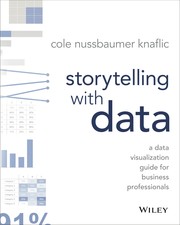
Storytelling with Data: A Data Visualization Guide for Business Professionals
by Cole Nussbaumer Knaflic · 2015
~290 pages~7 hrs to read
Teaches how to choose the right chart, remove clutter and build a narrative around a result. Read it before your next stakeholder readout, since an unclear chart is the usual reason a good analysis gets ignored.
View book →
The Elements of Statistical Learning: Data Mining, Inference, and Prediction, 2nd Edition
by Trevor Hastie, Robert Tibshirani, Jerome Friedman · 2001
~750 pages~19 hrs to read
The rigorous, mathematical companion to the introductory text, covering regularisation, boosting, additive models and more. Keep it as a reference for when you need to understand why a method behaves as it does.
View book →
Senior and leading
Decisions that stick: framing business problems, shipping models, running controlled experiments and arguing cause rather than correlation.

Data Science for Business: What You Need to Know about Data Mining and Data-Analytic Thinking
by Foster Provost, Tom Fawcett · 2013
~410 pages~10 hrs to read
Frames data science as a way to make business decisions, covering problem framing, evaluation and the trade-offs behind predictive models. A good fit for senior data scientists who must scope projects and explain their value to non-technical leaders.
View book →
Designing Machine Learning Systems: An Iterative Process for Production-Ready Applications
by Chip Huyen · 2022
~390 pages~10 hrs to read
Covers data pipelines, deployment, monitoring and the lifecycle of production models. Read it when your work shifts from notebooks to models that other teams depend on.
View book →Trustworthy Online Controlled Experiments: A Practical Guide to A/B Testing
by Ron Kohavi, Diane Tang, Ya Xu · 2020
~200 pages~5 hrs to read
The reference on running A/B tests that you can believe: metric choice, pitfalls, sample ratio checks and experiment platforms. Read it when you own experimentation or advise a team on it.
View book →
Causal Inference: The Mixtape
by Scott Cunningham · 2021
~580 pages~15 hrs to read
Introduces difference-in-differences, regression discontinuity, instrumental variables and related methods for estimating causal effects from observational data. Read it when stakeholders ask what an intervention actually caused, not just what correlates with it.
View book →
Book links go to Amazon and are affiliate links. As an Amazon Associate I earn from qualifying purchases.
Frequently asked questions
Which book should a Data Scientist read first?
Python for Data Analysis, 3rd Edition by Wes McKinney. Nearly every later task begins by loading, cleaning and reshaping data. Work through it with a real dataset in hand.
Do I need to read all 12 books?
No. The list is a menu, not a syllabus. Find your stage (getting started: 4, doing the job: 4, senior and leading: 4), begin with one book (we suggest Python for Data Analysis, 3rd Edition), then pick the next book by the problem you are facing at work. Come back to the others when the situation they cover arrives.
How long does it take to read these books?
All 12 books add up to about 5,490 pages, roughly 137 hours at 1.5 minutes a page. At three hours a week that is about 46 weeks; at six hours a week, about 23. The list is meant to be read over time, one book at a time, not in one run.
Are these books up to date?
They range from 2001 (The Elements of Statistical Learning) to 2022 (Designing Machine Learning Systems). Older titles are included because they teach principles that have not changed; for tools and platforms, we favour recent editions. Check the edition before you buy.
Related reading
Some links are affiliate links: we earn a small commission if you buy, at no cost to you. It does not change what we list.