AI Enablement & Literacy Lead Career Roadmap
AI Enablement Leads help organisations adopt AI tools effectively — designing training programmes, building AI usage policies, identifying high-impact automation opportunities, and measuring workforce-wide AI productivity gains. This role is exploding as every company races to upskill employees.
Is this the right path for you?
AI enablement leads come from L&D professionals who've added AI tool training to their scope, from HR and operations leads who got pulled into AI adoption work, and from internal comms and change management practitioners. The role is fundamentally about organizational behavior change — getting people to actually use AI tools rather than fear or ignore them.
If you get more satisfaction from helping 500 people use AI well than from using it brilliantly yourself — if you find the human side of technology adoption more interesting than the technology itself — you're already thinking like an enablement lead. The job rewards empathy for the person who's skeptical as much as fluency with the tools.
This role lives or dies on trust. If people feel like AI enablement is a compliance program rather than a genuine offer of help, adoption collapses and the program gets cut. The best AI enablement leaders come in as collaborators — they start by understanding what actually blocks people, not by delivering a curriculum they designed in advance.
Career Progression
Where does this role lead?
Click any role to explore timeline, key skills and, where the Department of Labor publishes it, pay.
Entry
AI Enablement Specialist
~1–2 yrs
$46,717 (Level I)
You're running AI training sessions and building the prompt libraries and playbooks that help employees use AI tools effectively. Strong facilitation skills and personal AI tool mastery are the entry requirements.
Key skills
Pay shown is the U.S. Department of Labor prevailing wage for Level I (entry), Level III (mid) and Level IV (senior) in the nearest BLS occupation, base wage for the typical metro, wage year 2025, shown for the main track only. It is a benchmark, not an offer; branches and lead, staff and executive stages have no official figure.
Visual roadmap
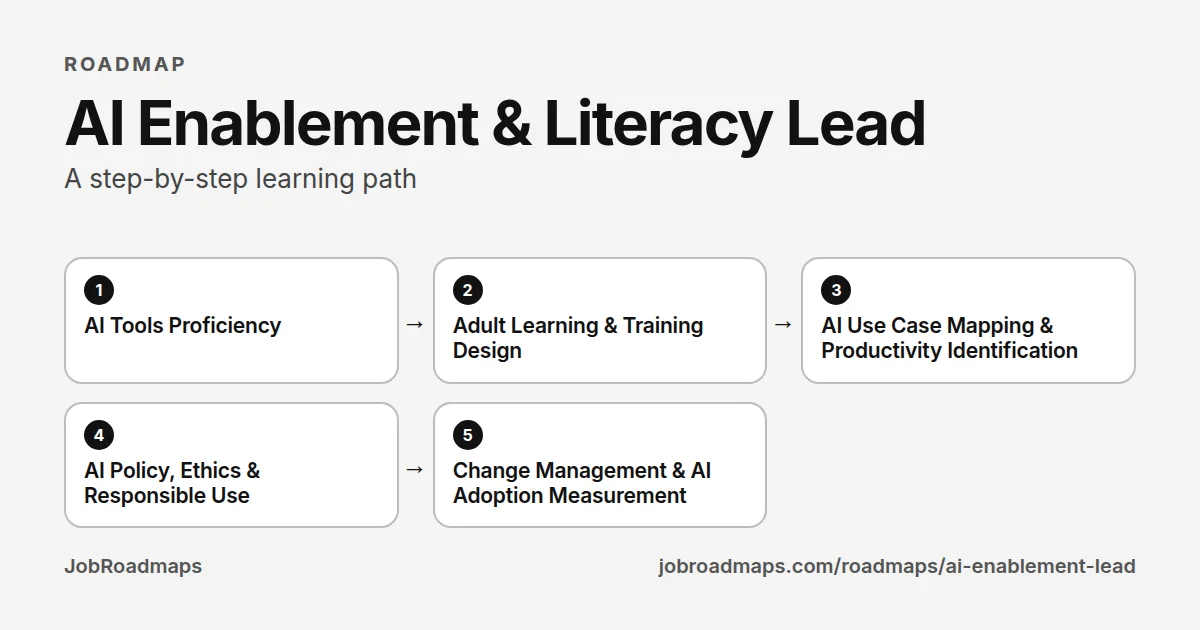
AI Enablement & Literacy Lead learning path
Work down the line, one step at a time. Tick each skill as you can do it.
- 1
AI Tools Proficiency
4–6 weeksBecome an advanced user of the main enterprise AI tools: ChatGPT/GPT-4, Claude, Microsoft Copilot, GitHub Copilot, and domain-specific AI tools in your industry. Understand what each tool does well, where it fails, and how to prompt effectively across different use cases.
Skills to learn
- ChatGPT / GPT-4
- Claude
- Microsoft Copilot
- GitHub Copilot
- Prompt Engineering
- AI Tool Evaluation
- 2
Adult Learning & Training Design
4–6 weeksLearn instructional design principles: ADDIE model, Bloom's Taxonomy, spaced repetition, and the Kirkpatrick evaluation model. Design AI training that sticks — moving employees from awareness to habit formation. Create hands-on exercises, not slide decks.
Skills to learn
- ADDIE Model
- Bloom's Taxonomy
- Training Needs Analysis
- Curriculum Design
- Hands-On Exercise Design
- Kirkpatrick Evaluation
- 3
AI Use Case Mapping & Productivity Identification
4–5 weeksMap AI opportunities across business functions: marketing, sales, operations, HR, finance, and legal. Identify the highest-ROI use cases for AI adoption in each team. Build use case libraries and "AI playbooks" that give employees ready-to-use prompts for their workflows.
Skills to learn
- Use Case Mapping
- AI Playbook Development
- Workflow Analysis
- ROI Identification
- Departmental AI Adoption
- Prompt Libraries
- 4
AI Policy, Ethics & Responsible Use
3–4 weeksDesign AI acceptable use policies for employees: what can and cannot be fed to AI tools, data classification for AI, disclosure requirements, and intellectual property considerations. Build clear guidance that enables productivity without creating legal or security risk.
Skills to learn
- AI Acceptable Use Policy
- Data Classification for AI
- IP & AI Considerations
- Employee AI Guidelines
- AI Risk Communication
- Policy Implementation
- 5
Change Management & AI Adoption Measurement
4–5 weeksDrive adoption using change management frameworks: Prosci ADKAR, Kotter's 8-step model, and early adopter networks. Measure AI adoption: tool usage rates, productivity benchmarks, and self-reported efficiency gains. Report ROI of AI enablement to leadership.
Skills to learn
- Prosci ADKAR
- Early Adopter Networks
- AI Adoption Metrics
- Productivity Measurement
- ROI Reporting
- Executive Communication
jobroadmaps.com/roadmaps/ai-enablement-lead · Pay, demand and employer data for this role are further down the page.
Job Market Insights for AI Enablement & Literacy Lead
Data-backed
Which skills appear most in job postings?
Read from live job postings, ranked from most to least often named.
Python is the most-named skill. Common, but not universal: many postings do not list it.
Past the fundamentals, 2 specialisation skills (Python included) start separating candidates who can do the job from candidates who have done it. The 7 niche skills are named rarely enough that knowing them is upside, not prerequisite.
Skill
How often named
APIs
AI agents
Data pipelines
Documentation
Customer empathy
Production deployment
Sorted by how often named · JobRoadmaps
Industry overlay
Targeting a specific industry?
The core roadmap gets you through the door anywhere. The difference between "qualified" and "they hired someone else" often lives in industry-specific context — the norms, the compliance floors, the tools assumed fluent in that sector.
Microsoft Copilot deployment
Microsoft 365 Copilot is the most widely deployed enterprise AI tool — enablement leads who specialise in Copilot deployment and adoption are in extremely high demand.
AI adoption measurement dashboards
SaaS companies with large software portfolios need systematic measurement of AI feature adoption across their employee base — building the analytics infrastructure for this is a core enablement capability.
Companies hiring:
MicrosoftSalesforceGoogleServiceNowWorkdayGovernance and compliance
Enterprise environments demand auditable, compliant AI systems; enablement teams must build guardrails, access controls, and audit trails.
Change management at scale
Large organizations have entrenched processes and resistance; success requires structured adoption programs and stakeholder alignment.
Cross-functional alignment
Enterprise projects involve many departments; enablement teams must navigate politics and secure buy-in from Security, Legal, Risk, and Product simultaneously.
Companies hiring:
Scale AIOscar HealthZocdocCollibraIndustry premiums based on aggregated job posting data · Updated quarterly
Interactive
How ready are you right now?
Check the skills you already have to see your current job-market fit.
The most-named skill for this role is Python, so a gap there costs you the most. No single skill dominates, but each gap narrows which postings fit you. Check what you already have to see your biggest current gap.
Readiness Check
Check the skills you already have
0/5
base skills
Your biggest gap: Python, the most often named of the skills you have not ticked.
Start there, then work down the list.
Books worth reading as a AI Enablement & Literacy Lead
Where to start, in order. The full list of 12, grouped by career stage, is on its own page.
Getting started

Co-Intelligence: Living and Working with AI
by Ethan Mollick · 2024
A business-school professor shows how to work with AI systems in everyday tasks and where they fail. A good first read before you teach anyone else.
View book →
Prompt Engineering for Generative AI: Future-Proof Inputs for Reliable AI Outputs
by James Phoenix, Mike Taylor · 2024
Covers the principles of writing reliable prompts and testing them across tasks. Gives you the hands-on material for training sessions and prompt libraries.
View book →
Doing the job

Telling Ain't Training: Updated, Expanded, Enhanced
by Harold D. Stolovitch, Erica J. Keeps · 2002
~290 pages~7 hrs to read
A practical guide to why information alone does not change performance and how to design training that does. A fit for programmes where the goal is changed work habits.
View book →
Switch: How to Change Things When Change Is Hard
by Chip Heath, Dan Heath · 2010
~310 pages~8 hrs to read
Offers a simple model for change: direct the rational mind, motivate the emotional side and shape the environment. Useful for getting teams to adopt new AI tools.
View book →
Senior and leading

Leading Change
by John P. Kotter · 1996
~210 pages~5 hrs to read
The classic eight-stage account of leading organisational change. Read it when you run adoption across a whole company rather than a single team.
View book →
Diffusion of Innovations
by Everett M. Rogers · 1962
~510 pages~13 hrs to read
The foundational study of how new ideas spread through groups, including early adopters, champions and the factors that slow uptake. Informs how you plan a rollout.
View book →
All 12 books for a AI Enablement & Literacy Lead →Browse all books →
Some book links are affiliate links: we earn a small commission if you buy, at no cost to you. It does not affect what we list.
Prerequisites & Education
What credentials do employers look for?
These are the most common paths into this role — no single one is required.
Education
View list — coming soon- BA/MA in Education, Organisational Psychology, or HR — adult learning principles and change management frameworks are the foundation
- BA in Business or Communications with L&D experience — alternative path for enablement leads from business backgrounds
- Background in L&D, instructional design, or internal communications — the most common entry path
Adult learning principles and change management expertise matter more than the specific degree. Most AI Enablement Leads come from L&D, HR, or internal communications backgrounds, not AI engineering.
Certifications
View list — coming soon- ATD Certified Professional in Talent Development (CPTD) — the L&D profession's primary credential; shows instructional design and programme evaluation expertise ($1,250)
- Prosci Change Management Certification — Prosci ADKAR is the most widely used enterprise change framework; essential for AI adoption programmes ($4,500, 3 days)
- Microsoft Certified: AI Fundamentals (AI-900) — entry-level AI literacy; directly useful for Copilot deployment programmes ($165, 2 weeks)
- Certified AI Governance Professional (AIGP, IAPP) — policy and governance awareness increasingly expected of senior enablement leads ($550)
Prosci certification is the most differentiated credential in this list. Change management is consistently the hardest part of AI adoption programmes, and formal training in ADKAR signals you can handle it.
Bootcamps & Self-Study Paths
View list — coming soon- ATD Certificate programmes — instructional design and performance improvement programmes well-regarded in L&D
- Coursera AI For Everyone (Andrew Ng) — free audit; the standard AI literacy programme for business professionals
- LinkedIn Learning AI courses — widely used for rapid AI literacy deployment; useful to know what your trainees are watching
AI enablement is a delivery role. The best preparation is running real enablement programmes and measuring their impact — not accumulating certifications.
Portfolio
View list — coming soon- AI enablement programme plan: audience analysis, curriculum, delivery method, and success metrics
- AI use case playbook for a business function (e.g. "AI Prompts for Marketing Teams")
- Adoption metrics dashboard showing AI tool usage rates and productivity benchmarks pre/post training
- Sample AI acceptable use policy tailored to a specific industry
Show ROI data above everything else. Enablement programmes that quantify productivity gains — "team X saved 4 hours/week per person" — are what get budgets approved and careers advanced.
Your Roadmap
5 stepsAI Tools Proficiency
4–6 weeksBecome an advanced user of the main enterprise AI tools: ChatGPT/GPT-4, Claude, Microsoft Copilot, GitHub Copilot, and domain-specific AI tools in your industry. Understand what each tool does well, where it fails, and how to prompt effectively across different use cases.
Skills to learn
Adult Learning & Training Design
4–6 weeksLearn instructional design principles: ADDIE model, Bloom's Taxonomy, spaced repetition, and the Kirkpatrick evaluation model. Design AI training that sticks — moving employees from awareness to habit formation. Create hands-on exercises, not slide decks.
Skills to learn
AI Use Case Mapping & Productivity Identification
4–5 weeksMap AI opportunities across business functions: marketing, sales, operations, HR, finance, and legal. Identify the highest-ROI use cases for AI adoption in each team. Build use case libraries and "AI playbooks" that give employees ready-to-use prompts for their workflows.
Skills to learn
AI Policy, Ethics & Responsible Use
3–4 weeksDesign AI acceptable use policies for employees: what can and cannot be fed to AI tools, data classification for AI, disclosure requirements, and intellectual property considerations. Build clear guidance that enables productivity without creating legal or security risk.
Skills to learn
Change Management & AI Adoption Measurement
4–5 weeksDrive adoption using change management frameworks: Prosci ADKAR, Kotter's 8-step model, and early adopter networks. Measure AI adoption: tool usage rates, productivity benchmarks, and self-reported efficiency gains. Report ROI of AI enablement to leadership.
Skills to learn
Start here this week
This week: run one informal AI workshop for five to ten people who are skeptical or confused about AI tools. Don't present. Facilitate. Ask them what they've tried, what broke, what they wish they could do. Write down what you observed. The gap between what they say blocks them and what the AI training catalog addresses — that's the program design problem.
For structured entry, PROSCI's change management certification is the most recognized credential for adoption-focused roles. LinkedIn Learning and Coursera both have AI literacy courses designed for non-technical audiences — understanding what these courses cover (and where they fall short) is part of the job. Internal mobility from HR, L&D, or ops into an AI enablement role is the most common path.
Pay
U.S. Department of Labor data for the nearest BLS occupation, Training and development specialists. BLS has no occupation for this exact title, so treat these as a benchmark.
Median: U.S. Bureau of Labor Statistics, Occupational Employment and Wage Statistics (median wage, May 2024) and Employment Projections (2024–34). Levels: U.S. Department of Labor Office of Foreign Labor Certification prevailing wage levels (wage year 2025, typical metro), a base-wage benchmark for the metro in the middle of 523 areas, not an offer. See every metro.
Job Titles at Each Level
Entry
AI Enablement Specialist / L&D Specialist (AI)
Mid
AI Enablement Lead / AI Adoption Manager
Senior
Director of AI Enablement / Head of AI Workforce Transformation
Steps Overview
- 1
AI Tools Proficiency
4–6 weeks
- 2
Adult Learning & Training Design
4–6 weeks
- 3
AI Use Case Mapping & Productivity Identification
4–5 weeks
- 4
AI Policy, Ethics & Responsible Use
3–4 weeks
- 5
Change Management & AI Adoption Measurement
4–5 weeks
Explore more roadmaps
Not sure this is the right path? Browse all business career roadmaps.
View Similar RoadmapsBuilt a project while following this roadmap?
Turn it into a hiring-ready case study in 10 seconds — free.
Ready to explore more?
Browse all career roadmaps across tech, business, and creative fields.