Technical Writer Career Roadmap
Technical writing is the discipline of making complicated things usable — turning a tangle of features, edge cases, and engineering assumptions into documentation a real person can follow without rage. It sits in the seam between writing and engineering: you have to understand the product deeply enough to explain it, and write clearly enough that the explanation actually lands. It's quietly one of the best-kept secrets in tech careers, because the demand is steady, the work is calm relative to shipping code, and strong writers who can read an API are genuinely scarce.
Is this the right path for you?
Technical writing is a natural landing spot for people with a foot in two worlds: humanities graduates and former journalists who can write but want a stable tech career, support engineers and QA folks who know a product cold and can explain it, and developers who'd rather document systems than build them. A writing degree isn't required and a CS degree isn't either — what's required is the ability to write clearly and the patience to understand something technical before explaining it.
The aptitude signal is a specific kind of empathy: you have to genuinely care whether the reader succeeds, and be bothered — almost personally — when instructions are confusing. It pairs with a tolerance for detail and iteration, because good docs are rewritten many times. People who like the puzzle of making hard things simple, and who don't need the spotlight, tend to thrive.
Honest note: while AI writing tools can now draft boilerplate documentation, this has raised the bar rather than eliminated the job — the value has shifted toward writers who can architect information, verify technical accuracy, and handle the API and developer docs that AI still gets subtly wrong. Generalist "clean up this text" writing is the exposed end; technical depth is the durable one. Aim for the depth, and this stays one of tech's quietly reliable careers.
Career Progression
Where does this role lead?
Click any role to explore timeline, key skills and, where the Department of Labor publishes it, pay.
Entry
Junior Tech Writer
~0–2 yrs
You'll rewrite the same page five times and interview engineers who'd rather be coding. Learning to extract knowledge from busy experts is the core skill.
Key skills
Visual roadmap
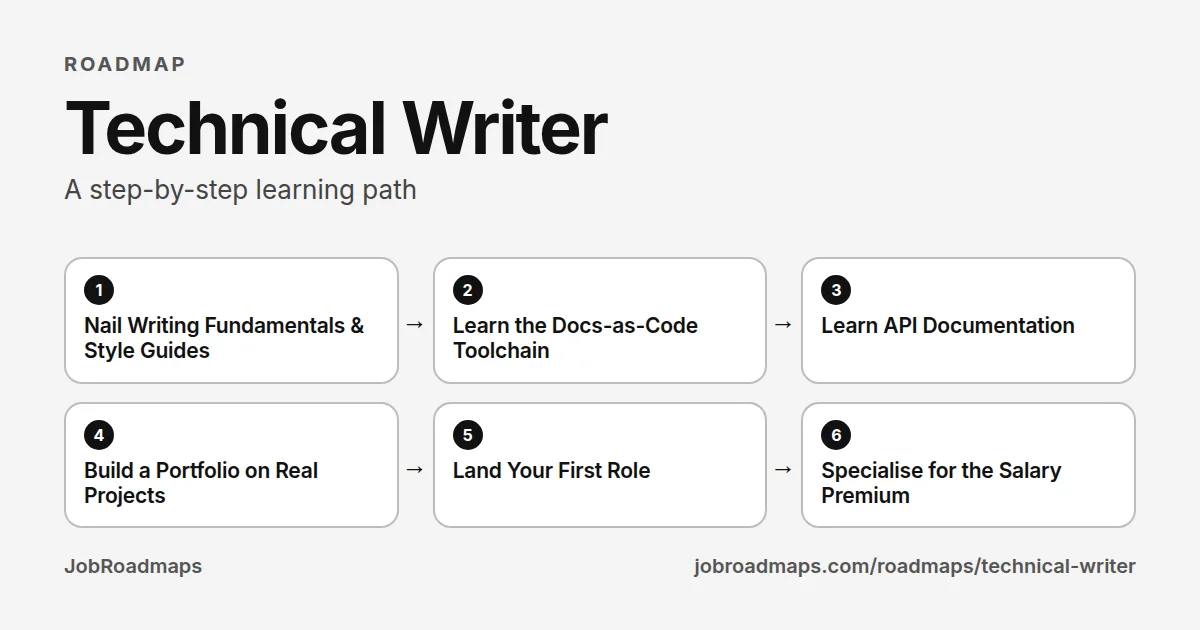
Technical Writer learning path
Work down the line, one step at a time. Tick each skill as you can do it.
- 1
Nail Writing Fundamentals & Style Guides
3–4 weeksThe core skill is clear, concise, unambiguous writing — and it's more teachable than people expect. Work through Google's free Technical Writing courses, then internalise a major style guide (Google's or Microsoft's) so your prose follows conventions professional teams actually use. Clarity, not vocabulary, is the whole game here.
Skills to learn
- Plain language & concision
- Active voice
- Google & Microsoft style guides
- Audience analysis
- Structuring instructions
- Editing & self-review
Start with
- 2
Learn the Docs-as-Code Toolchain
3–5 weeksModern documentation is written like software: in Markdown, versioned in Git, and published through static site generators. Getting comfortable with this workflow is often what separates a hireable technical writer from a Word-document one. You don't need to be an engineer, but you do need to live in the same tools they do.
Skills to learn
- Markdown
- Git & GitHub workflow
- Static site generators (Docusaurus, MkDocs)
- Command line basics
- Pull requests & reviews
- Version control for docs
Start with
- 3
Learn API Documentation
6–8 weeksAPI documentation is where the money is — it commands a clear premium because it demands both writing skill and enough technical literacy to read a spec and test an endpoint. Learn the OpenAPI specification, how reference docs and tutorials differ, and how developer audiences actually read. Tom Johnson's free course is the field's standard text.
Skills to learn
- REST API concepts
- OpenAPI / Swagger
- Reference vs conceptual docs
- Documenting endpoints & parameters
- Code samples & curl
- Developer-audience empathy
- Postman basics
Start with
- 4
Build a Portfolio on Real Projects
6–10 weeksNobody hires a technical writer on a resume alone — they hire on writing samples. Pick an open-source project with weak documentation and improve it: write a getting-started guide, document an API, or restructure a messy README. Real, published, reviewed contributions are worth more than any coursework and give you something concrete to point to.
Skills to learn
- Open-source contribution
- Getting-started guides
- README & tutorial writing
- Diátaxis framework
- Publishing a portfolio site
- Working with maintainers
Start with
- 5
Land Your First Role
1–3 monthsWith a portfolio in hand, target junior and associate technical writer roles, and don't overlook contract-to-hire postings, which are a common way in. Lean on the Write the Docs community for job leads and mentorship — it's an unusually welcoming professional network. Emphasise your portfolio and toolchain fluency over years of experience you don't yet have.
Skills to learn
- Resume & portfolio presentation
- Documentation writing tests
- Interviewing for writing roles
- Working with SMEs & engineers
- Networking (Write the Docs)
Start with
- 6
Specialise for the Salary Premium
OngoingSeniority in technical writing comes from depth and ownership. Specialise where the pay is — API and developer documentation, or information architecture and docs-site ownership at scale — and grow into a documentation lead who sets standards, tooling, and strategy for a whole product. Deep API-docs specialists routinely out-earn generalist writers.
Skills to learn
- Advanced API & SDK documentation
- Information architecture
- Docs tooling & automation
- Content strategy
- Docs team leadership
- Localisation & scale
Start with
jobroadmaps.com/roadmaps/technical-writer · Pay, demand and employer data for this role are further down the page.
Job Market Insights for Technical Writer
Data-backed
What do employers actually ask for?
Read from live job postings — how often each credential is named, from rare to almost always.
"Bachelor's degree" is the most common credential named, yet it appears only occasionally in what we could read. Postings that state it are the minority, but these counts are a floor, so do not read this as "no one asks".
Some postings say outright that equivalent experience or a self-taught route is accepted. That wording is worth reading closely when you see it.
Our read: a portfolio that proves the skill, and a referral from someone inside the company, usually carry more weight than a credential match on paper. That is judgement, not something these counts measure.
Requirement
How often named
Bachelor's degree
Master's degree
Computer Science background
Equivalent experience accepted
Our read: how often a credential is named is not how strictly it is enforced. Equivalent experience, a standout portfolio, or a referral often counts for more than the credential listed.
Data-backed
Which skills appear most in job postings?
Read from live job postings, ranked from most to least often named.
editing is the most-named skill. Common, but not universal: many postings do not list it.
Past the fundamentals, 5 specialisation skills (editing included) start separating candidates who can do the job from candidates who have done it. The 5 niche skills are named rarely enough that knowing them is upside, not prerequisite.
Skill
How often named
editing
version control
style guides
integration guides
API documentation
content management
code examples
developer experience
interactive tutorials
markdown
Sorted by how often named · JobRoadmaps
Data-backed
Which tools and artifacts appear most in job postings?
Read from live job postings, ranked from most to least often named.
GitHub is the most-named tool, but no tool is a universal requirement here.
Tool / Artifact
How often named
Sorted by how often named · JobRoadmaps
Industry overlay
Targeting a specific industry?
The core roadmap gets you through the door anywhere. The difference between "qualified" and "they hired someone else" often lives in industry-specific context — the norms, the compliance floors, the tools assumed fluent in that sector.
Docs-as-code workflow
Documentation lives in Git and ships through pull requests alongside the product — writers who cannot work in a repo are filtered out.
Information architecture
A help center with thousands of articles succeeds or fails on findability, and structuring it is a distinct craft beyond writing.
Release-cadence documentation
SaaS ships continuously, so docs, release notes, and screenshots must keep pace with weekly product changes.
In-app content & UX writing
Tooltips, empty states, and onboarding flows increasingly belong to the docs team, blurring into UX writing.
Support deflection metrics
Docs are measured by the tickets they prevent, and writers are expected to use search and feedback data to prioritise work.
Companies hiring:
AtlassianSalesforceZendeskNotionIntercomcode example correctness
Developers expect runnable, production-grade examples; outdated or broken code examples erode trust immediately.
API deep-dive guides
Complex infrastructure requires comprehensive reference and conceptual documentation to enable advanced use cases.
agent and llm integration
Newer platforms must document how AI agents and LLMs interact with their systems; writers must understand emerging patterns.
Companies hiring:
Modal LabsPalantirIndustry premiums based on aggregated job posting data · Updated quarterly
Interactive
How ready are you right now?
Check the skills you already have to see your current job-market fit.
The most-named skill for this role is editing, so a gap there costs you the most. No single skill dominates, but each gap narrows which postings fit you. Check what you already have to see your biggest current gap.
Readiness Check
Check the skills you already have
0/5
base skills
Your biggest gap: editing, the most often named of the skills you have not ticked.
Start there, then work down the list.
Books worth reading as a Technical Writer
Where to start, in order. The full list of 12, grouped by career stage, is on its own page.
Getting started

On Writing Well: The Classic Guide to Writing Nonfiction
by William Zinsser · 1976
~340 pages~9 hrs to read
Clear, humane advice on simplicity, clutter and structure in nonfiction. A good base for writing procedures and explanations people can follow.
View book →
The Elements of Style
by William Strunk Jr., E. B. White · 1918
~110 pages~3 hrs to read
A compact reference on usage, composition and common errors. Keep it close in your first months while you build editing habits.
View book →
Doing the job

Docs for Developers: An Engineer's Field Guide to Technical Writing
by Jared Bhatti, Zachary Sarah Corleissen, Jen Lambourne, David Nunez, Heidi Waterhouse · 2021
Walks through planning, writing, publishing and measuring documentation for software projects. The most direct match for what developer-facing docs jobs involve.
View book →Every Page Is Page One: Topic-based Writing for Technical Communication and the Web
by Mark Baker · 2013
~290 pages~7 hrs to read
Argues that readers arrive from search at any page, and shows how to write self-contained topics. Changes how you structure docs for the web.
View book →
Senior and leading

Content Strategy for the Web
by Kristina Halvorson, Melissa Rach · 2009
~200 pages~5 hrs to read
Explains how to plan, create and govern content across an organization. Read it when you start deciding what documentation to build and how to maintain it.
View book →
Information Architecture: For the Web and Beyond
by Louis Rosenfeld, Peter Morville, Jorge Arango · 1998
~460 pages~12 hrs to read
Covers organizing, labeling and navigating large bodies of content. Useful for structuring documentation sets that scale past a few dozen pages.
View book →
All 12 books for a Technical Writer →Browse all books →
Some book links are affiliate links: we earn a small commission if you buy, at no cost to you. It does not affect what we list.
Prerequisites & Education
What credentials do employers look for?
These are the most common paths into this role — no single one is required.
Education Level
View list — coming soon- Bachelor's in English, communications, or journalism — the traditional route
- Bachelor's in computer science or engineering — increasingly valued for developer-docs roles
- Bachelor's in any field with a strong writing portfolio
- No degree — open-source documentation contributions can substitute entirely
The field splits in two: general technical writing values writing degrees; developer documentation values technical fluency. For the higher-paying developer-docs track, proof you can read code matters more than your major.
Certifications
View list — coming soon- Google Technical Writing One & Two — free courses with completion records; the standard recommendation
- CPTC (Certified Professional Technical Communicator, STC) — the field's formal cert; niche but recognised
- "Documenting APIs" course by Tom Johnson — free, and the definitive API documentation curriculum
- AWS Cloud Practitioner or similar — a light technical cert that helps for cloud-product docs roles
Certifications are weak signals in technical writing — the portfolio is everything. Google's free courses are worth taking for the craft, not the certificate.
Bootcamps & Training
View list — coming soon- Google Technical Writing courses — free, self-paced, designed for engineers and writers alike
- "Documenting APIs" (idratherbewriting.com) — free and specifically built around a portfolio project
- University extension certificates in technical communication (UW, UC schools) — structured, employer-recognised
- Write the Docs — free community, conference talks, and learning resources; also a hiring network
The best training doubles as portfolio building. Tom Johnson's API course has you produce actual documentation samples — prioritise programs that leave you with artifacts.
Portfolio & Other
View list — coming soon- A portfolio site with 3–5 writing samples — tutorials, how-tos, reference docs, and a README
- Open-source documentation contributions — Kubernetes, MDN, and most major projects welcome docs PRs
- An API reference sample — document a public API using OpenAPI conventions to show developer-docs skill
- Google Season of Docs — paid open-source documentation projects that double as strong credentials
- Docs-as-code fluency — Markdown, Git, and static site generators (Docusaurus, Sphinx) shown in your repos
Open source solves the portfolio bootstrap problem: real products, real users, and public proof of your work. Two merged docs PRs on a known project outweigh any certificate.
Your Roadmap
6 stepsNail Writing Fundamentals & Style Guides
3–4 weeksThe core skill is clear, concise, unambiguous writing — and it's more teachable than people expect. Work through Google's free Technical Writing courses, then internalise a major style guide (Google's or Microsoft's) so your prose follows conventions professional teams actually use. Clarity, not vocabulary, is the whole game here.
Skills to learn
Learn the Docs-as-Code Toolchain
3–5 weeksModern documentation is written like software: in Markdown, versioned in Git, and published through static site generators. Getting comfortable with this workflow is often what separates a hireable technical writer from a Word-document one. You don't need to be an engineer, but you do need to live in the same tools they do.
Skills to learn
Learn API Documentation
6–8 weeksAPI documentation is where the money is — it commands a clear premium because it demands both writing skill and enough technical literacy to read a spec and test an endpoint. Learn the OpenAPI specification, how reference docs and tutorials differ, and how developer audiences actually read. Tom Johnson's free course is the field's standard text.
Skills to learn
Build a Portfolio on Real Projects
6–10 weeksNobody hires a technical writer on a resume alone — they hire on writing samples. Pick an open-source project with weak documentation and improve it: write a getting-started guide, document an API, or restructure a messy README. Real, published, reviewed contributions are worth more than any coursework and give you something concrete to point to.
Skills to learn
Land Your First Role
1–3 monthsWith a portfolio in hand, target junior and associate technical writer roles, and don't overlook contract-to-hire postings, which are a common way in. Lean on the Write the Docs community for job leads and mentorship — it's an unusually welcoming professional network. Emphasise your portfolio and toolchain fluency over years of experience you don't yet have.
Skills to learn
Specialise for the Salary Premium
OngoingSeniority in technical writing comes from depth and ownership. Specialise where the pay is — API and developer documentation, or information architecture and docs-site ownership at scale — and grow into a documentation lead who sets standards, tooling, and strategy for a whole product. Deep API-docs specialists routinely out-earn generalist writers.
Skills to learn
Start here this week
This week: start Google's free Technical Writing courses — they're the single best on-ramp and take only a few hours to begin — and pick one open-source project whose documentation frustrates you. Even improving a single confusing README and opening a pull request gives you a real, reviewable writing sample, which is the currency this field actually runs on.
For a structured path: finish Google's Technical Writing courses, learn the docs-as-code toolchain (Markdown, Git, a static site generator), then work through Tom Johnson's free API documentation course while building two or three portfolio pieces on real projects. Join the Write the Docs community early — it's where a lot of first jobs and mentorships come from — and target junior or contract roles with your portfolio front and centre.
Pay
U.S. Department of Labor data for the nearest BLS occupation, Technical writers. BLS has no occupation for this exact title, so treat these as a benchmark.
Median: U.S. Bureau of Labor Statistics, Occupational Employment and Wage Statistics (median wage, May 2024) and Employment Projections (2024–34). No Level I–IV wages are published for this occupation in our tables.
Job Titles at Each Level
Entry
Junior Technical Writer
Mid
Technical Writer
Senior
Senior Technical Writer / Documentation Lead
Steps Overview
- 1
Nail Writing Fundamentals & Style Guides
3–4 weeks
- 2
Learn the Docs-as-Code Toolchain
3–5 weeks
- 3
Learn API Documentation
6–8 weeks
- 4
Build a Portfolio on Real Projects
6–10 weeks
- 5
Land Your First Role
1–3 months
- 6
Specialise for the Salary Premium
Ongoing
Explore more roadmaps
Not sure this is the right path? Browse all creative career roadmaps.
View Similar RoadmapsBuilt a project while following this roadmap?
Turn it into a hiring-ready case study in 10 seconds — free.
Ready to explore more?
Browse all career roadmaps across tech, business, and creative fields.