Technical Program Manager (TPM) Career Roadmap
A technical program manager owns the programs that are too big and too tangled for any one engineering team: the GPU cluster that has to come online across five vendors, the platform migration that touches every service, the model launch that needs research, infrastructure, security and go-to-market to land in the same week. You do not write the code. You make the dependencies visible, get the decisions made, and tell leadership the truth about where it stands. It is a role for people who can follow the architecture conversation well enough to question an estimate, and who treat a status doc as a piece of engineering.
Is this the right path for you?
Not an entry-level job. In the live postings we track, 165 carry a Technical Program Manager title across 33 companies, and none uses junior, associate, entry, intern or graduate wording; 51 use senior-level words such as senior, staff, principal, lead or director. The real routes in are software engineers or QA and engineering leads who already coordinate across teams, project and program managers moving into technical organizations, and product-ops, release or infrastructure managers. If you are in one of those seats, this is a lateral move, not a restart.
You will like it if you get energy from untangling a mess nobody owns, and you can sit through an architecture review without needing to take over. You will not like it if you need to ship your own artifact to feel productive: your output is other people's work landing on time. Comfort with giving leadership an unwelcome status, early and plainly, is the temperament signal that matters most.
Be honest about the market. Our postings come from about a hundred tech-company job boards and lean heavily towards AI, infrastructure and SaaS scale-ups; the largest counts are Anthropic, OpenAI, Scale AI and Databricks, so this sample over-represents AI labs and does not describe every employer. Competition for the few postings is with experienced operators, not with fresh graduates. Build the track record first.
Career Progression
Where does this role lead?
Click any role to explore timeline, key skills and, where the Department of Labor publishes it, pay.
Entry
Associate TPM / Program Coordinator
~0–2 yrs
Rare in the postings we track: none of the TPM titles carries early-career wording. Most people arrive from engineering, QA, release or project management instead. If you start here, learn the codebase and the people before you learn the process.
Key skills
What the postings say you’ll do
Lines copied word for word from live Technical Program Manager postings we track, read September 30, 2026. They show how employers word the job, not what every Technical Program Manager does. Postings change and expire.
“Act as the connective tissue between API, infrastructure, database, networking, and inference teams, owning cross-org dependencies end to end”
“Build and operationalize program mechanisms (roadmaps, milestones, risk registers, runbooks) that make delivery predictable at massive scale.”
“Translate technical constraints and risks into executive-level communications for senior leadership and external stakeholders”
“Own end-to-end program planning and execution, from initial discovery and scoping through delivery, measurement, and retrospectives.”
“Technical depth, product domain expertise, and AI systems literacy; knowing how AI solutions work, where they fail, and the scope and impact of those failures.”
“Shape the success of engagements by proactively managing risks, aligning cross-functional teams, and ensuring customer outcomes are met or exceeded”
“Navigate tradeoffs between speed, quality, and scope, helping teams make informed decisions under pressure”
Who is hiring right now
Drawn from live postings across many employers today. Employers with live postings we tag to this roadmap, counted today. The sample is about a hundred tech-company job boards, tilted toward AI, data and infrastructure companies, so agencies, consultancies and most non-tech employers are not represented.
| Employer | Live postings | Early-career titles | Most common title |
|---|---|---|---|
| Anthropic | 40 | 0 | Technical Program Manager, API Platform |
| OpenAI | 21 | 0 | GRC Technical Program Manager, Product Lifecycle Assurance |
| Databricks | 15 | 0 | Sr Staff Technical Program Manager- Security |
| Scale AI | 8 | 0 | Technical Program Manager (Homeland Layered Defense), Public Sector |
| Pure Storage | 7 | 0 | Hardware Technical Program Manager, Hyperscale Line of Business |
| Cohere | 6 | 0 | Staff Technical Program Manager, Machine Learning |
| 6 | 0 | Senior Staff Technical Program Manager, Search Signals | |
| Snowflake | 6 | 0 | Senior Technical Program Manager |
| Harvey | 5 | 0 | Sr. Technical Program Manager, GTM Technology |
| Mistral AI | 5 | 0 | Technical Program Manager, Engineering |
| Stripe | 5 | 0 | Technical Program Manager |
| Crusoe | 4 | 0 | Senior Staff Technical Program Manager, NPI |
“Early-career titles” are roles whose title signals an entry-level or new-graduate position. Top 12 of 45 employers shown.
Look-alike roles, compared
Neighbouring titles read very differently once you open the posting. One line from a real posting for each, with how many live postings we track under that title and how many carry early-career wording.
Technical Program Manager
191 live postings · 45 employers · 0 with early-career wording
“Act as the connective tissue between API, infrastructure, database, networking, and inference teams, owning cross-org dependencies end to end”
Anthropic · Technical Program Manager, API Platform posting
Program Manager
213 live postings · 65 employers · 5 with early-career wording
“Manage vendor and partner relationships to ensure the timely procurement and delivery of critical hardware and services.”
Fastly · Senior Program Manager, Network Infrastructure posting
Technical Product Manager
26 live postings · 12 employers · 0 with early-career wording
“Prioritize what we should build and when by collaborating with stakeholders on product vision and strategy, while taking customer feedback into account.”
Appian · Senior Technical Product Manager - Cloud Infrastructure posting
Engineering Manager
431 live postings · 75 employers · 1 with early-career wording
“Build, mentor, and grow a high-performing team of engineers and analysts, fostering a culture of technical excellence, continuous learning, and cross-functional collaboration.”
Datadog · Engineering Manager I, Commercial Audit posting
Quotes read September 30, 2026, from the live postings we track.
Visual roadmap
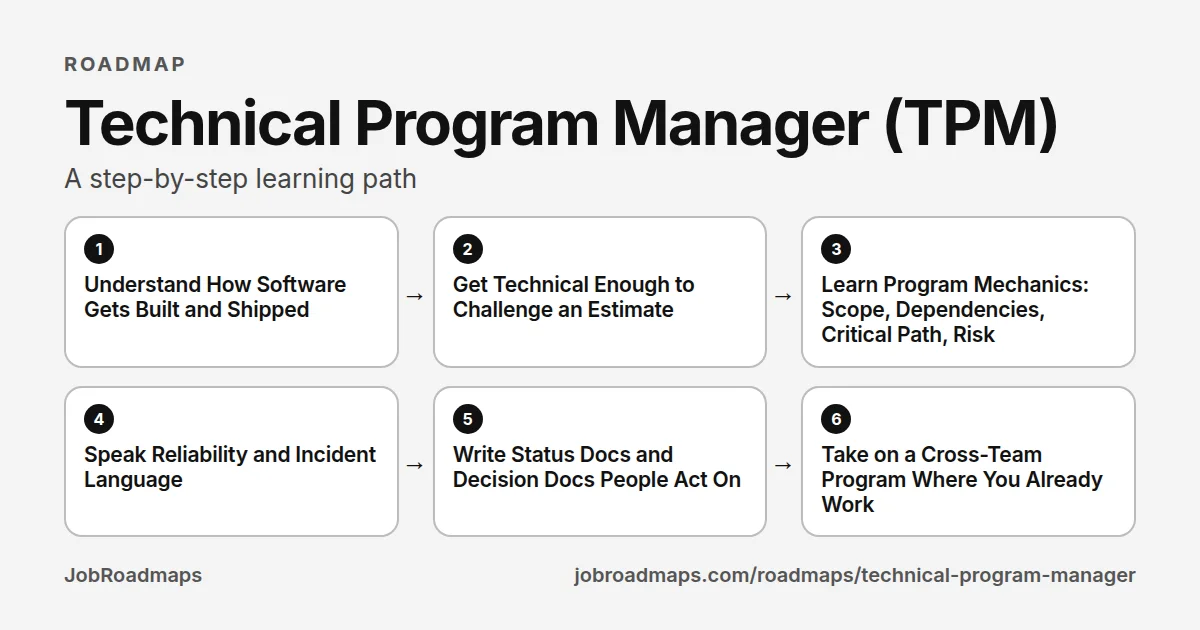
Technical Program Manager learning path
Work down the line, one step at a time. Tick each skill as you can do it.
- 1
Understand How Software Gets Built and Shipped
4–8 weeksYou cannot sequence work you do not understand. Learn the path from commit to production: branches, code review, continuous integration, environments, feature flags, release trains, rollbacks. If you have already shipped software, this step is a gap check. If you have not, it is the whole entry fee, because a TPM who cannot read a release plan gets managed by the engineers they are meant to coordinate.
Skills to learn
- Software development lifecycle
- CI/CD pipelines
- Release and rollback processes
- Feature flags and staged rollouts
- Environments (dev, staging, production)
- Agile and sprint mechanics
- Reading a pull request and a design doc
Start with
- 2
Get Technical Enough to Challenge an Estimate
8–12 weeksThe postings keep asking for technical depth that lets you "engage meaningfully" with the engineers, in the words of the job ads. Pick the domain your target team lives in (cloud infrastructure, data platforms, security, ML systems) and learn its vocabulary: what a service boundary is, why a migration is hard, what a capacity plan contains. You are not trying to out-engineer anyone. You are trying to ask the question that exposes the optimistic number.
Skills to learn
- System design fundamentals
- Cloud platform basics
- Containers and orchestration
- Distributed systems trade-offs
- Reading architecture diagrams
- Capacity and cost reasoning
- Asking good technical questions
Start with
- 3
Learn Program Mechanics: Scope, Dependencies, Critical Path, Risk
6–10 weeksThis is the craft itself. A program is a set of projects that depend on each other, owned by teams that do not report to you. Learn to break a goal into milestones, find the critical path, name the owner of each dependency, keep a risk register that people actually read, and say who decides what. Practise on something real, even a side project with three moving parts.
Skills to learn
- Scoping and milestone planning
- Dependency mapping
- Critical path analysis
- Risk registers and mitigation
- RACI and decision ownership
- Tracking in Jira or similar tools
- Escalation without drama
Start with
- 4
Speak Reliability and Incident Language
3–5 weeksInfrastructure and platform programs live and die on reliability trade-offs: speed against stability, cost against redundancy. Learn what an SLO is, how error budgets shape a release, and how a blameless postmortem works. In the live postings we track, security, reliability and infrastructure TPM roles are a visible slice, and this vocabulary is the common ground with those teams.
Skills to learn
- Service level objectives and error budgets
- Incident response roles
- Blameless postmortems
- Release readiness reviews
- Reliability versus feature-speed trade-offs
- Follow-through on postmortem actions
Start with
- 5
Write Status Docs and Decision Docs People Act On
4–6 weeks, then ongoingYour output is mostly writing: a one-page status that leads with risk, a decision doc that lays out options and who chooses, a launch plan that a tired engineer can follow. Practise the executive version too: translate a technical constraint into a business consequence in three sentences. Keep a sanitised sample of each; they are your portfolio.
Skills to learn
- Status reports that lead with risk
- Decision and design documents
- Executive summaries
- Meeting facilitation and follow-up
- Technical writing clarity
- Stakeholder communication cadence
Start with
- 6
Take on a Cross-Team Program Where You Already Work
6–18 monthsThe usual route in is internal. Volunteer to run the migration, the launch, the audit-readiness push or the vendor rollout that nobody owns. Keep the written trail: scope, milestones, risks raised, decisions made, what shipped. Then apply for TPM roles with a program you can walk through, not a certificate. If you are coming from project management, target a technical team and show the technical step above first.
Skills to learn
- Running a program end to end
- Influence without authority
- Managing up with bad news
- Retrospectives
- Building a program case study
- Interviewing for TPM roles
Start with
jobroadmaps.com/roadmaps/technical-program-manager · Pay, demand and employer data for this role are further down the page.
Job Market Insights for Technical Program Manager
Data-backed
What do employers actually ask for?
Read from live job postings — how often each credential is named, from rare to almost always.
"Certification mentioned" is the most common credential named, yet it appears only rarely in what we could read. Postings that state it are the minority, but these counts are a floor, so do not read this as "no one asks".
Our read: a portfolio that proves the skill, and a referral from someone inside the company, usually carry more weight than a credential match on paper. That is judgement, not something these counts measure.
Requirement
How often named
Certification mentioned
Computer Science background
Bachelor's degree
Our read: how often a credential is named is not how strictly it is enforced. Equivalent experience, a standout portfolio, or a referral often counts for more than the credential listed.
Data-backed
Which skills appear most in job postings?
Read from live job postings, ranked from most to least often named.
Postings for this role rarely list skills by name. The most-named, technical depth, is still only occasional, so none of these is a universal requirement.
Skill
How often named
technical depth
platform engineering
developer velocity
change management
dependency management
risk management
data governance
strategic communication
influence without authority
incident management
cross-functional collaboration
roadmap planning
project tracking
requirements traceability
Sorted by how often named · JobRoadmaps
Data-backed
Which tools and artifacts appear most in job postings?
Read from live job postings, ranked from most to least often named.
No tool dominates. The most-named, Jira, is still rare; postings for this role rarely list tools by name.
Tool / Artifact
How often named
Jira
Salesforce
GitLab
Confluence
Asana
Notion
Sorted by how often named · JobRoadmaps
Industry overlay
Targeting a specific industry?
The core roadmap gets you through the door anywhere. The difference between "qualified" and "they hired someone else" often lives in industry-specific context — the norms, the compliance floors, the tools assumed fluent in that sector.
Cross-team program planning
The common requirement is owning planning from scoping through delivery and retrospectives across several engineering teams.
Developer-productivity programs
Duolingo posts a staff TPM role on developer amplification and Okta one on Jira administration; both are about making engineering teams faster, not shipping a user feature.
Asynchronous documentation
GitLab describes an all-remote, written-first way of working, where issues, epics and handbook pages carry the program instead of meetings.
Compliance milestones (SOC 2, FedRAMP)
Figma ties infrastructure program delivery to compliance programs, which need dated milestones and named control owners.
Companies hiring:
GitLabFigmaOktaAsanaNotionAppianDuolingoEngineering onboarding and developer platforms
Affirm posts a staff-level TPM role on engineering onboarding, the internal platform work that keeps a growing engineering organization productive.
Data foundations and migrations
Adyen posts a TPM role on data foundations; programs like this carry long dependency chains across engineering and data teams, so sequencing and risk tracking matter most.
Platform and extensibility programs
Stripe posts TPM roles on infrastructure and extensibility, where many product teams depend on shared platform changes.
Companies hiring:
StripeAffirmAdyenIndustry premiums based on aggregated job posting data · Updated quarterly
Interactive
How ready are you right now?
Check the skills you already have to see your current job-market fit.
The most-named skill for this role is technical depth, so a gap there costs you the most. No single skill dominates, but each gap narrows which postings fit you. Check what you already have to see your biggest current gap.
Readiness Check
Check the skills you already have
0/5
base skills
Your biggest gap: technical depth, the most often named of the skills you have not ticked.
Start there, then work down the list.
Books worth reading as a Technical Program Manager
Where to start, in order. The full list of 12, grouped by career stage, is on its own page.
Getting started

Making Things Happen: Mastering Project Management
by Scott Berkun · 2008
~400 pages~10 hrs to read
A practical guide to running software projects: scoping, specs, schedules, decisions and keeping a team moving, written by a former Microsoft program manager. A good first read when you take over your first cross-team project.
View book →
The Mythical Man-Month: Essays on Software Engineering
by Frederick P. Brooks · 1975
~320 pages~8 hrs to read
Essays on why large software projects run late, including the cost of adding people and the communication overhead of big teams. Read it early to understand the schedule pressure you will be asked to manage.
View book →
Doing the job
Influence Without Authority
by Allan R. Cohen, David L. Bradford · 1990
~320 pages~8 hrs to read
A method for getting help from people who do not report to you: work out what each side values and trade accordingly. Central to a TPM job, where every dependency sits with a team you do not manage.
View book →Thinking in Systems: A Primer
by Donella H. Meadows · 2008
~220 pages~6 hrs to read
An introduction to feedback loops, delays and leverage points in complex systems. Helps you see why a program keeps slipping in the same place and where changing the process matters more than pushing harder.
View book →
Senior and leading

How Big Things Get Done
by Bent Flyvbjerg, Dan Gardner · 2023
~360 pages~9 hrs to read
Draws on a large database of projects, from buildings to IT, to explain why big projects overrun and how planning and reference-class forecasting reduce that risk. For TPMs who run large, multi-year programs.
View book →
An Elegant Puzzle: Systems of Engineering Management
by Will Larson · 2019
~290 pages~7 hrs to read
Essays on team sizing, org design, migrations and engineering strategy. Gives senior TPMs a view of how engineering leaders think about the same constraints you plan around.
View book →
All 12 books for a Technical Program Manager →Browse all books →
Some book links are affiliate links: we earn a small commission if you buy, at no cost to you. It does not affect what we list.
Prerequisites & Education
What credentials do employers look for?
These are the most common paths into this role — no single one is required.
Education Level
View list — coming soon- Bachelor's in computer science, engineering or a related technical field — the cleanest signal when you are moving in from outside
- Bachelor's in any field plus engineering, QA, release or infrastructure experience — the common route in practice
- Bachelor's in business or management plus years running technical programs — works when the track record is real
- No degree — possible only with a strong, documented record of delivering cross-team technical work
Postings ask for technical understanding and a record of delivering complex programs far more often than for a particular degree. What gets screened is the programs you have run, not the diploma.
Certifications
View list — coming soon- Google Project Management Professional Certificate (Coursera) — a structured start if your background is not in project work
- AWS Certified Cloud Practitioner — shared cloud vocabulary for infrastructure and platform programs
- Google Cloud Digital Leader or Microsoft Azure Fundamentals — the same job on a different cloud, pick the one your target employers use
- PMP (PMI) — appears in a few postings as a plus or a post-hire requirement; most name no certification
Certifications are a minor signal for this role. In the postings we read, most name none. A program you delivered, written up clearly, is worth more than any of them.
Bootcamps & Training
View list — coming soon- Technical Writing One (Google) — a short free course that improves status docs and decision docs
- Introduction to Kubernetes (Linux Foundation, LFS158) — free grounding in how containerised platforms are run
- Site Reliability Engineering book (Google, free online) — the vocabulary of SLOs, incidents and postmortems
- Atlassian Agile and Team Playbook guides — free, practical material on planning cadence and team health checks
There is no recognised TPM bootcamp. Skip anything that promises one and spend the time on a real program inside your current team.
Portfolio & Other
View list — coming soon- A program case study: goal, scope, milestones, dependencies, risks raised, decisions made, outcome
- A sanitised status report that leads with risk and states what you need from leadership
- A decision document that lays out options, trade-offs and who decides
- A dependency map or critical-path view from a real migration, launch or rollout
- A short postmortem you facilitated, with the follow-up actions and who closed them
Hiring managers cannot see your judgement on a CV. Written artifacts from real programs are the closest thing to a work sample, so keep the sanitised versions.
Your Roadmap
6 stepsUnderstand How Software Gets Built and Shipped
4–8 weeksYou cannot sequence work you do not understand. Learn the path from commit to production: branches, code review, continuous integration, environments, feature flags, release trains, rollbacks. If you have already shipped software, this step is a gap check. If you have not, it is the whole entry fee, because a TPM who cannot read a release plan gets managed by the engineers they are meant to coordinate.
Skills to learn
Get Technical Enough to Challenge an Estimate
8–12 weeksThe postings keep asking for technical depth that lets you "engage meaningfully" with the engineers, in the words of the job ads. Pick the domain your target team lives in (cloud infrastructure, data platforms, security, ML systems) and learn its vocabulary: what a service boundary is, why a migration is hard, what a capacity plan contains. You are not trying to out-engineer anyone. You are trying to ask the question that exposes the optimistic number.
Skills to learn
Learn Program Mechanics: Scope, Dependencies, Critical Path, Risk
6–10 weeksThis is the craft itself. A program is a set of projects that depend on each other, owned by teams that do not report to you. Learn to break a goal into milestones, find the critical path, name the owner of each dependency, keep a risk register that people actually read, and say who decides what. Practise on something real, even a side project with three moving parts.
Skills to learn
Speak Reliability and Incident Language
3–5 weeksInfrastructure and platform programs live and die on reliability trade-offs: speed against stability, cost against redundancy. Learn what an SLO is, how error budgets shape a release, and how a blameless postmortem works. In the live postings we track, security, reliability and infrastructure TPM roles are a visible slice, and this vocabulary is the common ground with those teams.
Skills to learn
Write Status Docs and Decision Docs People Act On
4–6 weeks, then ongoingYour output is mostly writing: a one-page status that leads with risk, a decision doc that lays out options and who chooses, a launch plan that a tired engineer can follow. Practise the executive version too: translate a technical constraint into a business consequence in three sentences. Keep a sanitised sample of each; they are your portfolio.
Skills to learn
Take on a Cross-Team Program Where You Already Work
6–18 monthsThe usual route in is internal. Volunteer to run the migration, the launch, the audit-readiness push or the vendor rollout that nobody owns. Keep the written trail: scope, milestones, risks raised, decisions made, what shipped. Then apply for TPM roles with a program you can walk through, not a certificate. If you are coming from project management, target a technical team and show the technical step above first.
Skills to learn
Start here this week
This week, pick one cross-team piece of work at your current job that has no clear owner (a migration, a launch checklist, a recurring audit) and write a one-page plan for it: the goal, the milestones, who each dependency sits with, the top three risks, and who decides what. Share it with the people involved and ask what is missing. That page is the first line of your portfolio.
For structure, follow the steps above in order: engineering fundamentals, enough technical depth for your target domain, program mechanics, reliability language, then writing. Run one real program using them, keep the written trail, and apply to TPM roles at your own company first. Plan on a couple of years to build a credible record if you are not already close; an internal move is the most common way through.
Job Titles at Each Level
Entry
Associate Technical Program Manager / Technical Program Coordinator
Mid
Technical Program Manager
Senior
Senior Technical Program Manager / Principal Technical Program Manager
Steps Overview
- 1
Understand How Software Gets Built and Shipped
4–8 weeks
- 2
Get Technical Enough to Challenge an Estimate
8–12 weeks
- 3
Learn Program Mechanics: Scope, Dependencies, Critical Path, Risk
6–10 weeks
- 4
Speak Reliability and Incident Language
3–5 weeks
- 5
Write Status Docs and Decision Docs People Act On
4–6 weeks, then ongoing
- 6
Take on a Cross-Team Program Where You Already Work
6–18 months
Explore more roadmaps
Not sure this is the right path? Browse all tech career roadmaps.
View Similar RoadmapsBuilt a project while following this roadmap?
Turn it into a hiring-ready case study in 10 seconds — free.
Ready to explore more?
Browse all career roadmaps across tech, business, and creative fields.