Technical Account Manager Career Roadmap
A technical account manager owns the technical relationship with a software company's largest customers after the contract is signed. You review how the customer has built on the product, spot the risks before they become outages, run the regular business reviews, take the hard escalations, and carry what customers need back to the product and engineering teams. It sits between support, customer success and engineering. It is not the customer success manager's job (the commercial owner of renewal and expansion), not a support engineer's (a queue of cases), and not a solutions architect's (design work before the sale).
Is this the right path for you?
The routes in are mostly sideways. Support engineers who have outgrown the queue and want fewer, deeper customers. Solutions and sales engineers who prefer the long relationship to the pre-sale. Implementation consultants, IT operations people and software engineers who like customers. Of the 67 postings we track with TAM titles across 22 companies, one is written for an early-career seat; the rest expect product depth and customer experience. Several employers also use a TAM architect or a head-of-technical-account-management title, which shows how wide the family is.
The temperament is a calm technical adviser. You enjoy being the person a customer's engineers call first, you can stay level in an escalation, and you can say no to a customer and keep the relationship. If you want to ship code, a development role is a better fit; if you want to carry a revenue number, customer success or account management fits better. This job is about technical trust.
Honest note: the title is used loosely, so read the posting, not the name. Of the 67 titles, 24 carry senior-level words and 7 are director, head or manager roles. In the stored text of the postings, 28 mention product feedback or working with product teams, 25 mention customer success, 18 mention escalations, 11 mention renewals, 9 mention business reviews and 10 mention APIs. Okta, Stripe, Datadog and ClickUp post the most, and our sample leans toward software and infrastructure companies, so seats in other industries will read differently.
Career Progression
Where does this role lead?
Click any role to explore timeline, key skills and, where the Department of Labor publishes it, pay.
Entry
Technical Account Manager Analyst / Associate
~0–2 yrs
Early-career TAM seats are rare, so many people enter one step away in support, solutions or implementation. In an analyst seat you support a TAM on a set of accounts, learn the product from the inside and take your first escalations.
Key skills
Visual roadmap
Technical Account Manager learning path
Work down the line, one step at a time. Tick each skill as you can do it.
- 1
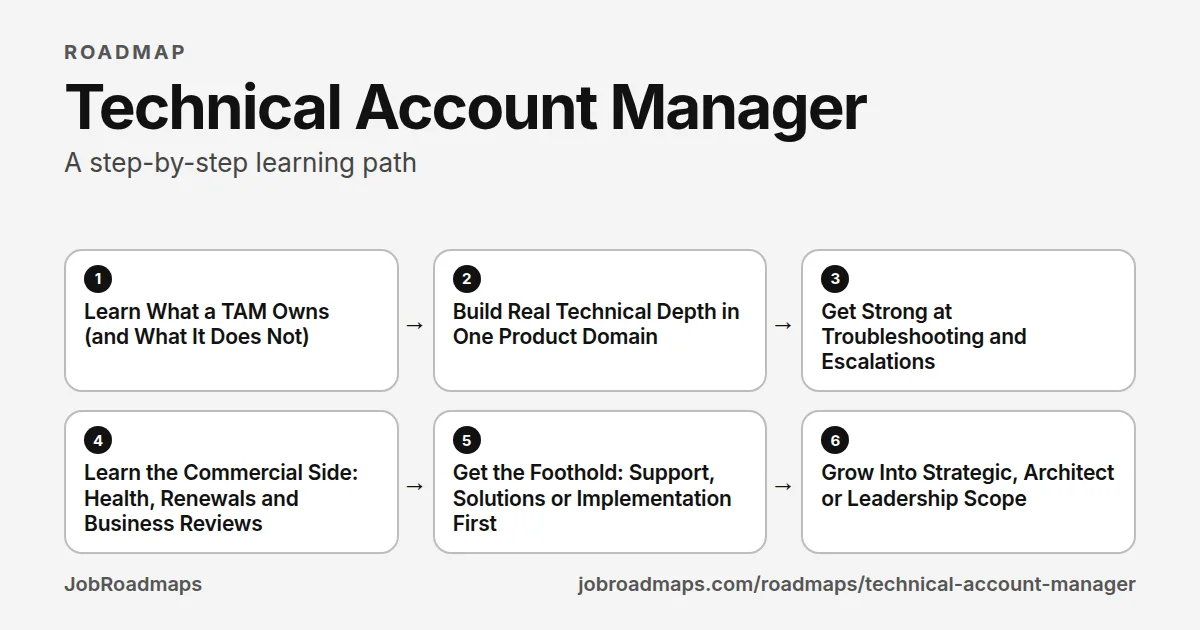
Learn What a TAM Owns (and What It Does Not)
1–2 weeksStart with the shape of the job, because the title is used loosely. In the live postings we track, a TAM is the named technical owner for a small number of large accounts: reviews their setup, runs scheduled business reviews, takes escalations and relays product feedback. The customer success manager owns the commercial plan, the support engineer works the case queue, and the solutions architect designs before the sale. Read three postings from the companies you want to join and write down which of those jobs each one is really asking for.
Skills to learn
- TAM versus CSM, support engineer and solutions architect
- Post-sales customer lifecycle (onboarding, adoption, renewal)
- Account plans and success criteria
- Business reviews: what goes in and who attends
- Reading a job posting for the real scope
Start with
- 2
Build Real Technical Depth in One Product Domain
8–12 weeksTAMs are hired for depth, not breadth. Pick the domain of the companies you want: cloud and infrastructure, data and databases, identity and security, payments and APIs, or communications. Learn it far enough to read a customer's architecture, spot the setting that will hurt them in six months and explain the trade-off to an engineer and to their manager in different words. Get hands-on: build something small on the product category, break it and fix it.
Skills to learn
- Cloud basics (AWS, Azure or Google Cloud)
- Networking and HTTP fundamentals
- REST APIs and authentication
- SQL for checking data
- Linux and the command line
- Reading logs and metrics
- One product category in depth (observability, databases, identity or payments)
Start with
- 3
Get Strong at Troubleshooting and Escalations
6–10 weeksEscalations are where a TAM earns trust, and the postings name them often. Learn a method for narrowing a problem: reproduce, isolate, form a hypothesis, test it. Practise writing a case summary an engineer can act on without a call, a clear status update for an anxious customer, and a postmortem that explains cause and fix without blame. This is the skill that separates a TAM from an account manager with a technical vocabulary.
Skills to learn
- Structured troubleshooting
- Reproducing and isolating a problem
- Writing escalations engineers can act on
- Customer status updates under pressure
- Postmortems and root-cause write-ups
- Severity, priority and impact
Start with
- 4
Learn the Commercial Side: Health, Renewals and Business Reviews
4–6 weeksA TAM's technical advice has to connect to what the customer pays for and keeps. Learn how account health is judged (adoption, incidents, sentiment), what a renewal conversation turns on, and how to run a business review that a technical lead and an executive both find useful. You are not carrying the quota, but you are expected to see churn risk early and to say so in time for someone to act.
Skills to learn
- Account health and churn-risk signals
- Renewal mechanics and timing
- Running a quarterly business review
- Success plans and measurable outcomes
- Stakeholder mapping on the customer side
- Working alongside the customer success manager and sales
Start with
- 5
Get the Foothold: Support, Solutions or Implementation First
6–12 monthsMost TAM seats ask for experience and name a first step: support engineering, solutions or sales engineering, implementation, IT operations or consulting. A few employers hire early-career TAMs (Okta posts a new-graduate analyst seat), but expect to enter one step away. Take the adjacent role at a company that has a TAM team, learn the product from the inside and say plainly which TAM seat you are aiming for. Build a case file you can talk through: one escalation you led, what you found and what changed.
Skills to learn
- Support engineering and implementation as entry routes
- Solutions and sales engineering as entry routes
- Internal moves into a TAM team
- Telling one escalation as a clear story
- Reading what a TAM team at a company actually does
Start with
- 6
Grow Into Strategic, Architect or Leadership Scope
OngoingSenior seats widen the job. Principal and strategic TAMs own the executive relationship and the hardest escalations; some employers use a TAM architect title for design-level advice; others move TAMs into management, and the postings include directors and heads of technical account management. Decide which direction you want: deeper technical authority, a bigger set of accounts, or a team. Each needs a different story in the interview.
Skills to learn
- Executive relationships and strategic account plans
- Architecture review and design advice
- Turning customer patterns into product changes
- Mentoring other TAMs
- Managing a team and a regional function
Start with
jobroadmaps.com/roadmaps/technical-account-manager · Pay, demand and employer data for this role are further down the page.
Books worth reading as a Technical Account Manager
Where to start, in order. The full list of 12, grouped by career stage, is on its own page.
Getting started

The Trusted Advisor
by David H. Maister, Charles H. Green, Robert M. Galford · 2000
~260 pages~7 hrs to read
The classic on how advisers earn trust: credibility, reliability, intimacy and low self-orientation. A TAM's value is being the person a customer calls first, and this book names the habits behind that. Read it before your first strategic account.
View book →Customer Success: How Innovative Companies Are Reducing Churn and Growing Recurring Revenue
by Nick Mehta, Dan Steinman, Lincoln Murphy · 2016
~240 pages~6 hrs to read
Explains the subscription model that TAM work sits inside: onboarding, adoption, health, renewal and expansion. Read it to understand why your account plan is built around retention, and how your role differs from the customer success manager's.
View book →
Doing the job

Site Reliability Engineering: How Google Runs Production Systems
by Betsy Beyer, Chris Jones, Jennifer Petoff, Niall Richard Murphy · 2016
~520 pages~13 hrs to read
The reference for incident response, monitoring, postmortems and service-level objectives. TAMs who support infrastructure and platform products are expected to speak this vocabulary with the customer's engineers. Read the chapters on troubleshooting and incident handling first.
View book →
The DevOps Handbook: How to Create World-Class Agility, Reliability, and Security in Technology Organizations
by Gene Kim, Jez Humble, Patrick Debois, John Willis · 2021
~480 pages~12 hrs to read
Covers delivery pipelines, deployment practice and feedback loops in detail. Useful when your customers are platform and infrastructure teams and you need to judge whether their setup is healthy and where your product fits.
View book →
Senior and leading

The Manager's Path: A Guide for Tech Leaders Navigating Growth and Change
by Camille Fournier · 2017
~240 pages~6 hrs to read
A level-by-level guide from technical lead to executive. Read it when you are asked to lead other TAMs or a regional team, so you know what changes about the job at each step.
View book →
Radical Candor: Be a Kick-Ass Boss Without Losing Your Humanity
by Kim Scott · 2017
~270 pages~7 hrs to read
A framework for giving direct feedback without damaging the relationship. Lead-level TAMs coach newer TAMs and give honest feedback to product and engineering; this is a way to do both well.
View book →
All 12 books for a Technical Account Manager →Browse all books →
Some book links are affiliate links: we earn a small commission if you buy, at no cost to you. It does not affect what we list.
Courses and certifications for a Technical Account Manager
10 courses, tutorials and certifications, each read on the provider's own page. One from each stage to start; the full list, with a guide to choosing, is on its own page.
Getting started · Course
Introduction to Linux (LFS101)
The Linux Foundation
Doing the job · Hands-on tutorial
Effective Troubleshooting (Google SRE Book)
Google
Prerequisites & Education
What credentials do employers look for?
These are the most common paths into this role — no single one is required.
Education Level
View list — coming soon- Bachelor's in computer science, engineering, information systems or a related field: the usual signal for enterprise product depth
- Bachelor's in any field plus hands-on experience in support, solutions or implementation: a common route, since the work is learned on the job
- Associate degree or self-taught with strong product and troubleshooting evidence: possible where the experience is clear and recent
- Experience as a support engineer, solutions or sales engineer, consultant or IT operations engineer: how most people actually move into the role
Check the requirements in the postings you target. Many name years of customer-facing technical experience more than a degree, and the stronger signal is a story about an escalation you led.
Certifications
View list — coming soon- AWS Certified Cloud Practitioner: a light, widely recognised base for talking to customers about cloud
- AWS Certified Solutions Architect – Associate: worth it when your customers build on a public cloud
- The vendor's own product certification: the most relevant credential when you already work for or target that company
- ITIL 4 Foundation: useful vocabulary where customers run formal IT service management
Certifications are a modest signal for this role. The postings we track more often ask for product expertise and customer-facing experience than for a named certificate.
Bootcamps & Training
View list — coming soon- AWS Skill Builder: free cloud and architecture courses
- The product vendor's own academy or documentation: the fastest route to the depth the posting asks for
- Support Driven: community, talks and job leads for customer-facing technical roles
- Google SRE Book and Workbook: free reading on troubleshooting, incidents and postmortems
A paid bootcamp is rarely required. Product depth plus a clear account of how you handle escalations carries more weight.
Portfolio & Other
View list — coming soon- A one-page account review for a fictional customer: how they use the product, the risks you would check and your first questions
- A written escalation case (anonymised): symptoms, how you isolated the cause, the fix and what you changed afterwards
- A sample business-review outline covering adoption, incidents, risks and next quarter
- A small project built on the product category you want to support, with a README on what you learned
- A short summary of customer patterns turned into a product-feedback proposal
This role is judged on technical trust and judgement. A short, honest write-up of how you handled a hard case shows both better than a certificate.
Your Roadmap
6 stepsLearn What a TAM Owns (and What It Does Not)
1–2 weeksStart with the shape of the job, because the title is used loosely. In the live postings we track, a TAM is the named technical owner for a small number of large accounts: reviews their setup, runs scheduled business reviews, takes escalations and relays product feedback. The customer success manager owns the commercial plan, the support engineer works the case queue, and the solutions architect designs before the sale. Read three postings from the companies you want to join and write down which of those jobs each one is really asking for.
Skills to learn
Build Real Technical Depth in One Product Domain
8–12 weeksTAMs are hired for depth, not breadth. Pick the domain of the companies you want: cloud and infrastructure, data and databases, identity and security, payments and APIs, or communications. Learn it far enough to read a customer's architecture, spot the setting that will hurt them in six months and explain the trade-off to an engineer and to their manager in different words. Get hands-on: build something small on the product category, break it and fix it.
Skills to learn
Get Strong at Troubleshooting and Escalations
6–10 weeksEscalations are where a TAM earns trust, and the postings name them often. Learn a method for narrowing a problem: reproduce, isolate, form a hypothesis, test it. Practise writing a case summary an engineer can act on without a call, a clear status update for an anxious customer, and a postmortem that explains cause and fix without blame. This is the skill that separates a TAM from an account manager with a technical vocabulary.
Skills to learn
Learn the Commercial Side: Health, Renewals and Business Reviews
4–6 weeksA TAM's technical advice has to connect to what the customer pays for and keeps. Learn how account health is judged (adoption, incidents, sentiment), what a renewal conversation turns on, and how to run a business review that a technical lead and an executive both find useful. You are not carrying the quota, but you are expected to see churn risk early and to say so in time for someone to act.
Skills to learn
Get the Foothold: Support, Solutions or Implementation First
6–12 monthsMost TAM seats ask for experience and name a first step: support engineering, solutions or sales engineering, implementation, IT operations or consulting. A few employers hire early-career TAMs (Okta posts a new-graduate analyst seat), but expect to enter one step away. Take the adjacent role at a company that has a TAM team, learn the product from the inside and say plainly which TAM seat you are aiming for. Build a case file you can talk through: one escalation you led, what you found and what changed.
Skills to learn
Grow Into Strategic, Architect or Leadership Scope
OngoingSenior seats widen the job. Principal and strategic TAMs own the executive relationship and the hardest escalations; some employers use a TAM architect title for design-level advice; others move TAMs into management, and the postings include directors and heads of technical account management. Decide which direction you want: deeper technical authority, a bigger set of accounts, or a team. Each needs a different story in the interview.
Skills to learn
Start here this week
This week: choose one product you could imagine supporting, and write a one-page account review for a fictional customer using it: how they probably use it, three risks you would check, and the first question you would ask their engineering lead. Then read two TAM postings from different companies and underline what they have in common. That exercise is close to what the job asks for in the first month.
For structure: spend the first two months on one product domain and the troubleshooting method, then take a support, solutions or implementation seat at a company with a TAM team, and ask to shadow a business review. Keep a private file of escalations you handled, what you found and what changed. It becomes your interview stories and your portfolio.
Job Titles at Each Level
Entry
Technical Account Manager Analyst
Mid
Technical Account Manager / Technical Account Manager 2
Senior
Senior Technical Account Manager / Principal Technical Account Manager
Steps Overview
- 1
Learn What a TAM Owns (and What It Does Not)
1–2 weeks
- 2
Build Real Technical Depth in One Product Domain
8–12 weeks
- 3
Get Strong at Troubleshooting and Escalations
6–10 weeks
- 4
Learn the Commercial Side: Health, Renewals and Business Reviews
4–6 weeks
- 5
Get the Foothold: Support, Solutions or Implementation First
6–12 months
- 6
Grow Into Strategic, Architect or Leadership Scope
Ongoing
Explore more roadmaps
Not sure this is the right path? Browse all tech career roadmaps.
View Similar RoadmapsBuilt a project while following this roadmap?
Turn it into a hiring-ready case study in 10 seconds — free.
Ready to explore more?
Browse all career roadmaps across tech, business, and creative fields.