Solutions Architect Career Roadmap
A solutions architect designs how a customer's systems will use a product or platform, and makes the technical case for it before the sale and during rollout. You run discovery calls, draw the architecture, run proofs of concept and answer security and integration questions, then hand the design to the team that builds it. Most of the postings we track are pre-sales roles at software vendors, and they are titled solutions architect, pre-sales solutions architect, partner solutions architect or delivery solutions architect. It is not a sales engineer's demo-only job, not a cloud architect's internal estate, and not an AI solutions architect's work on model deployments, which has its own roadmap.
Is this the right path for you?
The routes in are varied. Sales engineers and support engineers who want to design rather than only demonstrate. Software and infrastructure engineers who like talking to customers. Consultants and implementation specialists who already draw architectures for clients. Many postings name a specific platform, so the most direct route is to know one cloud or data platform well and be able to show a design you made.
You will fit if you enjoy explaining complex systems to people who are not engineers, and you can say no to a design that will not work. The job is a mix of technical depth, patience with long sales cycles and careful writing. If you want to write production code every day, or to close deals as the main job, other roles suit you better.
Be honest about the market. Our postings are concentrated: a large share are pre-sales roles at a few software vendors, with many seats for the same company across regions and industries. That makes the role easier to find than the title suggests, but it also means the work is tied to a product. Build a base on a cloud platform and a data or security area, so you can move between vendors rather than depend on one.
Job titles this roadmap covers
- Pre-Sales Solutions Architect
- The same work framed around winning the deal: discovery, architecture, proof of concept and security review before signature. MongoDB and Stripe post pre-sales versions of the role.
- Partner Solutions Architect
- Supports the companies that resell or build on a vendor's product. Datadog, Elastic and Stripe post partner versions, often with a focus on a partner region or cloud.
- Delivery Solutions Architect
- Works after the sale: designs the production system and guides the customer through rollout. Databricks posts many delivery seats, many by industry.
- Specialist Solutions Architect
- Goes deep on one area such as security, data or payments. Elastic posts security specialists and Stripe posts specialist seats for billing, payments and tax.
- Customer Solutions Architect
- Owns the technical relationship with a set of existing customers rather than new prospects. Fivetran posts customer solutions architect roles.
Career Progression
Where does this role lead?
Click any role to explore timeline, key skills and, where the Department of Labor publishes it, pay.
Entry
Solutions Architect
~1–3 yrs
$78,416 (Level I)
You run discovery and design for a set of accounts with a senior architect alongside. Pre-sales seats at software vendors are the most common way in, and a clear portfolio of designs helps you stand out.
Key skills
Pay shown is the U.S. Department of Labor prevailing wage for Level I (entry), Level III (mid) and Level IV (senior) in the nearest BLS occupation, base wage for the typical metro, wage year 2025, shown for the main track only. It is a benchmark, not an offer; branches and lead, staff and executive stages have no official figure.
Visual roadmap
Solutions Architect learning path
Work down the line, one step at a time. Tick each skill as you can do it.
- 1
Learn What a Solutions Architect Does
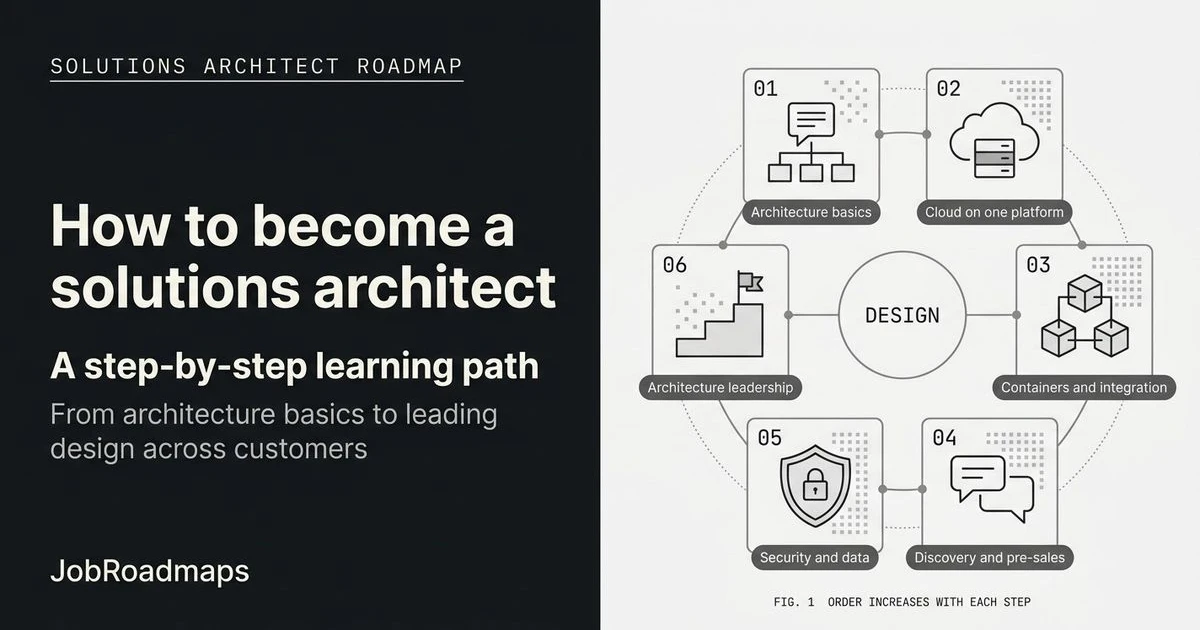
2–3 weeksStart with the customer conversation. A solutions architect has to understand the business problem, map it to a technical design and explain the trade-offs in plain language. Learn the lifecycle: discovery, design, proof of concept, security and procurement review, then delivery. Read three postings from vendors you like and note whether the job leans pre-sales, delivery or partner work.
Skills to learn
- Discovery and the customer's business problem
- Architecture diagrams and trade-offs
- Proof of concept and success criteria
- Security and procurement reviews
- Pre-sales versus delivery roles
Start with
- 2
Learn Cloud Architecture on One Platform
6–10 weeksMost postings name a cloud platform, and AWS, Azure and Google Cloud appear in many listings. Learn one well: compute, storage, networking, identity and the managed services that matter for your customers. The aim is to draw a sound design and defend it, not to memorise every service. The associate-level AWS exam is a common way to prove the base.
Skills to learn
- Compute, storage and networking
- Identity and access management
- Managed databases and data platforms
- High availability and disaster recovery
- Cost and trade-off reasoning
Start with
- 3
Learn Containers, Infrastructure and Integration
6–10 weeksCustomers expect the design to run on containers and infrastructure as code. Learn Kubernetes basics, how a deployment pipeline works, and how a platform integrates with identity, data and monitoring systems. Integration is often the hardest question in a pre-sales call, so practise drawing how two systems exchange data.
Skills to learn
- Containers and orchestration
- Infrastructure as code
- APIs and integration patterns
- CI/CD and release pipelines
- Monitoring and observability
Start with
- 4
Run Discovery and Pre-Sales Conversations
4–6 weeksThe role is decided in the first two calls. Learn to ask about the business outcome before the technology, to take notes a customer recognises, and to say what you do not know. Practise a discovery call and a short demo of a design with a colleague playing the customer, and write up the outcome the customer agreed to.
Skills to learn
- Discovery questions and qualification
- Mapping business needs to design
- Demo and proof-of-concept scoping
- Handling objections and security questions
- Writing a clear summary for the customer
Start with
- 5
Handle Security, Data and Compliance
4–6 weeksSecurity questions come up in most enterprise deals, and data platforms come up in many. Learn the basics of identity, encryption, data residency and the compliance questions an enterprise asks. You do not need to be a security specialist, but you do need to explain the controls and know when to bring in one.
Skills to learn
- Identity, access and single sign-on
- Encryption and data residency
- Compliance questions in enterprise deals
- Data pipelines and warehouses
- Escalation to specialists
Start with
- 6
Get In and Grow Into Architecture Leadership
6–12 monthsMost people enter from a sales engineer, support engineer, consultant or software engineer role, then move into pre-sales or partner work. Build a portfolio of design write-ups, proof-of-concept results and reference architectures you can share. From there the path leads to senior architect, principal, partner or delivery leadership, and into specialist tracks such as security or data.
Skills to learn
- Entry routes: sales engineering, support, consulting, software engineering
- A portfolio of design write-ups and proofs of concept
- Senior and principal architect seats
- Partner and delivery leadership
- Specialist tracks: security, data, payments
Start with
jobroadmaps.com/roadmaps/solutions-architect · Pay, demand and employer data for this role are further down the page.
Books worth reading as a Solutions Architect
Where to start, in order. The full list of 14, grouped by career stage, is on its own page.
Getting started

Fundamentals of Software Architecture
by Mark Richards, Neal Ford · 2020
~430 pages~11 hrs to read
A map of the architecture styles and the trade-offs between them. It gives you the language a customer architect uses in the first design call.
View book →
Designing Data-Intensive Applications
by Martin Kleppmann · 2017
~620 pages~16 hrs to read
How data systems are designed, from storage and replication to consistency. It is the reference most architects use when a customer asks where their data should live.
View book →
Doing the job

Software Architecture: The Hard Parts
by Neal Ford, Mark Richards, Pramod Sadalage, Zhamak Dehghani · 2021
~450 pages~11 hrs to read
How to weigh architecture decisions when the right answer depends on the business. It is the trade-off reasoning senior architects are paid for.
View book →
Building Evolutionary Architectures
by Neal Ford, Rebecca Parsons, Patrick Kua, Pramod Sadalage · 2017
How to design systems that can change safely over time, with fitness functions that check the design. Useful when a customer asks how the platform will evolve.
View book →
Senior and leading

Team Topologies
by Matthew Skelton, Manuel Pais, Ruth Malan · 2019
~240 pages~6 hrs to read
How to organise teams around the systems they own. Useful when a customer's delivery model is the real constraint on the architecture.
View book →
The Staff Engineer's Path: A Guide for Individual Contributors Navigating Growth and Change
by Tanya Reilly · 2022
~520 pages~13 hrs to read
A guide to the senior technical path, including how to set direction and influence without a title. It is written for the architect who advises across several teams.
View book →
All 14 books for a Solutions Architect →Browse all books →
Some book links are affiliate links: we earn a small commission if you buy, at no cost to you. It does not affect what we list.
Prerequisites & Education
What credentials do employers look for?
These are the most common paths into this role — no single one is required.
Education Level
View list — coming soon- Bachelor's in computer science or engineering: the most common signal for architect seats
- Bachelor's in another field with strong technical work and a cloud certification: a regular route
- Experience in software engineering, support or infrastructure with clear customer contact: how many people move in
- Consulting or sales engineering experience with a portfolio of designs: a common route into pre-sales
Check each posting. Many name platform experience and customer-facing work more than a specific degree.
Certifications
View list — coming soon- AWS Certified Solutions Architect – Associate: a widely recognised base for cloud design
- Microsoft Azure Solutions Architect Expert: the Azure equivalent, for Azure-led customers
- Google Cloud Professional Cloud Architect: for Google Cloud-led customers
- Vendor certifications for the product you will sell: most pre-sales seats value them highly
Platform certifications are a strong signal, and the one you choose should match the platform your target employers use.
Bootcamps & Training
View list — coming soon- AWS and Azure architecture guidance: free reference material on design
- Kubernetes basics tutorial: free hands-on practice with containers
- Databricks training home: free courses for data platform design
- Terraform tutorials: free infrastructure-as-code practice
A paid bootcamp is rarely needed. A portfolio of designs and proofs of concept matters more.
Portfolio & Other
View list — coming soon- A reference architecture for a common business problem, with a short write-up of the trade-offs
- A discovery call script and the summary you would send a customer after it
- A proof-of-concept plan with success criteria and the results you would report
- A security questionnaire answered for a made-up product, with the gaps marked
Use public or invented examples only. Never publish a customer's confidential design.
Your Roadmap
6 stepsLearn What a Solutions Architect Does
2–3 weeksStart with the customer conversation. A solutions architect has to understand the business problem, map it to a technical design and explain the trade-offs in plain language. Learn the lifecycle: discovery, design, proof of concept, security and procurement review, then delivery. Read three postings from vendors you like and note whether the job leans pre-sales, delivery or partner work.
Skills to learn
Learn Cloud Architecture on One Platform
6–10 weeksMost postings name a cloud platform, and AWS, Azure and Google Cloud appear in many listings. Learn one well: compute, storage, networking, identity and the managed services that matter for your customers. The aim is to draw a sound design and defend it, not to memorise every service. The associate-level AWS exam is a common way to prove the base.
Skills to learn
Learn Containers, Infrastructure and Integration
6–10 weeksCustomers expect the design to run on containers and infrastructure as code. Learn Kubernetes basics, how a deployment pipeline works, and how a platform integrates with identity, data and monitoring systems. Integration is often the hardest question in a pre-sales call, so practise drawing how two systems exchange data.
Skills to learn
Run Discovery and Pre-Sales Conversations
4–6 weeksThe role is decided in the first two calls. Learn to ask about the business outcome before the technology, to take notes a customer recognises, and to say what you do not know. Practise a discovery call and a short demo of a design with a colleague playing the customer, and write up the outcome the customer agreed to.
Skills to learn
Handle Security, Data and Compliance
4–6 weeksSecurity questions come up in most enterprise deals, and data platforms come up in many. Learn the basics of identity, encryption, data residency and the compliance questions an enterprise asks. You do not need to be a security specialist, but you do need to explain the controls and know when to bring in one.
Skills to learn
Get In and Grow Into Architecture Leadership
6–12 monthsMost people enter from a sales engineer, support engineer, consultant or software engineer role, then move into pre-sales or partner work. Build a portfolio of design write-ups, proof-of-concept results and reference architectures you can share. From there the path leads to senior architect, principal, partner or delivery leadership, and into specialist tracks such as security or data.
Skills to learn
Start here this week
This week: pick a public company you know and sketch how its product might work for a problem it has, on one page. List the three questions you would ask in a discovery call and the two risks you would raise first. Then write a short summary a customer could read. That exercise is close to what a first solutions architect interview asks for.
For structure: spend the first month on a cloud platform's architecture guidance and the associate-level exam, the next two on containers, infrastructure and integration, then run one discovery call and a proof of concept with a colleague, and write it up as your portfolio. Apply to pre-sales and partner seats, and for delivery roles at vendors whose product you already know.
Pay
U.S. Department of Labor data for the nearest BLS occupation, Computer network architects. BLS has no occupation for this exact title, so treat these as a benchmark.
Median: U.S. Bureau of Labor Statistics, Occupational Employment and Wage Statistics (median wage, May 2024) and Employment Projections (2024–34). Levels: U.S. Department of Labor Office of Foreign Labor Certification prevailing wage levels (wage year 2025, typical metro), a base-wage benchmark for the metro in the middle of 331 areas, not an offer. See every metro.
Job Titles at Each Level
Entry
Solutions Architect / Pre-Sales Solutions Architect
Mid
Senior Solutions Architect / Partner Solutions Architect
Senior
Principal Solutions Architect / Solutions Architecture Manager
Steps Overview
- 1
Learn What a Solutions Architect Does
2–3 weeks
- 2
Learn Cloud Architecture on One Platform
6–10 weeks
- 3
Learn Containers, Infrastructure and Integration
6–10 weeks
- 4
Run Discovery and Pre-Sales Conversations
4–6 weeks
- 5
Handle Security, Data and Compliance
4–6 weeks
- 6
Get In and Grow Into Architecture Leadership
6–12 months
Explore more roadmaps
Not sure this is the right path? Browse all tech career roadmaps.
View Similar RoadmapsBuilt a project while following this roadmap?
Turn it into a hiring-ready case study in 10 seconds — free.
Ready to explore more?
Browse all career roadmaps across tech, business, and creative fields.