Software Engineer Career Roadmap
A software engineer is paid to turn a vague request into code that keeps working after you stop looking at it. The language is the least durable part of the job. What lasts is the layer underneath — data structures, how a program meets an operating system, a database, and a network — plus the judgment to change a large codebase without breaking it. This is the general path, distinct from the frontend, backend, full-stack, and mobile roadmaps: one production language, tested code, code review, system design, and the interview loop that gates every offer. And the ladder is steep — in the live postings we track, senior and staff-level titles far outnumber entry-level ones.
Is this the right path for you?
Four routes in. A computer science or related degree plus an internship that converts to a new-grad offer. A career change through self-study, with public projects and open-source contributions to show. A move from an adjacent job — QA, IT, support engineering, data analysis — where you already write code and get moved onto an engineering team. Or a referral from someone who has read your pull requests. Every route runs through the same narrow door: in the live postings we track, 135 of 1,613 software engineer and developer titles — about 8% — carry intern, new grad, graduate, junior, entry, or associate wording.
The job selects for a temperament more than a language. You need to be comfortable not knowing why something broke and staying with it until you do; comfortable having your code read, questioned, and rewritten by strangers; and comfortable with work that is never finished, only maintained. If you like problems that stay solved, the constant migrations, on-call rotations, and half-documented legacy code will wear on you. If you like taking a mess apart until it makes sense, they are the job.
Honest note: the ladder is steep. The same postings show 518 titles with senior wording and 535 with staff, principal, director, or head wording, against those 135 entry-level ones. Our data comes from about a hundred tech-company job boards — skewed toward AI labs, infrastructure, and SaaS scale-ups such as Anthropic, Databricks, OpenAI, Stripe, and Cloudflare — so it says nothing about banks, agencies, or non-tech employers, which hire differently. But at the companies we track, the market assumes you can already ship. Treat internships, new-grad programs, and open-source track records as the real entry points, and expect the first job to take longer than the learning did.
Career Progression
Where does this role lead?
Click any role to explore timeline, key skills and, where the Department of Labor publishes it, pay.
Entry
Junior / New Grad Engineer
~0–2 yrs
$74,464 (Level I)
You'll spend more time reading code than writing it, and most of your early tickets are small bugs and well-scoped features. The skill being tested is how fast you learn and how you take review feedback.
Key skills
Pay shown is the U.S. Department of Labor prevailing wage for Level I (entry), Level III (mid) and Level IV (senior) in the nearest BLS occupation, base wage for the typical metro, wage year 2025, shown for the main track only. It is a benchmark, not an offer; branches and lead, staff and executive stages have no official figure.
What the postings say you’ll do
Lines copied word for word from live Software Engineer postings we track, read September 30, 2026. They show how employers word the job, not what every Software Engineer does. Postings change and expire.
“Build, modify and maintain web applications with React, ensuring compatibility across multiple browsers and platforms”
“Has experience with the design and architecture of a modern, scalable, high availability web application”
“Develop and direct software system testing and validation procedures, programming, and documentation.”
“Sound judgment when balancing moving quickly with producing quality code and long-term code maintainability”
“Apply standard software engineering practices—including modular design, code reviews, automated testing, and CI/CD—to infrastructure codebases and tooling.”
“Build reliable, secure and high performance services and client libraries for storing and accessing humongous amount of data on cloud storage backends, e.g., AWS S3, GCS, Azure Blob Store.”
“Own well-scoped features from implementation through production. Break work into small, independently shippable increments and deliver consistent progress toward team goals.”
Who is hiring right now
Drawn from live postings across many employers today. Employers with live postings we tag to this roadmap, counted today. The sample is about a hundred tech-company job boards, tilted toward AI, data and infrastructure companies, so agencies, consultancies and most non-tech employers are not represented.
| Employer | Live postings | Early-career titles | Most common title |
|---|---|---|---|
| Anthropic | 188 | 0 | Software Engineer, Business Technology |
| Databricks | 167 | 0 | Senior Software Engineer - Backend |
| OpenAI | 151 | 0 | Software Engineer, Cloud Infrastructure |
| Palantir | 137 | 55 | Forward Deployed Software Engineer - US Government |
| Elastic | 125 | 0 | Principal Software Engineer - Search Infra - Elasticsearch |
| Roblox | 118 | 2 | Principal Software Engineer |
| Affirm | 105 | 4 | Senior Software Engineer |
| Okta | 96 | 0 | Staff Software Engineer |
| Snowflake | 71 | 3 | Staff Software Engineer, Frontier Security Team |
| Coinbase | 62 | 1 | Senior Software Engineer, Backend (Retail DEX) |
| Scale AI | 62 | 8 | Software Engineer - New Grad |
| Stripe | 60 | 16 | Software Engineer, New Grad |
“Early-career titles” are roles whose title signals an entry-level or new-graduate position. Top 12 of 134 employers shown.
Look-alike roles, compared
Neighbouring titles read very differently once you open the posting. One line from a real posting for each, with how many live postings we track under that title and how many carry early-career wording.
Software Engineer
2,922 live postings · 134 employers · 153 with early-career wording
“Develop scalable computer systems that manage a large volume of information and use them to fulfill business goals for Stripe and its partners.”
Stripe · Software Engineer posting
Infrastructure / Platform Engineer
139 live postings · 59 employers · 8 with early-career wording
“Building a distributed system for millions and billions of AI agents running on E2B”
E2B · Platform Engineer posting
Machine Learning Engineer
335 live postings · 67 employers · 9 with early-career wording
“Employ statistical and machine learning techniques on large datasets to discover patterns of fraud, platform abuse, and identity theft”
Ramp · Machine Learning Engineer posting
Security Engineer
292 live postings · 83 employers · 3 with early-career wording
“Perform technical security assessments, code audits, and design reviews for new AI infrastructure, platforms, and products.”
Figma · Security Engineer posting
Quotes read September 30, 2026, from the live postings we track.
Visual roadmap
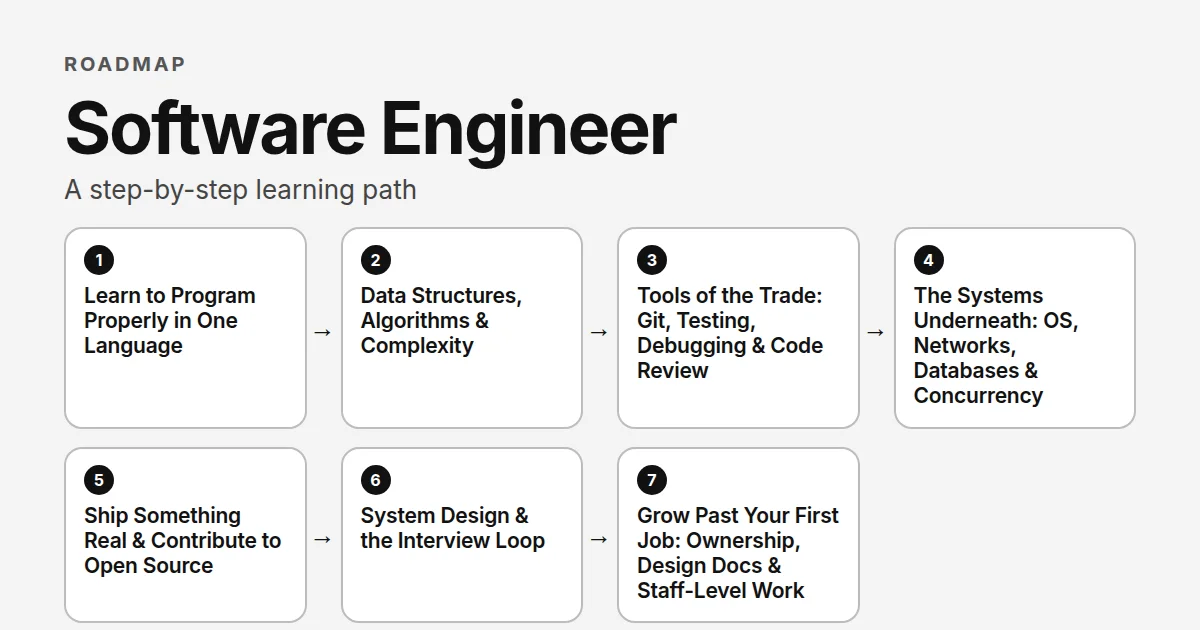
Software Engineer learning path
Work down the line, one step at a time. Tick each skill as you can do it.
- 1
Learn to Program Properly in One Language
8–12 weeksPick one general-purpose language and stay in it long enough to stop fighting it. Python, Java, Go, and TypeScript all get people hired; hopping between them does not. The point is fluency in the parts every language shares — variables, control flow, functions, types, errors, modules, reading a stack trace — not collecting syntax.
Skills to learn
- One language, in depth
- Functions, types & error handling
- Reading stack traces
- Debugger and print-debugging
- Command-line programs
- Reading other people's code
- Standard library over frameworks
Start with
- 2
Data Structures, Algorithms & Complexity
8–12 weeksThis is the screen almost every hiring loop starts with, and it is also the vocabulary the rest of the job runs on. Learn arrays, hash maps, trees, heaps, graphs, and the sorting and search patterns built on them — and why each one is fast or slow. Implement them by hand once, then practise recognising which one a problem is asking for.
Skills to learn
- Big-O time and space analysis
- Arrays, linked lists, stacks, queues
- Hash maps and sets
- Trees, heaps, and graphs
- Sorting and binary search
- Recursion and dynamic programming
- Two pointers, sliding window, BFS/DFS
Start with
- 3
Tools of the Trade: Git, Testing, Debugging & Code Review
4–6 weeksMost of a working week is not writing new code. It is reading a diff, reproducing a bug, writing the test that would have caught it, and getting a change reviewed. Learn Git well enough to recover from your own mistakes, write tests that fail for the right reason, and review code without turning it into a fight. These habits are what separate a hobbyist project from something a team can maintain.
Skills to learn
- Git branching, rebasing & conflict resolution
- Unit and integration tests (pytest, JUnit, Go test)
- Test-driven development basics
- Debugging by bisection and reproduction
- Writing small, reviewable pull requests
- Giving and receiving code review
- The shell, editors, and CI basics
Start with
- 4
The Systems Underneath: OS, Networks, Databases & Concurrency
8–12 weeksFrameworks change every few years; the machine underneath does not. Learn what a process and a thread are, what a system call costs, how TCP and HTTP move bytes, how a relational database stores and indexes rows, and why two threads touching one variable go wrong. You do not need to build an operating system — you need enough of a mental model that a production bug stops being magic.
Skills to learn
- Processes, threads & memory
- Concurrency and race conditions
- TCP/IP, DNS & HTTP
- SQL, indexes & transactions
- File systems and I/O
- Linux command line
- Caching and where latency comes from
Start with
- 5
Ship Something Real & Contribute to Open Source
8–12 weeksTutorials end where the hard parts start. Build one thing from scratch that forces you to make design decisions — an interpreter, a key-value store, a small web server — and put it in public with tests and a README. Then send a pull request to a project you did not write. A maintainer's review comments are the closest thing a new engineer has to verifiable, third-party evidence of skill.
Skills to learn
- Building a project past the tutorial stage
- Reading an unfamiliar codebase
- Writing a README and setup instructions
- Opening issues and pull requests
- Responding to review feedback
- Deploying something other people can use
Start with
- 6
System Design & the Interview Loop
6–10 weeksEvery offer runs through a loop: coding rounds, usually a design discussion for anything above the most junior level, and a behavioural round. Practise out loud, against a clock, with another person — solving problems alone on a screen does not prepare you for explaining your thinking to a stranger. Start system design with data storage and failure modes, not with drawing boxes for a famous product.
Skills to learn
- Timed coding rounds, talking while you solve
- Requirements clarification and trade-offs
- System design: storage, caching, queues
- Consistency, replication & failure modes
- Behavioural stories with specifics
- Mock interviews with real people
- Negotiating an offer
Start with
- 7
Grow Past Your First Job: Ownership, Design Docs & Staff-Level Work
Ongoing — first job to seniorThe jump from junior to mid is doing assigned work reliably. Mid to senior is choosing the work: writing the design doc, naming the trade-offs, carrying a project through production, and being on call for it. Beyond senior, the job shifts again — toward technical direction, cross-team problems, and making other engineers effective. Not everyone takes that step, and staying a strong senior engineer is a legitimate place to stop.
Skills to learn
- Writing design docs
- Estimating and sequencing work
- On-call, incident response & postmortems
- Mentoring and code review at scale
- Cross-team technical influence
- Choosing what not to build
- Managing up and writing for non-engineers
Start with
jobroadmaps.com/roadmaps/software-engineer · Pay, demand and employer data for this role are further down the page.
Job Market Insights for Software Engineer
Data-backed
What do employers actually ask for?
Read from live job postings — how often each credential is named, from rare to almost always.
"Computer Science background" is the most common credential named, yet it appears only occasionally in what we could read. Postings that state it are the minority, but these counts are a floor, so do not read this as "no one asks".
Some postings say outright that equivalent experience or a self-taught route is accepted. That wording is worth reading closely when you see it.
Our read: a portfolio that proves the skill, and a referral from someone inside the company, usually carry more weight than a credential match on paper. That is judgement, not something these counts measure.
Requirement
How often named
Computer Science background
Bachelor's degree
Equivalent experience accepted
PhD / doctorate
Master's degree
Certification mentioned
Our read: how often a credential is named is not how strictly it is enforced. Equivalent experience, a standout portfolio, or a referral often counts for more than the credential listed.
Data-backed
Which skills appear most in job postings?
Read from live job postings, ranked from most to least often named.
Distributed systems is the most-named skill. Common, but not universal: many postings do not list it.
Past the fundamentals, 1 specialisation skill (Distributed systems included) start separating candidates who can do the job from candidates who have done it. The 19 niche skills are named rarely enough that knowing them is upside, not prerequisite.
Skill
How often named
Distributed systems
Testing
Collaboration
Monitoring
CI CD
Code review
Logging
Sorted by how often named · JobRoadmaps
Data-backed
Which tools and artifacts appear most in job postings?
Read from live job postings, ranked from most to least often named.
AWS is the most-named tool, but no tool is a universal requirement here.
Industry overlay
Targeting a specific industry?
The core roadmap gets you through the door anywhere. The difference between "qualified" and "they hired someone else" often lives in industry-specific context — the norms, the compliance floors, the tools assumed fluent in that sector.
Idempotency and safe retries
Networks fail and clients retry. Payment code must produce the same result whether a request arrives once or five times, or money moves twice.
Ledger and data-integrity modelling
Balances must reconcile exactly. Engineers model money movement as append-only records with strict consistency, not as numbers overwritten in place.
Testing for money edge cases
Rounding, currency handling, time zones, and partial failures are where financial bugs live, so tests target them deliberately.
Audit logging and compliance constraints
Regulated products must record who did what and when. Logging and access controls are requirements, not afterthoughts.
Security engineering basics
Systems that hold financial data are attacked constantly. Secure handling of secrets, authentication, and input is part of everyday code review.
Companies hiring:
StripeAffirmRobinhoodBrexAPI design and versioning
Customers build on your interfaces. A breaking change is a support incident for every integration, so engineers learn to evolve contracts without breaking callers.
Multi-tenant data isolation
One codebase serves many customer organisations. A bug that leaks data across tenants is the worst kind of defect, so isolation is checked at every layer.
Production ownership and on-call
Teams typically run what they build. You debug live incidents in code you wrote, which changes how carefully you write it.
Feature flags and gradual rollout
Continuous delivery means shipping code dark, enabling it for a few accounts, and rolling back without a redeploy.
Backwards-compatible migrations
Schema and data changes must run while the product stays live, so engineers plan changes in stages instead of one cut-over.
Companies hiring:
AnthropicOpenAIOktaFigmaScale AIIndustry premiums based on aggregated job posting data · Updated quarterly
Interactive
How ready are you right now?
Check the skills you already have to see your current job-market fit.
The most-named skill for this role is Distributed systems, so a gap there costs you the most. No single skill dominates, but each gap narrows which postings fit you. Check what you already have to see your biggest current gap.
Readiness Check
Check the skills you already have
0/5
base skills
Your biggest gap: Distributed systems, the most often named of the skills you have not ticked.
Start there, then work down the list.
Books worth reading as a Software Engineer
Where to start, in order. The full list of 12, grouped by career stage, is on its own page.
Getting started

The Pragmatic Programmer: Your Journey to Mastery
by David Thomas, Andrew Hunt · 1999
~350 pages~9 hrs to read
Short, practical tips on debugging, automation, estimating and taking ownership of your code. Best read in your first year, when habits are still forming and any language will do.
View book →
Code Complete: A Practical Handbook of Software Construction
by Steve McConnell · 1993
~910 pages~23 hrs to read
A long reference on the daily craft: naming, routines, defensive programming, debugging and code-level design. Read it in sections early on, then return to it when you review others' code.
View book →
Doing the job

Refactoring: Improving the Design of Existing Code
by Martin Fowler · 1999
~450 pages~11 hrs to read
A catalog of small, behavior-preserving changes with the reasoning for each. Reach for it once you maintain real codebases and need to improve messy code without breaking it.
View book →
Working Effectively with Legacy Code
by Michael Feathers · 2004
~460 pages~12 hrs to read
Techniques for getting untested, tangled code under test so you can change it safely. Most working engineers inherit such code, so this pays off quickly in your first maintenance-heavy role.
View book →
Senior and leading

Fundamentals of Software Architecture
by Mark Richards, Neal Ford · 2020
~430 pages~11 hrs to read
Surveys architectural styles, characteristics and trade-off analysis, with attention to how architects work with teams. Suits engineers moving into senior roles who now make system-wide design decisions.
View book →
The Staff Engineer's Path: A Guide for Individual Contributors Navigating Growth and Change
by Tanya Reilly · 2022
~520 pages~13 hrs to read
Covers big-picture thinking, leading projects without authority and working across teams. Meant for senior engineers deciding whether and how to grow toward staff-level scope.
View book →
All 12 books for a Software Engineer →Browse all books →
Some book links are affiliate links: we earn a small commission if you buy, at no cost to you. It does not affect what we list.
Prerequisites & Education
What credentials do employers look for?
These are the most common paths into this role — no single one is required.
Education Level
View list — coming soon- Bachelor's in computer science or software engineering — the default screen for new-grad hiring, and the route internship pipelines run through
- Bachelor's in another quantitative field (math, physics, electrical engineering) plus real projects — common and accepted
- Online master's in computer science, such as Georgia Tech's OMSCS — a route for career changers who already hold a bachelor's degree
- No degree — possible through a public track record and referrals, but expect more resume filters to work against you
Software engineering has no licence and no single gatekeeping credential. A degree buys access to the internship-to-new-grad pipeline; after your first job, almost nobody asks about it again.
Certifications
View list — coming soon- AWS Certified Developer – Associate — validates building and deploying applications on AWS; useful if your target employers run there
- Google Cloud Professional Cloud Developer — the equivalent for teams building on Google Cloud
- Certified Kubernetes Application Developer (CKAD) — a hands-on exam from the Linux Foundation; relevant to infrastructure-leaning teams
- None at all — no certification is a standard gate for this role the way OSCP or PMP is elsewhere; the interview loop and your code are the credential
Certifications are optional extras here, not entry tickets. Take one only if a specific employer or cloud platform you are targeting makes it useful — never instead of shipping projects.
Bootcamps & Training
View list — coming soon- Recurse Center — a self-directed programming retreat for people who already program; no curriculum, and a strong community of working engineers
- CodePath — courses taught by industry engineers, aimed at students and early-career learners; applications open in cycles
- Boot.dev — a structured, browser-based curriculum built around hands-on projects
- Exercism — free language tracks with human mentoring; the fastest way to get feedback on idiomatic code in your chosen language
We do not endorse any general-purpose bootcamp for this role. Choose training that gives you feedback from working engineers and forces you to build real things, and check any placement claims independently.
Portfolio & Other
View list — coming soon- A tool you actually use, on GitHub — with a README, tests that run with one command, and continuous integration passing
- Merged pull requests to a real open-source project — even a bug fix or docs correction; a maintainer's review is independent evidence
- A from-scratch build (interpreter, key-value store, HTTP server) — shows you understand the layer below the framework
- A design document for something you built — the problem, the options you rejected, and why
Reviewers rarely have time to read a whole repository. Make the first screen count: what it does, how to run it, how it is tested. A small, finished project beats a large, half-built one.
Your Roadmap
7 stepsLearn to Program Properly in One Language
8–12 weeksPick one general-purpose language and stay in it long enough to stop fighting it. Python, Java, Go, and TypeScript all get people hired; hopping between them does not. The point is fluency in the parts every language shares — variables, control flow, functions, types, errors, modules, reading a stack trace — not collecting syntax.
Skills to learn
Data Structures, Algorithms & Complexity
8–12 weeksThis is the screen almost every hiring loop starts with, and it is also the vocabulary the rest of the job runs on. Learn arrays, hash maps, trees, heaps, graphs, and the sorting and search patterns built on them — and why each one is fast or slow. Implement them by hand once, then practise recognising which one a problem is asking for.
Skills to learn
Tools of the Trade: Git, Testing, Debugging & Code Review
4–6 weeksMost of a working week is not writing new code. It is reading a diff, reproducing a bug, writing the test that would have caught it, and getting a change reviewed. Learn Git well enough to recover from your own mistakes, write tests that fail for the right reason, and review code without turning it into a fight. These habits are what separate a hobbyist project from something a team can maintain.
Skills to learn
The Systems Underneath: OS, Networks, Databases & Concurrency
8–12 weeksFrameworks change every few years; the machine underneath does not. Learn what a process and a thread are, what a system call costs, how TCP and HTTP move bytes, how a relational database stores and indexes rows, and why two threads touching one variable go wrong. You do not need to build an operating system — you need enough of a mental model that a production bug stops being magic.
Skills to learn
Ship Something Real & Contribute to Open Source
8–12 weeksTutorials end where the hard parts start. Build one thing from scratch that forces you to make design decisions — an interpreter, a key-value store, a small web server — and put it in public with tests and a README. Then send a pull request to a project you did not write. A maintainer's review comments are the closest thing a new engineer has to verifiable, third-party evidence of skill.
Skills to learn
System Design & the Interview Loop
6–10 weeksEvery offer runs through a loop: coding rounds, usually a design discussion for anything above the most junior level, and a behavioural round. Practise out loud, against a clock, with another person — solving problems alone on a screen does not prepare you for explaining your thinking to a stranger. Start system design with data storage and failure modes, not with drawing boxes for a famous product.
Skills to learn
Grow Past Your First Job: Ownership, Design Docs & Staff-Level Work
Ongoing — first job to seniorThe jump from junior to mid is doing assigned work reliably. Mid to senior is choosing the work: writing the design doc, naming the trade-offs, carrying a project through production, and being on call for it. Beyond senior, the job shifts again — toward technical direction, cross-team problems, and making other engineers effective. Not everyone takes that step, and staying a strong senior engineer is a legitimate place to stop.
Skills to learn
Start here this week
This week: write one small command-line tool you would actually use — a log parser, a file renamer, a budget splitter — in the language you are learning. Push it to GitHub with a README and a test file that runs with a single command, then ask one person who codes to read it and leave a review comment. That loop of writing, testing, publishing, and being reviewed is the job in miniature, and doing it once teaches more than another week of tutorials.
For structure, start with Harvard's CS50x for fundamentals, then work through Princeton's algorithms material and a structured problem list for data structures. Use Teach Yourself Computer Science as the map for the gaps — operating systems, networking, databases — and add the systems reading once the algorithm basics feel routine. Apply to internship and new-grad postings early and repeatedly, because those carry the explicit entry-level wording, and keep your open-source pull requests current while you wait.
Pay
U.S. Department of Labor data for the nearest BLS occupation, Software developers. BLS has no occupation for this exact title, so treat these as a benchmark.
Median: U.S. Bureau of Labor Statistics, Occupational Employment and Wage Statistics (median wage, May 2024) and Employment Projections (2024–34). Levels: U.S. Department of Labor Office of Foreign Labor Certification prevailing wage levels (wage year 2025, typical metro), a base-wage benchmark for the metro in the middle of 511 areas, not an offer. See every metro.
Job Titles at Each Level
Entry
Junior Software Engineer / New Grad Software Engineer
Mid
Software Engineer
Senior
Senior Software Engineer / Staff Software Engineer
Steps Overview
- 1
Learn to Program Properly in One Language
8–12 weeks
- 2
Data Structures, Algorithms & Complexity
8–12 weeks
- 3
Tools of the Trade: Git, Testing, Debugging & Code Review
4–6 weeks
- 4
The Systems Underneath: OS, Networks, Databases & Concurrency
8–12 weeks
- 5
Ship Something Real & Contribute to Open Source
8–12 weeks
- 6
System Design & the Interview Loop
6–10 weeks
- 7
Grow Past Your First Job: Ownership, Design Docs & Staff-Level Work
Ongoing — first job to senior
Explore more roadmaps
Not sure this is the right path? Browse all tech career roadmaps.
View Similar RoadmapsBuilt a project while following this roadmap?
Turn it into a hiring-ready case study in 10 seconds — free.
Ready to explore more?
Browse all career roadmaps across tech, business, and creative fields.