Security Engineer Career Roadmap
A security engineer builds security into systems instead of reporting on it afterwards. You review code before it ships, threat-model a design before anyone writes it, lock down IAM and cloud infrastructure, write the detections that fire when something slips through, and build the tooling that makes the safe path the easy one. It is an engineering job first: you write code, read other people's code, and ship. It sits between the analyst who watches alerts, the pentester who attacks from outside, and the AI security specialist who focuses on model risk. The security engineer is the person inside the company who fixes the underlying problem.
Is this the right path for you?
Security engineering is rarely a first job. In the live job postings we track, we found 170 with "security engineer", "application security" or "appsec" in the title across 45 companies, and only 2 carry entry-level words. The real paths in: a software engineer who moves into application security, a sysadmin or DevOps engineer who moves into cloud security, or a SOC analyst who moves into detection engineering. Bootcamp-to-security-engineer directly is the rare exception.
You need to enjoy building, not just breaking. The best security engineers care about the developer experience of the fix: a guardrail nobody bypasses beats a perfect control nobody adopts. You will spend as much time persuading a team to change a design as you do finding the flaw. If you want to do exploit development for its own sake, look at penetration testing. If you want to triage alerts on a shift, cybersecurity analyst is the closer match.
Honest note: the same postings skew senior. 46 of the 170 carry the word "senior", and 34 carry staff, principal, director or head. Our data comes from about 100 tech-company job boards, tilted towards AI labs, infrastructure and SaaS scale-ups, so it shows where those companies hire, not the whole market. But the signal is consistent: employers want people who have already shipped code or run infrastructure, and treat security as the specialisation on top. Plan for a two-step career, not a one-step jump.
Career Progression
Where does this role lead?
Click any role to explore timeline, key skills and, where the Department of Labor publishes it, pay.
Entry
Junior Security Engineer
~0–2 yrs
$70,117 (Level I)
True entry-level roles are scarce, so most people arrive here from a developer, DevOps or SOC job. You triage findings, review pull requests and fix what the scanners surface. Ship small, finished security fixes; that record is what gets you promoted.
Key skills
Pay shown is the U.S. Department of Labor prevailing wage for Level I (entry), Level III (mid) and Level IV (senior) in the nearest BLS occupation, base wage for the typical metro, wage year 2025, shown for the main track only. It is a benchmark, not an offer; branches and lead, staff and executive stages have no official figure.
What the postings say you’ll do
Lines copied word for word from live Security Engineer postings we track, read September 30, 2026. They show how employers word the job, not what every Security Engineer does. Postings change and expire.
“You should have a demonstrated ability to find vulnerabilities in complex systems and craft exploits to demonstrate business impact.”
“You will write code and integrate AI/LLM solutions to automate initial triage and data enrichment, building tools that help the team handle security findings at scale.”
“Work across the vulnerability lifecycle from detection and impact assessment through risk-based prioritization, remediation, and verification.”
“Conduct threat modeling and risk assessments to proactively identify potential risks and develop mitigation strategies.”
“Harden our identity and access management stack, including Okta and Google Workspace, with phishing-resistant MFA, strong SSO and SCIM lifecycles, and least-privilege access across SaaS.”
“Onboard, normalize and optimize security logging data for large-scale data analysis, detection engineering, deployment of ML models, and efficient querying during incidents.”
“Proven track record of automating security controls and workflows using a cloud-first approach.”
Who is hiring right now
Drawn from live postings across many employers today. Employers with live postings we tag to this roadmap, counted today. The sample is about a hundred tech-company job boards, tilted toward AI, data and infrastructure companies, so agencies, consultancies and most non-tech employers are not represented.
| Employer | Live postings | Early-career titles | Most common title |
|---|---|---|---|
| Anthropic | 26 | 0 | Security Engineer - Threat Intel |
| Samsara | 15 | 0 | Staff Application Security Engineer |
| Palantir | 14 | 1 | Information Security Engineer |
| Braze | 13 | 0 | Senior Security Engineer II |
| xAI | 11 | 0 | Application Security Engineer |
| Stripe | 10 | 1 | Staff Security Engineer, Abuse Control |
| Mozilla | 8 | 0 | Senior Security Engineer - SecOps |
| OpenAI | 8 | 0 | Security Engineer, Application Security |
| Scale AI | 8 | 0 | Infrastructure Security Engineer, Public Sector |
| Flexport | 7 | 0 | Security Engineer, Corporate Security |
| Klaviyo | 7 | 0 | Senior Security Engineer - Detection & Response |
| ClickHouse | 6 | 0 | Incident Response Security Engineer |
“Early-career titles” are roles whose title signals an entry-level or new-graduate position. Top 12 of 83 employers shown.
Look-alike roles, compared
Neighbouring titles read very differently once you open the posting. One line from a real posting for each, with how many live postings we track under that title and how many carry early-career wording.
Security Engineer
302 live postings · 85 employers · 3 with early-career wording
“Perform technical security assessments, code audits, and design reviews for new product features.”
Figma · Security Engineer posting
Detection / Threat Analyst
61 live postings · 27 employers · 0 with early-career wording
“This role within the Fastly Customer Security Operations Center (CSOC) will be responsible for monitoring and analyzing customer activity, with added emphasis on security functions, like identifying account-takeover or Bot Attacks and WAF administration.”
Fastly · Threat Detection Analyst (Japanese Speaking) posting
Offensive Security / Red Team
12 live postings · 8 employers · 0 with early-career wording
“Design and run rigorous evaluations of model cyber capabilities and safeguards, including policy adherence, correct refusal, over refusal, and resilience to jailbreaking and other adversarial techniques.”
OpenAI · Red Team Specialist - Cyber posting
Security Compliance / GRC
57 live postings · 28 employers · 0 with early-career wording
“Support external compliance audits end-to-end: coordinating evidence requests, liaising with auditors, and tracking findings through to closure.”
Asana · Security Compliance Lead posting
Quotes read September 30, 2026, from the live postings we track.
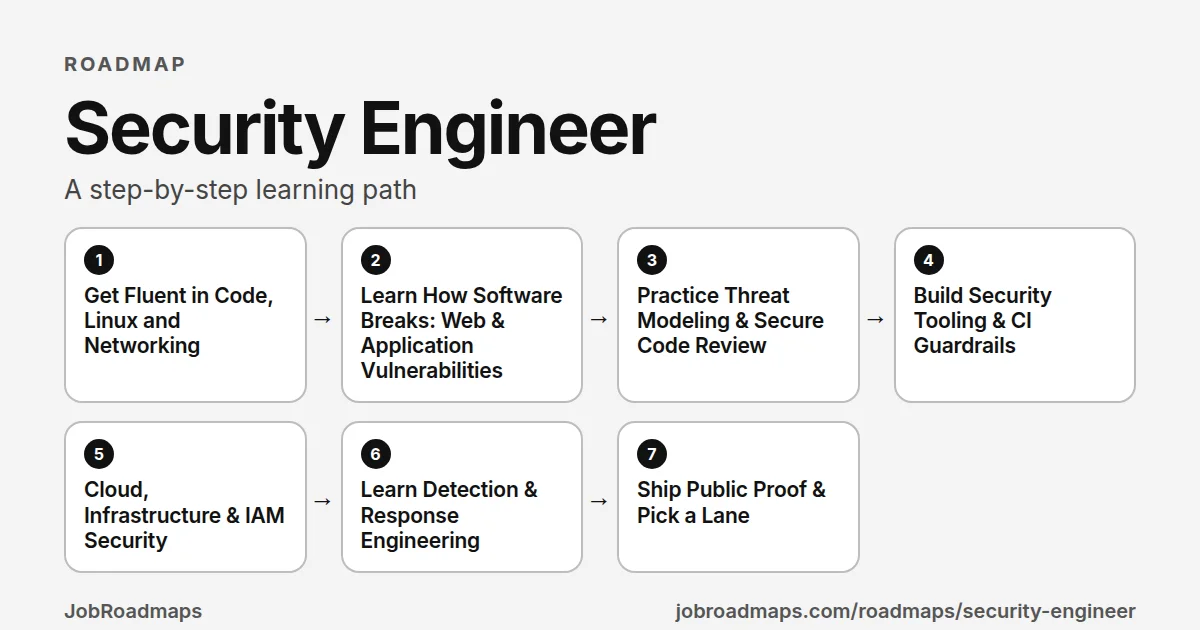
Visual roadmap
Security Engineer learning path
Work down the line, one step at a time. Tick each skill as you can do it.
- 1
Get Fluent in Code, Linux and Networking
8–12 weeks (or skip if you already ship code)Security engineers are judged as engineers. You need to read a service you did not write, follow a request through it, and write a script that fixes something without breaking prod. Pick one language you can genuinely read (Python or Go are common in security tooling), get comfortable on a Linux shell, and understand what HTTP, DNS and TLS actually do on the wire. If you already work as a developer or sysadmin, spend a week on the gaps and move on.
Skills to learn
- One language you can read fluently (Python or Go)
- Linux command line & permissions
- HTTP, DNS & TLS fundamentals
- Git & code review workflow
- Reading unfamiliar codebases
- Bash for glue scripting
Start with
- 2
Learn How Software Breaks: Web & Application Vulnerabilities
10–14 weeksEvery appsec and product-security job assumes you know the vulnerability classes cold: injection, broken access control, SSRF, authentication and session flaws, insecure deserialisation. Work through PortSwigger's labs until you can spot the pattern in code, not just exploit it in a lab. Then run OWASP Juice Shop and fix what you find. Attack knowledge is the input; the deliverable in this job is the fix.
Skills to learn
- Injection & XSS
- Broken access control (IDOR / BOLA)
- SSRF & request forgery
- Authentication, sessions & OAuth flaws
- Burp Suite basics
- CWE and CVSS vocabulary
Start with
- 3
Practice Threat Modeling & Secure Code Review
6–10 weeksThis is the core craft. Threat modeling catches the design flaw before it is built; secure code review catches the implementation flaw before it ships. Take a real system, ideally one you built, draw the data flows and trust boundaries, list what could go wrong, and decide what you would change. Then review real pull requests with a checklist of vulnerability classes in mind. Write the findings up as tickets an engineer can act on in ten minutes.
Skills to learn
- Data-flow diagrams & trust boundaries
- STRIDE and attack trees
- Secure code review
- Security requirements (OWASP ASVS)
- Writing actionable findings
- Risk rating & prioritisation
Start with
- 4
Build Security Tooling & CI Guardrails
8–12 weeksThe job is scale: one engineer cannot review every change, so you build guardrails that do. Write custom static-analysis rules for the bug class you keep finding, wire dependency and secret scanning into CI, add policy checks to infrastructure code, and learn what makes a scanner noisy enough that developers ignore it. A rule that catches one real bug class in a real repo is worth more on your resume than ten tool names.
Skills to learn
- Custom static-analysis rules (Semgrep / CodeQL)
- CI/CD security checks
- Dependency & secret scanning
- Supply-chain basics (SLSA, provenance)
- Policy as code
- Cutting false positives
Start with
- 5
Cloud, Infrastructure & IAM Security
10–14 weeksMost real compromises today run through identity and configuration, not memory corruption. Learn how IAM policy evaluation actually works, how a single over-broad role becomes a path to everything, and how to express least privilege in Terraform instead of a wiki page. Add Kubernetes and container security, and learn to read a cloud account like an attacker would. Sysadmins and DevOps engineers have a head start here.
Skills to learn
- IAM policy design & least privilege
- Cloud misconfiguration patterns
- Secrets management
- Kubernetes & container hardening
- Infrastructure as code (Terraform)
- Logging & audit trail design
Start with
- 6
Learn Detection & Response Engineering
8–12 weeksPrevention fails, so somebody has to build the detections and the response path. This is where SOC analysts move into engineering: turn attacker behaviour into queryable, tested detection logic, map coverage to MITRE ATT&CK, instrument hosts and containers, and automate the first ten minutes of an incident. Treat detections like code: version-controlled, tested against attack simulations, and reviewed.
Skills to learn
- MITRE ATT&CK mapping
- Detection rules as code (Sigma)
- Endpoint & container telemetry (osquery, Falco)
- Attack simulation to test detections
- Incident response runbooks
- Log pipelines & query languages
Start with
- 7
Ship Public Proof & Pick a Lane
OngoingBecause so few security engineering roles are true entry-level, your evidence has to look like work someone already did. Publish a threat model, a Semgrep rule pack, a Terraform module with sane IAM defaults or a detection set with tests. Get one real fix merged into an open-source project. Then pick a lane (appsec, cloud and infrastructure, or detection and response) and go deep enough that a hiring manager can picture you owning it.
Skills to learn
- Open-source security contributions
- Technical writing
- Vulnerability disclosure
- Secure development lifecycle (NIST SSDF)
- Security maturity models
- Choosing a specialisation
Start with
jobroadmaps.com/roadmaps/security-engineer · Pay, demand and employer data for this role are further down the page.
Job Market Insights for Security Engineer
Data-backed
What do employers actually ask for?
Read from live job postings — how often each credential is named, from rare to almost always.
"Certification mentioned" is the most common credential named, yet it appears only rarely in what we could read. Postings that state it are the minority, but these counts are a floor, so do not read this as "no one asks".
Our read: a portfolio that proves the skill, and a referral from someone inside the company, usually carry more weight than a credential match on paper. That is judgement, not something these counts measure.
Requirement
How often named
Certification mentioned
Computer Science background
Bachelor's degree
PhD / doctorate
Master's degree
Our read: how often a credential is named is not how strictly it is enforced. Equivalent experience, a standout portfolio, or a referral often counts for more than the credential listed.
Data-backed
Which skills appear most in job postings?
Read from live job postings, ranked from most to least often named.
incident response is the most-named skill. Common, but not universal: many postings do not list it.
Past the fundamentals, 2 specialisation skills (incident response included) start separating candidates who can do the job from candidates who have done it. The 18 niche skills are named rarely enough that knowing them is upside, not prerequisite.
Skill
How often named
incident response
threat modeling
cloud security
SIEM
detection engineering
infrastructure as code
vulnerability management
threat intelligence
code review
penetration testing
threat hunting
security assessment
zero trust
Sorted by how often named · JobRoadmaps
Data-backed
Which tools and artifacts appear most in job postings?
Read from live job postings, ranked from most to least often named.
No tool dominates. The most-named, Okta, is still rare; postings for this role rarely list tools by name.
Tool / Artifact
How often named
Okta
Cloudflare
GitHub
Slack
GitLab
CrowdStrike
Sorted by how often named · JobRoadmaps
Industry overlay
Targeting a specific industry?
The core roadmap gets you through the door anywhere. The difference between "qualified" and "they hired someone else" often lives in industry-specific context — the norms, the compliance floors, the tools assumed fluent in that sector.
API authorisation security
Financial products are API-first, so object-level authorisation and business-logic flaws in money-moving endpoints are the highest-impact bugs.
Fraud and abuse threat modeling
Attackers target the product logic itself, so threat models must cover abuse of legitimate features, not only classic vulnerabilities.
Secrets and key management
Payment credentials, signing keys and tokens need strict lifecycle control, rotation and audit trails.
Compliance-aware engineering
Audit and regulatory requirements shape controls, and engineers build evidence collection into systems instead of assembling it by hand.
Cloud IAM and segmentation
Separating environments and limiting blast radius is a standard way to contain the damage of a compromised credential.
Companies hiring:
StripeRobinhoodRampMulti-tenant isolation review
A cross-tenant data leak is the defining failure for SaaS, so verifying tenant boundaries in design and code is a standing objective.
AuthN/AuthZ and OAuth security
SaaS products live on SSO, API tokens and third-party integrations, and flaws there recur as high-impact findings.
Secure code review and static analysis
Engineering teams ship continuously, so scalable review depends on custom rules and CI checks rather than manual gatekeeping.
Vulnerability management and disclosure
Customers and security researchers report issues, and triaging and fixing them on a deadline is part of the routine.
Customer security assurance
Enterprise buyers ask for security answers and evidence, so engineers often support questionnaires and reviews.
Companies hiring:
NotionIntercomKlaviyoTwilioZeta GlobalIndustry premiums based on aggregated job posting data · Updated quarterly
Interactive
How ready are you right now?
Check the skills you already have to see your current job-market fit.
The most-named skill for this role is incident response, so a gap there costs you the most. No single skill dominates, but each gap narrows which postings fit you. Check what you already have to see your biggest current gap.
Readiness Check
Check the skills you already have
0/5
base skills
Your biggest gap: incident response, the most often named of the skills you have not ticked.
Start there, then work down the list.
Books worth reading as a Security Engineer
Where to start, in order. The full list of 12, grouped by career stage, is on its own page.
Getting started

Alice and Bob Learn Application Security
by Tanya Janca · 2020
~300 pages~8 hrs to read
A plain-language tour of securing software across design, coding, testing and deployment. A good first book for engineers moving into application security from development.
View book →
Designing Secure Software: A Guide for Developers
by Loren Kohnfelder · 2021
~310 pages~8 hrs to read
Teaches security thinking at the design stage, with mitigations and secure design patterns. Read it early to build the habit of reviewing architecture, not just finished code.
View book →
Doing the job

Building Secure and Reliable Systems
by Heather Adkins, Betsy Beyer, Paul Blankinship, Piotr Lewandowski, Ana Oprea, Adam Stubblefield · 2020
~560 pages~14 hrs to read
Google's engineers on designing, implementing and operating systems that stay secure and reliable, including least privilege, review, recovery and incident response. For engineers owning production systems.
View book →
Secure by Design
by Dan Bergh Johnsson, Daniel Deogun, Daniel Sawano · 2019
~410 pages~10 hrs to read
Shows how domain-driven design choices make whole classes of vulnerabilities harder to write. Useful when you review code and want to push fixes into the design, not patch each bug.
View book →
Senior and leading

Security Engineering: A Guide to Building Dependable Distributed Systems
by Ross Anderson · 2001
~1000 pages~25 hrs to read
A broad reference on why systems fail, spanning protocols, access control, usability and economics. Senior engineers can use it to reason about trade-offs and organizational risk.
View book →
Security Chaos Engineering: Sustaining Resilience in Software and Systems
by Kelly Shortridge, Aaron Rinehart · 2023
Argues for resilience through experimentation and treats failure as expected. Useful for security leads shaping how teams test controls and respond to incidents.
View book →
All 12 books for a Security Engineer →Browse all books →
Some book links are affiliate links: we earn a small commission if you buy, at no cost to you. It does not affect what we list.
Prerequisites & Education
What credentials do employers look for?
These are the most common paths into this role — no single one is required.
Education Level
View list — coming soon- Bachelor's in computer science or software engineering — the most common background, because the job is engineering first
- Bachelor's in another field plus real software, DevOps or SOC experience — routinely accepted
- No degree — a track record of shipped code, infrastructure or security work and public artifacts can carry an application
- Master's in security or computer science — useful for research-heavy or cryptography-adjacent teams, rarely required
Employers hiring security engineers screen for engineering ability more than for security credentials. A degree helps, but the evidence that gets interviews is code, systems you have run and security fixes you have shipped.
Certifications
View list — coming soon- AWS Certified Security - Specialty — validates cloud IAM, logging and data-protection knowledge on the largest cloud
- Google Cloud Professional Cloud Security Engineer — the equivalent for Google Cloud environments
- Burp Suite Certified Practitioner (PortSwigger) — a practical web-security exam that shows you can find and reason about application flaws
- CSSLP (ISC2) or CISSP — broad, management-flavoured credentials; more useful for compliance-heavy employers than for engineering teams
Certifications rarely decide a security engineering hire the way OSCP does for pentesting. Take a cloud-provider security cert if you are moving from infrastructure, or the practical web exam if you are moving from development. Skip the rest until an employer asks.
Bootcamps & Training
View list — coming soon- PortSwigger Web Security Academy — free, lab-based, and the standard way to learn web vulnerability classes
- PentesterLab — hands-on exercises, including code review, that build the bug-spotting reflex
- Secure Code Warrior — developer-focused secure coding training; useful for seeing how organisations train their own engineers
- SANS SEC540 (Cloud Native Security and DevSecOps Automation) — directly on-topic but expensive; worth it when an employer pays
Generic cybersecurity bootcamps skew towards analyst roles. For this job, free lab platforms and one strong programming foundation do more than a certificate of completion.
Portfolio & Other
View list — coming soon- A published threat model of a real or open-source system — data-flow diagram, trust boundaries and the changes you would make
- A custom Semgrep or CodeQL rule pack that catches a real bug class, with tests and a short write-up
- A Terraform module or IAM policy set with least-privilege defaults and an explanation of the trade-offs
- A detection-as-code repository — Sigma rules mapped to ATT&CK and tested with attack simulations
- A merged security fix or responsibly disclosed vulnerability in an open-source project
Because so few postings are entry-level, your portfolio has to read like work already done at a job. Ship small artifacts that other engineers could adopt, and explain the decision, not just the tool.
Your Roadmap
7 stepsGet Fluent in Code, Linux and Networking
8–12 weeks (or skip if you already ship code)Security engineers are judged as engineers. You need to read a service you did not write, follow a request through it, and write a script that fixes something without breaking prod. Pick one language you can genuinely read (Python or Go are common in security tooling), get comfortable on a Linux shell, and understand what HTTP, DNS and TLS actually do on the wire. If you already work as a developer or sysadmin, spend a week on the gaps and move on.
Skills to learn
Learn How Software Breaks: Web & Application Vulnerabilities
10–14 weeksEvery appsec and product-security job assumes you know the vulnerability classes cold: injection, broken access control, SSRF, authentication and session flaws, insecure deserialisation. Work through PortSwigger's labs until you can spot the pattern in code, not just exploit it in a lab. Then run OWASP Juice Shop and fix what you find. Attack knowledge is the input; the deliverable in this job is the fix.
Skills to learn
Practice Threat Modeling & Secure Code Review
6–10 weeksThis is the core craft. Threat modeling catches the design flaw before it is built; secure code review catches the implementation flaw before it ships. Take a real system, ideally one you built, draw the data flows and trust boundaries, list what could go wrong, and decide what you would change. Then review real pull requests with a checklist of vulnerability classes in mind. Write the findings up as tickets an engineer can act on in ten minutes.
Skills to learn
Build Security Tooling & CI Guardrails
8–12 weeksThe job is scale: one engineer cannot review every change, so you build guardrails that do. Write custom static-analysis rules for the bug class you keep finding, wire dependency and secret scanning into CI, add policy checks to infrastructure code, and learn what makes a scanner noisy enough that developers ignore it. A rule that catches one real bug class in a real repo is worth more on your resume than ten tool names.
Skills to learn
Cloud, Infrastructure & IAM Security
10–14 weeksMost real compromises today run through identity and configuration, not memory corruption. Learn how IAM policy evaluation actually works, how a single over-broad role becomes a path to everything, and how to express least privilege in Terraform instead of a wiki page. Add Kubernetes and container security, and learn to read a cloud account like an attacker would. Sysadmins and DevOps engineers have a head start here.
Skills to learn
Learn Detection & Response Engineering
8–12 weeksPrevention fails, so somebody has to build the detections and the response path. This is where SOC analysts move into engineering: turn attacker behaviour into queryable, tested detection logic, map coverage to MITRE ATT&CK, instrument hosts and containers, and automate the first ten minutes of an incident. Treat detections like code: version-controlled, tested against attack simulations, and reviewed.
Skills to learn
Ship Public Proof & Pick a Lane
OngoingBecause so few security engineering roles are true entry-level, your evidence has to look like work someone already did. Publish a threat model, a Semgrep rule pack, a Terraform module with sane IAM defaults or a detection set with tests. Get one real fix merged into an open-source project. Then pick a lane (appsec, cloud and infrastructure, or detection and response) and go deep enough that a hiring manager can picture you owning it.
Skills to learn
Start here this week
This week: pick a small app you have written or can read (your own project or an open-source one) and threat-model it on paper. Draw the data flow, mark the trust boundaries, and list five ways it could be abused. Then open PortSwigger's Web Security Academy and complete the first access-control lab. Both are free, and they tell you fast whether reasoning about how things fail is what you want to do all day.
For a structured route: if you already write code, spend the next few months on vulnerability classes, threat modeling and custom static-analysis rules, then apply to product security or appsec teams. If you come from ops or infrastructure, go cloud security first, with IAM, Terraform and Kubernetes hardening. If you come from a SOC, go detection engineering, writing detections as code. In every case, ship one public artifact per stage.
Pay
U.S. Department of Labor data for the nearest BLS occupation, Information security analysts. BLS has no occupation for this exact title, so treat these as a benchmark.
Median: U.S. Bureau of Labor Statistics, Occupational Employment and Wage Statistics (median wage, May 2024) and Employment Projections (2024–34). Levels: U.S. Department of Labor Office of Foreign Labor Certification prevailing wage levels (wage year 2025, typical metro), a base-wage benchmark for the metro in the middle of 303 areas, not an offer. See every metro.
Job Titles at Each Level
Entry
Junior Security Engineer / Associate Security Engineer
Mid
Security Engineer / Application Security Engineer
Senior
Senior Security Engineer / Staff Security Engineer
Steps Overview
- 1
Get Fluent in Code, Linux and Networking
8–12 weeks (or skip if you already ship code)
- 2
Learn How Software Breaks: Web & Application Vulnerabilities
10–14 weeks
- 3
Practice Threat Modeling & Secure Code Review
6–10 weeks
- 4
Build Security Tooling & CI Guardrails
8–12 weeks
- 5
Cloud, Infrastructure & IAM Security
10–14 weeks
- 6
Learn Detection & Response Engineering
8–12 weeks
- 7
Ship Public Proof & Pick a Lane
Ongoing
Explore more roadmaps
Not sure this is the right path? Browse all tech career roadmaps.
View Similar RoadmapsBuilt a project while following this roadmap?
Turn it into a hiring-ready case study in 10 seconds — free.
Ready to explore more?
Browse all career roadmaps across tech, business, and creative fields.