Machine Learning / MLOps Lead Career Roadmap
MLOps Leads own the full ML lifecycle — from experimentation to production. They build pipelines that train, evaluate, deploy, and monitor models reliably at scale. The role sits at the intersection of ML research, software engineering, and platform reliability.
Is this the right path for you?
MLOps leads come from ML engineers who got frustrated with models that couldn't deploy reliably, from DevOps engineers who learned enough ML to understand what makes the deployment problem different, and from data engineers who got pulled into the model serving side. The role is senior-leaning — the 'lead' implies accountability for production systems, not just individual contributor work.
If broken training pipelines bother you the same way broken code does — if you find the reliability and reproducibility of ML systems more interesting than the modeling itself — you're already thinking like an MLOps engineer. The job rewards operational paranoia applied to a non-deterministic system, which is a specific kind of frustration tolerance.
Most paths to MLOps lead run through 2–3 years as an ML engineer or data engineer first. The 'lead' title implies you've shipped models to production and watched them fail in interesting ways — data drift, pipeline breakage, feature store inconsistencies. That failure experience is the credential. People who haven't experienced production ML failure don't know what they don't know.
Career Progression
Where does this role lead?
Click any role to explore timeline, key skills and, where the Department of Labor publishes it, pay.
Entry
ML Engineer
~1–2 yrs
$94,286 (Level I)
You're building and training models, running experiments, and learning how ML works in production. The jump from notebook to pipeline is where most ML engineers level up.
Key skills
Pay shown is the U.S. Department of Labor prevailing wage for Level I (entry), Level III (mid) and Level IV (senior) in the nearest BLS occupation, base wage for the typical metro, wage year 2025, shown for the main track only. It is a benchmark, not an offer; branches and lead, staff and executive stages have no official figure.
Visual roadmap
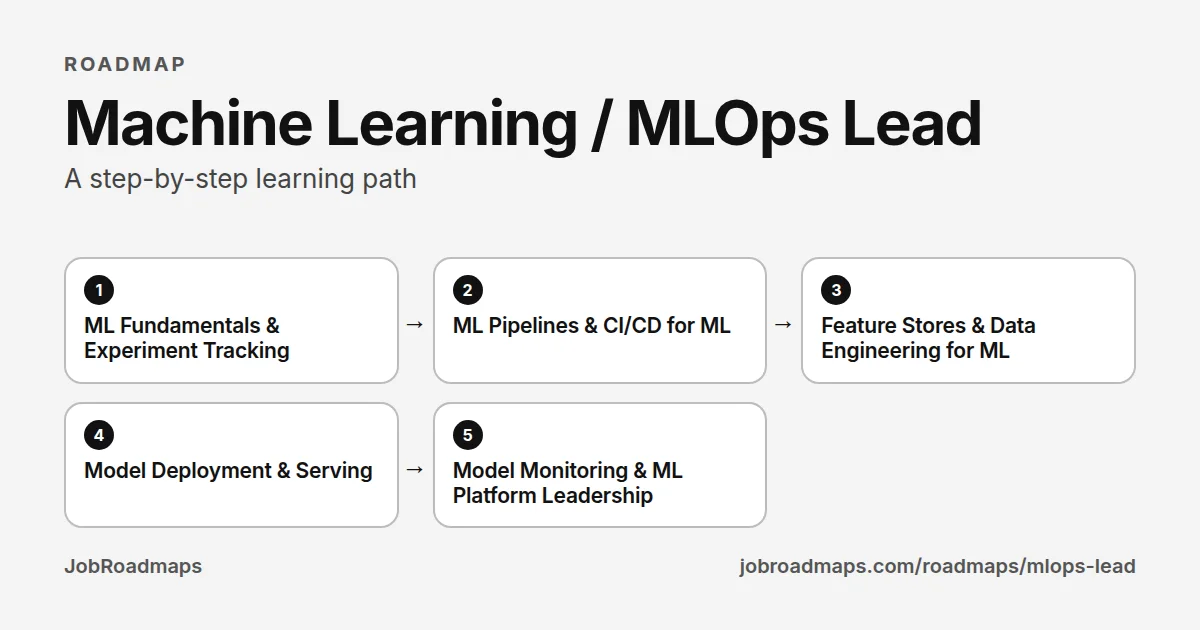
Machine Learning / MLOps Lead learning path
Work down the line, one step at a time. Tick each skill as you can do it.
- 1
ML Fundamentals & Experiment Tracking
6–8 weeksMaster scikit-learn, XGBoost, and PyTorch basics. Set up experiment tracking with MLflow or Weights & Biases to log metrics, parameters, and artefacts. Learn reproducible experiment design with seeded runs and versioned datasets.
Skills to learn
- Python
- PyTorch
- scikit-learn
- MLflow
- Weights & Biases
- Experiment Tracking
- 2
ML Pipelines & CI/CD for ML
8–10 weeksBuild automated training pipelines with Kubeflow Pipelines, Metaflow, or Vertex AI Pipelines. Integrate model training into CI/CD: trigger retrains on data drift, run evaluation gates, and promote only models that pass quality thresholds.
Skills to learn
- Kubeflow Pipelines
- Metaflow
- Vertex AI Pipelines
- GitHub Actions for ML
- Pipeline Orchestration
- Data Versioning with DVC
- 3
Feature Stores & Data Engineering for ML
6–8 weeksDesign and operate feature stores (Feast, Tecton, Hopsworks) for consistent training-serving parity. Build data validation pipelines with Great Expectations. Understand point-in-time correctness and feature freshness requirements.
Skills to learn
- Feast / Tecton
- Feature Engineering
- Great Expectations
- Point-in-Time Joins
- Data Quality
- Apache Spark
- 4
Model Deployment & Serving
6–8 weeksDeploy models via REST APIs (BentoML, Triton, TorchServe) and batch inference jobs. Master canary deployments, A/B testing of model versions, and shadow mode evaluation. Understand hardware optimisation: quantisation, ONNX, and GPU serving.
Skills to learn
- BentoML
- Triton Inference Server
- Canary Deployments
- ONNX
- Model Quantisation
- Kubernetes for ML
- 5
Model Monitoring & ML Platform Leadership
8–10 weeksImplement data drift detection (Evidently AI, Arize, WhyLabs) and automated retraining triggers. Build SLOs for model latency and accuracy. Transition to platform leadership: define ML standards, mentor engineers, and drive the ML infrastructure roadmap.
Skills to learn
- Evidently AI
- Arize
- Data Drift Detection
- SLOs for ML
- Retraining Automation
- Platform Roadmap
jobroadmaps.com/roadmaps/mlops-lead · Pay, demand and employer data for this role are further down the page.
Job Market Insights for Machine Learning / MLOps Lead
Data-backed
What do employers actually ask for?
Read from live job postings — how often each credential is named, from rare to almost always.
"Computer Science background" is the most common credential named, yet it appears only occasionally in what we could read. Postings that state it are the minority, but these counts are a floor, so do not read this as "no one asks".
Some postings say outright that equivalent experience or a self-taught route is accepted. That wording is worth reading closely when you see it.
Our read: a portfolio that proves the skill, and a referral from someone inside the company, usually carry more weight than a credential match on paper. That is judgement, not something these counts measure.
Requirement
How often named
Computer Science background
PhD / doctorate
Master's degree
Bachelor's degree
Equivalent experience accepted
Our read: how often a credential is named is not how strictly it is enforced. Equivalent experience, a standout portfolio, or a referral often counts for more than the credential listed.
Data-backed
Which skills appear most in job postings?
Read from live job postings, ranked from most to least often named.
Postings for this role rarely list skills by name. The most-named, Deep learning, is still only occasional, so none of these is a universal requirement.
Skill
How often named
Deep learning
Reinforcement learning
Distributed systems
Feature engineering
Natural language processing
Recommendation systems
Model evaluation
Classification
Computer vision
LLM fine-tuning
Production ML systems
Regression
Ranking models
Data quality
A/B testing
Sorted by how often named · JobRoadmaps
Data-backed
Which tools and artifacts appear most in job postings?
Read from live job postings, ranked from most to least often named.
No tool dominates. The most-named, Spark, is still rare; postings for this role rarely list tools by name.
Tool / Artifact
How often named
CI/CD
MLflow
Ray
Sorted by how often named · JobRoadmaps
Industry overlay
Targeting a specific industry?
The core roadmap gets you through the door anywhere. The difference between "qualified" and "they hired someone else" often lives in industry-specific context — the norms, the compliance floors, the tools assumed fluent in that sector.
Model explainability (XAI)
Regulatory requirements mandate that credit and fraud decisions be explainable. SHAP values and LIME are standard tools in fintech MLOps.
Model audit trails
Financial regulators require complete audit trails for model versions, training data, and deployment decisions.
Low-latency inference
Fraud detection models must return decisions in milliseconds for real-time transaction processing.
Companies hiring:
StripeBrexPlaidAffirmSquareMulti-tenant ML infrastructure
SaaS platforms serve multiple customers from shared ML infrastructure — isolation, fairness, and cost attribution across tenants require careful platform design.
Automated retraining pipelines
SaaS products can't have engineers manually retraining models for each customer — automated, event-triggered retraining is the standard.
LLM cost optimisation
Serving LLM-powered features to thousands of customers means token costs compound quickly. MLOps leads own the cost governance layer.
Companies hiring:
SalesforceDatadogSnowflakeDatabricksWeights & BiasesIndustry premiums based on aggregated job posting data · Updated quarterly
Interactive
How ready are you right now?
Check the skills you already have to see your current job-market fit.
The most-named skill for this role is Deep learning, so a gap there costs you the most. No single skill dominates, but each gap narrows which postings fit you. Check what you already have to see your biggest current gap.
Readiness Check
Check the skills you already have
0/5
base skills
Your biggest gap: Deep learning, the most often named of the skills you have not ticked.
Start there, then work down the list.
Books worth reading as a Machine Learning / MLOps Lead
Where to start, in order. The full list of 12, grouped by career stage, is on its own page.
Getting started

Introducing MLOps
by Mark Treveil, Nicolas Omont, Clément Stenac · 2020
Defines the MLOps lifecycle: model development, deployment, monitoring, governance and the team roles around them. A sensible orientation before you design a platform.
View book →Practical MLOps
by Noah Gift, Alfredo Deza · 2021
~490 pages~12 hrs to read
Hands-on coverage of containers, CI/CD, cloud ML services and monitoring for operating models. Read it for concrete workflows you can set up in your first months.
View book →
Doing the job

Designing Machine Learning Systems
by Chip Huyen · 2022
~390 pages~10 hrs to read
Covers data pipelines, feature engineering, deployment, monitoring and iteration for production ML. Read it when you own a system, not just a model, and need to reason about what breaks over time.
View book →Machine Learning Design Patterns
by Valliappa Lakshmanan, Sara Robinson, Michael Munn · 2020
~400 pages~10 hrs to read
Catalogues recurring solutions for data representation, training, serving, reproducibility and responsible AI. Handy when you design a pipeline and want proven patterns to compare against.
View book →
Senior and leading

The Manager's Path
by Camille Fournier · 2017
~240 pages~6 hrs to read
Walks through each step of technical leadership, from mentoring to managing managers. Read it as you take on a team and need to know what changes at each level.
View book →
Team Topologies: Organizing Business and Technology Teams for Fast Flow
by Matthew Skelton, Manuel Pais, Ruth Malan · 2019
~240 pages~6 hrs to read
Describes stream-aligned, platform, enabling and complicated-subsystem teams and how they interact. Helps you decide how an ML platform team should serve the model-building teams around it.
View book →
All 12 books for a Machine Learning / MLOps Lead →Browse all books →
Some book links are affiliate links: we earn a small commission if you buy, at no cost to you. It does not affect what we list.
Prerequisites & Education
What credentials do employers look for?
These are the most common paths into this role — no single one is required.
Education
View list — coming soon- BS/MS in Computer Science, Statistics, or Machine Learning — strong theoretical foundation for production ML
- Full-Stack Deep Learning (FSDL) — the closest thing to a comprehensive MLOps programme
- Self-taught with hands-on pipeline projects — viable with a strong GitHub history of deployed ML systems
A degree accelerates the research-heavy parts of MLOps but is rarely a hard requirement. Demonstrable systems experience carries more weight at most companies.
Certifications
View list — coming soon- Google Professional ML Engineer — industry-recognised MLOps credential; tests pipelines, deployment, and monitoring on GCP ($200)
- Google Cloud Professional Cloud DevOps Engineer — validates CI/CD pipelines, SRE practices, and service reliability on GCP; directly relevant for MLOps CI/CD and deployment automation ($200)
- AWS Machine Learning Specialty — valuable for SageMaker-based ML pipelines ($300)
- Databricks Certified ML Professional — useful for Spark-based data-heavy ML workflows ($200)
Cloud provider ML certifications carry the most recognition. Google and AWS certs open the most doors.
Bootcamps & Self-Study Paths
View list — coming soon- MLOps Zoomcamp (DataTalks.Club) — free, 9 weeks, covers MLflow, Prefect, Evidently, and full pipeline deployment
- Full-Stack Deep Learning (FSDL) — comprehensive, production-focused; covers the complete ML lifecycle
- Made With ML — free MLOps curriculum used by thousands of ML engineers worldwide
Free structured programmes with hands-on projects are the fastest credible path. Finishing MLOps Zoomcamp with a deployed project is more valuable than most paid courses.
Portfolio
View list — coming soon- End-to-end ML pipeline: data ingestion → training → deployment → monitoring (deployed, GitHub-linked)
- Experiment tracking setup with MLflow or W&B demonstrating reproducible runs
- Model serving API with health checks, versioning, and rollback capability
- Data drift monitoring dashboard with automated alerting
MLOps is about reliability. Your portfolio should demonstrate working systems, not just working models. Include architecture diagrams, SLO definitions, and failure post-mortems.
Your Roadmap
5 stepsML Fundamentals & Experiment Tracking
6–8 weeksMaster scikit-learn, XGBoost, and PyTorch basics. Set up experiment tracking with MLflow or Weights & Biases to log metrics, parameters, and artefacts. Learn reproducible experiment design with seeded runs and versioned datasets.
Skills to learn
ML Pipelines & CI/CD for ML
8–10 weeksBuild automated training pipelines with Kubeflow Pipelines, Metaflow, or Vertex AI Pipelines. Integrate model training into CI/CD: trigger retrains on data drift, run evaluation gates, and promote only models that pass quality thresholds.
Skills to learn
Feature Stores & Data Engineering for ML
6–8 weeksDesign and operate feature stores (Feast, Tecton, Hopsworks) for consistent training-serving parity. Build data validation pipelines with Great Expectations. Understand point-in-time correctness and feature freshness requirements.
Skills to learn
Model Deployment & Serving
6–8 weeksDeploy models via REST APIs (BentoML, Triton, TorchServe) and batch inference jobs. Master canary deployments, A/B testing of model versions, and shadow mode evaluation. Understand hardware optimisation: quantisation, ONNX, and GPU serving.
Skills to learn
Model Monitoring & ML Platform Leadership
8–10 weeksImplement data drift detection (Evidently AI, Arize, WhyLabs) and automated retraining triggers. Build SLOs for model latency and accuracy. Transition to platform leadership: define ML standards, mentor engineers, and drive the ML infrastructure roadmap.
Skills to learn
Start here this week
This week: set up MLflow or Weights & Biases on any existing model project. Instrument the training run to track five experiments — different hyperparameters, different data splits, different preprocessing steps. Log everything. The act of deciding what to track teaches you more about MLOps than any course description.
For structured entry, the MLOps Zoomcamp (free, cohort-based) is the best structured curriculum for this path. It covers experiment tracking, model serving, workflow orchestration, and monitoring. Pair it with the Made With ML course for the engineering depth. Both are free and more current than most academic programs.
Pay
U.S. Department of Labor data for the nearest BLS occupation, Computer and information research scientists. BLS has no occupation for this exact title, so treat these as a benchmark.
Median: U.S. Bureau of Labor Statistics, Occupational Employment and Wage Statistics (median wage, May 2024) and Employment Projections (2024–34). Levels: U.S. Department of Labor Office of Foreign Labor Certification prevailing wage levels (wage year 2025, typical metro), a base-wage benchmark for the metro in the middle of 77 areas, not an offer. See every metro.
Job Titles at Each Level
Entry
ML Engineer / MLOps Engineer
Mid
Senior ML Engineer / MLOps Lead
Senior
Principal ML Engineer / Head of ML Platform
Steps Overview
- 1
ML Fundamentals & Experiment Tracking
6–8 weeks
- 2
ML Pipelines & CI/CD for ML
8–10 weeks
- 3
Feature Stores & Data Engineering for ML
6–8 weeks
- 4
Model Deployment & Serving
6–8 weeks
- 5
Model Monitoring & ML Platform Leadership
8–10 weeks
Explore more roadmaps
Not sure this is the right path? Browse all tech career roadmaps.
View Similar RoadmapsBuilt a project while following this roadmap?
Turn it into a hiring-ready case study in 10 seconds — free.
Ready to explore more?
Browse all career roadmaps across tech, business, and creative fields.