Machine Learning Engineer Career Roadmap
Machine learning engineering sits at the uncomfortable intersection of research and production — where the beautiful notebook someone spent weeks on needs to actually run, reliably, on real data, at scale, without a PhD supervisor nearby to debug it. The romanticized version is training elegant models. The actual version involves data pipelines, feature stores, model registries, deployment infrastructure, and the slow realization that most of the job is software engineering with a statistical vocabulary.
Is this the right path for you?
ML engineers come from two directions: data scientists who got tired of their models living in notebooks and learned enough engineering to ship them, and software engineers who learned ML and wanted to build the systems that run it at scale. Both paths work. The data scientist path brings modeling depth but often lacks production systems thinking. The software engineer path brings systems thinking but often lacks modeling intuition.
If you find the gap between 'the model works in the notebook' and 'the model works in production under load' more interesting than either side of it — if you want to understand both the math and the infrastructure — you're already thinking like an ML engineer. The role lives at the intersection and rewards people who are comfortable in both.
This is one of the most technically demanding career paths on this list. Strong Python, real ML theory (not just sklearn calls), MLOps tooling, and system design are all expected before the first interview at companies worth joining. The bar is genuinely high and rising. Shortcuts in the math foundation show up in interviews at every level.
Career Progression
Where does this role lead?
Click any role to explore timeline, key skills and, where the Department of Labor publishes it, pay.
Entry
Junior ML Engineer
~1–2 yrs
$94,286 (Level I)
You're running experiments from existing codebases and cleaning data. Getting comfortable with the full model training loop — data in, metrics out — is the first milestone.
Key skills
Pay shown is the U.S. Department of Labor prevailing wage for Level I (entry), Level III (mid) and Level IV (senior) in the nearest BLS occupation, base wage for the typical metro, wage year 2025, shown for the main track only. It is a benchmark, not an offer; branches and lead, staff and executive stages have no official figure.
Visual roadmap
Machine Learning Engineer learning path
Work down the line, one step at a time. Tick each skill as you can do it.
- 1
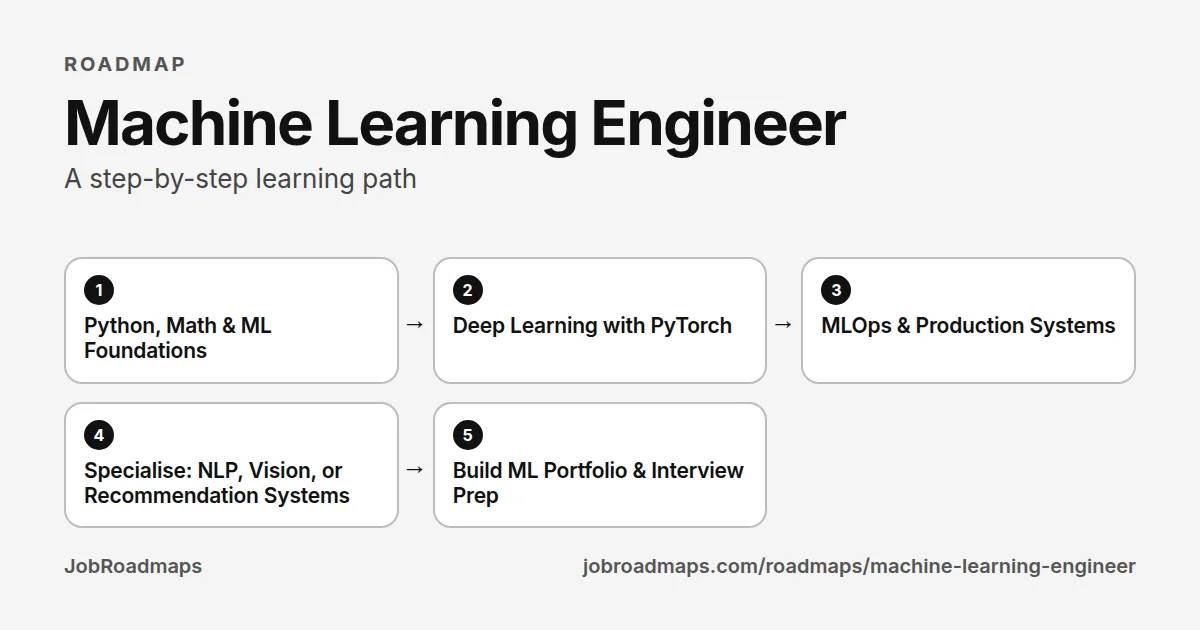
Python, Math & ML Foundations
8–10 weeksSolidify Python skills with NumPy, pandas, and Matplotlib. Study the math behind ML: linear algebra, calculus, probability, and statistics. Complete Andrew Ng's ML course — it is the essential foundation for this career.
Skills to learn
- Python 3 (type hints, dataclasses)
- NumPy & SciPy
- Linear Algebra (vectors, matrices, SVD)
- Calculus (chain rule, gradient descent)
- Probability & Bayesian Thinking
- pandas (data wrangling)
- Jupyter Notebooks / Google Colab
- Git for ML (DVC, MLflow)
- scikit-learn Fundamentals
Start with
- 2
Deep Learning with PyTorch
10–12 weeksLearn neural network architectures: CNNs for vision, RNNs/LSTMs for sequences, and transformers for NLP. PyTorch is the dominant framework in research and production. Build and train models end-to-end on GPU.
Skills to learn
- PyTorch (tensors, autograd, nn.Module)
- Feedforward Neural Networks
- CNNs (Conv2D, BatchNorm, Pooling)
- RNNs & LSTMs
- Transformer Architecture (Attention)
- BERT & GPT Architecture
- GPU Training (CUDA, MPS)
- Backpropagation Mechanics
- Regularization (Dropout, Weight Decay)
- Learning Rate Schedulers
Start with
- 3
MLOps & Production Systems
6–8 weeksLearn to take models from notebooks to production. Study model serving (FastAPI, TorchServe), experiment tracking (MLflow, Weights & Biases), feature stores, and CI/CD for ML pipelines. Understand monitoring for data drift.
Skills to learn
- MLflow (experiment tracking, registry)
- Weights & Biases (W&B)
- FastAPI (model serving)
- TorchServe / BentoML
- Docker for ML Containers
- DVC (data version control)
- Feature Stores (Feast, Tecton)
- Data Drift Monitoring (Evidently AI)
- CI/CD for ML (GitHub Actions)
- Apache Airflow (pipeline orchestration)
Start with
- 4
Specialise: NLP, Vision, or Recommendation Systems
8–10 weeksPick a domain to go deep: NLP (transformers, fine-tuning LLMs, RAG), Computer Vision (object detection, segmentation), or RecSys (collaborative filtering, ranking). Build a domain-specific portfolio project.
Skills to learn
- HuggingFace Transformers
- HuggingFace Datasets & Hub
- PEFT / LoRA Fine-tuning
- Sentence Transformers (embeddings)
- YOLO / Detectron2 (computer vision)
- Stable Diffusion (generative)
- Collaborative Filtering (RecSys)
- LangChain / LlamaIndex (LLM apps)
- ONNX (model export & optimisation)
- vLLM / TensorRT (inference speed)
Start with
- 5
Build ML Portfolio & Interview Prep
8–12 weeksComplete 2–3 end-to-end ML projects on Kaggle or GitHub — include data pipeline, model training, evaluation, and deployment. Practice ML system design interviews. Contribute to open-source ML libraries to show expertise.
Skills to learn
- Kaggle Competitions (top 10-20% target)
- ML System Design (Chip Huyen framework)
- Open Source Contributions (HuggingFace)
- Research Paper Implementation (arXiv)
- LeetCode (DSA + ML coding rounds)
- End-to-End Deployed ML App
- Technical Blog / Paper Write-up
- ML Interview Prep (breadth + depth)
Start with
jobroadmaps.com/roadmaps/machine-learning-engineer · Pay, demand and employer data for this role are further down the page.
Job Market Insights for Machine Learning Engineer
Data-backed
What do employers actually ask for?
Read from live job postings — how often each credential is named, from rare to almost always.
"PhD / doctorate" is the most common credential named, yet it appears only occasionally in what we could read. Postings that state it are the minority, but these counts are a floor, so do not read this as "no one asks".
Some postings say outright that equivalent experience or a self-taught route is accepted. That wording is worth reading closely when you see it.
Our read: a portfolio that proves the skill, and a referral from someone inside the company, usually carry more weight than a credential match on paper. That is judgement, not something these counts measure.
Requirement
How often named
PhD / doctorate
Computer Science background
Master's degree
Equivalent experience accepted
Bachelor's degree
Our read: how often a credential is named is not how strictly it is enforced. Equivalent experience, a standout portfolio, or a referral often counts for more than the credential listed.
Data-backed
Which skills appear most in job postings?
Read from live job postings, ranked from most to least often named.
Experimentation is the most-named skill. Common, but not universal: many postings do not list it.
Past the fundamentals, 1 specialisation skill (Experimentation included) start separating candidates who can do the job from candidates who have done it. The 19 niche skills are named rarely enough that knowing them is upside, not prerequisite.
Skill
How often named
Experimentation
Fine-tuning
Ranking
Deep learning
Reinforcement learning
Model training
Data pipelines
Statistics
Natural language processing
Recommendation systems
Computer vision
Feature engineering
Large language models
Distributed systems
Agentic systems
Model serving
Anomaly detection
Sorted by how often named · JobRoadmaps
Data-backed
Which tools and artifacts appear most in job postings?
Read from live job postings, ranked from most to least often named.
No tool dominates. The most-named, Datadog, is still rare; postings for this role rarely list tools by name.
Industry overlay
Targeting a specific industry?
The core roadmap gets you through the door anywhere. The difference between "qualified" and "they hired someone else" often lives in industry-specific context — the norms, the compliance floors, the tools assumed fluent in that sector.
Model explainability (SHAP, LIME)
Credit and lending decisions are subject to fair-lending regulation, so models must produce reason codes a regulator or applicant can understand.
Real-time fraud scoring at low latency
Transaction approval happens in milliseconds, so fraud models must run inference within a payment authorization window, not batch.
Adversarial robustness
Fraud rings actively probe and adapt to detection models, requiring engineers to design for a moving, adversarial target rather than a static distribution.
Class imbalance handling
Fraud and default events are rare relative to legitimate transactions, forcing specific sampling and evaluation-metric choices beyond plain accuracy.
Model risk governance (SR 11-7 style validation)
Regulated financial institutions require formal model validation, documentation, and monitoring processes before a model reaches production.
Companies hiring:
StripeCapital OnePayPalAffirmPlaidRecommendation systems
Personalizing content, products, and experiences for millions of users drives engagement and monetization.
Ranking
Optimizing relevance in search, feeds, and marketplace matching is core to platform value.
Two-sided marketplace optimization
Balancing supply and demand across platform participants requires sophisticated incentive and allocation models.
Companies hiring:
LyftAirbnbSpotifyPinterestClickUpOpenTableStripeLaterIndustry premiums based on aggregated job posting data · Updated quarterly
Interactive
How ready are you right now?
Check the skills you already have to see your current job-market fit.
The most-named skill for this role is Experimentation, so a gap there costs you the most. No single skill dominates, but each gap narrows which postings fit you. Check what you already have to see your biggest current gap.
Readiness Check
Check the skills you already have
0/5
base skills
Your biggest gap: Experimentation, the most often named of the skills you have not ticked.
Start there, then work down the list.
Books worth reading as a Machine Learning Engineer
Where to start, in order. The full list of 12, grouped by career stage, is on its own page.
Getting started

Hands-On Machine Learning with Scikit-Learn, Keras & TensorFlow, 3rd Edition
by Aurélien Géron · 2017
~860 pages~22 hrs to read
Project-driven walk-through of the machine learning workflow, from classical models in Scikit-Learn to neural networks in Keras. Work through it once you are comfortable with Python and basic statistics.
View book →
Mathematics for Machine Learning
by Marc Peter Deisenroth, A. Aldo Faisal, Cheng Soon Ong · 2020
~370 pages~9 hrs to read
Covers the linear algebra, calculus, probability and optimisation that underpin machine learning, then applies them to regression, PCA and classification. Read it early if your background is software rather than maths.
View book →
Doing the job
Machine Learning Design Patterns
by Valliappa Lakshmanan, Sara Robinson, Michael Munn · 2020
~400 pages~10 hrs to read
Catalogues recurring solutions to data, training and serving problems such as feature stores, checkpoints and workflow pipelines. Useful when you are designing a system rather than just training a model.
View book →Building Machine Learning Powered Applications: Going from Idea to Product
by Emmanuel Ameisen · 2020
~260 pages~7 hrs to read
Follows one ML product from the first idea through modelling, validation, deployment and monitoring. Read it when you are building your first end-to-end application.
View book →
Senior and leading

Designing Machine Learning Systems: An Iterative Process for Production-Ready Applications
by Chip Huyen · 2022
~390 pages~10 hrs to read
Covers data pipelines, deployment, monitoring and the lifecycle of production models. Read it when your work shifts from notebooks to models that other teams depend on.
View book →
AI Engineering: Building Applications with Foundation Models
by Chip Huyen · 2025
~350 pages~9 hrs to read
Covers evaluation, prompt engineering, RAG, fine-tuning, inference optimisation and the architecture of applications built on foundation models. Aimed at engineers who own those systems and decide how they are evaluated and run.
View book →
All 12 books for a Machine Learning Engineer →Browse all books →
Some book links are affiliate links: we earn a small commission if you buy, at no cost to you. It does not affect what we list.
Prerequisites & Education
What credentials do employers look for?
These are the most common paths into this role — no single one is required.
Education Level
View list — coming soon- Bachelor's in Computer Science, Mathematics, or Electrical Engineering
- Master's in Machine Learning, AI, or Applied Statistics — common at senior roles
- PhD — expected at research-adjacent ML roles at AI labs and large tech companies
- Bachelor's in a quantitative field with demonstrated ML project experience
Senior ML engineering roles at top companies strongly favour Master's or PhD candidates. Strong project portfolios can compensate at startups and product companies.
Certifications
View list — coming soon- Google Professional Machine Learning Engineer — most industry-relevant ML cert
- AWS Certified Machine Learning – Specialty — valuable for MLOps and cloud-deployed models
- AWS Certified AI Practitioner — $100 entry-level AI cert; good baseline if your ML work runs on AWS
- Microsoft Azure AI Fundamentals (AI-900) — $165 entry-level cert; good baseline for ML engineers deploying models on Azure infrastructure
- Microsoft Azure Data Scientist Associate (DP-100) — covers model training, experimentation, and deployment on Azure ML; directly relevant for teams using Azure Machine Learning ($165)
- Google Cloud Professional Data Engineer — validates building and operationalising data pipelines on BigQuery, Dataflow, and Pub/Sub; increasingly expected where ML data pipelines run on GCP ($200)
- TensorFlow Developer Certificate (Google) — signals hands-on model-building competency
- Databricks Certified Machine Learning Professional — valued at data-platform heavy companies
- ARTiBA Artificial Intelligence Engineer (AIE) — $750, vendor-neutral AI engineering credential covering core modelling concepts and data preparation in AI workflows
- CertNexus Certified AI Practitioner (CAIP) — $368, covers ML algorithms, model training/optimisation, and operationalising models; no cloud-specific bias
- SAS Certified Professional: AI & Machine Learning — $5,845 for three exams; enterprise-tier credential valued at large organisations running SAS infrastructure
Google ML Engineer and AWS ML Specialty are the most frequently cited in ML job postings. SAS cert is niche — only worth it if you're targeting enterprise companies already using SAS.
Bootcamps & Training
View list — coming soon- fast.ai Practical Deep Learning for Coders — highly respected by practitioners, used by researchers
- DeepLearning.AI specialisations (Andrew Ng, Coursera) — widely cited on ML resumes
- Full Stack Deep Learning (FSDL) — covers training, deployment, and MLOps in full
- Kaggle Learn — short, practical, and respected as an entry to ML workflows
fast.ai and DeepLearning.AI are the two training paths most commonly listed on ML engineer resumes. Pair with real Kaggle competition entries or deployed models.
Portfolio & Other
View list — coming soon- GitHub with reproducible ML experiments using MLflow or Weights & Biases for tracking
- Deployed model serving real traffic — via FastAPI, Hugging Face Spaces, or Modal
- Kaggle competition history — top 10% or better in any competition is meaningful
- Fine-tuned or custom-trained model published on Hugging Face Hub with a model card
- Technical blog post or paper explaining architecture decisions and trade-offs
A deployed model with documented training experiments is the gold standard. Hiring managers at AI companies will look for evidence that you can take a model from training to production.
Your Roadmap
5 stepsPython, Math & ML Foundations
8–10 weeksSolidify Python skills with NumPy, pandas, and Matplotlib. Study the math behind ML: linear algebra, calculus, probability, and statistics. Complete Andrew Ng's ML course — it is the essential foundation for this career.
Skills to learn
Deep Learning with PyTorch
10–12 weeksLearn neural network architectures: CNNs for vision, RNNs/LSTMs for sequences, and transformers for NLP. PyTorch is the dominant framework in research and production. Build and train models end-to-end on GPU.
Skills to learn
MLOps & Production Systems
6–8 weeksLearn to take models from notebooks to production. Study model serving (FastAPI, TorchServe), experiment tracking (MLflow, Weights & Biases), feature stores, and CI/CD for ML pipelines. Understand monitoring for data drift.
Skills to learn
Specialise: NLP, Vision, or Recommendation Systems
8–10 weeksPick a domain to go deep: NLP (transformers, fine-tuning LLMs, RAG), Computer Vision (object detection, segmentation), or RecSys (collaborative filtering, ranking). Build a domain-specific portfolio project.
Skills to learn
Build ML Portfolio & Interview Prep
8–12 weeksComplete 2–3 end-to-end ML projects on Kaggle or GitHub — include data pipeline, model training, evaluation, and deployment. Practice ML system design interviews. Contribute to open-source ML libraries to show expertise.
Skills to learn
Start here this week
This week: take any Kaggle-winning model on a dataset that interests you and figure out how you'd deploy it as an API that someone could actually call. Not deploy it — just design the deployment. What does the request/response look like? Where does the model artifact live? What happens when inference is slow? That exercise reveals the gap between data science and ML engineering.
For structured entry, fast.ai's Practical Deep Learning course followed by Andrew Ng's Machine Learning Specialization gives you both the top-down intuition and the bottom-up math. Then move to the MLOps Zoomcamp (free) for production skills. The combination is better than a master's program at a median school and costs almost nothing.
Pay
U.S. Department of Labor data for the nearest BLS occupation, Computer and information research scientists. BLS has no occupation for this exact title, so treat these as a benchmark.
Median: U.S. Bureau of Labor Statistics, Occupational Employment and Wage Statistics (median wage, May 2024) and Employment Projections (2024–34). Levels: U.S. Department of Labor Office of Foreign Labor Certification prevailing wage levels (wage year 2025, typical metro), a base-wage benchmark for the metro in the middle of 77 areas, not an offer. See every metro.
Job Titles at Each Level
Entry
Junior ML Engineer / Applied Scientist
Mid
ML Engineer / MLOps Engineer
Senior
Senior ML Engineer / AI Research Lead
Steps Overview
- 1
Python, Math & ML Foundations
8–10 weeks
- 2
Deep Learning with PyTorch
10–12 weeks
- 3
MLOps & Production Systems
6–8 weeks
- 4
Specialise: NLP, Vision, or Recommendation Systems
8–10 weeks
- 5
Build ML Portfolio & Interview Prep
8–12 weeks
Explore more roadmaps
Not sure this is the right path? Browse all tech career roadmaps.
View Similar RoadmapsBuilt a project while following this roadmap?
Turn it into a hiring-ready case study in 10 seconds — free.
Ready to explore more?
Browse all career roadmaps across tech, business, and creative fields.