HRIS Analyst Career Roadmap
An HRIS analyst looks after the systems that hold a company's people data. You configure and support the HR platform (in most of the postings we track, Workday), keep employee records accurate, build the reports that HR and finance rely on, run changes through testing and connect the platform to payroll, benefits, recruiting and identity systems. Postings call the job HRIS analyst, people systems analyst, people technology analyst or Workday analyst. It is not a recruiter's job, not an HR generalist's and not a software engineer's, though the strongest analysts learn to automate their own work.
Is this the right path for you?
The routes in are varied. HR coordinators and HR operations staff who became the person everyone asks about the system. Payroll and benefits specialists, recruiting-operations coordinators, business-systems analysts and finance analysts who like HR processes and data. Graduates in human resources, information systems or business with strong spreadsheets. The seats exist at employers of every size, with the most visible demand in our postings at technology and fintech companies.
You will fit if you enjoy being precise. The job is checking that a change reached thousands of records the way it should, explaining to a manager why an approval is stuck, and noticing that two reports disagree before the CFO does. If you like both people and systems, and you are patient with detail and with non-technical colleagues, it suits you. If you want to lead people strategy, or write production software all day, other roads are better.
Be honest about the market. Dozens of seats appear in our postings, but a large share ask for hands-on experience in one platform, and much of the vendor’s deeper training is open to customers and partners rather than the public. That makes a first role harder to land from outside: the usual way in is to start in HR operations or payroll at a company that runs the system, volunteer for system work and move across. It is a niche with real demand and a narrow door.
Job titles this roadmap covers
- People Systems Analyst
- The same job under a different name. Datadog, Fastly and Klaviyo post people systems roles that cover the HR platform, its reports and its integrations.
- People Technology Analyst
- Analyst seats for the technology behind people processes. Okta, OpenAI and Collibra post people technology analyst and delivery roles.
- Workday Analyst
- An HRIS analyst who works mainly in Workday. Stripe, Baseten and Okta post Workday analyst seats, some focused on payroll, absence or time tracking.
- Workday Integration Specialist
- Focuses on moving data between the HR platform and other systems. Cloudflare, Asana and Carta post integration specialist, engineer and architect roles.
- Workday Reporting Specialist
- Builds the reports and dashboards HR leaders use. Cloudflare and Oscar Health post reporting and analytics roles tied to the platform.
- HRIS Manager
- Leads the platform and the team. Klaviyo, Datadog and Figma post HRIS manager seats, which are the next step up from analyst.
Career Progression
Where does this role lead?
Click any role to explore timeline, key skills and, where the Department of Labor publishes it, pay.
Entry
HRIS Analyst / People Systems Analyst
~0–2 yrs
You answer requests, fix records, build reports and test changes. Entry seats are available but competitive, and the fastest way to stand out is to automate a task you repeat.
Key skills
Visual roadmap
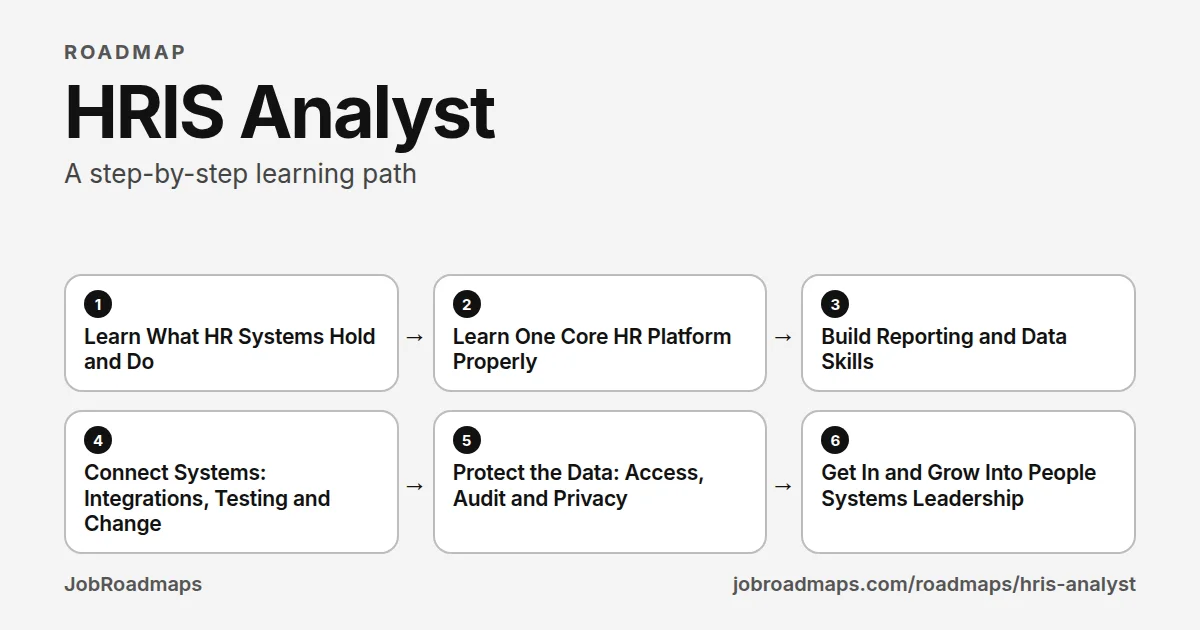
HRIS Analyst learning path
Work down the line, one step at a time. Tick each skill as you can do it.
- 1
Learn What HR Systems Hold and Do
2–3 weeksStart with the data and the lifecycle. An HRIS stores the employee record and the organisation around it: jobs and positions, managers, locations, compensation, absence and time, benefits and the changes that happen from hire to exit. Learn which team owns which process (HR, payroll, finance, IT, recruiting) and where one hands data to the next. Read three postings from companies you like and note which parts of the platform each stresses.
Skills to learn
- The employee record and the organisation structure
- Hire-to-exit lifecycle events
- Payroll, benefits, absence and time
- Which team owns which process
- How HR, finance and IT depend on the same data
Start with
- 2
Learn One Core HR Platform Properly
6–10 weeksThe postings we track come mostly from technology employers, and nearly all of them name Workday, so that is the system to learn first. Other platforms exist and some employers use them, but they rarely appear in our sample. Learn how a core HR platform is built: business processes and approvals, security groups and who can see what, calculated fields, reports and the way a change moves from request to production. Use the vendor's free training where you can reach it, and practise on the concepts even without a sandbox.
Skills to learn
- Business processes and approval steps
- Security roles and domain access
- Calculated fields and custom reports
- Tenant changes, releases and testing
- Absence, time and compensation set-up
Start with
- 3
Build Reporting and Data Skills
6–10 weeksMost of the day is questions about people data: headcount, movement, who has access, why a record is wrong. Postings stress reporting and data accuracy. Learn SQL for a data warehouse or export, a spreadsheet to the point where you can model and check a file, and how to present a result so an HR leader can act on it. Practise on a public data set, then on a sample employee file you invent.
Skills to learn
- SQL joins, grouping and filtering
- Spreadsheets for checking and reconciling files
- Data accuracy checks and audits of records
- Dashboards that HR leaders use
- Explaining a number and its limits
Start with
- 4
Connect Systems: Integrations, Testing and Change
6–10 weeksA people platform does not stand alone. It feeds payroll, benefits, recruiting, identity and finance, and it receives data back. Learn how files and APIs move data between systems, how an identity provider uses the HR record to create and remove access, and how to test a change before it reaches employees. Postings often name requirements gathering, testing and change management; this step is where those skills sit.
Skills to learn
- File and API integrations between systems
- How the HR record drives user access
- Requirements, test cases and user acceptance testing
- Release notes and change communication
- Troubleshooting a failed integration
Start with
- 5
Protect the Data: Access, Audit and Privacy
3–4 weeksPeople data is among the most sensitive a company holds. Learn the habits that keep it safe: least-privilege access, regular access reviews, audit trails, retention and deletion rules, and what employment recordkeeping rules require. You do not need to be a lawyer, but you do need to know when to ask one and how to show an auditor what changed and who approved it.
Skills to learn
- Least-privilege security roles
- Access reviews and audit evidence
- Retention, deletion and employee privacy
- Employment recordkeeping basics
- Working with legal, security and internal audit
Start with
- 6
Get In and Grow Into People Systems Leadership
6–12 monthsMost people enter from an HR coordinator, HR operations, payroll, benefits, recruiting-operations or business-systems role, then move to analyst. Show a portfolio of work (a report you rebuilt, a data clean-up with before-and-after checks, a process you mapped and tested) and describe it in people terms. From analyst the path leads to senior analyst, then to manager and director seats such as those at Datadog and ClickHouse, or to specialist tracks in integrations, architecture and people analytics.
Skills to learn
- Entry routes: HR operations, payroll, benefits, recruiting operations, business systems
- A portfolio of HR-systems projects with outcomes
- Specialist tracks: integrations, architecture, people analytics
- Managing analysts and vendor relationships
- Moving toward head of people systems
Start with
jobroadmaps.com/roadmaps/hris-analyst · Pay, demand and employer data for this role are further down the page.
Books worth reading as a HRIS Analyst
Where to start, in order. The full list of 12, grouped by career stage, is on its own page.
Getting started
Human Resource Information Systems: Basics, Applications, and Future Directions
by Richard D. Johnson, Michael J. Kavanagh, Kevin D. Carlson · 2020
The standard textbook on what HR systems do: records, payroll, recruiting, learning and how they are selected and run. Read it for the vocabulary and the full map of the field before you specialise in one platform.
View book →
Learning SQL
by Alan Beaulieu · 2005
~380 pages~10 hrs to read
A clear, practical SQL book. HR questions turn into queries about people, jobs and dates, and this is how you learn to write and check them.
View book →
Doing the job

Data Quality Fundamentals: A Practitioner's Guide to Building Trustworthy Data Pipelines
by Barr Moses, Lior Gavish, Molly Vorwerck · 2022
How to measure and keep data trustworthy: freshness, completeness, accuracy and lineage. Read it when records disagree across systems and nobody trusts the report.
View book →
Storytelling with Data: A Data Visualization Guide for Business Professionals
by Cole Nussbaumer Knaflic · 2015
~290 pages~7 hrs to read
How to turn a table into a chart and a short story a leader will act on. It is the best fit for the reporting half of the job.
View book →
Senior and leading

Switch: How to Change Things When Change Is Hard
by Chip Heath, Dan Heath · 2010
~310 pages~8 hrs to read
A framework for making change stick when people resist it. It fits every system rollout, from a new approval flow to a platform move.
View book →
Leading Change
by John P. Kotter · 1996
~210 pages~5 hrs to read
The classic account of why large changes fail and what leaders do to carry them through. Read it when you move from supporting the platform to running a change programme.
View book →
All 12 books for a HRIS Analyst →Browse all books →
Some book links are affiliate links: we earn a small commission if you buy, at no cost to you. It does not affect what we list.
Courses and certifications for a HRIS Analyst
8 courses, tutorials and certifications, each read on the provider's own page. One from each stage to start; the full list, with a guide to choosing, is on its own page.
Getting started · Course
Workday training and certifications
Workday
Doing the job · Certification
Salesforce Certified Tableau Desktop Foundations
Salesforce (Tableau)
Prerequisites & Education
What credentials do employers look for?
These are the most common paths into this role — no single one is required.
Education Level
View list — coming soon- Bachelor's in human resources, information systems, business or a related field: the most common signal
- Bachelor's in any field plus strong spreadsheet, SQL and HR-process skills shown in real work: a regular route
- Associate degree or HR-operations experience with system exposure and a portfolio of reports: possible with clear results
- Experience in HR operations, payroll, benefits, recruiting operations or business systems: how many people actually move in
Check the postings you target. Many name hands-on experience with a specific platform more than a specific degree.
Certifications
View list — coming soon- Workday Pro certifications: offered through the vendor to customers and partners, and named by employers that run the platform
- SHRM Certified Professional (SHRM-CP): shows HR knowledge for people whose work is operational in HR
- SQL or data-analysis certificates: help show you can work beyond built-in reports
- IAPP privacy certification (CIPP): useful where you handle employee data across regions
Platform certifications are a strong signal, but most are open to customers and partners rather than the public. If your employer runs the system, ask for the training.
Bootcamps & Training
View list — coming soon- Workday Basics Series: free introductory training open to everyone
- SQLBolt and Kaggle Intro to SQL: free SQL practice
- Postman learning centre: free API practice for integration work
- SHRM resources: HR fundamentals and professional community
A paid bootcamp is rarely needed. A portfolio with before-and-after checks and a clear test plan matters more.
Portfolio & Other
View list — coming soon- A headcount and movement report built from an invented employee file, with a note on its limits
- A data clean-up: records you found wrong, how you found them, and the checks that prove the fix
- A process map for a new-hire or promotion workflow with approval steps and test cases
- A short access-review write-up showing who can see which data and why
Use invented or public data only. Never publish real employee records.
Your Roadmap
6 stepsLearn What HR Systems Hold and Do
2–3 weeksStart with the data and the lifecycle. An HRIS stores the employee record and the organisation around it: jobs and positions, managers, locations, compensation, absence and time, benefits and the changes that happen from hire to exit. Learn which team owns which process (HR, payroll, finance, IT, recruiting) and where one hands data to the next. Read three postings from companies you like and note which parts of the platform each stresses.
Skills to learn
Learn One Core HR Platform Properly
6–10 weeksThe postings we track come mostly from technology employers, and nearly all of them name Workday, so that is the system to learn first. Other platforms exist and some employers use them, but they rarely appear in our sample. Learn how a core HR platform is built: business processes and approvals, security groups and who can see what, calculated fields, reports and the way a change moves from request to production. Use the vendor's free training where you can reach it, and practise on the concepts even without a sandbox.
Skills to learn
Build Reporting and Data Skills
6–10 weeksMost of the day is questions about people data: headcount, movement, who has access, why a record is wrong. Postings stress reporting and data accuracy. Learn SQL for a data warehouse or export, a spreadsheet to the point where you can model and check a file, and how to present a result so an HR leader can act on it. Practise on a public data set, then on a sample employee file you invent.
Skills to learn
Connect Systems: Integrations, Testing and Change
6–10 weeksA people platform does not stand alone. It feeds payroll, benefits, recruiting, identity and finance, and it receives data back. Learn how files and APIs move data between systems, how an identity provider uses the HR record to create and remove access, and how to test a change before it reaches employees. Postings often name requirements gathering, testing and change management; this step is where those skills sit.
Skills to learn
Protect the Data: Access, Audit and Privacy
3–4 weeksPeople data is among the most sensitive a company holds. Learn the habits that keep it safe: least-privilege access, regular access reviews, audit trails, retention and deletion rules, and what employment recordkeeping rules require. You do not need to be a lawyer, but you do need to know when to ask one and how to show an auditor what changed and who approved it.
Skills to learn
Get In and Grow Into People Systems Leadership
6–12 monthsMost people enter from an HR coordinator, HR operations, payroll, benefits, recruiting-operations or business-systems role, then move to analyst. Show a portfolio of work (a report you rebuilt, a data clean-up with before-and-after checks, a process you mapped and tested) and describe it in people terms. From analyst the path leads to senior analyst, then to manager and director seats such as those at Datadog and ClickHouse, or to specialist tracks in integrations, architecture and people analytics.
Skills to learn
Start here this week
This week: invent a small employee file in a spreadsheet (fifty people with job, manager, location, start date and status), then answer three questions: who has no manager, which managers have the most direct reports, and which records look wrong. Write a half-page note that an HR leader could act on. That exercise is close to what a first interview task looks like.
For structure: spend the first month on the HR lifecycle and the platform's concepts using the vendor's free material, the next two on SQL and reporting, then map one process (a promotion or a new-hire onboarding) from request to approval to payroll, write the test cases and keep it as your portfolio. Apply for analyst seats, and for HR-operations seats at companies that run the platform you want to learn.
Job Titles at Each Level
Entry
HRIS Analyst / People Systems Analyst
Mid
Senior HRIS Analyst / HRIS Manager
Senior
People Systems Manager / Director, People Systems
Steps Overview
- 1
Learn What HR Systems Hold and Do
2–3 weeks
- 2
Learn One Core HR Platform Properly
6–10 weeks
- 3
Build Reporting and Data Skills
6–10 weeks
- 4
Connect Systems: Integrations, Testing and Change
6–10 weeks
- 5
Protect the Data: Access, Audit and Privacy
3–4 weeks
- 6
Get In and Grow Into People Systems Leadership
6–12 months
Explore more roadmaps
Not sure this is the right path? Browse all business career roadmaps.
View Similar RoadmapsBuilt a project while following this roadmap?
Turn it into a hiring-ready case study in 10 seconds — free.
Ready to explore more?
Browse all career roadmaps across tech, business, and creative fields.