Financial Analyst Career Roadmap
Numbers are a language, and financial analysts are the translators — converting raw data into decisions that move capital, reshape strategy, and occasionally determine whether a company survives. It's pattern recognition under pressure, with a spreadsheet, a model, and the nagging awareness that somewhere someone is making serious decisions based on whether your assumptions are right. The work demands rigor and an unsentimental relationship with being wrong.
Is this the right path for you?
Financial analysts come from finance, accounting, and economics degrees — the undergraduate pipeline into investment banking, FP&A, and equity research is well-worn and reasonably predictable. Econ majors who discovered they prefer models to theory end up here. Business school graduates looking for quantitative rigor end up here. The path is credential-heavy compared to tech roles.
If you'd rather spend three hours reconciling a DCF model than write the narrative slide that summarizes it — if you find the assumptions behind a financial projection more interesting than the projection itself — you're already thinking like an analyst. The job rewards people who are unsentimental about being wrong and willing to rebuild the model when the assumptions don't hold.
The CFA is a multi-year commitment and a deliberate professional signal, not a starting gun. Starting Level I before you have your first role is a reasonable move if you're going directly for buy-side positions — for most FP&A and corporate finance paths, getting the job first and then studying for CFA is the more practical sequence. Don't let the credential become a procrastination device.
Career Progression
Where does this role lead?
Click any role to explore timeline, key skills and, where the Department of Labor publishes it, pay.
Entry
Junior Analyst
~1–2 yrs
Building financial models accurately and explaining your assumptions clearly. Speed and precision in Excel will define your reputation early.
Key skills
Visual roadmap
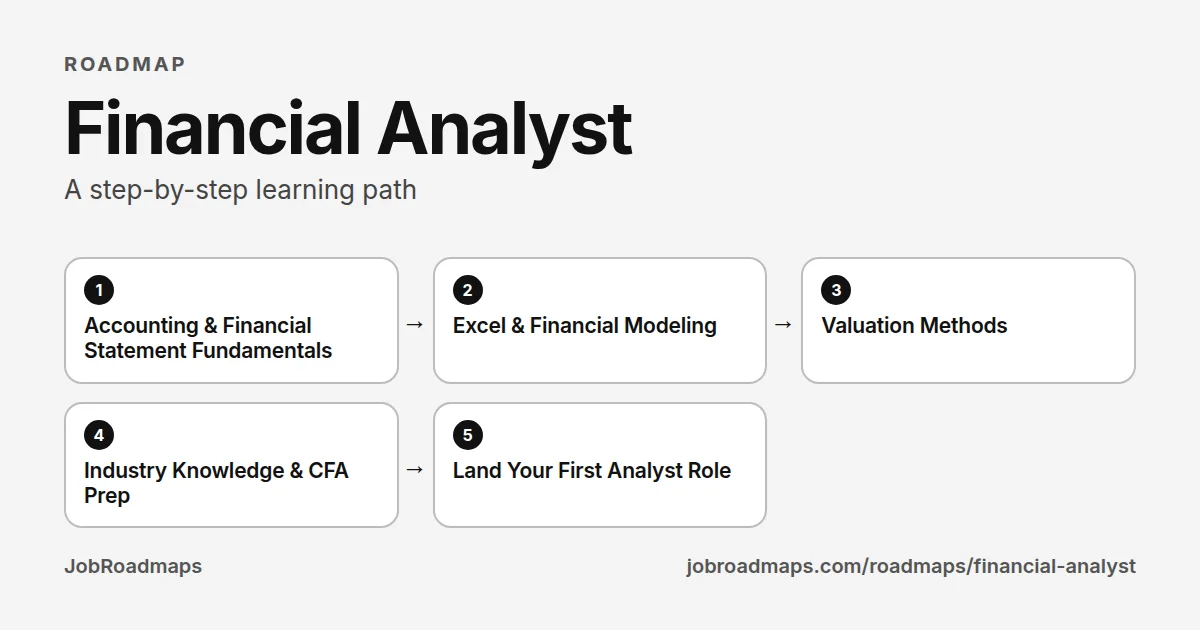
Financial Analyst learning path
Work down the line, one step at a time. Tick each skill as you can do it.
- 1
Accounting & Financial Statement Fundamentals
6–8 weeksMaster the three financial statements: income statement, balance sheet, and cash flow statement. Understand how they interlink, key ratios, and GAAP principles. Practice reading real 10-K filings.
Skills to learn
- Income Statement
- Balance Sheet
- Cash Flow Statement
- Financial Ratios
- GAAP
- SEC Filings
Start with
- 2
Excel & Financial Modeling
8–10 weeksExcel is the backbone of financial analysis. Learn advanced formulas, pivot tables, charts, and shortcuts. Build a 3-statement financial model, DCF valuation, and LBO model from scratch.
Skills to learn
- Excel Advanced
- Financial Modeling
- DCF Analysis
- LBO Modeling
- Sensitivity Analysis
- Scenario Analysis
Start with
- 3
Valuation Methods
5–7 weeksLearn the four main valuation methodologies: DCF, comparable company analysis (comps), precedent transactions, and asset-based valuation. Practice valuing real public companies.
Skills to learn
- DCF Valuation
- Comparable Analysis
- Precedent Transactions
- Terminal Value
- WACC
- Equity Research
Start with
- 4
Industry Knowledge & CFA Prep
12–16 weeksChoose a sector focus (tech, healthcare, real estate, banking). Start studying for the CFA Level I exam — it significantly boosts your credibility. Learn Bloomberg Terminal basics if possible.
Skills to learn
- CFA Level I
- Bloomberg Terminal
- Industry Research
- Equity Analysis
- Fixed Income Basics
- Portfolio Theory
Start with
- 5
Land Your First Analyst Role
4–8 weeksTailor your resume to highlight quantitative skills and any modeling work. Network on LinkedIn with analysts and associates. Apply to big banks, boutique advisory firms, and corporate FP&A teams. Nail the technical and behavioral interviews.
Skills to learn
- Resume Writing
- Networking
- Technical Interviews
- Behavioral Interviews
- CFA Progress
- Case Studies
Start with
jobroadmaps.com/roadmaps/financial-analyst · Pay, demand and employer data for this role are further down the page.
Job Market Insights for Financial Analyst
Data-backed
What do employers actually ask for?
Read from live job postings — how often each credential is named, from rare to almost always.
"Bachelor's degree" is the most common credential named, yet it appears only occasionally in what we could read. Postings that state it are the minority, but these counts are a floor, so do not read this as "no one asks".
Our read: a portfolio that proves the skill, and a referral from someone inside the company, usually carry more weight than a credential match on paper. That is judgement, not something these counts measure.
Requirement
How often named
Bachelor's degree
Our read: how often a credential is named is not how strictly it is enforced. Equivalent experience, a standout portfolio, or a referral often counts for more than the credential listed.
Data-backed
Which skills appear most in job postings?
Read from live job postings, ranked from most to least often named.
financial modeling leads the list and is named frequent. If you are only going to learn one thing before applying, the postings say start here.
The 1 base skill sit at the top of the scale, appearing across company sizes and seniority levels. Treat them as the baseline an application is read against.
Past the fundamentals, 6 specialisation skills (monthly close process included) start separating candidates who can do the job from candidates who have done it. The 5 niche skills are named rarely enough that knowing them is upside, not prerequisite.
Skill
How often named
financial modeling
monthly close process
attention to detail
financial reporting
business partnering
variance analysis
resource allocation
accruals
long-term planning
budgeting and forecasting
headcount planning
Sorted by how often named · JobRoadmaps
Industry overlay
Targeting a specific industry?
The core roadmap gets you through the door anywhere. The difference between "qualified" and "they hired someone else" often lives in industry-specific context — the norms, the compliance floors, the tools assumed fluent in that sector.
SaaS metrics
Critical for forecasting ARR, MRR, net retention, and churn; essential to evaluate subscription business health and guide sales planning.
GTM financial planning
Go-to-market team support requires deep understanding of sales compensation, quota, and pipeline metrics unique to SaaS sales models.
multi-year SaaS scenarios
SaaS business models require long-term contract visibility and recurring revenue modeling across multi-year forecast horizons.
Companies hiring:
OktaMongoDBSnowflakeBrazeVeeva SystemsPing Identityoperational KPI tracking
Logistics companies require close monitoring of volume, utilization, cost per unit, and service metrics that drive unit economics and forecasts.
regional P&L analysis
Flexport operates across 112+ countries; analysts must consolidate and analyze P&L by geography and business line to drive efficiency.
workflow automation
Large volumes of transactions and operational data require automation to reduce manual close effort and improve forecasting accuracy.
Companies hiring:
FlexportIndustry premiums based on aggregated job posting data · Updated quarterly
Interactive
How ready are you right now?
Check the skills you already have to see your current job-market fit.
The most-named skill for this role is financial modeling, so a gap there costs you the most. Skills at the top of the scale appear across most postings, so a single gap there narrows your options more than a gap in a rarer skill. Check what you already have to see your biggest current gap.
Readiness Check
Check the skills you already have
0/7
base skills
Your biggest gap: financial modeling, the most often named of the skills you have not ticked.
Start there, then work down the list.
Books worth reading as a Financial Analyst
Where to start, in order. The full list of 12, grouped by career stage, is on its own page.
Getting started

Financial Intelligence, Revised Edition
by Karen Berman, Joe Knight · 2006
~280 pages~7 hrs to read
Explains the income statement, balance sheet and cash flow statement in plain language, including where judgment and estimates hide in the numbers. Read it in your first weeks, before the models get complicated.
View book →
The Interpretation of Financial Statements
by Benjamin Graham, Spencer B. Meredith · 1937
~120 pages~3 hrs to read
A short guide to reading a balance sheet and income statement and testing what they say about a company's health. Useful early, as a quick check on whether you can read a set of accounts end to end.
View book →
Doing the job

Financial Shenanigans
by Howard Schilit, Jeremy Perler, Yoni Engelhart · 1993
~320 pages~8 hrs to read
Catalogues the accounting techniques companies use to flatter earnings and cash flow, and the warning signs in the filings. Read it once you are reading 10-Ks regularly and want to spot quality-of-earnings problems.
View book →
Valuation: Measuring and Managing the Value of Companies
by McKinsey & Company Inc., Tim Koller, Marc Goedhart, David Wessels · 1990
~960 pages~24 hrs to read
A thorough reference on enterprise DCF, return on invested capital, forecasting and the drivers of value. Come to it when you are building valuations that other people will rely on.
View book →
Senior and leading
Expectations Investing
by Michael J. Mauboussin, Alfred Rappaport · 2001
~270 pages~7 hrs to read
Reverses the valuation process: start from the price, work out the expectations it implies, then judge whether they are reasonable. Helps senior analysts frame recommendations for decision-makers.
View book →
The Outsiders
by William N. Thorndike · 2012
~250 pages~6 hrs to read
Profiles eight chief executives and how they allocated capital: buybacks, acquisitions, debt and cash. A good read for anyone moving toward finance management or a CFO track.
View book →
All 12 books for a Financial Analyst →Browse all books →
Some book links are affiliate links: we earn a small commission if you buy, at no cost to you. It does not affect what we list.
Prerequisites & Education
What credentials do employers look for?
These are the most common paths into this role — no single one is required.
Education Level
View list — coming soon- Bachelor's in Finance, Accounting, Economics, or Business Administration
- Bachelor's in Mathematics or Statistics — increasingly valued for quant roles
- Bachelor's in any discipline with strong GPA — investment banking often prioritises GPA
- MBA — near-required for VP track at bulge-bracket banks
Finance is one of the more credential-strict disciplines. A relevant bachelor's degree and GPA matter more here than in tech-adjacent roles.
Certifications
View list — coming soon- CFA Level I – most universally recognised credential in buy-side and research roles
- CFA Level II — significantly boosts comp and seniority trajectory
- Financial Modeling & Valuation Analyst (FMVA) — Corporate Finance Institute
- CPA — essential for accounting-adjacent analyst roles
- Bloomberg Market Concepts (BMC) — entry-level but widely listed
CFA is the gold standard. Passing Level I alone differentiates a candidate; charterholders command a measurable salary premium.
Bootcamps & Training
View list — coming soon- Wall Street Prep — financial modelling and LBO, used by banks for onboarding
- Breaking Into Wall Street (BIWS) — Excel and modelling training with templates
- Corporate Finance Institute (CFI) — comprehensive online finance curriculum
- Analyst Prep — structured CFA exam preparation
Wall Street Prep and BIWS are well-known by hiring managers. Completing their modelling courses and including them on a resume is a legitimate signal.
Portfolio & Other
View list — coming soon- Financial model samples (DCF, 3-statement, LBO) — shared as Excel or PDF
- Stock pitch or equity research writeup on a public company
- Any real investment committee presentation or case competition material
- Excel fluency demonstrated through model walk-through in interviews
- Bloomberg Terminal familiarity — note any access experience
A clean, well-structured DCF model with a thoughtful investment thesis is one of the most effective things you can include in a finance job application.
Your Roadmap
5 stepsAccounting & Financial Statement Fundamentals
6–8 weeksMaster the three financial statements: income statement, balance sheet, and cash flow statement. Understand how they interlink, key ratios, and GAAP principles. Practice reading real 10-K filings.
Skills to learn
Excel & Financial Modeling
8–10 weeksExcel is the backbone of financial analysis. Learn advanced formulas, pivot tables, charts, and shortcuts. Build a 3-statement financial model, DCF valuation, and LBO model from scratch.
Skills to learn
Valuation Methods
5–7 weeksLearn the four main valuation methodologies: DCF, comparable company analysis (comps), precedent transactions, and asset-based valuation. Practice valuing real public companies.
Skills to learn
Industry Knowledge & CFA Prep
12–16 weeksChoose a sector focus (tech, healthcare, real estate, banking). Start studying for the CFA Level I exam — it significantly boosts your credibility. Learn Bloomberg Terminal basics if possible.
Skills to learn
Land Your First Analyst Role
4–8 weeksTailor your resume to highlight quantitative skills and any modeling work. Network on LinkedIn with analysts and associates. Apply to big banks, boutique advisory firms, and corporate FP&A teams. Nail the technical and behavioral interviews.
Skills to learn
Start here this week
This week: build a discounted cash flow model for a public company using only their 10-K filing. No templates. No YouTube walkthroughs. Find the revenue figures, estimate the growth rate, discount it back, and see what you get relative to the current stock price. The exercise will show you exactly what you don't know.
For structured entry, the FMVA from Corporate Finance Institute is the most recognized non-degree credential in the field and can substitute for relevant experience in some hiring processes. Wall Street Prep's courses are also well-regarded in investment banking contexts. Either is worth doing before your first role — they teach the modeling vocabulary that job descriptions assume you have.
Pay
U.S. Department of Labor data for the nearest BLS occupation, Financial and investment analysts. BLS has no occupation for this exact title, so treat these as a benchmark.
Median: U.S. Bureau of Labor Statistics, Occupational Employment and Wage Statistics (median wage, May 2024) and Employment Projections (2024–34). No Level I–IV wages are published for this occupation in our tables.
Job Titles at Each Level
Entry
Junior Financial Analyst
Mid
Financial Analyst / Senior Analyst
Senior
Finance Manager / VP of Finance / CFO
Steps Overview
- 1
Accounting & Financial Statement Fundamentals
6–8 weeks
- 2
Excel & Financial Modeling
8–10 weeks
- 3
Valuation Methods
5–7 weeks
- 4
Industry Knowledge & CFA Prep
12–16 weeks
- 5
Land Your First Analyst Role
4–8 weeks
Explore more roadmaps
Not sure this is the right path? Browse all business career roadmaps.
View Similar RoadmapsBuilt a project while following this roadmap?
Turn it into a hiring-ready case study in 10 seconds — free.
Ready to explore more?
Browse all career roadmaps across tech, business, and creative fields.