Engineering Manager Career Roadmap
Engineering management is the job you get after you have been good at the other one. Nobody graduates into it — it is a promotion or a lateral move, usually offered to a senior engineer the team already trusts. The work changes shape: fewer commits, more 1:1s, hiring loops, planning, and hard conversations, and your output is measured by what the team ships and how the people on it grow. Technical judgment still matters, but you spend it deciding and unblocking rather than writing the code.
Is this the right path for you?
The entry paths are narrow and every one runs through engineering. The common one is internal: a senior engineer becomes tech lead on a project, then takes the team when a management seat opens. The second is lateral — a tech lead or staff-level engineer moves into a manager opening at a company that already trusts them, or interviews elsewhere with a record of leading both people and delivery. A degree-to-manager route does not exist, and neither does a bootcamp.
The signal to look for in yourself: you get more satisfaction from a teammate's promotion or a stuck project moving than from your own clean diff. You can hear someone say the thing they have been avoiding and stay in the conversation. You are willing to watch a colleague do a task differently — sometimes worse — than you would, and coach instead of taking it back. If your best days are still the ones where you vanish for six hours and ship, that is not a flaw; it is a reason to look hard at the staff-engineer track instead.
Honest note: this is a small door. In the live postings we track — job boards at roughly 100 tech companies, skewed toward AI, infrastructure, and SaaS scale-ups — 215 postings carry "engineering manager" in the title, across 38 companies. Only 3 carry an entry-level word; 38 say senior. Anthropic, Databricks, and Stripe post the most, but those boards are not the whole market. Expect the bar to be a proven senior engineer who has also led people or projects, and expect internal candidates to have the head start.
Career Progression
Where does this role lead?
Click any role to explore timeline, key skills and, where the Department of Labor publishes it, pay.
Entry
Technical Lead
Bridge role
You are still a senior engineer, but the work is now other people's work too. This is the audition: if unblocking a teammate feels better than closing your own ticket, keep going.
Key skills
What the postings say you’ll do
Lines copied word for word from live Engineering Manager postings we track, read September 30, 2026. They show how employers word the job, not what every Engineering Manager does. Postings change and expire.
“Monitor system reliability, build for operational excellence, and own incident response processes”
“Attract, grow, and retain diverse engineering talent; provide clear expectations, coaching, and career development, and build a healthy, inclusive team culture.”
“Establish clear operating rhythms for planning, two-week sprints, risk management and monthly stakeholder updates.”
“Work cross-functionally with customers, forward deployed teams, product, and internal engineering teams to translate enterprise and government requirements into platform capabilities”
“Coach and mentor individual contributors to support their career development while maintaining high technical standards”
“Manage technical debt, including long term technical architecture decisions and balance product roadmap”
“Collaborate cross-functionally and across teams, with responsibility for the product, team health, and customer satisfaction.”
Who is hiring right now
Drawn from live postings across many employers today. Employers with live postings we tag to this roadmap, counted today. The sample is about a hundred tech-company job boards, tilted toward AI, data and infrastructure companies, so agencies, consultancies and most non-tech employers are not represented.
| Employer | Live postings | Early-career titles | Most common title |
|---|---|---|---|
| Canonical | 39 | 0 | Linux Enablement - Software Engineering Manager |
| Anthropic | 34 | 0 | Engineering Manager, Business Technology |
| Databricks | 26 | 0 | Director of Engineering |
| Roblox | 20 | 0 | Director of Engineering – Studio Systems |
| Stripe | 19 | 0 | Engineering Manager - LPM Foundations |
| Pure Storage | 18 | 0 | AI Engineering Manager |
| Brex | 17 | 0 | Engineering Manager, Bill Pay |
| Verkada | 17 | 1 | Solutions Engineering Manager, Select & Territory |
| Scale AI | 16 | 0 | Engineering Manager, Agent Oversight |
| OpenAI | 14 | 0 | Data Engineering Manager, Growth & Revenue |
| Snowflake | 14 | 0 | Director of Engineering - Traffic & Networking |
| GitLab | 12 | 0 | Engineering Manager, Dedicated Integrations |
“Early-career titles” are roles whose title signals an entry-level or new-graduate position. Top 12 of 81 employers shown.
Look-alike roles, compared
Neighbouring titles read very differently once you open the posting. One line from a real posting for each, with how many live postings we track under that title and how many carry early-career wording.
Engineering Manager
431 live postings · 75 employers · 1 with early-career wording
“Set technical direction and prioritize roadmap initiatives that drive the most impact for internal users”
Anthropic · Engineering Manager, Business Technology posting
Technical Program Manager
191 live postings · 45 employers · 0 with early-career wording
“Act as the connective tissue between API, infrastructure, database, networking, and inference teams, owning cross-org dependencies end to end”
Anthropic · Technical Program Manager, API Platform posting
Director / Head of Engineering
30 live postings · 19 employers · 0 with early-career wording
“Manage 50-60 engineers through a layer of Engineering Managers; this is a manager-of-managers role”
Datadog · Director, Engineering - Digital Experience Monitoring posting
Staff / Principal Engineer (individual contributor)
917 live postings · 94 employers · 6 with early-career wording
“Serve as the primary technical decision-maker for major architectural decisions with org-wide scope.”
Anthropic · Senior Staff Software Engineer, API posting
Quotes read September 30, 2026, from the live postings we track.
Visual roadmap
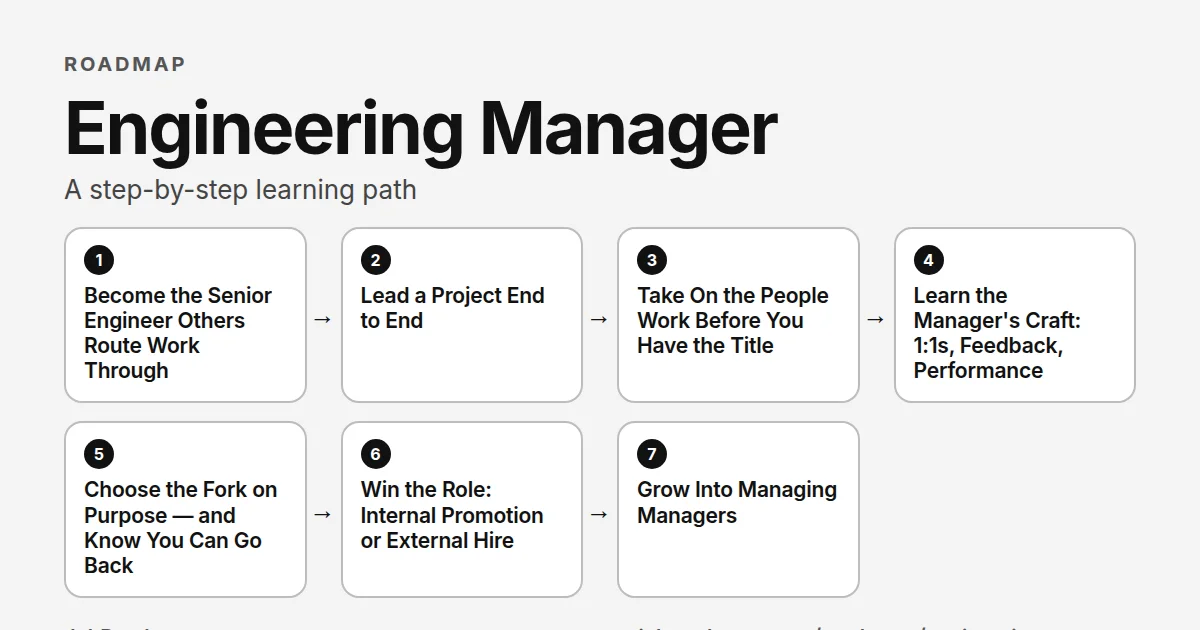
Engineering Manager learning path
Work down the line, one step at a time. Tick each skill as you can do it.
- 1
Become the Senior Engineer Others Route Work Through
OngoingManagers get picked from engineers the team already trusts. Own a system end to end, write the design docs, and review code so well that people ask for you on their changes. Read a public engineering ladder so you know what the next level actually asks for — and notice how much of it is people and process, not code.
Skills to learn
- Owning a production system
- Design docs & decision records
- Code review that teaches
- Reading an engineering ladder
- Writing clearly for non-authors
- Incident response & post-mortems
Start with
- 2
Lead a Project End to End
3–6 months per projectThe tech lead role is the audition. Take a project that needs more than one engineer and run it: scope it, break it into pieces people can own, sequence the risk, and write the status update nobody has to chase. You will find out fast whether unblocking others feels better or worse than writing the code yourself.
Skills to learn
- Scoping & breaking down work
- Estimation & sequencing risk
- Delegation without abdication
- Written status updates
- Cross-team dependencies
- Saying no to scope
Start with
- 3
Take On the People Work Before You Have the Title
6–12 months, alongside the day jobAsk to run the next new-hire onboarding. Sit on interview loops and write the debrief. Mentor someone a level below you and give them feedback that is specific enough to act on. This is the work managers do all day, and it is the cheapest evidence you can produce that you can do it.
Skills to learn
- Onboarding new engineers
- Interviewing & writing debriefs
- Mentoring & coaching
- Specific, actionable feedback
- Running a useful retro
- Noticing who is quietly stuck
Start with
- 4
Learn the Manager's Craft: 1:1s, Feedback, Performance
2–4 months of reading plus practiceNow study it on purpose. 1:1s that are for the report, not for you. Feedback that is direct and kind at the same time. Performance conversations you start early, before they are a surprise. Read while you practise, and ask a manager you respect to let you shadow how they prepare.
Skills to learn
- 1:1 structure & rhythm
- Direct feedback (radical candor)
- Setting expectations & goals
- Performance & underperformance
- Career conversations
- Difficult conversations
Start with
- 5
Choose the Fork on Purpose — and Know You Can Go Back
1–3 months to decide, 6–12 months to trialManagement is not a promotion above senior engineer; it is a different job on a parallel ladder. Before you commit, read the honest accounts of what you give up — hands-on craft, long uninterrupted hours — and what you gain. Ask for a trial (interim lead or a manager-in-training arrangement) so the decision comes from experience, not status. Moving back to IC afterwards is normal.
Skills to learn
- IC vs manager tradeoffs
- Career-ladder literacy
- Staying technical without coding all day
- Asking for a trial period
- Sponsorship from your manager
- Knowing your energy drains
Start with
- 6
Win the Role: Internal Promotion or External Hire
3–6 months of active search or promotion processInternally, you become the obvious candidate by already doing the work and by saying out loud that you want the role, so your manager can sponsor you. Externally, plan for interviews that probe people, delivery, and technical judgment — bring specific stories: a project you led, a hire you championed, a difficult conversation and what happened after. Prepare those stories in writing.
Skills to learn
- Behavioural interview stories
- Explaining technical judgment without coding
- Talking about failure honestly
- Reading a management job description
- Stakeholder communication
- Negotiating scope and team charter
Start with
- 7
Grow Into Managing Managers
OngoingOnce the first team runs, the next step changes again: you manage through other managers, own a planning cycle, and make trade-offs between teams. Delivery metrics, team structure, and hiring plans become the levers. Some people love this level; some discover the first-line job was their sweet spot — both are fine outcomes.
Skills to learn
- Managing managers
- Org design & team topologies
- Planning & prioritisation across teams
- Delivery metrics (DORA)
- Hiring plans & headcount trade-offs
- Communicating upward to executives
Start with
jobroadmaps.com/roadmaps/engineering-manager · Pay, demand and employer data for this role are further down the page.
Job Market Insights for Engineering Manager
Data-backed
What do employers actually ask for?
Read from live job postings — how often each credential is named, from rare to almost always.
"Computer Science background" is the most common credential named, yet it appears only rarely in what we could read. Postings that state it are the minority, but these counts are a floor, so do not read this as "no one asks".
Some postings say outright that equivalent experience or a self-taught route is accepted. That wording is worth reading closely when you see it.
Our read: a portfolio that proves the skill, and a referral from someone inside the company, usually carry more weight than a credential match on paper. That is judgement, not something these counts measure.
Requirement
How often named
Computer Science background
Equivalent experience accepted
PhD / doctorate
Master's degree
Our read: how often a credential is named is not how strictly it is enforced. Equivalent experience, a standout portfolio, or a referral often counts for more than the credential listed.
Data-backed
Which skills appear most in job postings?
Read from live job postings, ranked from most to least often named.
Postings for this role rarely list skills by name. The most-named, observability, is still only occasional, so none of these is a universal requirement.
Skill
How often named
observability
distributed systems
operational excellence
technical strategy
mentorship
security and compliance
performance management
cloud infrastructure
capacity planning
API design
deployment automation
team leadership
cross-functional collaboration
conflict resolution
Sorted by how often named · JobRoadmaps
Data-backed
Which tools and artifacts appear most in job postings?
Read from live job postings, ranked from most to least often named.
Claude is the most-named tool, but no tool is a universal requirement here.
Tool / Artifact
How often named
Claude
Stripe
GitLab
GitHub
Slack
Sorted by how often named · JobRoadmaps
Industry overlay
Targeting a specific industry?
The core roadmap gets you through the door anywhere. The difference between "qualified" and "they hired someone else" often lives in industry-specific context — the norms, the compliance floors, the tools assumed fluent in that sector.
Managing for reliability
When a system moves money, outages and incorrect state are high-stakes, so managers own incident follow-through and on-call health for their teams.
Working with risk, compliance, and legal
Regulated products mean planning around review cycles and constraints that engineers on an internal tool never meet.
Planning around dependencies
Financial products lean on partner systems and shared platforms, so delivery dates depend on teams the manager does not run.
Building careful engineering culture
Review, testing, and rollout discipline are set partly by the manager, who decides which shortcuts a team may and may not take.
Companies hiring:
StripeBrexRobinhoodHiring at speed
Fast-growing companies keep opening roles, so running interview loops, calibrating scorecards, and closing candidates is a large part of the manager job.
Managing through reorganisation
Teams split, merge, and change charters as these companies scale — keeping people focused through that is a standing skill, not an exception.
Translating between product and platform
Managers sit between customer-facing roadmaps and internal platform work and have to negotiate trade-offs between them.
Technical judgment on ambiguous work
Newer product areas have less settled practice, so managers are expected to weigh architecture and risk calls with their teams, not just track progress.
Companies hiring:
AnthropicOpenAICohereDatabricksTwilioOktaMongoDBIndustry premiums based on aggregated job posting data · Updated quarterly
Interactive
How ready are you right now?
Check the skills you already have to see your current job-market fit.
The most-named skill for this role is observability, so a gap there costs you the most. No single skill dominates, but each gap narrows which postings fit you. Check what you already have to see your biggest current gap.
Readiness Check
Check the skills you already have
0/5
base skills
Your biggest gap: observability, the most often named of the skills you have not ticked.
Start there, then work down the list.
Books worth reading as a Engineering Manager
Where to start, in order. The full list of 12, grouped by career stage, is on its own page.
Getting started

The Manager's Path
by Camille Fournier · 2017
~240 pages~6 hrs to read
Walks the engineering ladder from tech lead to CTO, with what each rung asks of you. Read it before or just after taking your first team, then reread as the role grows.
View book →
The Making of a Manager
by Julie Zhuo · 2019
~290 pages~7 hrs to read
A plain first-manager guide to 1:1s, feedback, hiring and growing a team, written from the author's own early mistakes. Good for new managers moving up from IC work.
View book →
Doing the job

High Output Management
by Andrew S. Grove · 1983
~240 pages~6 hrs to read
Grove's model of a manager's output as the output of the team around them. Useful for meeting design, delegation and performance reviews; the examples are dated but the logic holds.
View book →Radical Candor
by Kim Scott · 2017
A framework for giving direct feedback while still caring about the person. Helps managers handle hard performance conversations and build a habit of regular, honest feedback.
View book →
Senior and leading

An Elegant Puzzle
by Will Larson · 2019
~290 pages~7 hrs to read
Systems-thinking essays on sizing teams, org design, migrations, onboarding and engineering strategy. Suited to managers running several teams or moving into manager-of-managers work.
View book →
Team Topologies
by Matthew Skelton, Manuel Pais, Ruth Malan · 2019
~240 pages~6 hrs to read
Describes four team types and three interaction modes for organizing engineering teams around fast flow of change. Helps when you are drawing team boundaries or fixing ownership and handoff friction.
View book →
All 12 books for a Engineering Manager →Browse all books →
Some book links are affiliate links: we earn a small commission if you buy, at no cost to you. It does not affect what we list.
Prerequisites & Education
What credentials do employers look for?
These are the most common paths into this role — no single one is required.
Education Level
View list — coming soon- Bachelor's in computer science or a related field — the common baseline for the senior engineering work that comes first
- Bachelor's in another field plus years of strong engineering work — the record matters more than the diploma
- No degree — possible where the promotion is internal and the team can vouch for you
- MBA or a master's in management — optional; more relevant on the way to director-level business ownership than for a first manager role
No degree leads into this job directly. You are chosen on your engineering record and on how people describe working with you.
Certifications
View list — coming soon- Professional Scrum Master I (Scrum.org) — a signal of delivery-process vocabulary; optional
- Google Project Management Certificate (Coursera) — planning and stakeholder basics if you have never run a project formally
- Leading People and Teams Specialization (University of Michigan, Coursera) — structured coverage of leadership basics
- PMP (PMI) — relevant mainly where your organisation runs formal program governance
There is no certification that gates engineering management. Treat these as vocabulary and structure, not as qualifications — the job is decided on track record.
Bootcamps & Training
View list — coming soon- Wherewithall — manager training and one-on-one coaching aimed at managers in tech
- Radical Candor — feedback training and coaching
- Crucial Learning — Crucial Conversations courses for high-stakes and accountability conversations
- LeadDev — an engineering-leadership community with articles and events
Employer-paid training is the best value; the pay-out-of-pocket route is a book, a coach, and a peer group. Generic leadership seminars matter less than practising the actual conversations.
Portfolio & Other
View list — coming soon- A project you led that shipped — with the plan, the trade-offs you argued through, and what you would change
- An onboarding guide or checklist that new hires actually used
- Hiring-loop work — an interview rubric, scorecard, or debrief you wrote (sanitised)
- People who grew because of you, and colleagues willing to be references for how you lead
Managers do not have portfolios; they have reputations and references. The evidence is what your teammates and juniors say about working with you.
Your Roadmap
7 stepsBecome the Senior Engineer Others Route Work Through
OngoingManagers get picked from engineers the team already trusts. Own a system end to end, write the design docs, and review code so well that people ask for you on their changes. Read a public engineering ladder so you know what the next level actually asks for — and notice how much of it is people and process, not code.
Skills to learn
Lead a Project End to End
3–6 months per projectThe tech lead role is the audition. Take a project that needs more than one engineer and run it: scope it, break it into pieces people can own, sequence the risk, and write the status update nobody has to chase. You will find out fast whether unblocking others feels better or worse than writing the code yourself.
Skills to learn
Take On the People Work Before You Have the Title
6–12 months, alongside the day jobAsk to run the next new-hire onboarding. Sit on interview loops and write the debrief. Mentor someone a level below you and give them feedback that is specific enough to act on. This is the work managers do all day, and it is the cheapest evidence you can produce that you can do it.
Skills to learn
Learn the Manager's Craft: 1:1s, Feedback, Performance
2–4 months of reading plus practiceNow study it on purpose. 1:1s that are for the report, not for you. Feedback that is direct and kind at the same time. Performance conversations you start early, before they are a surprise. Read while you practise, and ask a manager you respect to let you shadow how they prepare.
Skills to learn
Choose the Fork on Purpose — and Know You Can Go Back
1–3 months to decide, 6–12 months to trialManagement is not a promotion above senior engineer; it is a different job on a parallel ladder. Before you commit, read the honest accounts of what you give up — hands-on craft, long uninterrupted hours — and what you gain. Ask for a trial (interim lead or a manager-in-training arrangement) so the decision comes from experience, not status. Moving back to IC afterwards is normal.
Skills to learn
Win the Role: Internal Promotion or External Hire
3–6 months of active search or promotion processInternally, you become the obvious candidate by already doing the work and by saying out loud that you want the role, so your manager can sponsor you. Externally, plan for interviews that probe people, delivery, and technical judgment — bring specific stories: a project you led, a hire you championed, a difficult conversation and what happened after. Prepare those stories in writing.
Skills to learn
Grow Into Managing Managers
OngoingOnce the first team runs, the next step changes again: you manage through other managers, own a planning cycle, and make trade-offs between teams. Delivery metrics, team structure, and hiring plans become the levers. Some people love this level; some discover the first-line job was their sweet spot — both are fine outcomes.
Skills to learn
Start here this week
This week: book 30 minutes with your manager and say plainly that you want to lead. Ask what they would need to see. Then pick one people task you can own this month — onboarding the next new hire, or joining an interview loop and writing the debrief. It costs nothing, and it turns "interested" into evidence they can point to when a seat opens.
For structure: lead one multi-person project end to end, take over onboarding and interviewing, and read The Manager's Path and Resilient Management alongside doing the work rather than after. Then ask for a formal trial — interim team lead, or a manager-in-training arrangement — and decide from the trial, not from the title. Going back to IC afterwards is a normal move, not a failure.
Pay
U.S. Department of Labor data for the nearest BLS occupation, Computer and information systems managers. BLS has no occupation for this exact title, so treat these as a benchmark.
Median: U.S. Bureau of Labor Statistics, Occupational Employment and Wage Statistics (median wage, May 2024) and Employment Projections (2024–34). No Level I–IV wages are published for this occupation in our tables.
Job Titles at Each Level
Entry
First-time Engineering Manager
Mid
Engineering Manager
Senior
Senior Engineering Manager / Director of Engineering
Steps Overview
- 1
Become the Senior Engineer Others Route Work Through
Ongoing
- 2
Lead a Project End to End
3–6 months per project
- 3
Take On the People Work Before You Have the Title
6–12 months, alongside the day job
- 4
Learn the Manager's Craft: 1:1s, Feedback, Performance
2–4 months of reading plus practice
- 5
Choose the Fork on Purpose — and Know You Can Go Back
1–3 months to decide, 6–12 months to trial
- 6
Win the Role: Internal Promotion or External Hire
3–6 months of active search or promotion process
- 7
Grow Into Managing Managers
Ongoing
Explore more roadmaps
Not sure this is the right path? Browse all tech career roadmaps.
View Similar RoadmapsBuilt a project while following this roadmap?
Turn it into a hiring-ready case study in 10 seconds — free.
Ready to explore more?
Browse all career roadmaps across tech, business, and creative fields.