Best books for Data Engineers
From pipelines to platforms. The opening books cover the discipline's lifecycle, SQL and a compact pipelines reference. The build set covers data modelling, orchestration, transformation with SQL, large-scale processing and event streaming. The lead set covers distributed data systems, streaming theory, decentralised data ownership and data quality.
12 books in 3 stages, about 3,800 pages (at least 95 hours of reading). The notes are ours, with no ratings or sales claims.
How to choose your books
A short method, so you read the right book for where you are instead of the longest list.
Find your stage
Getting started · 3 books
The lifecycle and the tools: how data moves from source to use, SQL and common pipeline patterns.
Jump to this stage ↓Doing the job · 5 books
Building pipelines: dimensional modelling, workflow orchestration, SQL transformations, batch processing and event streaming.
Jump to this stage ↓Senior and leading · 4 books
Systems and organisation: the theory behind distributed and streaming data, data ownership models and data quality.
Jump to this stage ↓
If you are unsure, start one stage lower than you think. Books in a later stage assume the working knowledge the earlier ones give you.
Begin with one book
Our starting pick
Fundamentals of Data Engineering
by Joe Reis, Matt Housley · 2022
It lays out the whole lifecycle (ingest, store, transform, serve), so each later tool book has a place to sit.
See the book ↓Then pick by your situation
Choose the next book by the problem in front of you, not by its place in the list.
If you are designing warehouse tables analysts will use
read The Data Warehouse Toolkit (doing the job)
If you are scheduling and monitoring pipelines
read Data Pipelines with Apache Airflow (doing the job)
If you need to reason about streaming and event data
read Streaming Systems (senior and leading)
Check it against what Data Engineer postings ask for
These skills come from our analysis of live Data Engineer job postings. If one is new to you, its book list sits one click away.
Each step on the scale reflects how often live job postings name the skill, tool or credential, based on our analysis of those postings.
Set a time budget
| Stage | Books | Pages | Reading | At 3 hrs a week |
|---|---|---|---|---|
| Getting started | 3 | ≥ 660 | ≥ 17 hrs | ≥ 6 wks |
| Doing the job | 5 | ≥ 1,760 | ≥ 44 hrs | ≥ 15 wks |
| Senior and leading | 4 | ≥ 1,380 | ≥ 35 hrs | ≥ 12 wks |
| All 3 stages | 12 | ≥ 3,800 | ≥ 95 hrs | ≥ 32 wks |
Treat this as a ceiling, not a target. Read one book at a time, apply it, then move on; read reference-style books in sections. Totals are approximate.
Judge any book before you buy it
Age
This list runs from 1996 (The Data Warehouse Toolkit) to 2023 (Analytics Engineering with SQL and dbt). Older books earn their place by teaching principles that do not change. For tools and platforms, buy the latest edition.
Level
Check the stage before the title. A book from a later stage will make sense only once you have faced the problems it solves.
Format
The longest book here, Designing Data-Intensive Applications, runs about 620 pages. Read very long books as references: pick the chapter that matches the problem you have.
Fit
Ask what you will do differently the week after you finish. If you cannot answer, the book is for a different moment. Come back to it when the situation arrives.
Getting started
The lifecycle and the tools: how data moves from source to use, SQL and common pipeline patterns.
 Start here
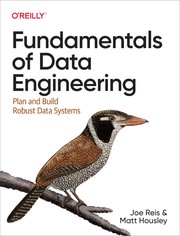
Fundamentals of Data Engineering
by Joe Reis, Matt Housley · 2022
Maps the data engineering lifecycle: generation, ingestion, storage, transformation and serving, plus security and orchestration. Read it first to get the whole field in view before choosing tools.
View book →
Learning SQL: Generate, Manipulate, and Retrieve Data
by Alan Beaulieu · 2005
~380 pages~10 hrs to read
Teaches queries, joins, grouping, subqueries and data modification from scratch with clear examples. SQL is the daily language of the job, so work through it early.
View book →
Data Pipelines Pocket Reference: Moving and Processing Data for Analytics
by James Densmore · 2021
~280 pages~7 hrs to read
A short guide to extracting, loading, transforming and orchestrating data with modern warehouses. A fast way to learn how typical ELT pipelines are structured before you build your first.
View book →
Doing the job
Building pipelines: dimensional modelling, workflow orchestration, SQL transformations, batch processing and event streaming.

The Data Warehouse Toolkit: The Definitive Guide to Dimensional Modeling, 3rd Edition
by Ralph Kimball, Margy Ross · 1996
~600 pages~15 hrs to read
The standard text on dimensional modelling: star schemas, fact and dimension tables, slowly changing dimensions and industry case studies. Read it once your pipelines work and you need to shape the data for analysts.
View book →
Data Pipelines with Apache Airflow
by Bas P. Harenslak, Julian Rutger de Ruiter · 2021
~330 pages~8 hrs to read
Covers writing, scheduling, testing and deploying workflows in Airflow, including custom components and cloud deployment. Read it when you start orchestrating pipelines for real.
View book →Analytics Engineering with SQL and dbt
by Rui Machado, Hélder Russa · 2023
Shows how to build modular, tested and documented transformations in the warehouse with dbt. Useful for mid-level engineers who sit between pipelines and analysts.
View book →Learning Spark: Lightning-Fast Data Analytics
by Jules S. Damji, Brooke Wenig, Tathagata Das, Denny Lee · 2015
~400 pages~10 hrs to read
Introduces Spark DataFrames, Spark SQL, structured streaming and performance tuning with Python and Scala examples. Read it when your data no longer fits a single machine.
View book →
Kafka: The Definitive Guide, 2nd Edition
by Gwen Shapira, Todd Palino, Rajini Sivaram, Krit Petty · 2017
~430 pages~11 hrs to read
Explains how Kafka producers, consumers, brokers and connectors work, and how to run them reliably. Read it when your pipelines move from nightly batches to event streams.
View book →
Senior and leading
Systems and organisation: the theory behind distributed and streaming data, data ownership models and data quality.

Designing Data-Intensive Applications
by Martin Kleppmann · 2017
~620 pages~16 hrs to read
Explains storage engines, replication, partitioning, transactions and stream and batch processing, and the trade-offs between them. Read it when you design the systems that data and models run on.
View book →
Streaming Systems: The What, Where, When, and How of Large-Scale Data Processing
by Tyler Akidau, Slava Chernyak, Reuven Lax · 2018
~350 pages~9 hrs to read
Builds the concepts behind stream processing: event time, windowing, watermarks and exactly-once semantics. Read it when you design or review real-time data systems.
View book →Data Mesh: Delivering Data-Driven Value at Scale
by Zhamak Dehghani · 2022
~410 pages~10 hrs to read
Lays out the data mesh approach: domain ownership, data as a product, a self-serve platform and federated governance. Read it when you are shaping a data platform across many teams.
View book →
Data Quality Fundamentals: A Practitioner's Guide to Building Trustworthy Data Pipelines
by Barr Moses, Lior Gavish, Molly Vorwerck · 2022
Covers how to measure, monitor and improve data quality across the pipeline, including observability, SLAs and incident handling. Read it when you own reliability and stakeholders have stopped trusting dashboards.
View book →
Book links go to Amazon and are affiliate links. As an Amazon Associate I earn from qualifying purchases.
Frequently asked questions
Which book should a Data Engineer read first?
Fundamentals of Data Engineering by Joe Reis, Matt Housley. It lays out the whole lifecycle (ingest, store, transform, serve), so each later tool book has a place to sit.
Do I need to read all 12 books?
No. The list is a menu, not a syllabus. Find your stage (getting started: 3, doing the job: 5, senior and leading: 4), begin with one book (we suggest Fundamentals of Data Engineering), then pick the next book by the problem you are facing at work. Come back to the others when the situation they cover arrives.
How long does it take to read these books?
The 9 books with a known page count add up to about 3,800 pages, roughly 95 hours at 1.5 minutes a page. At three hours a week that is about 32 weeks; at six hours a week, about 16. The list is meant to be read over time, one book at a time, not in one run.
Are these books up to date?
They range from 1996 (The Data Warehouse Toolkit) to 2023 (Analytics Engineering with SQL and dbt). Older titles are included because they teach principles that have not changed; for tools and platforms, we favour recent editions. Check the edition before you buy.
Related reading
Some links are affiliate links: we earn a small commission if you buy, at no cost to you. It does not change what we list.