Business Analyst Career Roadmap
Business analysis sits at the intersection of understanding what an organization needs and articulating it precisely enough that engineers can build it. It's requirements management, process modeling, stakeholder navigation, and the art of turning 'we want it to work better' into a specification someone can actually implement. The best BAs are organizational translators — fluent in both business logic and technical constraints, and deeply skeptical of both.
Is this the right path for you?
Business analysts come from operations, consulting, project management, finance, and accounting — any background where the work involved understanding how a business actually functions and documenting it clearly. The role is a common entry point into tech for people who don't have engineering backgrounds but can think systematically and communicate between technical and non-technical stakeholders.
If you find the gap between what a business says it needs and what it actually needs more interesting than either — if you're better at uncovering requirements than accepting them at face value — you're already thinking like a BA. The job is structured translation work: business problem in, technical requirements out, stakeholder consensus as the delivery mechanism.
BA is one of the more underrated entry paths into tech. The role is less credential-gated than most — a CBAP certification helps but isn't required, and domain knowledge often matters more than any credential. Companies at scale always need people who can translate between business and engineering, and the role creates natural exposure to both sides. Many PMs and technical leads started as BAs.
Career Progression
Where does this role lead?
Click any role to explore timeline, key skills and, where the Department of Labor publishes it, pay.
Entry
Junior Business Analyst
~1–2 yrs
$51,667 (Level I)
You're translating vague business requests into documented requirements. Learning to ask the right clarifying questions — and write them down precisely — is the foundational skill.
Key skills
Pay shown is the U.S. Department of Labor prevailing wage for Level I (entry), Level III (mid) and Level IV (senior) in the nearest BLS occupation, base wage for the typical metro, wage year 2025, shown for the main track only. It is a benchmark, not an offer; branches and lead, staff and executive stages have no official figure.
Visual roadmap
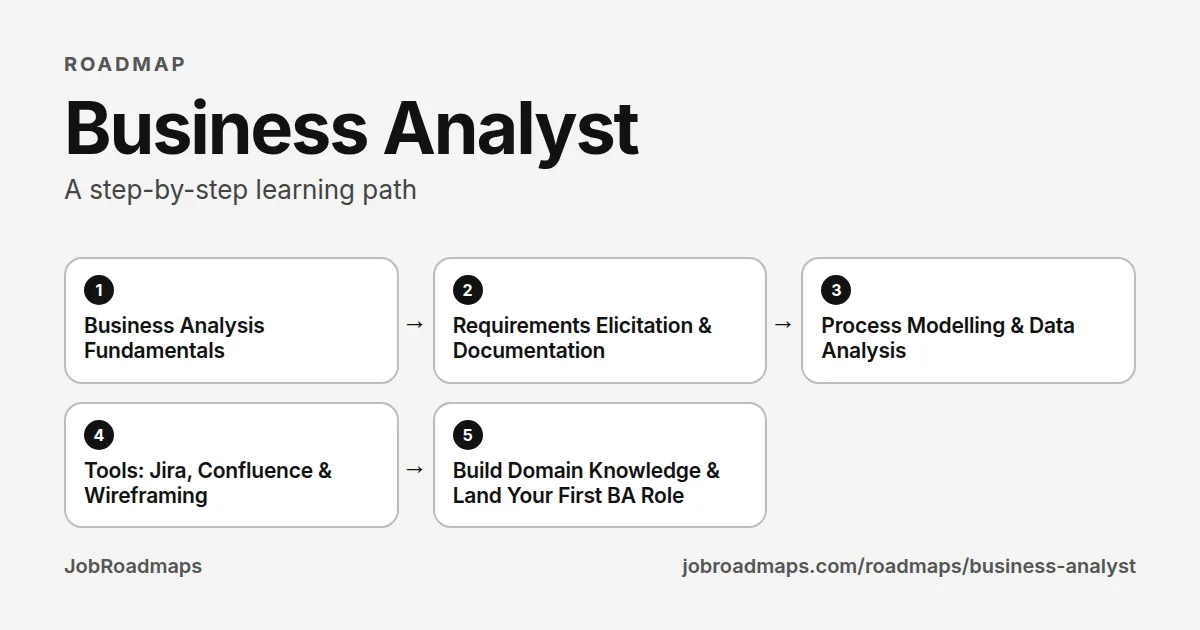
Business Analyst learning path
Work down the line, one step at a time. Tick each skill as you can do it.
- 1
Business Analysis Fundamentals
4–6 weeksLearn what BAs do: eliciting requirements, modelling processes, and managing stakeholders. Study the BABOK (Business Analysis Body of Knowledge) framework, Agile vs Waterfall methodologies, and how BAs fit within product and engineering teams.
Skills to learn
- BABOK Framework
- Agile & Scrum
- Waterfall / SDLC
- Stakeholder Identification
- Business Case Writing
- Project Lifecycle
Start with
- 2
Requirements Elicitation & Documentation
5–7 weeksMaster the core BA skill: extracting clear requirements from stakeholders through interviews, workshops, and observation. Write functional and non-functional requirements. Create user stories with acceptance criteria (BDD/Gherkin).
Skills to learn
- Stakeholder Interviews
- User Stories
- Acceptance Criteria
- BDD / Gherkin
- Functional Requirements
- Use Cases
Start with
- 3
Process Modelling & Data Analysis
5–7 weeksModel business processes with BPMN diagrams, swimlane flowcharts, and data flow diagrams. Learn SQL to query databases and validate data. Use Excel for data analysis, pivot tables, and communicating findings to stakeholders.
Skills to learn
- BPMN Process Modelling
- Data Flow Diagrams
- SQL
- Excel / Google Sheets
- Pivot Tables
- Visio / Lucidchart
Start with
- 4
Tools: Jira, Confluence & Wireframing
3–4 weeksGet proficient with the collaboration tools used in BA roles: Jira for backlog management, Confluence for documentation, and Balsamiq or Figma for low-fidelity wireframes. Understand how to write effective sprint tickets.
Skills to learn
- Jira
- Confluence
- Balsamiq / Figma Wireframes
- Backlog Management
- Sprint Planning
- Test Case Writing
Start with
- 5
Build Domain Knowledge & Land Your First BA Role
6–10 weeksDevelop domain expertise in a sector: finance, healthcare, e-commerce, or SaaS. Volunteer for BA tasks in current roles or contribute to open-source projects. Prepare a portfolio of requirements documents and process diagrams.
Skills to learn
- Domain Knowledge
- Portfolio Building
- BA Interview Prep
- Communication Skills
- Networking
- ECBA / CBAP Certification
Start with
jobroadmaps.com/roadmaps/business-analyst · Pay, demand and employer data for this role are further down the page.
Job Market Insights for Business Analyst
Data-backed
What do employers actually ask for?
Read from live job postings — how often each credential is named, from rare to almost always.
"Certification mentioned" is the most common credential named, yet it appears only rarely in what we could read. Postings that state it are the minority, but these counts are a floor, so do not read this as "no one asks".
Some postings say outright that equivalent experience or a self-taught route is accepted. That wording is worth reading closely when you see it.
Our read: a portfolio that proves the skill, and a referral from someone inside the company, usually carry more weight than a credential match on paper. That is judgement, not something these counts measure.
Requirement
How often named
Equivalent experience accepted
Certification mentioned
Our read: how often a credential is named is not how strictly it is enforced. Equivalent experience, a standout portfolio, or a referral often counts for more than the credential listed.
Data-backed
Which skills appear most in job postings?
Read from live job postings, ranked from most to least often named.
documentation is the most-named skill. Common, but not universal: many postings do not list it.
Past the fundamentals, 2 specialisation skills (documentation included) start separating candidates who can do the job from candidates who have done it. The 9 niche skills are named rarely enough that knowing them is upside, not prerequisite.
Skill
How often named
documentation
Salesforce
financial systems
Workday
revenue operations
quote to cash
process improvement
change management
lease accounting
Sorted by how often named · JobRoadmaps
Data-backed
Which tools and artifacts appear most in job postings?
Read from live job postings, ranked from most to least often named.
No tool dominates. The most-named, Looker, is still rare; postings for this role rarely list tools by name.
Tool / Artifact
How often named
Looker
Claude
Sorted by how often named · JobRoadmaps
Industry overlay
Targeting a specific industry?
The core roadmap gets you through the door anywhere. The difference between "qualified" and "they hired someone else" often lives in industry-specific context — the norms, the compliance floors, the tools assumed fluent in that sector.
Regulatory requirements gathering
New regulations (Basel III, Dodd-Frank, CFPB rules) arrive as legal text that analysts must translate into concrete system and process requirements before any engineering starts.
Risk and controls documentation
Financial institutions must document controls for every process change to satisfy internal audit and external examiners, making formal documentation a deliverable, not an afterthought.
Financial data reconciliation analysis
Analysts routinely investigate discrepancies between ledgers, statements, and source systems, requiring fluency in accounting logic most BA roles never touch.
SDLC within a regulated change-control process
Every requirement and change must pass through formal sign-off and audit trail steps before release, slowing and formalising the standard BA workflow.
Stakeholder management across compliance and legal
Requirements here are shaped as much by legal and compliance teams as by the business, requiring analysts to reconcile conflicting mandates from non-technical stakeholders.
Companies hiring:
JPMorgan ChaseCapital OneFidelityVisaAmerican ExpressERP/CRM implementation requirements
Rolling out Salesforce, Workday, or SAP to a large client means mapping the client's existing processes onto the platform's configuration options, a translation skill specific to enterprise software implementations.
Business process re-engineering (BPR)
Enterprise software rollouts routinely require clients to change how they work, not just what system they use, so analysts must justify and manage process change alongside system change.
Gap analysis against out-of-the-box configuration
Analysts must determine which client requirements the platform already supports versus what needs custom configuration or development, directly driving project cost and timeline.
User acceptance testing (UAT) coordination
Large implementations involve dozens of client stakeholders validating configured workflows before go-live, and analysts own designing and running that validation process.
Change management and end-user training
Enterprise software adoption fails without structured rollout communication and training, making change management a core analyst deliverable rather than a separate function.
Companies hiring:
SalesforceWorkdaySAPDeloitteServiceNowIndustry premiums based on aggregated job posting data · Updated quarterly
Interactive
How ready are you right now?
Check the skills you already have to see your current job-market fit.
The most-named skill for this role is documentation, so a gap there costs you the most. No single skill dominates, but each gap narrows which postings fit you. Check what you already have to see your biggest current gap.
Readiness Check
Check the skills you already have
0/5
base skills
Your biggest gap: documentation, the most often named of the skills you have not ticked.
Start there, then work down the list.
Books worth reading as a Business Analyst
Where to start, in order. The full list of 12, grouped by career stage, is on its own page.
Getting started

Software Requirements
by Karl Wiegers, Joy Beatty · 1999
~670 pages~17 hrs to read
The standard guide to eliciting, analyzing, specifying and managing requirements, with practices for both plan-driven and agile teams. Read it first and use it as a reference.
View book →
Writing Effective Use Cases
by Alistair Cockburn · 2000
~300 pages~8 hrs to read
Shows how to write use cases that capture goals, scenarios and exceptions without drowning in detail. Useful once you document system behavior for developers.
View book →
Doing the job

Mastering the Requirements Process: Getting Requirements Right
by Suzanne Robertson, James Robertson · 1999
~770 pages~19 hrs to read
A detailed requirements process with templates covering project scope, business events, use cases and quality attributes. Use it as a working reference on larger projects.
View book →
User Story Mapping: Discover the Whole Story, Build the Right Product
by Jeff Patton · 2014
~320 pages~8 hrs to read
Shows how to map a user's journey and slice it into releases. Useful for aligning stakeholders and agile teams on scope.
View book →
Senior and leading

How to Measure Anything: Finding the Value of Intangibles in Business
by Douglas W. Hubbard · 2007
~430 pages~11 hrs to read
Shows how to quantify uncertain things and estimate what more information is worth before spending on it. For analysts building business cases.
View book →
Data Science for Business: What You Need to Know About Data Mining and Data-Analytic Thinking
by Foster Provost, Tom Fawcett · 2013
~410 pages~10 hrs to read
Explains data-mining concepts and how to frame business problems as analytic ones. Read it when you scope analytics work with data teams.
View book →
All 12 books for a Business Analyst →Browse all books →
Some book links are affiliate links: we earn a small commission if you buy, at no cost to you. It does not affect what we list.
Prerequisites & Education
What credentials do employers look for?
These are the most common paths into this role — no single one is required.
Education Level
View list — coming soon- Bachelor's in Business Administration, Finance, Economics, or Information Systems
- Bachelor's in any quantitative discipline — strong analytical skills matter more than major
- MBA — accelerates path to senior BA or product owner roles at large enterprises
- Bachelor's in Computer Science or Engineering — valued for technical BA roles in software companies
BA roles vary widely — enterprise BA roles at large corporates favour business degrees and MBA credentials, while tech-company BA roles often value technical backgrounds and SQL skills more.
Certifications
View list — coming soon- CBAP (Certified Business Analysis Professional) — IIBA's gold-standard credential, required at many enterprises
- PMI-PBA (Professional in Business Analysis) — widely recognised alongside CBAP
- Entry Certificate in Business Analysis (ECBA) — entry-level IIBA cert for newcomers to the field
- Agile Analysis Certification (IIBA-AAC) — relevant for BA roles in agile software teams
CBAP requires 7,500 hours of BA experience to sit — it is a seniority signal, not an entry credential. ECBA is the appropriate starting point for career changers.
Bootcamps & Training
View list — coming soon- Udemy Business Analysis Fundamentals (Jeremy Aschenbrenner) — widely used BA prep course
- LinkedIn Learning Business Analyst career path — covers requirements, process modelling, and tools
- Coursera Business Analysis & Process Management (Macquarie University)
- IIBA endorsed education providers — verify on the IIBA website for recognised training
Formal BA training programs are less standardised than engineering bootcamps. Domain experience (healthcare, finance, e-commerce) and tool proficiency (SQL, Jira, Confluence) carry more weight.
Portfolio & Other
View list — coming soon- Business Requirements Document (BRD) or Functional Requirements Specification (FRS) sample
- Process flow diagrams (BPMN) documenting a workflow improvement or system integration
- SQL query portfolio demonstrating data extraction, reporting, and analysis capability
- Case study of a project: requirements gathered, stakeholders managed, outcome delivered
- Dashboard or data visualisation built in Tableau, Power BI, or Looker showing business insight
BAs rarely have a traditional portfolio — but sharing sanitised work samples (BRDs, process maps, dashboards) in interviews is highly effective. SQL and data skills are increasingly non-negotiable.
Your Roadmap
5 stepsBusiness Analysis Fundamentals
4–6 weeksLearn what BAs do: eliciting requirements, modelling processes, and managing stakeholders. Study the BABOK (Business Analysis Body of Knowledge) framework, Agile vs Waterfall methodologies, and how BAs fit within product and engineering teams.
Skills to learn
Requirements Elicitation & Documentation
5–7 weeksMaster the core BA skill: extracting clear requirements from stakeholders through interviews, workshops, and observation. Write functional and non-functional requirements. Create user stories with acceptance criteria (BDD/Gherkin).
Skills to learn
Process Modelling & Data Analysis
5–7 weeksModel business processes with BPMN diagrams, swimlane flowcharts, and data flow diagrams. Learn SQL to query databases and validate data. Use Excel for data analysis, pivot tables, and communicating findings to stakeholders.
Skills to learn
Tools: Jira, Confluence & Wireframing
3–4 weeksGet proficient with the collaboration tools used in BA roles: Jira for backlog management, Confluence for documentation, and Balsamiq or Figma for low-fidelity wireframes. Understand how to write effective sprint tickets.
Skills to learn
Build Domain Knowledge & Land Your First BA Role
6–10 weeksDevelop domain expertise in a sector: finance, healthcare, e-commerce, or SaaS. Volunteer for BA tasks in current roles or contribute to open-source projects. Prepare a portfolio of requirements documents and process diagrams.
Skills to learn
Start here this week
This week: document a process you know well — every step, every decision point, every exception to the rule. Then identify where the process breaks, where decisions are unclear, and where the people doing it disagree about the right answer. Present it in a BPMN diagram or a simple table. That is a BA deliverable. It's also your first portfolio piece.
For structured entry, the CBAP (Certified Business Analysis Professional) from IIBA is the field's primary credential, but it requires 7,500 hours of work experience — it's not a starting gun. The Entry Certificate in Business Analysis (ECBA) is the entry-level version and is achievable before your first role. PMI's PBA is also recognized and can be earned with less experience than the CBAP.
Pay
U.S. Department of Labor data for the nearest BLS occupation, Management analysts. BLS has no occupation for this exact title, so treat these as a benchmark.
Median: U.S. Bureau of Labor Statistics, Occupational Employment and Wage Statistics (median wage, May 2024) and Employment Projections (2024–34). Levels: U.S. Department of Labor Office of Foreign Labor Certification prevailing wage levels (wage year 2025, typical metro), a base-wage benchmark for the metro in the middle of 499 areas, not an offer. See every metro.
Job Titles at Each Level
Entry
Junior Business Analyst / Requirements Analyst
Mid
Business Analyst / Systems Analyst
Senior
Senior BA / Lead Business Analyst / BA Manager
Steps Overview
- 1
Business Analysis Fundamentals
4–6 weeks
- 2
Requirements Elicitation & Documentation
5–7 weeks
- 3
Process Modelling & Data Analysis
5–7 weeks
- 4
Tools: Jira, Confluence & Wireframing
3–4 weeks
- 5
Build Domain Knowledge & Land Your First BA Role
6–10 weeks
Explore more roadmaps
Not sure this is the right path? Browse all business career roadmaps.
View Similar RoadmapsBuilt a project while following this roadmap?
Turn it into a hiring-ready case study in 10 seconds — free.
Ready to explore more?
Browse all career roadmaps across tech, business, and creative fields.