AI Solutions Architect Career Roadmap
AI Solutions Architects design enterprise AI systems — selecting the right models, infrastructure, and integration patterns for business problems. They translate executive AI strategy into technical blueprints and work across data science, engineering, and product teams.
Is this the right path for you?
AI solutions architects come from solutions engineering, senior software architecture, and cloud architecture roles that have added AI to their scope. It's a senior path — most people arrive here after significant pre-sales technical experience or after years of building large-scale production systems. The role straddles business and technical domains deliberately.
If you think about what the AI system needs to accomplish for the business before you think about how to build it — if you find yourself wanting to design the data flow and the failure modes before selecting the model — you're already thinking like a solutions architect. The role rewards people who can translate business requirements into technical systems and back again.
One honest note: pre-sales AI demos and production AI architecture are very different things. Many 'AI solutions architect' roles at consultancies and vendors lean heavily on the demo side. The ones at enterprise software companies and hyperscalers actually require end-to-end system design literacy — compliance requirements, enterprise data handling, cost modeling, failure case analysis. Know which type you're targeting.
Career Progression
Where does this role lead?
Click any role to explore timeline, key skills and, where the Department of Labor publishes it, pay.
Entry
AI Engineer
~1–2 yrs
$57,990 (Level I)
You're building AI features and learning the patterns — RAG, tool use, agent workflows. Breadth across the AI stack matters more than depth in any one area at this stage.
Key skills
Pay shown is the U.S. Department of Labor prevailing wage for Level I (entry), Level III (mid) and Level IV (senior) in the nearest BLS occupation, base wage for the typical metro, wage year 2025, shown for the main track only. It is a benchmark, not an offer; branches and lead, staff and executive stages have no official figure.
Visual roadmap
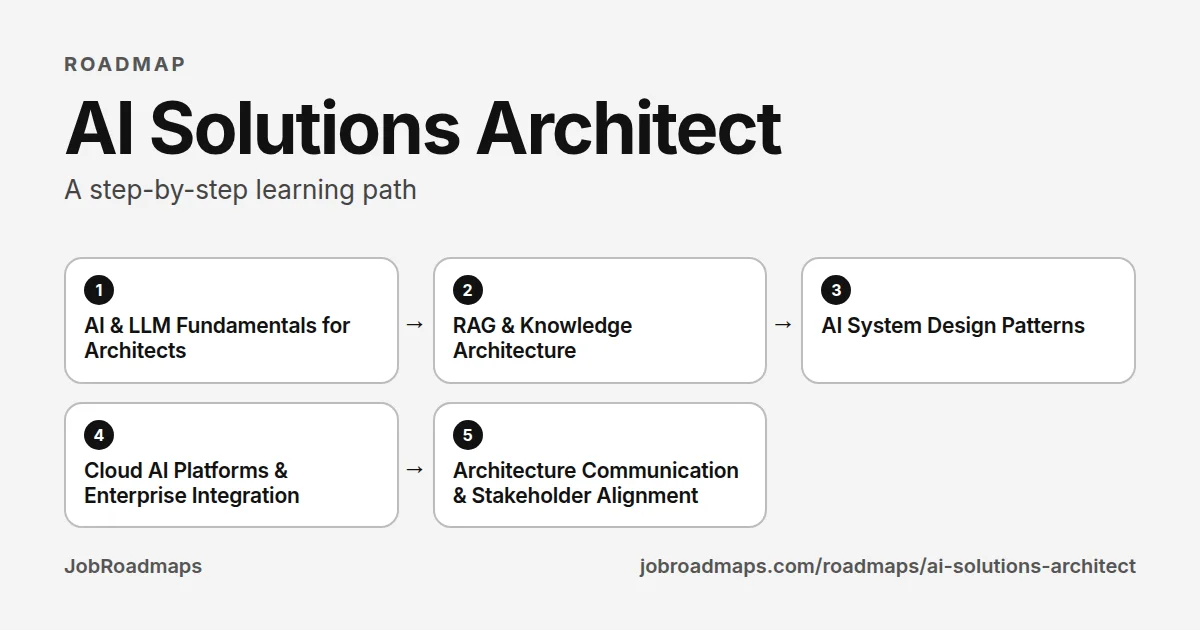
AI Solutions Architect learning path
Work down the line, one step at a time. Tick each skill as you can do it.
- 1
AI & LLM Fundamentals for Architects
4–6 weeksUnderstand how LLMs work at the architecture level — transformer attention, context windows, token costs, and model capability trade-offs. Learn the major model families (GPT-4, Claude, Gemini, Llama) and their pricing, rate limits, and enterprise agreements.
Skills to learn
- LLM Architecture
- Transformer Fundamentals
- Model Selection
- Token Cost Modelling
- Enterprise AI APIs
- Multimodal Models
- 2
RAG & Knowledge Architecture
6–8 weeksDesign enterprise RAG systems at scale: hybrid search (dense + sparse), reranking, multi-vector retrieval, and citation architectures. Learn vector database selection (Pinecone, Weaviate, Qdrant, pgvector) and index management for millions of documents.
Skills to learn
- Hybrid Search
- Reranking
- Vector Database Design
- Chunking Strategy
- Metadata Filtering
- Knowledge Graph Integration
- 3
AI System Design Patterns
6–8 weeksLearn canonical AI architecture patterns: multi-agent orchestration, tool-augmented LLMs, guardrail pipelines, and human-in-the-loop workflows. Study reliability patterns: fallback chains, circuit breakers for LLM calls, and graceful degradation.
Skills to learn
- Multi-Agent Architecture
- Guardrail Design
- Fallback Chains
- Caching Strategies
- Streaming Architecture
- Cost Governance
- 4
Cloud AI Platforms & Enterprise Integration
6–8 weeksMaster cloud AI services: Azure OpenAI Service, AWS Bedrock, Google Vertex AI. Understand enterprise integration patterns — SSO, VPC deployments, data residency, and SLA requirements. Design for compliance: GDPR, HIPAA, and SOC 2 in AI contexts.
Skills to learn
- Azure OpenAI Service
- AWS Bedrock
- Google Vertex AI
- Private VPC Deployments
- Data Residency
- Enterprise SLAs
- 5
Architecture Communication & Stakeholder Alignment
4–6 weeksDevelop the ability to write Architecture Decision Records (ADRs), present technical blueprints to executives, and run AI capability assessments. Learn to estimate ROI, build business cases for AI investments, and manage vendor relationships.
Skills to learn
- Architecture Decision Records
- Executive Communication
- AI ROI Modelling
- Vendor Assessment
- Technical Due Diligence
- Build vs Buy Frameworks
jobroadmaps.com/roadmaps/ai-solutions-architect · Pay, demand and employer data for this role are further down the page.
Job Market Insights for AI Solutions Architect
Data-backed
What do employers actually ask for?
Read from live job postings — how often each credential is named, from rare to almost always.
"Computer Science background" is the most common credential named, yet it appears only rarely in what we could read. Postings that state it are the minority, but these counts are a floor, so do not read this as "no one asks".
Some postings say outright that equivalent experience or a self-taught route is accepted. That wording is worth reading closely when you see it.
Our read: a portfolio that proves the skill, and a referral from someone inside the company, usually carry more weight than a credential match on paper. That is judgement, not something these counts measure.
Requirement
How often named
Equivalent experience accepted
Computer Science background
Bachelor's degree
Certification mentioned
Our read: how often a credential is named is not how strictly it is enforced. Equivalent experience, a standout portfolio, or a referral often counts for more than the credential listed.
Data-backed
Which skills appear most in job postings?
Read from live job postings, ranked from most to least often named.
Observability is the most-named skill. Common, but not universal: many postings do not list it.
Past the fundamentals, 1 specialisation skill (Observability included) start separating candidates who can do the job from candidates who have done it. The 19 niche skills are named rarely enough that knowing them is upside, not prerequisite.
Skill
How often named
Observability
Distributed systems
Evaluation frameworks
Fine-tuning
Security and governance
Large Language Models
API design
Context engineering
Retrieval-Augmented Generation
Agentic systems
Document intelligence
Application modernization
Workflow automation
Model governance
Sorted by how often named · JobRoadmaps
Data-backed
Which tools and artifacts appear most in job postings?
Read from live job postings, ranked from most to least often named.
Claude is the most-named tool, but no tool is a universal requirement here.
Tool / Artifact
How often named
Claude
MCP
Salesforce
GitHub
LangGraph
Stripe
Sorted by how often named · JobRoadmaps
Industry overlay
Targeting a specific industry?
The core roadmap gets you through the door anywhere. The difference between "qualified" and "they hired someone else" often lives in industry-specific context — the norms, the compliance floors, the tools assumed fluent in that sector.
Regulatory-compliant AI architecture
Architecture decisions must account for model explainability requirements, data residency, and audit log retention from the design stage.
Zero-trust AI security design
Financial AI systems handle sensitive PII — every component must be designed for least-privilege access and data minimisation.
Companies hiring:
StripeAdyenPlaidMarqetaUnitMulti-tenant AI system design
AI features in SaaS must handle thousands of tenants with data isolation, usage limits, and per-tenant model customisation.
AI feature flag architecture
Rolling out AI features requires careful feature flag design to manage rollbacks and A/B tests at tenant level.
Companies hiring:
SalesforceHubSpotNotionLinearIntercomIndustry premiums based on aggregated job posting data · Updated quarterly
Interactive
How ready are you right now?
Check the skills you already have to see your current job-market fit.
The most-named skill for this role is Observability, so a gap there costs you the most. No single skill dominates, but each gap narrows which postings fit you. Check what you already have to see your biggest current gap.
Readiness Check
Check the skills you already have
0/5
base skills
Your biggest gap: Observability, the most often named of the skills you have not ticked.
Start there, then work down the list.
Books worth reading as a AI Solutions Architect
Where to start, in order. The full list of 12, grouped by career stage, is on its own page.
Getting started

Fundamentals of Software Architecture
by Mark Richards, Neal Ford · 2020
~430 pages~11 hrs to read
Covers architecture characteristics, styles, trade-offs and how an architect works with teams. A foundation for the design side of the role.
View book →
Designing Data-Intensive Applications
by Martin Kleppmann · 2017
~620 pages~16 hrs to read
The standard reference on storage, replication, partitioning, transactions and stream processing. Read it once your AI features depend on databases and queues you have to reason about.
View book →
Doing the job

AI Engineering
by Chip Huyen · 2025
~350 pages~9 hrs to read
Covers building applications on foundation models: evaluation, prompting, RAG, finetuning, inference optimisation and the architecture around them. The closest thing to a textbook for the role; read it once you have shipped a first feature.
View book →
Designing Machine Learning Systems
by Chip Huyen · 2022
~390 pages~10 hrs to read
Covers data pipelines, feature engineering, deployment, monitoring and iteration for production ML. Read it when you own a system, not just a model, and need to reason about what breaks over time.
View book →
Senior and leading

The Software Architect Elevator
by Gregor Hohpe · 2020
~370 pages~9 hrs to read
About an architect moving between the engine room and the executive level, connecting technical decisions to business strategy. Read it when you start briefing leadership as well as designing systems.
View book →
The Pyramid Principle: Logic in Writing and Thinking
by Barbara Minto · 1987
~180 pages~5 hrs to read
A method for structuring an argument so the answer comes first and supporting points follow. Useful for architecture proposals and executive briefings.
View book →
All 12 books for a AI Solutions Architect →Browse all books →
Some book links are affiliate links: we earn a small commission if you buy, at no cost to you. It does not affect what we list.
Prerequisites & Education
What credentials do employers look for?
These are the most common paths into this role — no single one is required.
Education
View list — coming soon- BS/MS in Computer Science or Software Engineering — systems design and distributed computing fundamentals are essential
- BS in any engineering discipline with self-taught cloud and AI architecture skills
- DeepLearning.AI short courses (LLMs, RAG, agents) — accelerate the AI-specific knowledge layer
Most AI Solutions Architects come from senior engineering or cloud architecture backgrounds. A degree alone is far less important than hands-on architecture experience.
Certifications
View list — coming soon- AWS Solutions Architect Professional — the gold-standard cloud architecture cert for enterprise AI systems on AWS ($300)
- Google Cloud Professional Cloud Architect — essential for GCP-based AI systems; covers Vertex AI and enterprise AI patterns ($200)
- Google Cloud Generative AI Leader — validates leading gen AI initiatives on Google Cloud; covers Gemini Enterprise Agent Platform, Vertex AI, and responsible AI at the business level ($99)
- Azure Solutions Architect Expert — required for Azure OpenAI Service deployments in Microsoft enterprise environments ($165)
- Certified AI Governance Professional (AIGP, IAPP) — increasingly required for enterprise AI architecture roles ($550)
Holding at least one major cloud architecture cert is effectively required. Multi-cloud architects who hold two or three carry a meaningful salary premium.
Bootcamps & Self-Study Paths
View list — coming soon- DeepLearning.AI short course bundle — AI Agents in LangGraph, RAG, and Multi-Agent Systems are the directly relevant courses
- A Cloud Guru / Pluralsight cloud architecture paths — solid preparation for professional cloud certs
Short focused courses beat long programmes here. The role is experience-gated — a senior engineer who completes targeted AI courses is more hireable than a bootcamp grad.
Portfolio
View list — coming soon- Architecture Decision Records (ADRs) for 2–3 complex AI system designs with rationale and trade-offs
- Enterprise RAG system design with hybrid search, reranking, and multi-tenant isolation
- Multi-agent orchestration architecture with observability, cost controls, and fallback chains
- AI cost modelling spreadsheet showing latency/cost/quality trade-offs across model choices
AI Solutions Architects communicate in diagrams, not code. Build a portfolio with architecture diagrams, decision rationales, and business context. Show you can translate between engineering and executive language.
Your Roadmap
5 stepsAI & LLM Fundamentals for Architects
4–6 weeksUnderstand how LLMs work at the architecture level — transformer attention, context windows, token costs, and model capability trade-offs. Learn the major model families (GPT-4, Claude, Gemini, Llama) and their pricing, rate limits, and enterprise agreements.
Skills to learn
RAG & Knowledge Architecture
6–8 weeksDesign enterprise RAG systems at scale: hybrid search (dense + sparse), reranking, multi-vector retrieval, and citation architectures. Learn vector database selection (Pinecone, Weaviate, Qdrant, pgvector) and index management for millions of documents.
Skills to learn
AI System Design Patterns
6–8 weeksLearn canonical AI architecture patterns: multi-agent orchestration, tool-augmented LLMs, guardrail pipelines, and human-in-the-loop workflows. Study reliability patterns: fallback chains, circuit breakers for LLM calls, and graceful degradation.
Skills to learn
Cloud AI Platforms & Enterprise Integration
6–8 weeksMaster cloud AI services: Azure OpenAI Service, AWS Bedrock, Google Vertex AI. Understand enterprise integration patterns — SSO, VPC deployments, data residency, and SLA requirements. Design for compliance: GDPR, HIPAA, and SOC 2 in AI contexts.
Skills to learn
Architecture Communication & Stakeholder Alignment
4–6 weeksDevelop the ability to write Architecture Decision Records (ADRs), present technical blueprints to executives, and run AI capability assessments. Learn to estimate ROI, build business cases for AI investments, and manage vendor relationships.
Skills to learn
Start here this week
This week: architect on paper an AI system for one business problem you know well. Don't build it. Design it. Document the data flow from source to inference, the failure modes at each stage, the cost model under different load assumptions, and what you'd measure to know if it's working. That document is the deliverable the role produces.
For structured entry, the AWS Machine Learning Specialty certification is the most relevant credential for this path — it tests architectural reasoning about ML systems, not just implementation. Pair it with the Google Cloud Professional ML Engineer certification if you want multi-cloud credibility. Neither replaces demonstrated system design experience, but both signal literacy.
Pay
U.S. Department of Labor data for the nearest BLS occupation, Computer occupations, all other. BLS has no occupation for this exact title, so treat these as a benchmark.
Median: U.S. Bureau of Labor Statistics, Occupational Employment and Wage Statistics (median wage, May 2024) and Employment Projections (2024–34). Levels: U.S. Department of Labor Office of Foreign Labor Certification prevailing wage levels (wage year 2025, typical metro), a base-wage benchmark for the metro in the middle of 473 areas, not an offer. See every metro.
Job Titles at Each Level
Entry
AI Engineer / ML Engineer
Mid
AI Solutions Architect / AI Principal Engineer
Senior
Chief Architect / VP of AI Engineering
Steps Overview
- 1
AI & LLM Fundamentals for Architects
4–6 weeks
- 2
RAG & Knowledge Architecture
6–8 weeks
- 3
AI System Design Patterns
6–8 weeks
- 4
Cloud AI Platforms & Enterprise Integration
6–8 weeks
- 5
Architecture Communication & Stakeholder Alignment
4–6 weeks
Explore more roadmaps
Not sure this is the right path? Browse all tech career roadmaps.
View Similar RoadmapsBuilt a project while following this roadmap?
Turn it into a hiring-ready case study in 10 seconds — free.
Ready to explore more?
Browse all career roadmaps across tech, business, and creative fields.