AI Security & Red Teaming Specialist Career Roadmap
AI Security Specialists protect AI systems from adversarial attacks, prompt injections, data poisoning, and model theft. They run red team exercises on LLMs and AI agents, design safety evaluations, and advise organisations on secure AI deployment.
Is this the right path for you?
AI security specialists come from traditional security and red team backgrounds who've adapted to AI-specific attack surfaces, from ML engineers interested in adversarial robustness and model safety, and from researchers who found the attack surface of AI systems more interesting than capabilities. The field barely existed two years ago, which means most practitioners are self-trained.
If you find the ways AI systems can be manipulated more interesting than the ways they succeed — if prompt injection, jailbreaks, and adversarial examples are more compelling to you than benchmark performance — you're already thinking like an AI security specialist. The adversarial mindset that security requires applies directly here, with a different technical substrate.
This field is an early-mover opportunity, but the bar for 'expertise' is rising fast as the field matures. The people who define what AI security means in practice — who write the papers, build the tools, and establish the frameworks — are getting there now by building and publishing. Generic security credentials don't transfer automatically; AI-specific work is what distinguishes you.
Career Progression
Where does this role lead?
Click any role to explore timeline, key skills and, where the Department of Labor publishes it, pay.
Entry
AI Security Analyst
~1–2 yrs
$70,117 (Level I)
You're learning the AI attack surface — prompt injections, jailbreaks, and model misuse. A background in either cybersecurity or AI engineering helps; experience bridging both is rare and valuable.
Key skills
Pay shown is the U.S. Department of Labor prevailing wage for Level I (entry), Level III (mid) and Level IV (senior) in the nearest BLS occupation, base wage for the typical metro, wage year 2025, shown for the main track only. It is a benchmark, not an offer; branches and lead, staff and executive stages have no official figure.
Visual roadmap
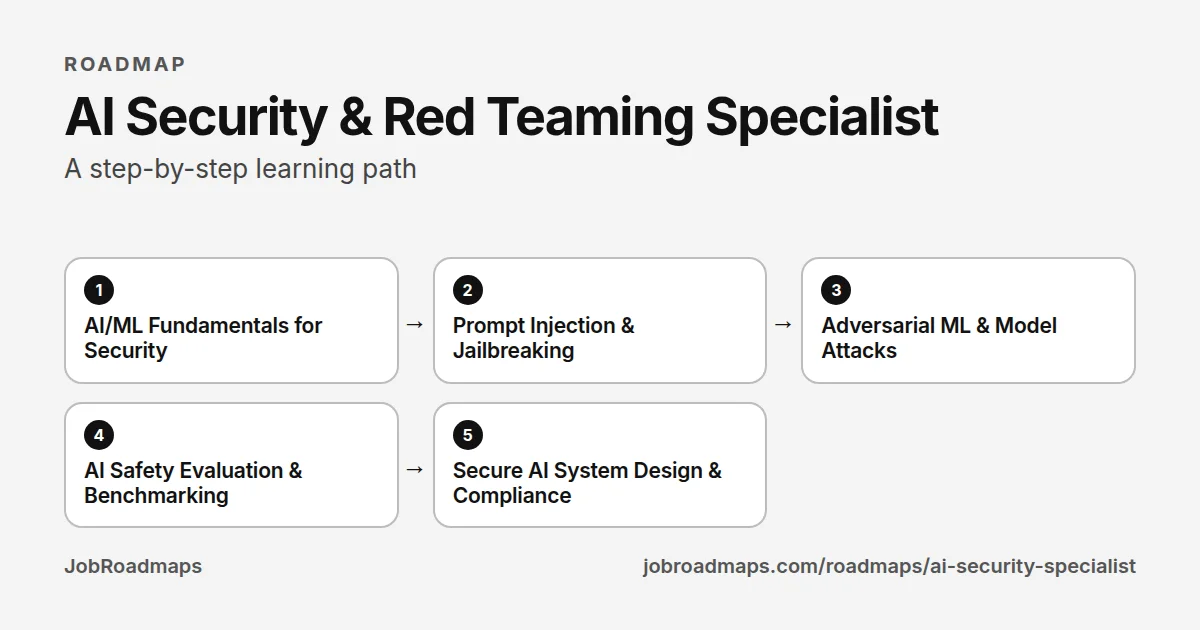
AI Security & Red Teaming Specialist learning path
Work down the line, one step at a time. Tick each skill as you can do it.
- 1
AI/ML Fundamentals for Security
4–6 weeksBuild the AI engineering foundation needed to attack and defend AI systems. Understand how LLMs process prompts, generate tokens, and how system prompts are structured. Learn RAG architectures and agent tool-use patterns — the attack surface comes from knowing the internals.
Skills to learn
- LLM Architecture
- Prompt Engineering
- RAG Systems
- Agent Tool Use
- Python
- API Security Basics
- 2
Prompt Injection & Jailbreaking
6–8 weeksMaster the taxonomy of LLM attacks: direct prompt injection, indirect prompt injection via RAG, jailbreaking, goal hijacking, and data exfiltration via prompts. Build a personal jailbreak library and contribute to open LLM evaluation benchmarks.
Skills to learn
- Prompt Injection
- Indirect Prompt Injection
- Jailbreaking Techniques
- Adversarial Prompts
- OWASP Top 10 for LLMs
- Red Teaming Methodology
- 3
Adversarial ML & Model Attacks
8–10 weeksStudy adversarial machine learning: evasion attacks, data poisoning, model extraction, and membership inference. Use libraries like ART (Adversarial Robustness Toolbox) and CleverHans. Understand defences: adversarial training, input preprocessing, and certified defences.
Skills to learn
- Adversarial Robustness Toolbox
- Evasion Attacks
- Data Poisoning
- Model Extraction
- Membership Inference
- Certified Defences
- 4
AI Safety Evaluation & Benchmarking
6–8 weeksBuild safety evaluation pipelines: create red-team datasets, measure harmful output rates, and track regressions across model versions. Learn evaluation frameworks: HELM, BIG-bench, TruthfulQA, and custom harm taxonomies used at AI labs.
Skills to learn
- Safety Benchmarking
- HELM / BIG-bench
- Harm Taxonomy Design
- Automated Red Teaming
- Human Evaluation
- Evaluation Pipeline Engineering
- 5
Secure AI System Design & Compliance
5–7 weeksDesign guardrails: input/output classifiers, content filtering, PII detection, and action sandboxing for agents. Understand AI security frameworks: NIST AI RMF, EU AI Act risk categories, and SOC 2 for AI. Write security review processes for AI feature launches.
Skills to learn
- Input/Output Classifiers
- PII Detection
- NIST AI RMF
- EU AI Act
- AI Governance Frameworks
- Security Review Processes
jobroadmaps.com/roadmaps/ai-security-specialist · Pay, demand and employer data for this role are further down the page.
Job Market Insights for AI Security & Red Teaming Specialist
Data-backed
Which skills appear most in job postings?
Read from live job postings, ranked from most to least often named.
Zero Trust is the most-named skill. Common, but not universal: many postings do not list it.
Past the fundamentals, 3 specialisation skills (Zero Trust included) start separating candidates who can do the job from candidates who have done it. The 16 niche skills are named rarely enough that knowing them is upside, not prerequisite.
Skill
How often named
Zero Trust
cloud security
SASE
security operations
incident response
threat detection
security automation
generative AI
Data Loss Prevention
endpoint security
vulnerability management
network security
identity and access management
privileged access management
retrieval augmented generation
software engineering
distributed systems
penetration testing
Sorted by how often named · JobRoadmaps
Data-backed
Which tools and artifacts appear most in job postings?
Read from live job postings, ranked from most to least often named.
No tool dominates. The most-named, CrowdStrike, is still rare; postings for this role rarely list tools by name.
Tool / Artifact
How often named
CrowdStrike
Sorted by how often named · JobRoadmaps
Industry overlay
Targeting a specific industry?
The core roadmap gets you through the door anywhere. The difference between "qualified" and "they hired someone else" often lives in industry-specific context — the norms, the compliance floors, the tools assumed fluent in that sector.
SASE
Vendors position AI protection inside cloud-delivered network security platforms.
Customer engagement
Specialist roles advise enterprise buyers on securing AI adoption.
Threat modeling
Product and engineering teams model adversarial AI threats for new detections.
Penetration testing
Offensive testing validates vendor products against adversarial AI attacks.
Companies hiring:
CloudflareHiddenLayerZscalerModel evaluation
Designing evals that surface failure modes is the primary research output.
AI safety
Red-teaming findings feed directly into model training and deployment decisions.
Program management
Coordinating research and engineering teams to run multi-stage red-team campaigns.
Companies hiring:
OpenAIIndustry premiums based on aggregated job posting data · Updated quarterly
Interactive
How ready are you right now?
Check the skills you already have to see your current job-market fit.
The most-named skill for this role is Zero Trust, so a gap there costs you the most. No single skill dominates, but each gap narrows which postings fit you. Check what you already have to see your biggest current gap.
Readiness Check
Check the skills you already have
0/5
base skills
Your biggest gap: Zero Trust, the most often named of the skills you have not ticked.
Start there, then work down the list.
Books worth reading as a AI Security & Red Teaming Specialist
Where to start, in order. The full list of 12, grouped by career stage, is on its own page.
Getting started

Hands-On Machine Learning with Scikit-Learn, Keras, and TensorFlow
by Aurélien Géron · 2017
~860 pages~22 hrs to read
A practical tour of classic machine learning and deep learning with working code. Read it first if you come from security and need to know how models are trained and where they can be manipulated.
View book →
Machine Learning and Security: Protecting Systems with Data and Algorithms
by Clarence Chio, David Freeman · 2018
~390 pages~10 hrs to read
Shows how machine learning is applied to security problems such as malware and fraud, and how attackers can target those models. A good bridge between the two fields.
View book →
Doing the job
Not with a Bug, But with a Sticker: Attacks on Machine Learning Systems and What to Do About Them
by Ram Shankar Siva Kumar, Hyrum Anderson · 2023
A readable survey of real attacks on machine learning systems and how organisations can respond, written by AI red team practitioners. A solid orientation before the technical texts.
View book →
Adversarial Machine Learning
by Anthony D. Joseph, Blaine Nelson, Benjamin I. P. Rubinstein, J. D. Tygar · 2019
~340 pages~9 hrs to read
An academic treatment of attacks on learning systems and the defences against them, including poisoning and evasion. Read it for the formal threat models behind the practical tools.
View book →
Senior and leading

Security Chaos Engineering: Sustaining Resilience in Software and Systems
by Kelly Shortridge, Aaron Rinehart · 2023
Argues for deliberately testing how systems behave under attack to build resilience instead of aiming for perfect prevention. Relevant to leaders planning red team programs and resilience exercises.
View book →
Human Compatible: Artificial Intelligence and the Problem of Control
by Stuart Russell · 2019
~340 pages~9 hrs to read
A non-technical argument about controlling increasingly capable AI systems. Gives senior practitioners vocabulary for safety discussions with executives and policymakers.
View book →
All 12 books for a AI Security & Red Teaming Specialist →Browse all books →
Some book links are affiliate links: we earn a small commission if you buy, at no cost to you. It does not affect what we list.
Prerequisites & Education
What credentials do employers look for?
These are the most common paths into this role — no single one is required.
Education
View list — coming soon- BS/MS in Computer Science or Cybersecurity — security fundamentals and reverse engineering directly applicable to AI red teaming
- Self-taught offensive security with CTF track record — many top AI security specialists are self-taught
- Background in ML engineering with added security training — common path for those transitioning into AI red teaming
This role sits at the intersection of AI and offensive security. Demonstrated exploitation skill (CTF wins, bug bounties) often outweighs formal education.
Certifications
View list — coming soon- EC-Council Certified Offensive AI Security Professional (COASP) — $650, purpose-built for AI security covering threat intelligence, AI/ML attack surfaces, and AI security architecture
- ISACA Advanced in AI Security Management (AAISM) — $50 exam fee, validates AI risk and security management for governance-focused roles; ISACA also offers AAIR (AI Risk) and AAIA (AI Audit)
- OSCP – Offensive Security Certified Professional — the most respected offensive security cert; proves you can actually exploit systems ($1,499)
- CEH – Certified Ethical Hacker — broader coverage; valuable at companies that prioritise formal credentials ($950)
- CompTIA Security+ — entry-level; useful for AI engineers adding security knowledge without prior security background ($392)
- GPEN – GIAC Penetration Tester — respected alternative to OSCP for penetration testing-focused roles ($949)
COASP and ISACA AAISM are the only credentials purpose-built for AI security. OSCP remains the gold standard for offensive security credibility. The $50 ISACA AAISM is the best value entry point.
Bootcamps & Self-Study Paths
View list — coming soon- TryHackMe / Hack The Box — platform-based offensive security training widely used in the community
- OWASP LLM Top 10 study + community contribution — the canonical AI security framework
- AI Village at DEF CON — community hub for AI security research and CTF competitions
The AI security community is small and active. DEF CON AI Village, HuggingFace security discussions, and the OWASP LLM working group are where the best practitioners gather.
Portfolio
View list — coming soon- Published jailbreak or prompt injection research (blog post, paper, or conference talk)
- Open-source AI red teaming tool or evaluation dataset with documented methodology
- CTF competition wins or write-ups demonstrating offensive security skill
- Bug bounty reports for AI systems or responsible disclosure CVEs
AI security is a community-driven field. Active participation on Twitter/X, publishing research, and contributing to OWASP LLM Top 10 discussions builds the reputation that leads to top roles at AI labs.
Your Roadmap
5 stepsAI/ML Fundamentals for Security
4–6 weeksBuild the AI engineering foundation needed to attack and defend AI systems. Understand how LLMs process prompts, generate tokens, and how system prompts are structured. Learn RAG architectures and agent tool-use patterns — the attack surface comes from knowing the internals.
Skills to learn
Prompt Injection & Jailbreaking
6–8 weeksMaster the taxonomy of LLM attacks: direct prompt injection, indirect prompt injection via RAG, jailbreaking, goal hijacking, and data exfiltration via prompts. Build a personal jailbreak library and contribute to open LLM evaluation benchmarks.
Skills to learn
Adversarial ML & Model Attacks
8–10 weeksStudy adversarial machine learning: evasion attacks, data poisoning, model extraction, and membership inference. Use libraries like ART (Adversarial Robustness Toolbox) and CleverHans. Understand defences: adversarial training, input preprocessing, and certified defences.
Skills to learn
AI Safety Evaluation & Benchmarking
6–8 weeksBuild safety evaluation pipelines: create red-team datasets, measure harmful output rates, and track regressions across model versions. Learn evaluation frameworks: HELM, BIG-bench, TruthfulQA, and custom harm taxonomies used at AI labs.
Skills to learn
Secure AI System Design & Compliance
5–7 weeksDesign guardrails: input/output classifiers, content filtering, PII detection, and action sandboxing for agents. Understand AI security frameworks: NIST AI RMF, EU AI Act risk categories, and SOC 2 for AI. Write security review processes for AI feature launches.
Skills to learn
Start here this week
This week: set up a local model (Ollama with any open-source LLM works), attempt five distinct jailbreaks using different attack vectors (prompt injection, role confusion, indirect injection, context manipulation, encoding tricks), document what worked and why, and write up the vectors as a simple red team report. That's your first AI security artifact.
For structured entry, OWASP's LLM Top 10 is the current reference framework for AI security vulnerabilities. The Adversarial Robustness Toolbox (ART) from IBM is the primary library for testing model robustness. MLCommons AI Safety benchmarks are the emerging evaluation standard. Read all three and understand what they test — the combination defines the field's current scope.
Pay
U.S. Department of Labor data for the nearest BLS occupation, Information security analysts. BLS has no occupation for this exact title, so treat these as a benchmark.
Median: U.S. Bureau of Labor Statistics, Occupational Employment and Wage Statistics (median wage, May 2024) and Employment Projections (2024–34). Levels: U.S. Department of Labor Office of Foreign Labor Certification prevailing wage levels (wage year 2025, typical metro), a base-wage benchmark for the metro in the middle of 303 areas, not an offer. See every metro.
Job Titles at Each Level
Entry
AI Security Engineer / ML Security Engineer
Mid
AI Red Teamer / AI Safety Engineer
Senior
Principal AI Security Researcher / Head of AI Red Team
Steps Overview
- 1
AI/ML Fundamentals for Security
4–6 weeks
- 2
Prompt Injection & Jailbreaking
6–8 weeks
- 3
Adversarial ML & Model Attacks
8–10 weeks
- 4
AI Safety Evaluation & Benchmarking
6–8 weeks
- 5
Secure AI System Design & Compliance
5–7 weeks
Explore more roadmaps
Not sure this is the right path? Browse all tech career roadmaps.
View Similar RoadmapsBuilt a project while following this roadmap?
Turn it into a hiring-ready case study in 10 seconds — free.
Ready to explore more?
Browse all career roadmaps across tech, business, and creative fields.