Account Executive Career Roadmap
An account executive owns the deal: you find out why a company would spend money, prove your product is the way to do it, get the right people to agree, and close it. In B2B software that means quota, a pipeline you are personally accountable for, and a forecast your manager repeats to the CFO. It is a numbers job wearing a conversation job's clothes. The work is discovery, qualification, demos, negotiation, and unglamorous CRM upkeep. It is also rarely a first job: most people arrive through a sales development or customer-facing role, not straight into the AE seat.
Is this the right path for you?
Almost nobody starts as an AE. In the live job postings we track, 846 have "account executive" in the title across 57 companies, and only 3 carry entry-level words like associate, junior or entry. The realistic routes in are sales development (SDR/BDR) then promotion or an external AE move, customer success or support at a software company, or a technical role such as sales or solutions engineering that moves toward quota. Career changers with a sales record in another industry sometimes skip a rung, but expect to prove you can sell software.
The temperament is specific. You tolerate rejection without taking it personally, you are curious about how other businesses make and lose money, and you are honest enough to tell a buyer, and your manager, that a deal is not real. You like being measured against a number. People who want predictable hours and a job that finishes when the task does tend to struggle. So do people who need every conversation to be warm.
Honest note: this is not a beginner-friendly title, and the market shape matters. Our postings come from roughly a hundred tech-company job boards, skewed to AI, infrastructure and SaaS scale-ups, so they show how those employers hire and not every sales market. In them, 135 titles carry senior words, 287 say Enterprise and 150 say Strategic, against 104 for Commercial, Mid-Market or SMB. The mid and upper rungs dominate, the entry-level rung is thin, and the ladder assumes you have already closed something.
Career Progression
Where does this role lead?
Click any role to explore timeline, key skills and, where the Department of Labor publishes it, pay.
Entry
Sales Development Rep
~1–2 yrs
You book the meetings AEs run. This is the usual proving ground: the record you build here (qualified meetings, quality of handoffs, coachability) is what gets you the AE conversation.
Key skills
What the postings say you’ll do
Lines copied word for word from live Account Executive postings we track, read September 30, 2026. They show how employers word the job, not what every Account Executive does. Postings change and expire.
“Strategically prospect into Chief Technology Officers, Engineering/IT Leaders, and technical end-users”
“Apply effective discovery and value-selling techniques to build and strengthen relationships with key decision-makers in both new and existing customers (5000+ FTEs)”
“Deliver product presentations and demos to potential customers, showcasing a range of solutions that provide maximum benefit to the customer.”
“Partner with our Solution Architects and work closely with the Professional Services team to achieve customer satisfaction”
“Own the full sales cycle, from business case development, to deal structuring and negotiating, to close”
“Assess your existing customers and develop a strategy to identify and engage all buying centres”
“Consistently communicate account health, pipeline, and forecast accuracy using Salesforce, Clari, and related tools”
Who is hiring right now
Drawn from live postings across many employers today. Employers with live postings we tag to this roadmap, counted today. The sample is about a hundred tech-company job boards, tilted toward AI, data and infrastructure companies, so agencies, consultancies and most non-tech employers are not represented.
| Employer | Live postings | Early-career titles | Most common title |
|---|---|---|---|
| Toast | 191 | 0 | Bilingual Strategic Cuisines Flex Account Executive (Spanish) |
| Anthropic | 106 | 0 | Account Executive, Startups |
| Cloudflare | 100 | 0 | Digital Natives Account Executive |
| Stripe | 99 | 0 | Account Executive, Product - Local Payment Methods |
| Databricks | 82 | 0 | Strategic Core Account Executive |
| Zscaler | 75 | 0 | Account Executive, Enterprise |
| Datadog | 67 | 0 | Strategic Account Executive |
| Braze | 66 | 0 | Account Executive, Enterprise |
| Block | 57 | 0 | Mid-Market Account Executive, Commerce |
| Elastic | 54 | 0 | Enterprise Account Executive |
| MongoDB | 54 | 1 | Enterprise Account Executive, Growth |
| Verkada | 46 | 0 | Account Executive, Territory (Mid-Market) |
“Early-career titles” are roles whose title signals an entry-level or new-graduate position. Top 12 of 111 employers shown.
Look-alike roles, compared
Neighbouring titles read very differently once you open the posting. One line from a real posting for each, with how many live postings we track under that title and how many carry early-career wording.
Account Executive
1,916 live postings · 111 employers · 14 with early-career wording
“Create and manage a pipeline of Enterprise accounts to consistently meet or exceed quarterly and annual sales targets”
Figma · Account Executive, Enterprise posting
Account Manager
247 live postings · 50 employers · 9 with early-career wording
“Successfully manage the end-to-end renewal process required to hit or exceed team renewal targets/quotas, leveraging your product knowledge to efficiently meet customers needs.”
Hootsuite · Account Manager, Scale posting
Customer Success Manager
339 live postings · 59 employers · 12 with early-career wording
“own NRR for your book: identify expansion opportunities, lead renewal conversations, and partner with AEs on upsells and cross-sells”
Composio · Founding Customer Success Manager posting
Sales Development Rep
362 live postings · 83 employers · 18 with early-career wording
“Achieve and exceed monthly goals for generating new business opportunities to fuel the sales pipeline.”
Twilio · Sales Development Representative posting
Quotes read September 30, 2026, from the live postings we track.
Visual roadmap
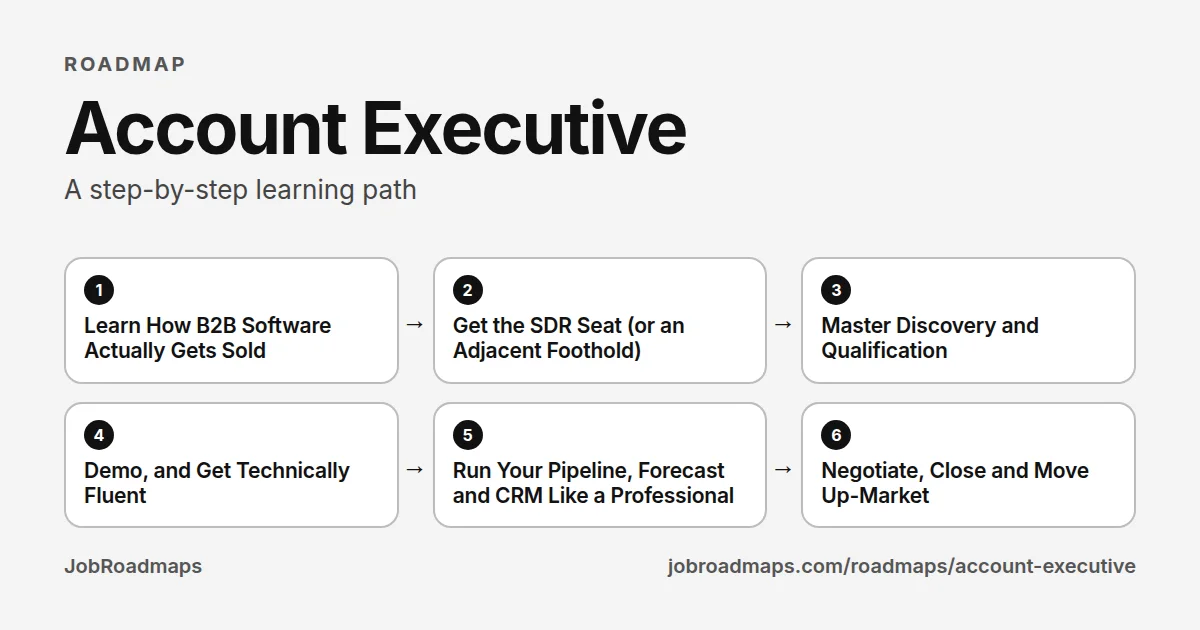
Account Executive learning path
Work down the line, one step at a time. Tick each skill as you can do it.
- 1
Learn How B2B Software Actually Gets Sold
2–4 weeksBefore you pick up a phone, learn the machine. A software deal passes through an SDR who books the meeting, an AE who runs the cycle, often a sales engineer who handles the technical proof, and later a customer success manager who keeps the account. Know what each role is measured on, what a stage in the pipeline means, and why buyers rarely sign without a business case. HubSpot's free inbound sales course and Salesforce's certification prep guide cover the vocabulary in an afternoon.
Skills to learn
- Sales funnel and pipeline stages
- SDR, AE, SE and CSM role split
- Buyer personas and buying committees
- SaaS business model basics
- CRM basics
- Sales cycle and deal stages
Start with
- 2
Get the SDR Seat (or an Adjacent Foothold)
3–6 months to land, then a year or more in seatThis is the step most roadmaps skip and most AEs actually took. In the live job postings we track, almost nothing is titled entry-level, so the door is a sales development role (SDR/BDR) where you book meetings for AEs, or a customer success, support or technical role that puts you next to buyers. Learn to prospect: cold email, calls, research, sequences, objection handling. Expect rejection to be the daily texture. A visible run of qualified meetings is what earns the AE promotion or the AE interview.
Skills to learn
- Outbound prospecting
- Cold calling and email
- Account research
- Objection handling
- Sequencing and cadence tools
- Meeting qualification
- Activity discipline and self-management
Start with
- 3
Master Discovery and Qualification
2–3 months, then for the rest of your careerDeals die in discovery. The skill is asking questions that surface a real problem, a cost of leaving it unsolved, and who controls the budget, then being willing to walk away from deals that lack all three. Learn the named frameworks and use them as checklists, not scripts: MEDDICC (metrics, economic buyer, decision criteria, decision process, pain, champion, competition, with MEDDPICC adding paper process), SPIN questioning from Neil Rackham, and the Challenger approach of teaching the buyer something new. Score every open deal against MEDDICC honestly. Gaps are the point.
Skills to learn
- Discovery call structure
- MEDDICC / MEDDPICC qualification
- SPIN questioning
- Challenger-style commercial teaching
- Champion building
- Economic buyer access
- Mutual action plans
Start with
- 4
Demo, and Get Technically Fluent
6–10 weeksMany of the companies in our postings sell to engineers, data teams and security buyers. You do not need to code, but you need to hold a conversation about APIs, cloud hosting and data without bluffing. A good demo is built backwards from the pain you found in discovery, not a feature tour. Learn to bring in a sales engineer for the technical proof and to keep the commercial thread while they do. Cloud fundamentals credentials are aimed at exactly this business-side audience.
Skills to learn
- Discovery-led demo design
- Working with a sales engineer
- Cloud and API literacy
- Security and procurement questionnaires
- Competitive positioning
- Storytelling with customer proof
Start with
- 5
Run Your Pipeline, Forecast and CRM Like a Professional
4–8 weeks, then continuousA rep with a messy CRM has a messy forecast, and managers stop trusting both. Learn stage definitions with clear exit criteria, how to size and inspect your pipeline, and how to call a deal commit, best case or pipeline without wishful thinking. Practise in a free CRM with your own mock deals. Basic spreadsheet skills still matter for quota math, coverage and territory planning.
Skills to learn
- Pipeline management
- Forecast categories and calls
- CRM hygiene
- Quota and coverage math
- Territory and account planning
- Spreadsheet modelling
- Deal inspection habits
Start with
- 6
Negotiate, Close and Move Up-Market
OngoingClosing is mostly the sum of what you did earlier. Negotiation is the rest: separating price from value, handling procurement and legal, and holding a position without burning the champion. Then the ladder. SMB deals are short and high-volume; mid-market adds multiple stakeholders; enterprise and strategic deals run long, involve committees and demand account planning. Our live postings are heavy on Enterprise and Strategic titles, so plan the move up deliberately: bigger accounts, longer cycles, more people to win over.
Skills to learn
- Negotiation and concessions strategy
- Procurement and legal navigation
- Multi-threading accounts
- Executive communication
- Long-cycle deal management
- Account planning for named accounts
Start with
jobroadmaps.com/roadmaps/account-executive · Pay, demand and employer data for this role are further down the page.
Job Market Insights for Account Executive
Data-backed
What do employers actually ask for?
Read from live job postings — how often each credential is named, from rare to almost always.
"Bachelor's degree" is the most common credential named, yet it appears only rarely in what we could read. Postings that state it are the minority, but these counts are a floor, so do not read this as "no one asks".
Some postings say outright that equivalent experience or a self-taught route is accepted. That wording is worth reading closely when you see it.
Our read: a portfolio that proves the skill, and a referral from someone inside the company, usually carry more weight than a credential match on paper. That is judgement, not something these counts measure.
Requirement
How often named
Bachelor's degree
Equivalent experience accepted
Our read: how often a credential is named is not how strictly it is enforced. Equivalent experience, a standout portfolio, or a referral often counts for more than the credential listed.
Data-backed
Which skills appear most in job postings?
Read from live job postings, ranked from most to least often named.
prospecting is the most-named skill. Common, but not universal: many postings do not list it.
Past the fundamentals, 1 specialisation skill (prospecting included) start separating candidates who can do the job from candidates who have done it. The 19 niche skills are named rarely enough that knowing them is upside, not prerequisite.
Skill
How often named
prospecting
collaboration
consultative sales
discovery
forecasting
value proposition
pipeline management
sales methodology
account planning
relationship building
communication skills
executive presence
full cycle sales
net new logo acquisition
quota attainment
technical fluency
business acumen
product expertise
solution selling
account expansion
Sorted by how often named · JobRoadmaps
Data-backed
Which tools and artifacts appear most in job postings?
Read from live job postings, ranked from most to least often named.
Salesforce is the most-named tool, but no tool is a universal requirement here.
Industry overlay
Targeting a specific industry?
The core roadmap gets you through the door anywhere. The difference between "qualified" and "they hired someone else" often lives in industry-specific context — the norms, the compliance floors, the tools assumed fluent in that sector.
Qualification frameworks (MEDDICC-style)
Subscription deals live or die on whether you have a champion, an economic buyer and a defined process. Frameworks like MEDDICC turn that into a checklist managers inspect.
Product-led motion awareness
Many SaaS products are tried by individuals or small teams before a sale. Reps often convert existing usage into a larger contract, so reading usage and expansion signals matters.
Multi-threading a buying committee
A single champion is a risk. Deals need contact across the team that uses the product, the budget owner and often IT or security.
Security and procurement navigation
Identity, design and analytics tools touch company data, so security reviews and vendor questionnaires are a normal step before signature.
Companies hiring:
FigmaOktaIntercomMixpanelElevenLabsSelling to finance and engineering together
Payment and finance products usually have a finance buyer and a technical implementer. Winning means speaking to both in one deal.
Regulatory and risk literacy
Prospects ask about compliance, data handling and risk early. You do not need to be a lawyer, but you need to know when to bring in legal or a specialist.
Business-case and ROI modelling
Financial products are bought on measurable cost or revenue impact, so buyers expect a numbers-based case, not a feature list.
Long-cycle stakeholder management
Replacing payments or finance systems touches many teams, which stretches timelines and raises the cost of a stalled champion.
Companies hiring:
StripeBrexIndustry premiums based on aggregated job posting data · Updated quarterly
Interactive
How ready are you right now?
Check the skills you already have to see your current job-market fit.
The most-named skill for this role is prospecting, so a gap there costs you the most. No single skill dominates, but each gap narrows which postings fit you. Check what you already have to see your biggest current gap.
Readiness Check
Check the skills you already have
0/5
base skills
Your biggest gap: prospecting, the most often named of the skills you have not ticked.
Start there, then work down the list.
Books worth reading as a Account Executive
Where to start, in order. The full list of 10, grouped by career stage, is on its own page.
Getting started

SPIN Selling
by Neil Rackham · 1988
~200 pages~5 hrs to read
Built on research into large B2B sales calls, it teaches the Situation, Problem, Implication and Need-payoff question sequence. A strong base for running discovery before you pitch.
View book →
Fanatical Prospecting
by Jeb Blount · 2015
~290 pages~7 hrs to read
Covers prospecting cadence, phone, email and social outreach, and protecting daily time for pipeline work. Useful for new AEs who must source part of their own pipeline.
View book →
Doing the job

Never Split the Difference
by Chris Voss, Tahl Raz · 2016
~290 pages~7 hrs to read
A former FBI hostage negotiator explains calibrated questions, labeling and tactical empathy. AEs can apply it to pricing, procurement pushback and late-stage discount requests.
View book →
The Challenger Sale
by Matthew Dixon, Brent Adamson · 2011
~220 pages~6 hrs to read
Draws on rep-performance research to describe teaching, tailoring and taking control of the conversation. Read it when moving from relationship selling to leading customers with insight.
View book →
Senior and leading

The New Strategic Selling
by Robert B. Miller, Stephen E. Heiman, Tad Tuleja · 1985
~430 pages~11 hrs to read
Gives a framework for mapping the buying influences, competitive position and red flags in a complex account. Suited to enterprise AEs managing multi-stakeholder deals with long cycles.
View book →
All 10 books for a Account Executive →Browse all books →
Some book links are affiliate links: we earn a small commission if you buy, at no cost to you. It does not affect what we list.
Prerequisites & Education
What credentials do employers look for?
These are the most common paths into this role — no single one is required.
Education Level
View list — coming soon- Bachelor's in business, marketing, communications or any field — sales hiring is not tied to a specific major
- Degree from a university with a dedicated sales program or sales center — the University Sales Center Alliance lists member institutions
- Technical degree or background — useful when the product is sold to developers, data teams or security buyers
- No degree — a sales development or customer-facing record at a software company is the path many people take instead
Sales is judged on results, not transcripts. Read the requirements on the specific postings you want; the credential that matters most is a documented record of qualified pipeline and closed deals.
Certifications
View list — coming soon- Salesforce Certified Agentforce Sales Foundations — Salesforce's sales-process credential, covering planning, customer engagement, deal, pipeline and forecasting topics
- HubSpot Academy Inbound Sales Certification — free, short, and a fast way to learn the vocabulary
- MEDDPICC certification via the MEDDICC.com Masterclass — signals fluency in a qualification framework many B2B teams use
- AWS Certified Cloud Practitioner or Google Cloud Cloud Digital Leader — foundational cloud credentials aimed at business-side roles, useful for technical selling
None of these is a licence to sell, and none replaces a quota-attainment record. Use them to learn a framework and to show initiative early in your career; do not stack them as a substitute for real deals.
Bootcamps & Training
View list — coming soon- Vendition — sales apprenticeship and online sales bootcamp that place graduates into sales development roles
- Coursera Salesforce Sales Development Representative Professional Certificate — built with SV Academy, teaches the SDR role and its tool stack
- HubSpot Academy — free courses on inbound selling and CRM basics
- Harvard Business School Online Negotiation Mastery — a paid course for the closing and negotiation stage
Be sceptical of any paid program that promises a job. Ask for outcome data first, and prefer routes where you are paid to learn (an SDR seat) over routes where you pay to be told you will be.
Portfolio & Other
View list — coming soon- Recorded mock discovery calls — role-play with a friend or mentor and review your own questions
- A MEDDICC scorecard on a real or realistic deal — shows you can spot gaps in qualification, not just recite the letters
- An account plan for a company you would like to sell to — target org, buyers, likely pain, first meeting goal
- A 30-60-90 day plan for the role you are applying for — interviewers use these to gauge how you think about ramp
- Your own outbound results — meetings booked, replies, and what you changed, if you are already in an SDR or similar seat
Sales candidates rarely have a public portfolio, so anything that shows how you think about a deal stands out. Never publish confidential customer data from a current or former employer.
Your Roadmap
6 stepsLearn How B2B Software Actually Gets Sold
2–4 weeksBefore you pick up a phone, learn the machine. A software deal passes through an SDR who books the meeting, an AE who runs the cycle, often a sales engineer who handles the technical proof, and later a customer success manager who keeps the account. Know what each role is measured on, what a stage in the pipeline means, and why buyers rarely sign without a business case. HubSpot's free inbound sales course and Salesforce's certification prep guide cover the vocabulary in an afternoon.
Skills to learn
Get the SDR Seat (or an Adjacent Foothold)
3–6 months to land, then a year or more in seatThis is the step most roadmaps skip and most AEs actually took. In the live job postings we track, almost nothing is titled entry-level, so the door is a sales development role (SDR/BDR) where you book meetings for AEs, or a customer success, support or technical role that puts you next to buyers. Learn to prospect: cold email, calls, research, sequences, objection handling. Expect rejection to be the daily texture. A visible run of qualified meetings is what earns the AE promotion or the AE interview.
Skills to learn
Master Discovery and Qualification
2–3 months, then for the rest of your careerDeals die in discovery. The skill is asking questions that surface a real problem, a cost of leaving it unsolved, and who controls the budget, then being willing to walk away from deals that lack all three. Learn the named frameworks and use them as checklists, not scripts: MEDDICC (metrics, economic buyer, decision criteria, decision process, pain, champion, competition, with MEDDPICC adding paper process), SPIN questioning from Neil Rackham, and the Challenger approach of teaching the buyer something new. Score every open deal against MEDDICC honestly. Gaps are the point.
Skills to learn
Demo, and Get Technically Fluent
6–10 weeksMany of the companies in our postings sell to engineers, data teams and security buyers. You do not need to code, but you need to hold a conversation about APIs, cloud hosting and data without bluffing. A good demo is built backwards from the pain you found in discovery, not a feature tour. Learn to bring in a sales engineer for the technical proof and to keep the commercial thread while they do. Cloud fundamentals credentials are aimed at exactly this business-side audience.
Skills to learn
Run Your Pipeline, Forecast and CRM Like a Professional
4–8 weeks, then continuousA rep with a messy CRM has a messy forecast, and managers stop trusting both. Learn stage definitions with clear exit criteria, how to size and inspect your pipeline, and how to call a deal commit, best case or pipeline without wishful thinking. Practise in a free CRM with your own mock deals. Basic spreadsheet skills still matter for quota math, coverage and territory planning.
Skills to learn
Negotiate, Close and Move Up-Market
OngoingClosing is mostly the sum of what you did earlier. Negotiation is the rest: separating price from value, handling procurement and legal, and holding a position without burning the champion. Then the ladder. SMB deals are short and high-volume; mid-market adds multiple stakeholders; enterprise and strategic deals run long, involve committees and demand account planning. Our live postings are heavy on Enterprise and Strategic titles, so plan the move up deliberately: bigger accounts, longer cycles, more people to win over.
Skills to learn
Start here this week
This week: pick three software companies you would want to sell for and open their public product pages and customer stories. Write one page for each: who buys it, what problem it fixes, and what you would ask a buyer in a first call. Then finish HubSpot Academy's free Inbound Sales course. It takes a few hours and gives you the vocabulary and a badge. That page of questions is the seed of a discovery skill and a strong interview answer.
For a structured route: work the SDR track (Coursera's Salesforce SDR certificate or an apprenticeship such as Vendition's) or target a customer success or technical role at a software company. In seat, log every qualified meeting and every deal outcome. Learn MEDDICC, score your own opportunities against it, and ask an AE to let you shadow discovery and demo calls. Add cloud fundamentals if you sell to developers. Ask your manager plainly what the promotion criteria to AE are, and when you apply externally, lead with pipeline you sourced and the deals you helped close.
Job Titles at Each Level
Entry
Associate Account Executive / SMB Account Executive
Mid
Account Executive / Mid-Market Account Executive
Senior
Senior Account Executive / Enterprise Account Executive
Steps Overview
- 1
Learn How B2B Software Actually Gets Sold
2–4 weeks
- 2
Get the SDR Seat (or an Adjacent Foothold)
3–6 months to land, then a year or more in seat
- 3
Master Discovery and Qualification
2–3 months, then for the rest of your career
- 4
Demo, and Get Technically Fluent
6–10 weeks
- 5
Run Your Pipeline, Forecast and CRM Like a Professional
4–8 weeks, then continuous
- 6
Negotiate, Close and Move Up-Market
Ongoing
Explore more roadmaps
Not sure this is the right path? Browse all business career roadmaps.
View Similar RoadmapsBuilt a project while following this roadmap?
Turn it into a hiring-ready case study in 10 seconds — free.
Ready to explore more?
Browse all career roadmaps across tech, business, and creative fields.