SEO Specialist Career Roadmap
SEO is the craft of being found — of understanding what people type into a search box and engineering the web so your page is the answer. It's an unusual blend: part technical (crawl budgets, Core Web Vitals, structured data), part editorial (what should this page actually say), and part strategic (which battles are even winnable). It's also a field in the middle of an earthquake, as AI-generated answers reshape what 'ranking' means. That volatility is exactly why good SEO specialists are valuable — the rules keep changing, and someone has to keep the traffic flowing anyway.
Is this the right path for you?
SEO welcomes an unusually broad range of backgrounds because no single path owns it: writers and journalists come in through content, developers through the technical side, marketers through strategy, and a large share are self-taught operators who ranked their own blog or side project and turned that proof into a job. No degree is required, and a live site you grew yourself is worth more than any credential.
The aptitude signal is a genuine interest in the puzzle — you have to enjoy forming a hypothesis, changing one thing, waiting weeks, and reading the data to see if you were right. Patience matters because SEO results are slow, and intellectual honesty matters because the field is full of confident nonsense. People who like measurable, compounding results and can tolerate ambiguity do well.
Honest note you deserve upfront: this career is being actively reshaped by AI search. AI Overviews are absorbing clicks that used to go to websites, and some routine SEO tasks are being automated. This is not a reason to avoid the field — demand for people who understand organic visibility is, if anything, rising — but it is a reason to lean hard into the technical and GEO sides rather than becoming a churn-out-blog-posts content SEO, which is the most exposed part of the profession.
Career Progression
Where does this role lead?
Click any role to explore timeline, key skills and, where the Department of Labor publishes it, pay.
Entry
SEO Analyst
~0–2 yrs
$40,518 (Level I)
You'll run audits, pull rankings, and write a lot of briefs. Build your own site on the side — nothing teaches SEO faster than ranking something yourself.
Key skills
Pay shown is the U.S. Department of Labor prevailing wage for Level I (entry), Level III (mid) and Level IV (senior) in the nearest BLS occupation, base wage for the typical metro, wage year 2025, shown for the main track only. It is a benchmark, not an offer; branches and lead, staff and executive stages have no official figure.
Visual roadmap
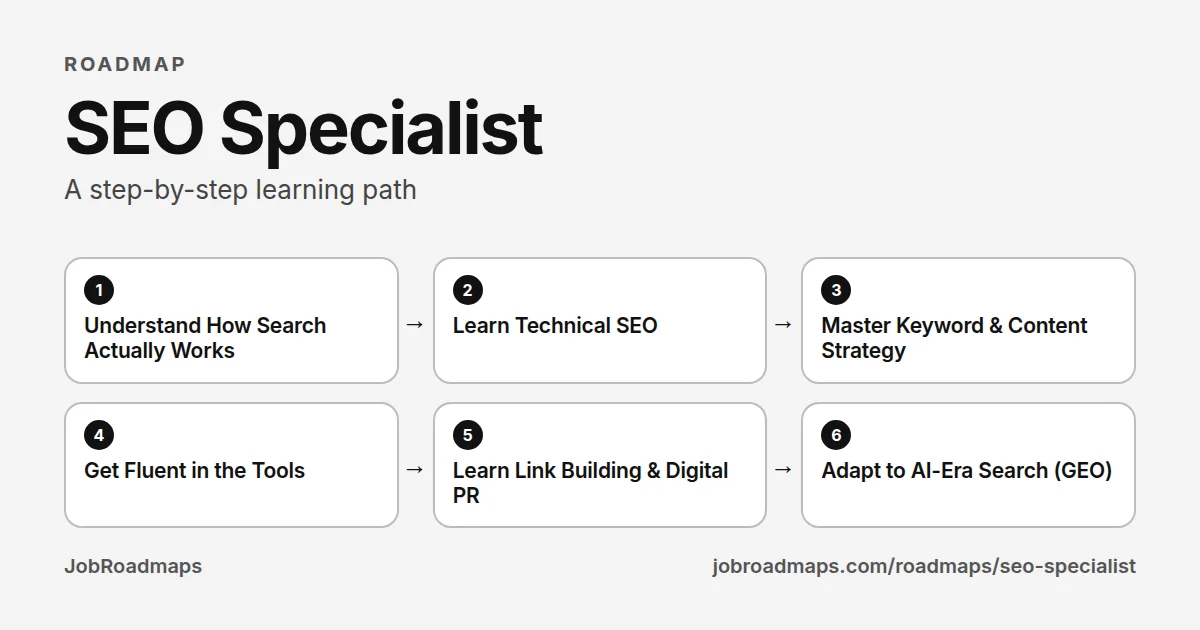
SEO Specialist learning path
Work down the line, one step at a time. Tick each skill as you can do it.
- 1
Understand How Search Actually Works
2–3 weeksStart with the machine: how search engines crawl, index, and rank pages, and what a search intent really is. Google's own Search Central documentation is the canonical source and it's free. Grasping the crawl-index-rank pipeline is what makes everything else — technical fixes, content decisions — make sense instead of feeling like superstition.
Skills to learn
- Crawling & indexing
- How ranking works
- Search intent
- SERP features
- Google Search Essentials
- Keywords & queries
Start with
- 2
Learn Technical SEO
4–6 weeksTechnical SEO is the plumbing that lets content rank at all: making sure pages are crawlable and indexable, fast (Core Web Vitals), mobile-friendly, and marked up with structured data. It's the most defensible skill in the field because it overlaps with engineering and can't be faked by writing more blog posts.
Skills to learn
- Crawlability & robots.txt
- XML sitemaps
- Core Web Vitals
- Structured data / schema.org
- Canonicalisation
- Redirects & status codes
- Site architecture
- JavaScript SEO
Start with
- 3
Master Keyword & Content Strategy
4–6 weeksRanking follows relevance, so you need to find what people search for, judge whether you can realistically compete, and shape content that satisfies the intent better than what already ranks. Learn keyword research, search-intent mapping, and how to structure content clusters. This is where SEO meets editorial judgement.
Skills to learn
- Keyword research
- Search intent mapping
- Content clusters & topic authority
- On-page optimisation
- Content briefs
- Competitive gap analysis
- E-E-A-T signals
Start with
- 4
Get Fluent in the Tools
3–5 weeksSEO runs on data, and the tools are how you get it. Master Google Search Console (free and non-negotiable), then one major suite — Ahrefs or Semrush — for keyword and backlink data, plus Screaming Frog for technical crawls. Employers expect tool fluency, and the tools' own academies are among the best free training available.
Skills to learn
- Google Search Console
- Ahrefs / Semrush
- Screaming Frog
- Google Analytics 4
- Rank tracking
- Log file analysis
- Reporting & dashboards
Start with
- 5
Learn Link Building & Digital PR
3–5 weeksBacklinks remain a core ranking signal, and earning them ethically is a distinct skill. Learn the legitimate side — digital PR, original research, guest content, and relationship-driven outreach — and learn to spot the spammy tactics that get sites penalised. This is often what separates pages that plateau from ones that break through in competitive niches.
Skills to learn
- Backlink analysis
- Digital PR
- Outreach & relationship building
- Anchor text strategy
- Link quality evaluation
- Disavowing toxic links
Start with
- 6
Adapt to AI-Era Search (GEO)
OngoingThis is the frontier, and ignoring it is career malpractice in 2026. AI Overviews and answer engines increasingly resolve queries without a click, which changes what "ranking" even means. Learn generative engine optimisation (GEO) — how to become the source AI systems cite — and how to defend traffic as zero-click search grows. The specialists who master this early will define the next decade of the field.
Skills to learn
- AI Overviews & SGE behaviour
- Generative Engine Optimisation (GEO)
- Answer-engine optimisation
- Zero-click search strategy
- Entity & knowledge-graph optimisation
- Measuring AI-referred traffic
Start with
jobroadmaps.com/roadmaps/seo-specialist · Pay, demand and employer data for this role are further down the page.
Job Market Insights for SEO Specialist
Data-backed
Which skills appear most in job postings?
Read from live job postings, ranked from most to least often named.
keyword research leads the list and is named almost always. If you are only going to learn one thing before applying, the postings say start here.
The 1 base skill sit at the top of the scale, appearing across company sizes and seniority levels. Treat them as the baseline an application is read against.
Past the fundamentals, 2 specialisation skills (site audits among them) appear in a minority of postings. Not universal, but the kind of depth that makes a hiring manager stop skimming.
Skill
How often named
keyword research
site audits
organic rankings
Sorted by how often named · JobRoadmaps
Industry overlay
Targeting a specific industry?
The core roadmap gets you through the door anywhere. The difference between "qualified" and "they hired someone else" often lives in industry-specific context — the norms, the compliance floors, the tools assumed fluent in that sector.
Programmatic SEO
Template-driven pages at scale — Zapier's integration pages are the canonical example — are the highest-leverage play in SaaS SEO.
Funnel-mapped content strategy
SaaS SEO is judged on signups, not sessions, so mapping keywords to funnel stages and intent is the strategic core of the role.
Signup attribution
Proving organic traffic becomes revenue requires fluency with GA4, CRM data, and attribution models — it is how the channel keeps its budget.
JavaScript framework SEO
SaaS sites are built on React and Next.js, so rendering, hydration, and crawlability issues are your problems to diagnose.
Competitive content gap analysis
SaaS categories are content arms races, and systematically finding topics competitors rank for and you do not drives the roadmap.
Companies hiring:
HubSpotSemrushZapierCanvaAhrefscourse content SEO
Large catalog of courses requires systematic optimization; keywords vary widely by subject, level, and audience.
global audience optimization
EdTech serves learners worldwide; SEO strategy must account for localization, language, and regional demand patterns.
user intent for learning pathways
Learners search for skill progression, certification, and career outcomes; content and metadata must align with these intents.
Companies hiring:
CourseraIndustry premiums based on aggregated job posting data · Updated quarterly
Interactive
How ready are you right now?
Check the skills you already have to see your current job-market fit.
The most-named skill for this role is keyword research, so a gap there costs you the most. Skills at the top of the scale appear across most postings, so a single gap there narrows your options more than a gap in a rarer skill. Check what you already have to see your biggest current gap.
Readiness Check
Check the skills you already have
0/3
base skills
Your biggest gap: keyword research, the most often named of the skills you have not ticked.
Start there, then work down the list.
Books worth reading as a SEO Specialist
Where to start, in order. The full list of 11, grouped by career stage, is on its own page.
Getting started

SEO for Dummies
by Peter Kent · 2019
~460 pages~12 hrs to read
A plain tour of how search engines work and the main tasks in optimisation: keywords, content, links and tracking. A low-stress starting point if you are new to the field.
View book →
The Art of SEO: Mastering Search Engine Optimization
by Eric Enge, Stephan Spencer, Jessie Stricchiola · 2009
~990 pages~25 hrs to read
The long reference on technical SEO, keyword research, content, link building and measurement. Read the early chapters first, then use the rest as the shelf book for audits.
View book →
Doing the job

Content Strategy for the Web
by Kristina Halvorson, Melissa Rach · 2012
~200 pages~5 hrs to read
Explains how to audit content, set goals, define voice and run a content workflow. Relevant when your calendar needs to follow a plan, not a mood.
View book →
Web Analytics 2.0: The Art of Online Accountability and Science of Customer Centricity
by Avinash Kaushik · 2009
~480 pages~12 hrs to read
Teaches how to move from counting visits to measuring outcomes, with clear thinking about metrics, experiments and attribution. The tools have changed since, but the reasoning still helps.
View book →
Senior and leading

Product-Led SEO: The Why Behind Building Your Organic Growth Strategy
by Eli Schwartz · 2021
~260 pages~7 hrs to read
Treats organic search as a growth channel tied to the product, with advice on strategy, programmatic pages and working with other teams. Fits SEO managers who have to set direction, not just run audits.
View book →
Good Strategy Bad Strategy: The Difference and Why It Matters
by Richard P. Rumelt · 2011
~320 pages~8 hrs to read
Explains what a real strategy looks like: a diagnosis, a guiding policy and coherent action. Read it when you are asked to write the marketing plan for a whole year.
View book →
All 11 books for a SEO Specialist →Browse all books →
Some book links are affiliate links: we earn a small commission if you buy, at no cost to you. It does not affect what we list.
Prerequisites & Education
What credentials do employers look for?
These are the most common paths into this role — no single one is required.
Education Level
View list — coming soon- Bachelor's in marketing, communications, or business — common but not screened hard
- Bachelor's in any field — SEO teams are full of English majors, journalists, and career changers
- No degree — a case study showing rankings you earned beats any diploma in this field
- Associate's degree plus demonstrable results
SEO has no formal credentialing body and hiring managers know it. The screening question is always "show me something you ranked" — education rarely decides the outcome.
Certifications
View list — coming soon- Google Analytics (GA4) Certification — free, and the closest thing to a baseline expectation
- Semrush SEO Toolkit certifications — free resume filters that prove tool fluency
- Ahrefs Certification — newer, free, and well-regarded for demonstrating practical workflows
- HubSpot SEO Certification — free, useful for content-marketing-adjacent roles
No SEO certification carries real authority — Google offers no SEO cert, only Analytics. Treat these as free resume filters and spend your real effort on case studies.
Bootcamps & Training
View list — coming soon- Ahrefs' free SEO course and Semrush Academy — the strongest free structured curricula
- Moz SEO Essentials — a solid beginner foundation from a long-trusted source
- Traffic Think Tank or CXL — paid communities/courses respected by working SEOs
- Google Search Central documentation — the primary source; deep familiarity is a genuine differentiator
SEO changes faster than any curriculum. The lasting skill is knowing how to test — build a site, try things, and measure in Search Console.
Portfolio & Other
View list — coming soon- Case studies with before/after Search Console data — the single credential that gets SEO jobs
- A site you own and rank — even a small niche site proves you can do the whole job end to end
- Technical audit samples — a real crawl analysis with prioritised, justified recommendations
- Freelance or local business results — "grew a plumber's organic leads 3x" is a compelling story
- Published writing — SEO is a content discipline; show you can write for both users and crawlers
Screenshot everything. Search Console graphs showing growth you caused are the strongest artifact in an SEO portfolio — start collecting them from your first project.
Your Roadmap
6 stepsUnderstand How Search Actually Works
2–3 weeksStart with the machine: how search engines crawl, index, and rank pages, and what a search intent really is. Google's own Search Central documentation is the canonical source and it's free. Grasping the crawl-index-rank pipeline is what makes everything else — technical fixes, content decisions — make sense instead of feeling like superstition.
Skills to learn
Learn Technical SEO
4–6 weeksTechnical SEO is the plumbing that lets content rank at all: making sure pages are crawlable and indexable, fast (Core Web Vitals), mobile-friendly, and marked up with structured data. It's the most defensible skill in the field because it overlaps with engineering and can't be faked by writing more blog posts.
Skills to learn
Master Keyword & Content Strategy
4–6 weeksRanking follows relevance, so you need to find what people search for, judge whether you can realistically compete, and shape content that satisfies the intent better than what already ranks. Learn keyword research, search-intent mapping, and how to structure content clusters. This is where SEO meets editorial judgement.
Skills to learn
Get Fluent in the Tools
3–5 weeksSEO runs on data, and the tools are how you get it. Master Google Search Console (free and non-negotiable), then one major suite — Ahrefs or Semrush — for keyword and backlink data, plus Screaming Frog for technical crawls. Employers expect tool fluency, and the tools' own academies are among the best free training available.
Skills to learn
Learn Link Building & Digital PR
3–5 weeksBacklinks remain a core ranking signal, and earning them ethically is a distinct skill. Learn the legitimate side — digital PR, original research, guest content, and relationship-driven outreach — and learn to spot the spammy tactics that get sites penalised. This is often what separates pages that plateau from ones that break through in competitive niches.
Skills to learn
Adapt to AI-Era Search (GEO)
OngoingThis is the frontier, and ignoring it is career malpractice in 2026. AI Overviews and answer engines increasingly resolve queries without a click, which changes what "ranking" even means. Learn generative engine optimisation (GEO) — how to become the source AI systems cite — and how to defend traffic as zero-click search grows. The specialists who master this early will define the next decade of the field.
Skills to learn
Start here this week
This week: set up Google Search Console on a site you control — a personal blog, a portfolio, anything — and read Google's Search Central documentation on how crawling and indexing work. Watching real query and impression data for a page you own turns SEO from abstract theory into something concrete you can experiment with.
For a structured path: work through the free Ahrefs SEO Course for Beginners, then spend a couple of months actually trying to rank one page on your own site for a low-competition keyword. Document what you did and what happened — that experiment, with real Search Console screenshots, becomes the portfolio that gets you an SEO analyst interview far faster than certificates alone.
Pay
U.S. Department of Labor data for the nearest BLS occupation, Market research analysts and marketing specialists. BLS has no occupation for this exact title, so treat these as a benchmark.
Median: U.S. Bureau of Labor Statistics, Occupational Employment and Wage Statistics (median wage, May 2024) and Employment Projections (2024–34). Levels: U.S. Department of Labor Office of Foreign Labor Certification prevailing wage levels (wage year 2025, typical metro), a base-wage benchmark for the metro in the middle of 527 areas, not an offer. See every metro.
Job Titles at Each Level
Entry
SEO Analyst
Mid
SEO Specialist
Senior
SEO Manager / Head of Organic Growth
Steps Overview
- 1
Understand How Search Actually Works
2–3 weeks
- 2
Learn Technical SEO
4–6 weeks
- 3
Master Keyword & Content Strategy
4–6 weeks
- 4
Get Fluent in the Tools
3–5 weeks
- 5
Learn Link Building & Digital PR
3–5 weeks
- 6
Adapt to AI-Era Search (GEO)
Ongoing
Explore more roadmaps
Not sure this is the right path? Browse all business career roadmaps.
View Similar RoadmapsBuilt a project while following this roadmap?
Turn it into a hiring-ready case study in 10 seconds — free.
Ready to explore more?
Browse all career roadmaps across tech, business, and creative fields.