Scrum Master Career Roadmap
A Scrum Master is the person whose entire job is to make a team work better — not by managing them, but by removing whatever is slowing them down and protecting the process that keeps them shipping. It's a servant-leadership role: no direct reports, no authority to command, just the harder power of facilitation, coaching, and relentless obstacle-clearing. Done badly it's a glorified meeting scheduler. Done well it's the difference between a team that dreads sprints and one that actually delivers, and companies pay real money for the latter.
Is this the right path for you?
Most Scrum Masters don't start as Scrum Masters — they cross over from inside a software team. Developers who like the people side more than the code, QA engineers, business analysts, and support leads all make natural transitions because they already understand how software gets built and where it gets stuck. It's also accessible to organised, people-oriented career changers from outside tech, though you'll work harder to establish credibility.
The aptitude signal is a genuine pull toward helping other people perform, combined with the ego strength to lead without authority. You have to be comfortable measuring your success by the team's output rather than your own visible work, and patient enough to coach change instead of forcing it. People who need to be the smartest person in the room struggle in this seat.
Honest note: the market is somewhat saturated with people who have a two-day certificate and no real facilitation ability, and layoffs in tech have made pure Scrum Master roles more competitive. The ones who stay employed are those who can demonstrably improve a team — real retrospectives, real impediment removal, real metrics — not those who just run the ceremonies. Depth beats the certificate here.
Career Progression
Where does this role lead?
Click any role to explore timeline, key skills and, where the Department of Labor publishes it, pay.
Entry
Junior Scrum Master
~0–2 yrs
$59,342 (Level I)
Running ceremonies is the easy part. Your real education is learning to read a team — who's blocked, who's checked out, what nobody is saying in standup.
Key skills
Pay shown is the U.S. Department of Labor prevailing wage for Level I (entry), Level III (mid) and Level IV (senior) in the nearest BLS occupation, base wage for the typical metro, wage year 2025, shown for the main track only. It is a benchmark, not an offer; branches and lead, staff and executive stages have no official figure.
Visual roadmap
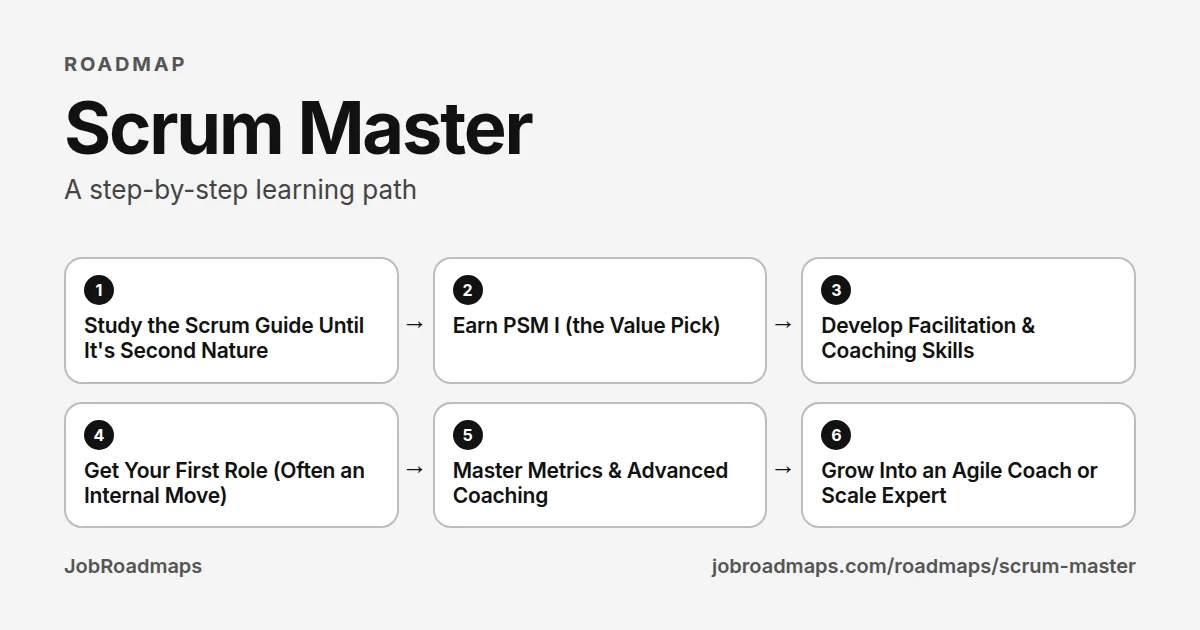
Scrum Master learning path
Work down the line, one step at a time. Tick each skill as you can do it.
- 1
Study the Scrum Guide Until It's Second Nature
2–3 weeksEverything starts with the Scrum Guide — it's free, it's short (under 20 pages), and it's the source of truth every certification tests against. Read it repeatedly until you can explain the events, artifacts, accountabilities, and the empirical pillars without notes. Most people underestimate how deeply you need to know this one document.
Skills to learn
- Scrum events (sprint, planning, review, retro)
- Scrum artifacts & commitments
- The three accountabilities
- Empiricism: transparency, inspection, adaptation
- Scrum values
- Sprint mechanics
Start with
- 2
Earn PSM I (the Value Pick)
3–6 weeksHere's the practical choice: Scrum.org's PSM I requires no mandatory course — you can self-study and sit the exam for a fraction of the cost — while Scrum Alliance's CSM requires a paid two-day course. PSM I is also lifetime, with no renewal fees. For self-funded career changers, PSM I is the smarter first credential.
Skills to learn
- Exam-level Scrum mastery
- Applying Scrum to scenarios
- Definition of Done
- Product Backlog understanding
- Self-study discipline
Start with
- 3
Develop Facilitation & Coaching Skills
4–6 weeksThe certificate proves you know Scrum; the job is about people. Learn to facilitate retrospectives that surface real problems, run planning that doesn't drag, and coach individuals through conflict without taking sides. These soft skills are what actually separate an effective Scrum Master from a ceremony-runner.
Skills to learn
- Meeting facilitation
- Running effective retrospectives
- Active listening
- Conflict resolution
- Coaching & powerful questions
- Servant leadership
- Impediment removal
Start with
- 4
Get Your First Role (Often an Internal Move)
1–3 monthsThe most common entry path is a lateral move: developers, QA engineers, and business analysts who already sit on a Scrum team stepping into the Scrum Master accountability. If you're on a team, volunteer to facilitate. If you're outside, target junior and associate Scrum Master roles and lean on your certification plus any facilitation you can point to.
Skills to learn
- Facilitating live ceremonies
- Working with a Product Owner
- Team dynamics
- Jira & agile tooling
- Internal transition strategy
- Interviewing for agile roles
Start with
- 5
Master Metrics & Advanced Coaching
2–4 monthsMid-level Scrum Masters move beyond running ceremonies to improving outcomes with evidence. Learn to read velocity, cycle time, and flow metrics honestly (without weaponising them against the team), and deepen your coaching so you're shaping team behaviour, not just scheduling it. PSM II validates this level.
Skills to learn
- Velocity & flow metrics
- Evidence-Based Management
- Cycle time & throughput
- Advanced coaching
- Team maturity models
- Stakeholder management
Start with
- 6
Grow Into an Agile Coach or Scale Expert
OngoingThe senior track splits two ways: become an Agile Coach who develops multiple teams and leaders, or specialise in scaling frameworks like SAFe for large enterprises. Both require you to influence beyond a single team and often to coach other Scrum Masters. This is where the compensation ceiling really lifts.
Skills to learn
- Enterprise agile coaching
- Scaling frameworks (SAFe, LeSS, Nexus)
- Organisational change
- Coaching Scrum Masters
- Leadership influence
- Agile transformation
Start with
jobroadmaps.com/roadmaps/scrum-master · Pay, demand and employer data for this role are further down the page.
Job Market Insights for Scrum Master
Data-backed
Which skills appear most in job postings?
Read from live job postings, ranked from most to least often named.
Agile leads the list and is named almost always. If you are only going to learn one thing before applying, the postings say start here.
The 1 base skill sit at the top of the scale, appearing across company sizes and seniority levels. Treat them as the baseline an application is read against.
Past the fundamentals, 1 specialisation skill (Velocity among them) appear in a minority of postings. Not universal, but the kind of depth that makes a hiring manager stop skimming.
Skill
How often named
Velocity
Sorted by how often named · JobRoadmaps
Industry overlay
Targeting a specific industry?
The core roadmap gets you through the door anywhere. The difference between "qualified" and "they hired someone else" often lives in industry-specific context — the norms, the compliance floors, the tools assumed fluent in that sector.
SAP implementation
Client ERP rollouts demand Scrum Masters who understand both agile ceremonies and large SAP programme phases.
Hybrid delivery
Consulting engagements often mix agile sprints with fixed-scope waterfall milestones.
Risk management
Client-facing delivery requires risks to be surfaced and escalated early to protect scope and budget.
AI product delivery
AI-focused clients expect delivery leads who can keep fast-moving experimental work predictable.
Companies hiring:
Pivot Point SolutionsNimble GravityVelocity
Teams building web features are expected to have velocity tracked and used to forecast sprint capacity.
Software development lifecycle
Web engineering teams need the Scrum Master to coordinate build, test and release timing.
Burndown charts
Sprint progress on feature work is typically shown with burndown charts.
Companies hiring:
SkySlopeIndustry premiums based on aggregated job posting data · Updated quarterly
Interactive
How ready are you right now?
Check the skills you already have to see your current job-market fit.
The most-named skill for this role is Agile, so a gap there costs you the most. Skills at the top of the scale appear across most postings, so a single gap there narrows your options more than a gap in a rarer skill. Check what you already have to see your biggest current gap.
Readiness Check
Check the skills you already have
0/2
base skills
Your biggest gap: Agile, the most often named of the skills you have not ticked.
Start there, then work down the list.
Books worth reading as a Scrum Master
Where to start, in order. The full list of 12, grouped by career stage, is on its own page.
Getting started

Scrum: The Art of Doing Twice the Work in Half the Time
by Jeff Sutherland, J.J. Sutherland · 2014
~260 pages~7 hrs to read
Co-creator Jeff Sutherland explains the thinking behind Scrum: sprints, backlogs, retrospectives and visible progress. A quick, motivating introduction to the framework.
View book →
Essential Scrum: A Practical Guide to the Most Popular Agile Process
by Kenneth S. Rubin · 2012
~500 pages~13 hrs to read
A thorough reference on Scrum roles, events, artifacts and planning at several levels. Keep it beside you during your first teams.
View book →
Doing the job

Coaching Agile Teams: A Companion for ScrumMasters, Agile Coaches, and Project Managers in Transition
by Lyssa Adkins · 2010
~320 pages~8 hrs to read
Covers the coach stance, facilitation, conflict and growing self-organization. Read it once the mechanics of Scrum are routine and you start coaching people.
View book →Liftoff: Start and Sustain Successful Agile Teams
by Diana Larsen, Ainsley Nies · 2011
~170 pages~4 hrs to read
A guide to launching a team or project with a shared purpose, working agreements and context. Use it when a new team forms or a team resets.
View book →
Senior and leading

Turn the Ship Around!: A True Story of Turning Followers into Leaders
by L. David Marquet · 2013
~240 pages~6 hrs to read
A submarine captain's account of giving control to the people closest to the work. A model for coaching teams toward self-direction.
View book →
Team Topologies: Organizing Business and Technology Teams for Fast Flow
by Matthew Skelton, Manuel Pais · 2019
~240 pages~6 hrs to read
Describes team types and interaction modes that reduce handoffs and cognitive load. Useful when you advise on team design across several teams.
View book →
All 12 books for a Scrum Master →Browse all books →
Some book links are affiliate links: we earn a small commission if you buy, at no cost to you. It does not affect what we list.
Prerequisites & Education
What credentials do employers look for?
These are the most common paths into this role — no single one is required.
Education Level
View list — coming soon- Bachelor's in any field — the typical baseline; the discipline has no degree gate
- Bachelor's in business or a technical field — helps with credibility on engineering teams
- No degree — certification plus facilitation experience is a workable entry profile
- Associate's degree with agile team experience in any role
Scrum Master hiring screens for facilitation skill and agile fluency, not academic background. Most Scrum Masters arrive from adjacent roles — QA, support, development, or project coordination.
Certifications
View list — coming soon- PSM I (Scrum.org) — rigorous exam, no mandatory course, no renewal fees; the best value entry cert
- CSM (Scrum Alliance) — requires a 2-day course and biennial renewal, but has the widest HR recognition
- PSM II — the credential that signals genuine depth beyond the entry level
- SAFe Scrum Master (SSM) — near-mandatory in banks, government, and large enterprises running SAFe
PSM I vs CSM is the classic tradeoff: PSM I is cheaper, harder, and permanent; CSM costs more but some recruiters filter for it specifically. Check job posts in your target market before choosing.
Bootcamps & Training
View list — coming soon- Scrum.org Professional Scrum Master course — optional but strong preparation for PSM I/II
- Scrum Alliance CSM course — the mandatory 2-day training bundled with the CSM exam
- SAFe SM training — required for the SSM cert; often employer-funded once you are inside an enterprise
- Agile community meetups and open-space events — free, and a genuine hiring network in most cities
Certification courses take days, not months — the real training is reps facilitating actual teams. Volunteer to run retros and standups in your current job before you change titles.
Portfolio & Other
View list — coming soon- Facilitation track record — sprints, retros, and planning sessions you have run, in any role
- A repertoire of retrospective formats and when you used each — a common interview probe
- Team metrics stories — cycle time, throughput, or predictability improvements you can quantify
- Agile community involvement — speaking or organising at meetups signals commitment
- Experience on an agile team in any capacity — developer, QA, and support backgrounds all convert
Interviews test whether you coach rather than command. Concrete stories of resolving team conflict or removing an impediment matter more than any certificate on the list.
Your Roadmap
6 stepsStudy the Scrum Guide Until It's Second Nature
2–3 weeksEverything starts with the Scrum Guide — it's free, it's short (under 20 pages), and it's the source of truth every certification tests against. Read it repeatedly until you can explain the events, artifacts, accountabilities, and the empirical pillars without notes. Most people underestimate how deeply you need to know this one document.
Skills to learn
Earn PSM I (the Value Pick)
3–6 weeksHere's the practical choice: Scrum.org's PSM I requires no mandatory course — you can self-study and sit the exam for a fraction of the cost — while Scrum Alliance's CSM requires a paid two-day course. PSM I is also lifetime, with no renewal fees. For self-funded career changers, PSM I is the smarter first credential.
Skills to learn
Develop Facilitation & Coaching Skills
4–6 weeksThe certificate proves you know Scrum; the job is about people. Learn to facilitate retrospectives that surface real problems, run planning that doesn't drag, and coach individuals through conflict without taking sides. These soft skills are what actually separate an effective Scrum Master from a ceremony-runner.
Skills to learn
Get Your First Role (Often an Internal Move)
1–3 monthsThe most common entry path is a lateral move: developers, QA engineers, and business analysts who already sit on a Scrum team stepping into the Scrum Master accountability. If you're on a team, volunteer to facilitate. If you're outside, target junior and associate Scrum Master roles and lean on your certification plus any facilitation you can point to.
Skills to learn
Master Metrics & Advanced Coaching
2–4 monthsMid-level Scrum Masters move beyond running ceremonies to improving outcomes with evidence. Learn to read velocity, cycle time, and flow metrics honestly (without weaponising them against the team), and deepen your coaching so you're shaping team behaviour, not just scheduling it. PSM II validates this level.
Skills to learn
Grow Into an Agile Coach or Scale Expert
OngoingThe senior track splits two ways: become an Agile Coach who develops multiple teams and leaders, or specialise in scaling frameworks like SAFe for large enterprises. Both require you to influence beyond a single team and often to coach other Scrum Masters. This is where the compensation ceiling really lifts.
Skills to learn
Start here this week
This week: read the Scrum Guide cover to cover — it's free and under 20 pages — then take Scrum.org's free Open Assessment to gauge where you stand. If you're already on a Scrum team at work, tell your current Scrum Master you'd like to facilitate the next retrospective. Hands-on facilitation, even once, changes how you interview.
For a structured path: study for and pass PSM I through self-study (skip the expensive mandatory-course route unless your employer pays), practise facilitation on any team you can access, and target internal transitions or junior Scrum Master postings. Once you have a year of real facilitation behind you, layer on PSM II and start thinking about the Agile Coach track.
Pay
U.S. Department of Labor data for the nearest BLS occupation, Project management specialists. BLS has no occupation for this exact title, so treat these as a benchmark.
Median: U.S. Bureau of Labor Statistics, Occupational Employment and Wage Statistics (median wage, May 2024) and Employment Projections (2024–34). Levels: U.S. Department of Labor Office of Foreign Labor Certification prevailing wage levels (wage year 2025, typical metro), a base-wage benchmark for the metro in the middle of 519 areas, not an offer. See every metro.
Job Titles at Each Level
Entry
Junior Scrum Master
Mid
Scrum Master
Senior
Senior Scrum Master / Agile Coach
Steps Overview
- 1
Study the Scrum Guide Until It's Second Nature
2–3 weeks
- 2
Earn PSM I (the Value Pick)
3–6 weeks
- 3
Develop Facilitation & Coaching Skills
4–6 weeks
- 4
Get Your First Role (Often an Internal Move)
1–3 months
- 5
Master Metrics & Advanced Coaching
2–4 months
- 6
Grow Into an Agile Coach or Scale Expert
Ongoing
Explore more roadmaps
Not sure this is the right path? Browse all business career roadmaps.
View Similar RoadmapsBuilt a project while following this roadmap?
Turn it into a hiring-ready case study in 10 seconds — free.
Ready to explore more?
Browse all career roadmaps across tech, business, and creative fields.