Salesforce Developer Career Roadmap
Salesforce is the biggest software economy most developers have never seriously looked at — 150,000+ companies run their revenue on it, and every one of them needs people who can bend the platform past what clicks alone can do. The path is strange and specific: you start as an admin, learn Apex (Java's corporate cousin), and pick up Lightning Web Components, all inside Trailhead, a learning system so gamified it hands out badges like a scout troop. The developers who tolerate the ecosystem's quirks are rewarded with salaries that outrun most general web development — because almost nobody outside the ecosystem realizes the jobs exist.
Is this the right path for you?
Salesforce development pulls from two unusual pools. The first: business-side people — sales ops, CRM admins, analysts — who already live in Salesforce and want to cross into code; the admin-to-developer pipeline is the ecosystem's official on-ramp, and it's real. The second: developers from other stacks who discover the ecosystem pays better than generic web work with a fraction of the applicant competition. No degree required in either case — certifications and Trailhead badges function as the credential system here.
The aptitude signal is comfort working inside constraints. Salesforce is an opinionated platform: governor limits cap your queries, tests are mandatory before deploys, and the 'right way' is documented whether you like it or not. Developers who treat constraints as puzzle rules do well; those who need total architectural freedom will find it claustrophobic. A tolerance for business process — understanding why sales ops wants that approval flow — matters as much as raw coding ability.
Honest note: the go-go hiring frenzy of 2021, when an Admin cert alone got you hired, is over — entry-level admin roles are now genuinely competitive, and AI features are automating pieces of routine configuration work. The developer tier is where the demand held: companies drowning in customization needs far outnumber the people who can write bulkified Apex. Push through the admin layer to PD1 rather than camping on it, and the market remains one of tech's better-kept secrets.
Career Progression
Where does this role lead?
Click any role to explore timeline, key skills and, where the Department of Labor publishes it, pay.
Entry
Salesforce Admin
~0–2 yrs
$74,464 (Level I)
Most developers enter through admin work — learn the platform's declarative tools deeply before writing code. Knowing when NOT to code is a Salesforce superpower.
Key skills
Pay shown is the U.S. Department of Labor prevailing wage for Level I (entry), Level III (mid) and Level IV (senior) in the nearest BLS occupation, base wage for the typical metro, wage year 2025, shown for the main track only. It is a benchmark, not an offer; branches and lead, staff and executive stages have no official figure.
Visual roadmap
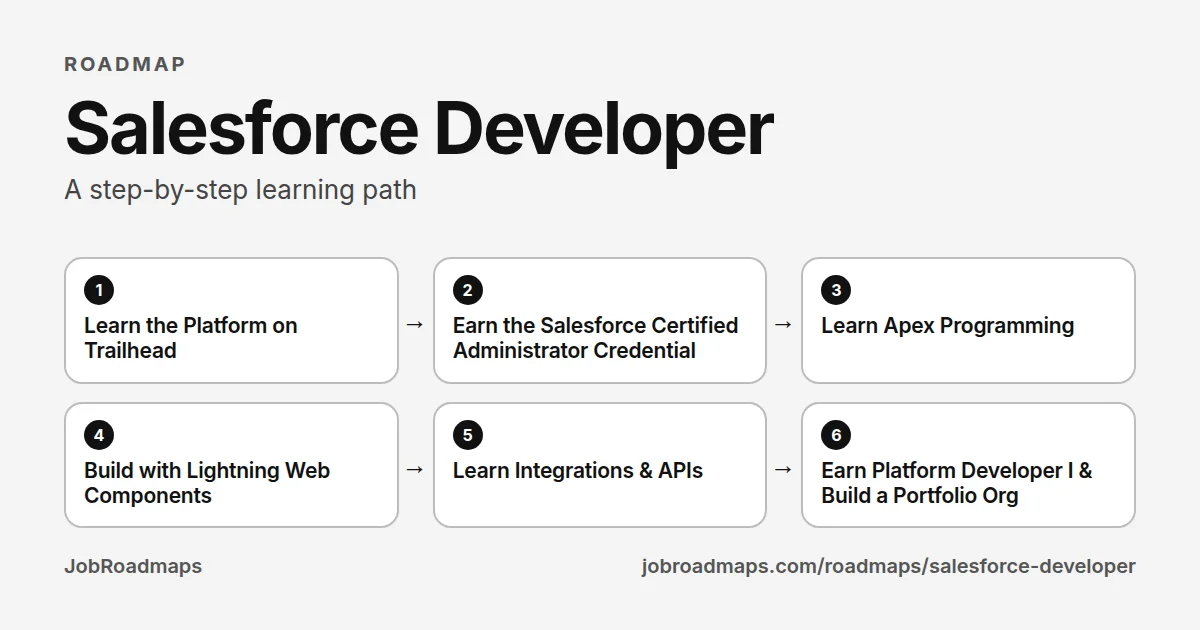
Salesforce Developer learning path
Work down the line, one step at a time. Tick each skill as you can do it.
- 1
Learn the Platform on Trailhead
3–5 weeksSign up for a free Trailhead account and a free Developer Edition org — a full Salesforce instance that costs nothing, forever. Work the Admin Beginner and CRM fundamentals trails to learn the object model: objects, fields, records, and relationships. Everything you build later sits on this vocabulary.
Skills to learn
- Salesforce Platform Fundamentals
- Standard Objects (Accounts, Contacts, Opportunities)
- Custom Objects & Fields
- Record Types & Page Layouts
- Relationships (lookup, master-detail)
- Reports & Dashboards
- Trailhead Playgrounds & Developer Orgs
- AppExchange Ecosystem Awareness
Start with
- 2
Earn the Salesforce Certified Administrator Credential
6–10 weeksThe Admin cert is the ecosystem entry ticket — even for developers. It proves you understand security models, automation, and data management, and admin roles are a legitimate paid on-ramp while you learn to code. Study flows, profiles, permission sets, and validation rules until the exam guide holds no surprises.
Skills to learn
- Security Model (profiles, permission sets, sharing rules)
- Flow Builder Automation
- Validation Rules & Formula Fields
- Data Import & Data Loader
- Sandboxes & Change Sets
- User Management
- Duplicate & Data Quality Management
- Exam Strategy (60 questions, 105 minutes)
Start with
- 3
Learn Apex Programming
8–10 weeksApex is Salesforce's server-side language — Java-flavored, strongly typed, and governed by strict per-transaction limits that force you to write efficient code from day one. Learn triggers, classes, SOQL queries, and the sacred art of bulkification: code that works for one record and for ten thousand.
Skills to learn
- Apex Syntax, Classes & Interfaces
- SOQL & SOSL Queries
- Apex Triggers & Trigger Frameworks
- Governor Limits & Bulkification
- DML Operations & Transactions
- Asynchronous Apex (Batch, Queueable, Future)
- Apex Testing (75% coverage requirement)
- Exception Handling & Debug Logs
Start with
- 4
Build with Lightning Web Components
6–8 weeksLWC is Salesforce's modern frontend framework — standards-based JavaScript, custom elements, and a component model that will feel familiar if you've touched React. Learn component composition, the wire service for data, and Apex integration. This is where general web skills and platform skills fuse.
Skills to learn
- Modern JavaScript (ES6+ modules, classes)
- LWC Component Structure (HTML, JS, CSS, meta)
- Decorators (@api, @track, @wire)
- Wire Service & Lightning Data Service
- Calling Apex from LWC
- Component Communication (events, message channels)
- SLDS (Salesforce Lightning Design System)
- VS Code + Salesforce Extension Pack
Start with
- 5
Learn Integrations & APIs
5–7 weeksReal Salesforce work is plumbing: syncing with ERPs, payment systems, marketing platforms, and data warehouses. Learn the REST and Bulk APIs, callouts from Apex, Platform Events, and authentication flows. Integration skills are the sharpest dividing line between junior and mid-level Salesforce developers.
Skills to learn
- Salesforce REST & Bulk APIs
- Apex HTTP Callouts & Named Credentials
- Platform Events & Change Data Capture
- OAuth 2.0 Flows & Connected Apps
- Inbound Integrations (Apex REST services)
- Middleware Awareness (MuleSoft concepts)
- Salesforce CLI & SFDX Project Structure
- Postman for API Testing
Start with
- 6
Earn Platform Developer I & Build a Portfolio Org
6–10 weeksPlatform Developer I is the credential hiring managers filter on. Pair it with a portfolio: a Developer Edition org containing a complete app — custom objects, Apex with real test coverage, LWC components, and one external integration — plus the code on GitHub. Then target admin-to-developer hybrid roles, consultancies, and Salesforce partners, who hire juniors in volume.
Skills to learn
- PD1 Exam Preparation & Practice Tests
- Portfolio App Design & Build
- GitHub Repo with SFDX Source Format
- README & Demo Documentation
- Salesforce Ecosystem Job Search (partners, ISVs, end users)
- Community Networking (Trailblazer Community, local user groups)
- Interview Prep (governor limits, trigger scenarios)
Start with
jobroadmaps.com/roadmaps/salesforce-developer · Pay, demand and employer data for this role are further down the page.
Job Market Insights for Salesforce Developer
Data-backed
Which skills appear most in job postings?
Read from live job postings, ranked from most to least often named.
Architecture Design is the most-named skill. Common, but not universal: many postings do not list it.
Past the fundamentals, 2 specialisation skills (Architecture Design included) start separating candidates who can do the job from candidates who have done it. The 17 niche skills are named rarely enough that knowing them is upside, not prerequisite.
Skill
How often named
Architecture Design
Apex
Salesforce CPQ
Quote-to-Cash
Permission Sets
Deployment
Authentication
Visualforce
Approval Processes
Aura
Authorization
SOQL
SOAP APIs
Record Types
Code Review
Web Services
Governor Limits
Order Management
Contract Management
Sorted by how often named · JobRoadmaps
Data-backed
Which tools and artifacts appear most in job postings?
Read from live job postings, ranked from most to least often named.
Salesforce is the most-named tool, but no tool is a universal requirement here.
Tool / Artifact
How often named
Salesforce
Claude
CI/CD
Slack
Sorted by how often named · JobRoadmaps
Industry overlay
Targeting a specific industry?
The core roadmap gets you through the door anywhere. The difference between "qualified" and "they hired someone else" often lives in industry-specific context — the norms, the compliance floors, the tools assumed fluent in that sector.
Sales Cloud customisation
Quota-carrying teams live in Salesforce all day — custom objects, flows, and Lightning pages shaped to the sales process are the core work.
CPQ implementation
Configure-price-quote logic for tiered SaaS pricing is notoriously complex and CPQ-experienced developers command a premium.
Platform integrations
Salesforce must sync with marketing automation, billing, and product analytics — REST callouts and platform events are daily tools.
Apex at scale
High-volume orgs hit governor limits fast, so bulkified triggers and asynchronous patterns separate professionals from admins who code.
Revenue data hygiene
Boards run on pipeline reports — deduplication, validation, and automation that keeps CRM data trustworthy is quietly critical work.
Companies hiring:
SalesforceDocuSignGongZoomAsanaHealth Cloud
The patient-centric data model and care-plan objects are distinct from core CRM, and Health Cloud experience is named in job requirements.
HIPAA-compliant configuration
PHI on the platform demands Shield encryption, restricted sharing models, and audit trails the developer must design in from the start.
Veeva platform skills
Veeva's life-sciences CRM is built on Salesforce, making it a large adjacent job market for the same core skills.
Consent management
Patient communication preferences and consent records carry legal weight and must be modeled and enforced in the org.
Interoperability (HL7/FHIR)
Connecting Salesforce to EHRs through FHIR APIs is the integration frontier where healthcare Salesforce work is heading.
Companies hiring:
Veeva SystemsHumanaCVS HealthIQVIACenteneIndustry premiums based on aggregated job posting data · Updated quarterly
Interactive
How ready are you right now?
Check the skills you already have to see your current job-market fit.
The most-named skill for this role is Architecture Design, so a gap there costs you the most. No single skill dominates, but each gap narrows which postings fit you. Check what you already have to see your biggest current gap.
Readiness Check
Check the skills you already have
0/5
base skills
Your biggest gap: Architecture Design, the most often named of the skills you have not ticked.
Start there, then work down the list.
Books worth reading as a Salesforce Developer
Where to start, in order. The full list of 12, grouped by career stage, is on its own page.
Getting started
Salesforce Certified Platform Administrator Study Guide: Launch and Elevate Your Salesforce Career
by Mike Wheeler · 2025
~430 pages~11 hrs to read
Covers the Salesforce data model, security, automation and administration tasks tested on the Administrator exam. Developers need this foundation because most Apex and LWC work extends what configuration already does.
View book →Learning Salesforce Development with Apex: Write, Run and Deploy Apex Code to Customize Your Salesforce Org
by Paul Battisson · 2020
~250 pages~6 hrs to read
Introduces Apex from the basics: triggers, SOQL and SOSL, testing and deployment. A reasonable first Apex book once you understand objects, fields and relationships.
View book →
Doing the job
Lightning Web Components (LWC) Development on the Salesforce Platform
by Brian Cline · 2023
Guide to building, testing and deploying Lightning Web Components. Read it once you are comfortable with Apex and need to build user interfaces.
View book →Salesforce Platform Enterprise Architecture, 4th Edition
by Andrew Fawcett · 2014
Applies enterprise design patterns, separation of concerns, testing and packaging to Salesforce apps. Best read when your org is getting complicated and you need structure.
View book →
Senior and leading

Mastering Salesforce DevOps: A Practical Guide to Building Trust While Delivering Innovation
by Andrew Davis · 2019
~450 pages~11 hrs to read
Practical guidance on source control, environments, testing and release management for Salesforce teams. For developers taking responsibility for how a team ships.
View book →Becoming a Salesforce Certified Technical Architect: Build a Strong Command of Architectural Concepts and Prepare for the Review Board
by Tameem Bahri · 2021
~630 pages~16 hrs to read
Covers architecture domains such as security, data, integration and solution design, with worked scenarios. Aimed at senior developers moving toward architect roles.
View book →
All 12 books for a Salesforce Developer →Browse all books →
Some book links are affiliate links: we earn a small commission if you buy, at no cost to you. It does not affect what we list.
Prerequisites & Education
What credentials do employers look for?
These are the most common paths into this role — no single one is required.
Education Level
View list — coming soon- Bachelor's in computer science or MIS — common but not enforced
- Bachelor's in any field — the Salesforce ecosystem is famously open to career changers
- No degree — certifications and a Trailhead track record carry the screening weight
- Associate's degree plus Salesforce Certified Administrator
The Salesforce ecosystem runs on its own credential system. Salesforce certifications matter more to hiring managers than degrees do.
Certifications
View list — coming soon- Salesforce Certified Administrator — the universal entry cert, even for developer-track candidates
- Platform Developer I — the core developer credential; expected for any Apex-writing role
- Platform App Builder — demonstrates declarative (low-code) fluency alongside code
- Platform Developer II — the senior credential; a meaningful salary lever after 2–3 years
Admin plus Platform Developer I is the standard entry combination. Salesforce certs require annual maintenance modules on Trailhead — budget time for them.
Bootcamps & Training
View list — coming soon- Trailhead — Salesforce's free official learning platform; the ecosystem's default training path
- Salesforce Pathfinder Program — free training program run with Deloitte for career changers
- Apex Hours — free community-run sessions focused specifically on developer topics
- Focus on Force — inexpensive, widely used exam study guides and practice tests
Trailhead is free and official — do not pay for a Salesforce bootcamp before exhausting it. Superbadges function as practical exams employers recognise.
Portfolio & Other
View list — coming soon- Trailhead profile — Ranger status and superbadges (especially Apex Specialist) are checked by recruiters
- Free Developer Edition org — build a working app with Apex triggers, LWCs, and flows you can demo
- GitHub with Apex and Lightning Web Component code — most SF candidates have none; you will stand out
- Volunteer implementation for a nonprofit — Salesforce's nonprofit program creates real project experience
- Salesforce community involvement — local Trailblazer groups are a genuine hiring channel
Your Trailhead profile is a public, verifiable portfolio. Recruiters in this ecosystem actually look at it — keep it current.
Your Roadmap
6 stepsLearn the Platform on Trailhead
3–5 weeksSign up for a free Trailhead account and a free Developer Edition org — a full Salesforce instance that costs nothing, forever. Work the Admin Beginner and CRM fundamentals trails to learn the object model: objects, fields, records, and relationships. Everything you build later sits on this vocabulary.
Skills to learn
Earn the Salesforce Certified Administrator Credential
6–10 weeksThe Admin cert is the ecosystem entry ticket — even for developers. It proves you understand security models, automation, and data management, and admin roles are a legitimate paid on-ramp while you learn to code. Study flows, profiles, permission sets, and validation rules until the exam guide holds no surprises.
Skills to learn
Learn Apex Programming
8–10 weeksApex is Salesforce's server-side language — Java-flavored, strongly typed, and governed by strict per-transaction limits that force you to write efficient code from day one. Learn triggers, classes, SOQL queries, and the sacred art of bulkification: code that works for one record and for ten thousand.
Skills to learn
Build with Lightning Web Components
6–8 weeksLWC is Salesforce's modern frontend framework — standards-based JavaScript, custom elements, and a component model that will feel familiar if you've touched React. Learn component composition, the wire service for data, and Apex integration. This is where general web skills and platform skills fuse.
Skills to learn
Learn Integrations & APIs
5–7 weeksReal Salesforce work is plumbing: syncing with ERPs, payment systems, marketing platforms, and data warehouses. Learn the REST and Bulk APIs, callouts from Apex, Platform Events, and authentication flows. Integration skills are the sharpest dividing line between junior and mid-level Salesforce developers.
Skills to learn
Earn Platform Developer I & Build a Portfolio Org
6–10 weeksPlatform Developer I is the credential hiring managers filter on. Pair it with a portfolio: a Developer Edition org containing a complete app — custom objects, Apex with real test coverage, LWC components, and one external integration — plus the code on GitHub. Then target admin-to-developer hybrid roles, consultancies, and Salesforce partners, who hire juniors in volume.
Skills to learn
Start here this week
This week: create a free Trailhead account and a free Developer Edition org (developer.salesforce.com/signup), and complete the 'Salesforce Platform Basics' module — it takes about an hour. Then start the Admin Beginner trail and set a badge-per-day pace. The org is yours forever; every trail you complete builds inside a real Salesforce instance, not a sandbox simulation.
For structure, follow the ecosystem's own sequence: Trailhead's 'Prepare for Your Administrator Credential' trailmix to the Admin cert (2–4 months), then the Developer Beginner trail and Apex modules toward Platform Developer I. Add Focus on Force practice exams before each cert — they're the community's standard for a reason. Two certs plus one portfolio org in eight months is a realistic, hireable outcome.
Pay
U.S. Department of Labor data for the nearest BLS occupation, Software developers. BLS has no occupation for this exact title, so treat these as a benchmark.
Median: U.S. Bureau of Labor Statistics, Occupational Employment and Wage Statistics (median wage, May 2024) and Employment Projections (2024–34). Levels: U.S. Department of Labor Office of Foreign Labor Certification prevailing wage levels (wage year 2025, typical metro), a base-wage benchmark for the metro in the middle of 511 areas, not an offer. See every metro.
Job Titles at Each Level
Entry
Salesforce Administrator
Mid
Salesforce Developer
Senior
Senior Salesforce Developer / Technical Architect
Steps Overview
- 1
Learn the Platform on Trailhead
3–5 weeks
- 2
Earn the Salesforce Certified Administrator Credential
6–10 weeks
- 3
Learn Apex Programming
8–10 weeks
- 4
Build with Lightning Web Components
6–8 weeks
- 5
Learn Integrations & APIs
5–7 weeks
- 6
Earn Platform Developer I & Build a Portfolio Org
6–10 weeks
Explore more roadmaps
Not sure this is the right path? Browse all tech career roadmaps.
View Similar RoadmapsBuilt a project while following this roadmap?
Turn it into a hiring-ready case study in 10 seconds — free.
Ready to explore more?
Browse all career roadmaps across tech, business, and creative fields.